Here's a question worth sitting with: when most researchers are debating whether to boost NAD+, a cancer biology team spent 2026 figuring out how to make sure a tumor cannot boost it at all.
That reversal is the core of this paper.
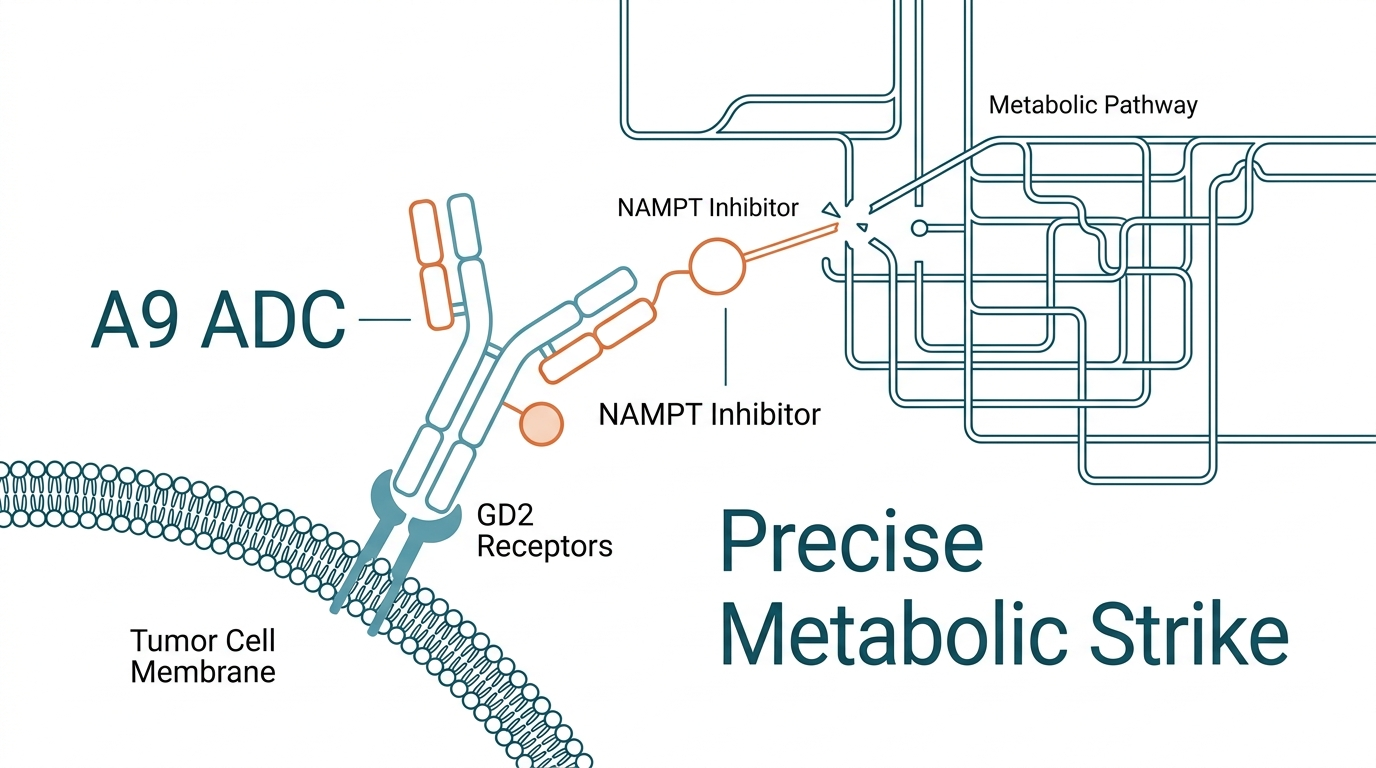
TL;DR: Liu's team engineered an antibody-drug conjugate called A9 — a GD2-targeting antibody carrying a NAMPT inhibitor — that delivers metabolic disruption precisely into GD2-high neuroblastoma cells. Once inside, it drives down both NAD+ and ATP, causing cell cycle arrest and apoptosis. GD2-low and normal cells are comparatively spared. A rescue experiment with NMN confirmed the mechanism is real, not noise.
The Core Problem With Targeting NAMPT Broadly
NAMPT sits at the center of the NAD+ salvage pathway. Every cell needs it — not just tumors. That's exactly the problem. Earlier attempts to inhibit NAMPT system-wide ran into serious toxicity because the drug couldn't distinguish between cancer cells and the healthy tissue depending on the same pathway.
Think of it like cutting a city's main power grid to shut down one illegal generator. The generator stops — but so does everything else.
What A9 Does Differently
The elegance of this approach is that it doesn't try to inhibit NAMPT everywhere. Instead, it delivers the inhibitor only where it's wanted.
GD2 is a ganglioside antigen that is highly expressed on the surface of neuroblastoma cells — a kind of molecular address label that many solid tumors display at elevated levels. The team attached a NAMPT inhibitor to an anti-GD2 antibody, creating A9. The antibody identifies the right address; the payload gets delivered only after binding.
In practice: A9 showed strong cytotoxicity against GD2-high cells. Against GD2-low cells and normal tissue, the damage was significantly reduced. Precision, not carpet-bombing.
What Happens Inside the Tumor Cell
Once A9 is internalized, the NAMPT inhibitor goes to work. The results are straightforward: both NAD+ and ATP fall inside the tumor cell. This isn't minor metabolic tweaking — it's hitting the cell's power distribution panel directly.
From there, the downstream consequences follow predictably. Cell cycle arrest sets in first, then apoptosis. The factory stops production; then it shuts down. This matters because it shows A9 isn't just tagging the tumor surface — it's translating surface binding into genuine metabolic collapse inside the cell.
The NMN Rescue Experiment: Proof of Mechanism
One of the most important steps in this paper was adding back NMN — a precursor molecule that can bypass the NAMPT block and restore NAD+.
When researchers did this, ATP levels recovered and cell survival improved. This is a critical control. It confirms that the killing effect of A9 runs through the NAMPT → NAD+ → ATP axis, not through some off-target toxicity. The mechanism is specific enough to be reversed with a targeted supplement.
In drug development terms: knowing why a compound kills a cell is at least as important as knowing that it does. Reversibility proves causality.
Where This Research Currently Stands
The most important result beyond cell culture is that A9 demonstrated anti-tumor activity in an SH-SY5Y xenograft mouse model. That means the compound doesn't just work in a petri dish — it functions in a living system. For early-stage translational research, that's a meaningful step.
But it's still early. Significant questions remain before anything like this reaches a patient:
- Is GD2 expression stable enough across human neuroblastoma to make this a reliable target?
- Will tumor heterogeneity allow escape from GD2-directed therapy?
- What are the safety, dosing, and durability profiles in a human context?
- Can the ADC chemistry be optimized for clinical-grade manufacturing?
None of these questions are answered yet. The current evidence is built on cell lines and xenograft models — not human trials.
Why This Direction Matters Anyway
There is a broader conceptual shift worth noting here. The mainstream NAD+ conversation in longevity and wellness circles is almost entirely about supplementation — adding NMN, NR, or other precursors to boost what's running low. The cancer biology side of the same molecule has landed on a completely different conclusion: for certain tumors that depend heavily on NAD+ recycling, the most lethal intervention may be blocking that recycling entirely.
For neuroblastoma in particular — a childhood cancer that remains difficult to treat at advanced stages — this opens a path that doesn't rely on broadly toxic chemotherapy. Precision metabolic disruption, delivered to cells that declare themselves as targets via GD2 expression.
That's still a long way from a clinical answer. But it's a scientifically sound direction, and this paper makes the mechanism legible.
References
- Liu et al. (2026). GD2-directed NAMPT inhibition using antibody-drug conjugates in neuroblastoma. European Journal of Medicinal Chemistry. doi: 10.1016/j.ejmech.2026.118691