TL;DR
A 2026 PRISMA-guided systematic review of 113 studies found that NAD⁺ boosters like NR and NMN reliably raise NAD⁺-related markers in the body. Whether that actually makes you healthier or slows aging remains inconclusive. Biological activity is not the same thing as clinical benefit.
What This Review Actually Is, and How Big It Is
A PRISMA-guided systematic review published in Ageing Research Reviews in February 2026 pulled together 113 eligible studies on NAD⁺ supplementation for anti-aging and wellness, searching the literature from January 2010 through October 2025. The authors, Cory Gallagher and Owoturo Oluwaseun Emmanuel, split the evidence into two buckets: 33 human intervention studies (28 randomized, 5 nonrandomized) and 80 rodent studies, covering both oral and parenteral (injected) routes of administration.
That is a large evidence base for a supplement category that has long been driven largely by user testimonials, and it is why the review rewards a close read rather than a headline skim. With 113 studies in play, you can see clearly where the evidence holds and where it thins out.
Evidence-at-a-Glance: What the Review Actually Concluded
| Dimension | This Review's Verdict | Strength of Evidence | Source |
|---|---|---|---|
| Raises blood/cellular NAD⁺ levels | ✅ Consistently effective | High (multiple RCTs) | F4 |
| Safety / tolerability (weeks–months) | ✅ Generally well tolerated | Medium–high | F5 |
| Anti-aging / functional clinical benefit | ⚠️ Inconclusive (often null) | Heterogeneous | F6 |
| IV NAD⁺ for anti-aging | ❌ No qualifying trial evidence | Near zero | F7, F8 |
| Animal metabolic/mitochondrial improvement | ✅ Common but inconsistent | Medium (varies by model) | F3 |
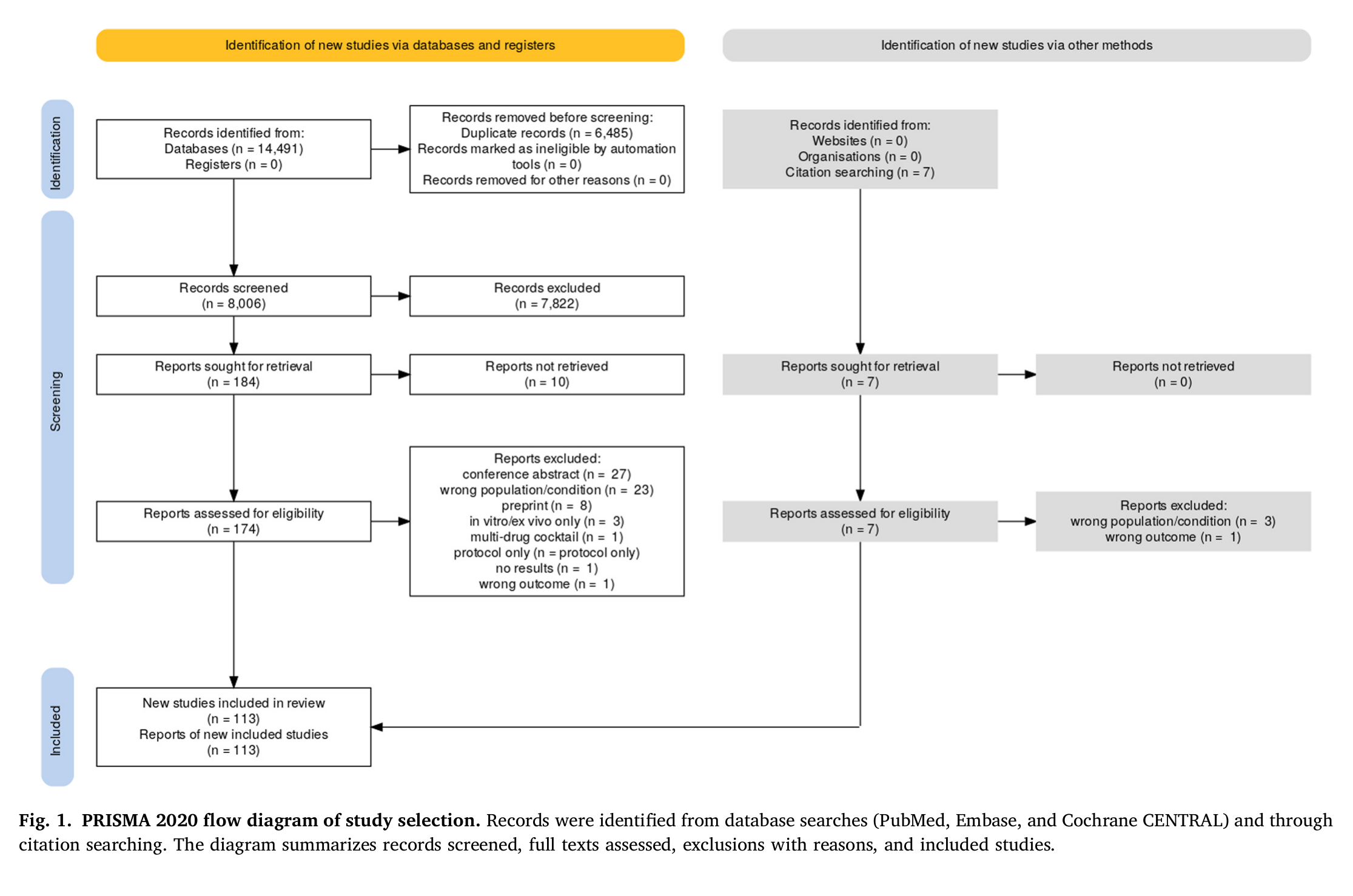
Figure 1: How the 113 studies were selected. 14,491 database records were screened down to 113 included studies (33 human, 80 rodent). Adapted from Gallagher & Emmanuel (2026), Ageing Research Reviews, Fig. 1.
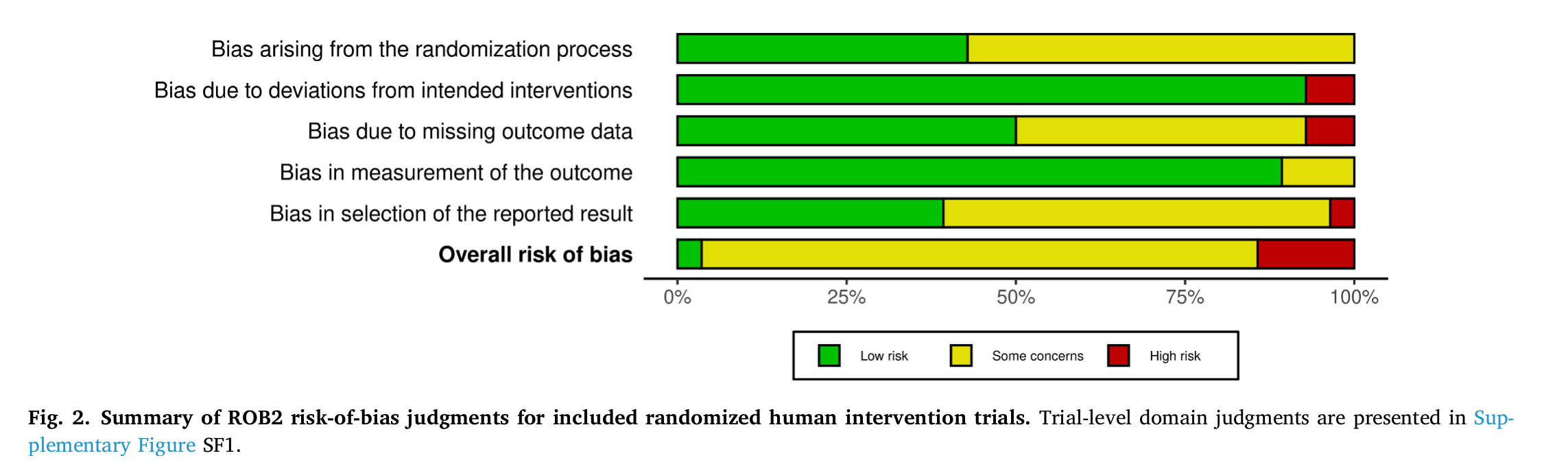
Figure 2: Risk-of-bias judgments for the included randomized human trials. Green = low risk, yellow = some concerns, red = high risk. Overall risk (bottom row) sits mostly in "some concerns", one reason the clinical evidence is read cautiously. Adapted from Gallagher & Emmanuel (2026), Ageing Research Reviews, Fig. 2.
The Good News: NR and NMN Do Raise NAD⁺ in Your Body
Here is what the review is confident about. Oral NR (nicotinamide riboside) and NMN (nicotinamide mononucleotide) consistently raised circulating (plasma/whole blood) or cellular (PBMC) NAD⁺-related metabolites across the human studies included. That is a real, repeatable, biochemical effect, and it is the part of the NAD⁺ story that holds up across trials.
The safety picture backs this up. Across weeks to months of supplementation, both compounds were generally well tolerated in the human studies reviewed. So at the level of "does this molecule do what it is supposed to do to your biochemistry, and is it safe to take for a few months," the answer from this review is a clear yes.
That combination of reliable target engagement plus a clean short-to-medium-term safety record is why NR and NMN have become the default entry point into the NAD⁺ supplement category. It is also the point where much of the marketing tends to stop citing the paper.
The Bad News: Raising NAD⁺ Isn't the Same as Getting Younger
This is the core finding of the review, and it is the part that seldom makes it into product descriptions. When the studies looked at actual functional, metabolic, vascular, or healthspan-related outcomes, meaning the things people are actually buying NAD⁺ supplements for, the results were heterogeneous, frequently null, and endpoint-specific.
In plain terms: raising a biomarker and improving how you actually feel, move, or age are two different questions. This review found solid evidence for the first and inconclusive evidence for the second. A supplement can pass every biochemistry checkpoint in a lab and still not move the needle on the clinical outcome a customer cares about. That gap, between "the molecule did what it was supposed to do" and "the person got a measurable health benefit," is the single most important thing this review establishes. It is why the overall conclusion is that NAD⁺ augmentation has clear biological activity while the clinical case for anti-aging or wellness benefit remains inconclusive.
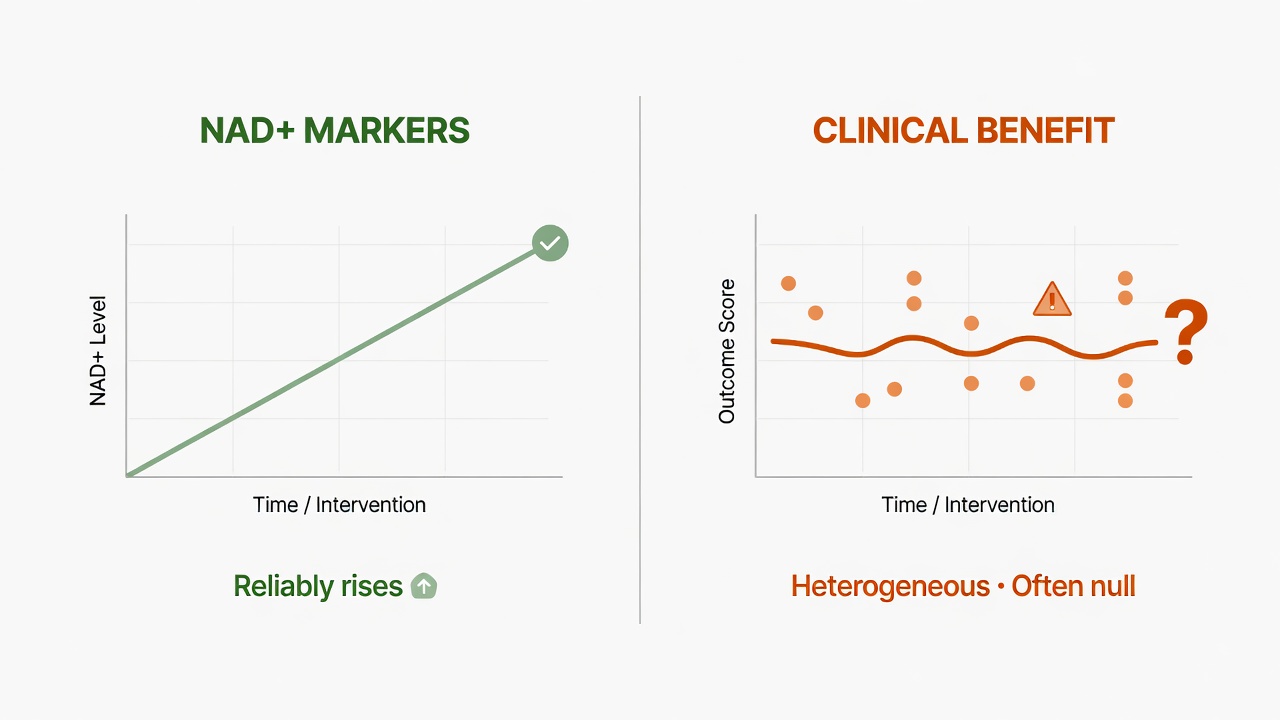
Figure 3: The review's core distinction. Left: NAD+ markers reliably rise with supplementation (high evidence); right: actual clinical and functional endpoints are heterogeneous and often null. "Measured" is not the same as "meaningful."
What About IV NAD⁺?
If you have come across a NAD⁺ IV drip offered at a wellness clinic or med spa, here is what the review found when it went looking for evidence to support it: nothing that qualifies as an outcomes trial. Across the entire 113-study review, there is no randomized or otherwise qualifying trial evaluating IV or intramuscular NAD⁺ itself for anti-aging or wellness purposes.
The parenteral evidence base is thin. The review identified exactly one nonrandomized study of IV NMN, which looked at short-term safety and biomarker changes rather than clinical outcomes. A separate IV NAD⁺ pharmacokinetics pilot study was noted only as contextual background, not as evidence of benefit.
One thing worth knowing before you weigh those conclusions: the first author, Cory Gallagher, is affiliated with Allure Management / Allure Aesthetics LLC, a medical aesthetics and wellness practice based in King of Prussia, Pennsylvania. That is precisely the kind of business that sells IV NAD⁺ services. An author from that industry background still reached a "no qualifying evidence" conclusion on IV NAD⁺, which, if anything, cuts toward more trust rather than less. The review did not manufacture support for the very treatment category the lead author's field profits from. (The second author, Owoturo Oluwaseun Emmanuel, is an independent researcher.)
If you are weighing an IV NAD⁺ drip against oral NR/NMN on the evidence in this review alone: the oral route has actual human trial data behind the biochemical effect. IV NAD⁺ for anti-aging currently does not.
Animals vs. Humans: Why Mice Respond and People Might Not
Across the 80 rodent studies in the review, NAD⁺ augmentation commonly improved metabolic, mitochondrial, inflammatory, and functional markers. Even within animal models, though, the effect size and which endpoints improved varied widely by model and protocol. That inconsistency inside the animal literature is itself a signal.
Set that next to the human clinical picture of heterogeneous, often-null functional endpoints, and the pattern is a familiar one in translational research. A mechanism that reproduces reliably in short-lived, genetically uniform lab animals under controlled conditions does not automatically carry over to long-lived, genetically diverse humans living normal lives. The review does not resolve why that gap exists. It documents that it exists, on both sides of the species line.
So Should You Take It? A Practical Read
Rather than a verdict dressed up as one, here is the framework this review can actually support.
This isn't a "don't bother" and it isn't a "buy now." The honest reading of this review is that NR and NMN reliably do the thing they are supposed to do at the biochemical level, they are reasonably safe over the timeframes studied, and the case for that translating into a clinical anti-aging or wellness benefit is still open. Not disproven, not confirmed.
Here is a useful way to think about the "target engagement is not a clinical endpoint" gap in lab terms. Raising a circulating metabolite tells you the compound got absorbed and did something upstream. It says nothing on its own about dose sufficiency at the tissue level, about where the NAD⁺ actually ends up distributed, or about what its downstream metabolic fate is once it gets there. A biomarker moving in the right direction is necessary but not sufficient evidence of a health benefit. That is true of NAD⁺ boosters, and it is true of most supplement categories built around a single measurable intermediate.
If you are deciding whether to try NR or NMN, here is a practical frame:
- What to actually track: don't just take it and hope. If you are going to evaluate it, pick a concrete functional or metabolic marker relevant to you, not just "I feel more energetic," which is highly placebo-sensitive, and get a baseline before you start.
- How long before judging: the human studies in this review ran weeks to months. Give it a comparable window before deciding it is doing anything, and don't expect a single data point to be conclusive.
- When to stop: if there is no measurable change in whatever you defined as your marker after a reasonable trial period, there is no strong evidence in this review that continuing produces a different clinical outcome.
- A distinction worth keeping in mind: some claims cite "raises NAD⁺ levels" as if that alone proved an anti-aging effect. On this review's evidence, raising the biomarker is the settled part, while the clinical benefit is still unsettled. They are two different questions, worth reading apart.
- IV specifically: on the evidence assembled in this review, there is currently no clinical trial basis for choosing an IV NAD⁺ drip over oral NR/NMN for anti-aging purposes. An IV drip may add convenience, and it typically costs more, but that added cost is not backed by outcomes data in this review.
The review does not break out which specific functional or metabolic endpoints were most often measured and came back null, so this practical read stays within what the evidence base actually supports: clear biochemical activity, unsettled clinical benefit. That boundary is the honest one to plan around.
Sources & Author Note
Reviewed paper: Gallagher C, Emmanuel OO. NAD⁺ supplementation for anti-aging and wellness: A PRISMA-guided systematic review of preclinical and clinical evidence. Ageing Research Reviews. 2026 Feb 6;116:103057. DOI: 10.1016/j.arr.2026.103057. PMID: 41655607.
Author's note: CY Hsieh works in biotech R&D and teaches molecular biology at a university, with lab experience in techniques like qPCR, ELISA, and immunohistochemistry that sit close to metabolic and aging biology. This piece was written after reading through the primary studies behind these 113 papers directly, not from marketing copy. Lab Grimoire's science writing follows that same read-first, write-second approach.