TL;DR: You assume brain aging is the brain's own problem? Four 2026 studies demolish that assumption — exhausted immune veterans, runaway blood sugar, and fragmenting arteries are bombarding your brain from outside simultaneously.
Brain Aging Doesn't Happen in Isolation
At sixty-five, you start forgetting where you put your keys. At seventy, a name sits on the tip of your tongue but won't come out. We usually blame the brain — but what if the real culprits aren't inside the skull at all?
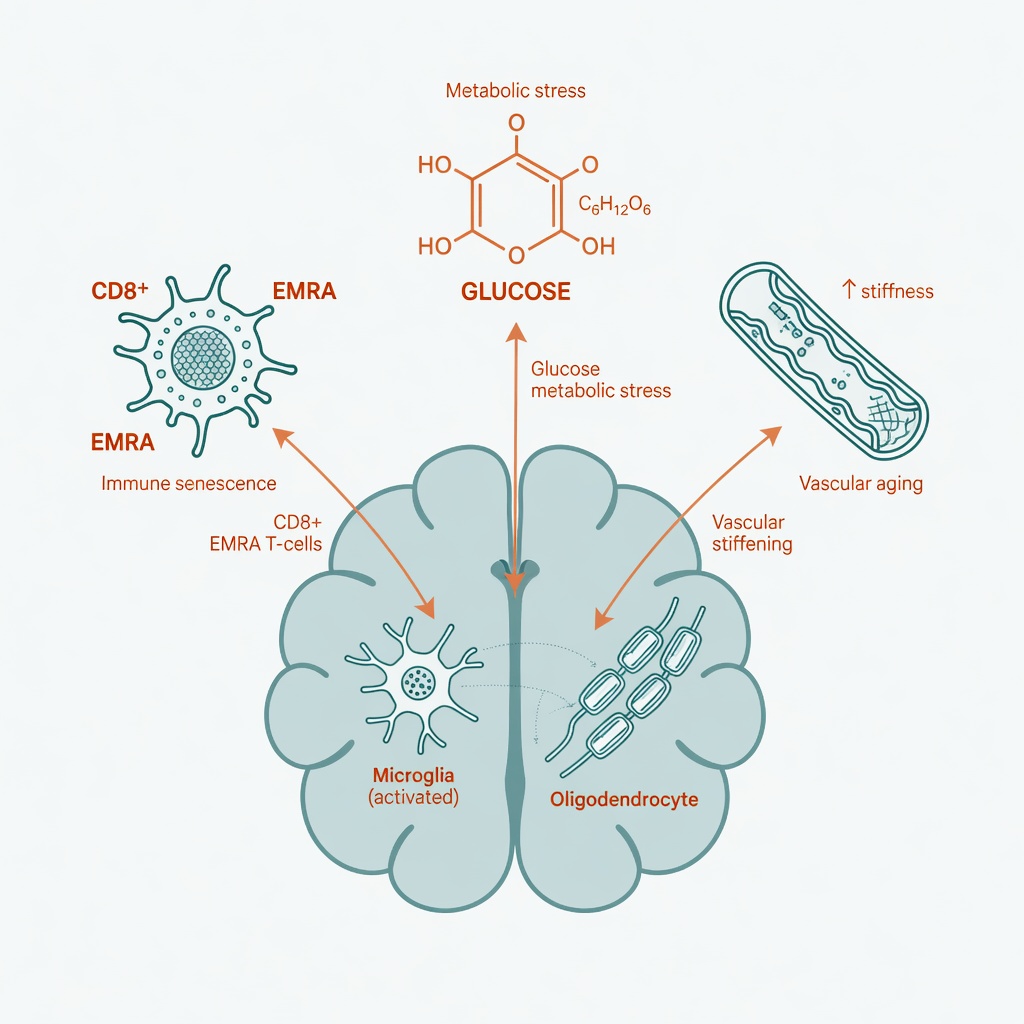
Four studies published between June and July 2026 independently arrived at the same structural conclusion: the major pressure driving brain aging doesn't originate in the brain. It arrives via the bloodstream — from patrolling immune cells, from metabolites like glucose, from deteriorating arteries — three independent pathways, each pushing aging signals toward the brain.
Signal One: Immunosenescent T Cells Cross the Blood-Brain Barrier
A study published in npj Aging (June 2026) tracked cognitive trajectories of 7,444 adults from the U.S. Health and Retirement Study over six years, alongside immune phenotyping. The finding: each standard-deviation increase in the CD8⁺ EMRA:Naïve T-cell ratio was associated with an additional -0.050 cognitive score per year (p<0.001). The CD4⁺ compartment showed no equivalent effect, suggesting that the CD8⁺ effector-memory terminal exhausted phenotype — not immune aging in general — carries the signal.
Think of your immune system as an army. CD8⁺ EMRA cells are the veterans who can't retire — zero combat power, but broadcasting inflammatory noise around the clock. How exactly this noise crosses the blood-brain barrier remains mechanistically open. Some researchers argue it may simply be a bystander effect of systemic chronic inflammation, not a direct causal chain. But the six-year, 7,000+ person longitudinal data is hard to dismiss, especially given that the CD4⁺ compartment showed no equivalent effect — pointing to CD8⁺ EMRA's specific pro-inflammatory properties rather than generic systemic noise.
Signal Two: Plasma Glucose Has Causal Leverage on Brain Age
A study in Molecular Psychiatry (June 2026) linked UK Biobank data from 37,458 healthy adults — brain imaging, plasma metabolomics, and genomics — to machine-learning-predicted Brain Age Gap (BAG), the difference between predicted and chronological brain age. Among nine metabolites significantly associated with BAG, plasma glucose was the strongest single predictor (β=0.32, P=9.90×10⁻¹²).
Critically, Mendelian Randomization (MR) analysis provided genetic evidence supporting a causal direction from glucose to accelerated brain aging. Elevated glucose was also associated with risk of seven brain disorders — dementia, Alzheimer's disease, vascular dementia, Parkinson's disease, stroke, major depressive disorder, and anxiety disorder — and with reduced gray matter volume across 80 cortical, subcortical, and cerebellar regions.
Your daily sugary drinks, the post-dinner blood sugar spike — liver and muscle handle the metabolism, but the bill gets mailed to the brain.
Signal Three: The Arterial Wall's Communication Network Is Fragmenting
The brain requires continuous, regulated blood delivery. Arterial health is not just about plumbing. A 2026 systematic review in Aging Cell integrated single-cell RNA sequencing (scRNA-seq) data from multiple datasets to map how arterial wall cell populations shift during aging.
The picture is not one cell type malfunctioning but an entire community losing coordination: endothelial cells become dysfunctional, smooth muscle cells undergo phenotypic switching, fibroblasts intensify extracellular matrix remodeling, and immune cells maintain persistent activation. Most importantly, the intercellular communication networks among these populations are systematically altered during aging. The arterial wall is a complex signaling community, and that community is losing its coherence.
Internal Response: Glial Cells Inflammage in Synchrony
The three external signals converge on a brain that is simultaneously failing from within.
A June 2026 npj Aging study analyzed Mouse Cell Atlas single-cell RNA-seq data spanning embryonic development through 24-month-old aging mice to track microglia and oligodendrocytes across the full lifespan. The finding: both glial populations showed highly correlated late-life increases in inflammatory and senescence-associated transcriptional modules, with a temporal correlation of Pearson r≈0.98 (Cohen's d≈11.08).
This is not simply "both cell types get inflamed." It says the brain's inflammaging is a coordinated collapse across at least two glial families on the same developmental clock — not isolated cellular events.
Before You Rush to Get Blood Work
These four studies build a coherent narrative, but important limitations apply across the board.
The immune-cognition link relies on observational longitudinal data that cannot exclude shared upstream confounders (e.g., systemic inflammation affecting both immune phenotype and cognition simultaneously). Arterial aging data is predominantly from animal models; species differences limit direct human extrapolation. The high glial correlation in mice awaits systematic validation in human tissue. Even the MR causal inference for glucose assumes that genetic instruments affect brain aging only through glucose — a premise that requires scrutiny given pleiotropy in complex systems.
The clinical effect sizes, while statistically robust, also warrant careful interpretation. A -0.050 cognitive unit per year per standard deviation of immune marker — while significant in a population of 7,444 — translates to cumulative losses that fall within measurement noise ranges at the individual level.
Brain aging is a multi-input systems problem. Controlling blood sugar, preserving immune youth, maintaining arterial integrity — each is worth pursuing. None alone is sufficient. And none has been shown to reverse damage already underway. This isn't a problem waiting for a silver bullet — it's an attrition war that demands simultaneous defense on multiple fronts.
References
Hua R et al. (2026). Peripheral immunosenescence biomarkers and longitudinal cognitive decline: a large population-based study. npj Aging. doi: 10.1038/s41514-026-00423-4
Li Z et al. (2026). Metabolomic signatures of brain aging: A multimodal and genetic study. Molecular Psychiatry. doi: 10.1038/s41380-026-03703-3
Xu H et al. (2026). Cellular Heterogeneity During Arterial Aging. Aging Cell. doi: 10.1111/acel.70597
Peng YS et al. (2026). Coordinated transcriptional shifts in microglia and oligodendrocytes from neurodevelopment to inflammaging. npj Aging. doi: 10.1038/s41514-026-00432-3