The Master Switch of Aging Had a Button No One Had Pressed
mTORC1 is the best-known molecular switch in aging research. It decides whether a cell keeps growing and whether it slides toward senescence. In 2026, a team led by Zhang, writing in Cell Death & Disease, filled in a missing piece: at the Golgi apparatus, that switch is pressed by a protein called YIF1A.
You have probably heard of rapamycin and other so-called anti-aging drugs. Their target is mTORC1. Researchers already knew mTORC1 can be activated on lysosomal membranes, and that it is also active at the Golgi, but who runs the Golgi station stayed unclear. Zhang's team pulled that hand out of the shadows: YIF1A, a Golgi-resident protein whose job is to translate growth-factor signals into mTORC1 activation.
How a Hand on the Golgi Flips Aging On
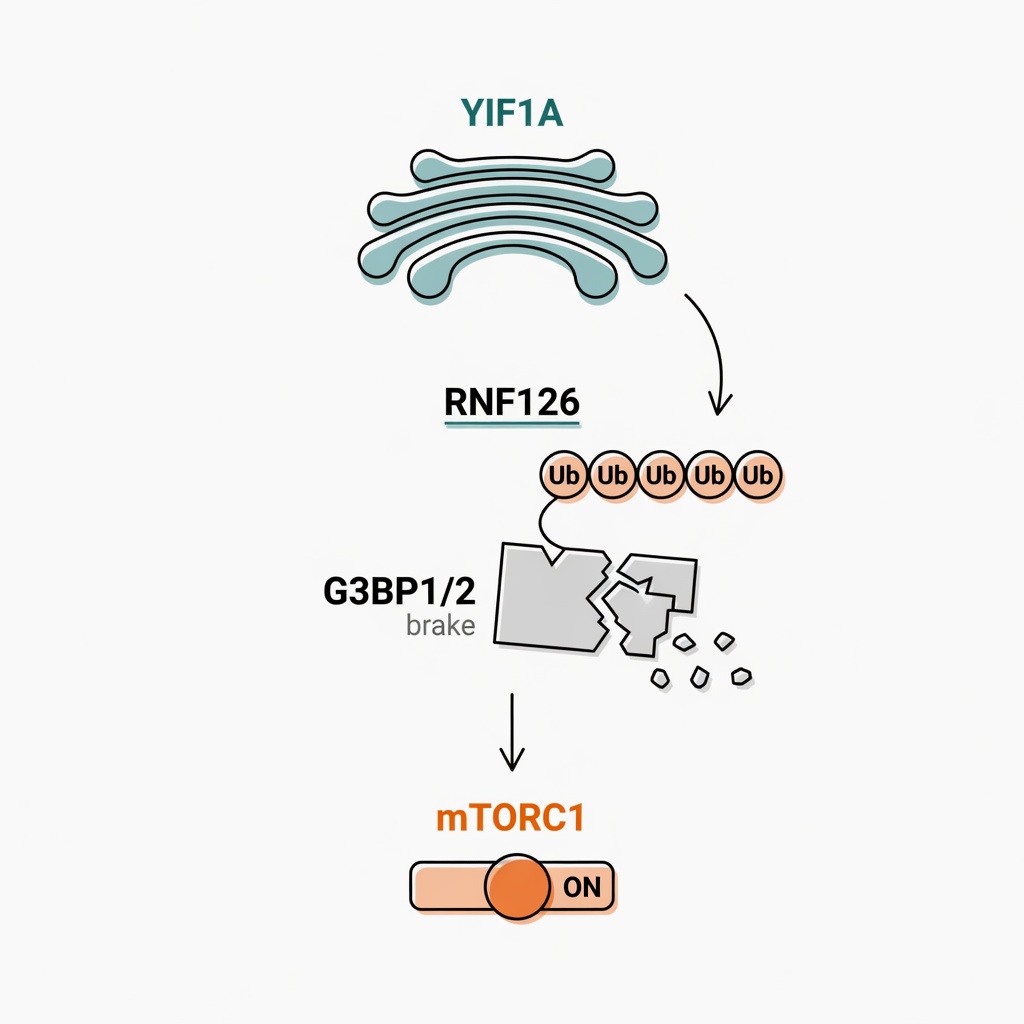
YIF1A does not act alone. It recruits an accomplice, the E3 ubiquitin ligase RNF126. Together they attach K48-linked ubiquitin chains onto a protein called G3BP1/2, which is the molecular equivalent of stamping it "send for disposal."
G3BP1/2 normally acts as a brake, holding mTORC1 back. When YIF1A drags RNF126 over to tag G3BP1/2 for degradation, the brake comes off and mTORC1 roars to life. Run it the other way and the logic holds: knock down either YIF1A or RNF126, and G3BP1/2 stays stable while mTORC1 activity drops sharply. Both ends of the causal chain are pinned down by experiment.
The most striking step comes last. The team pushed cells into senescence with etoposide and doxorubicin, two drugs that reliably force cells to age. Ordinary cells aged as expected, but cells with YIF1A knocked down resisted. Take away that one hand, and the aging switch is much harder to press.
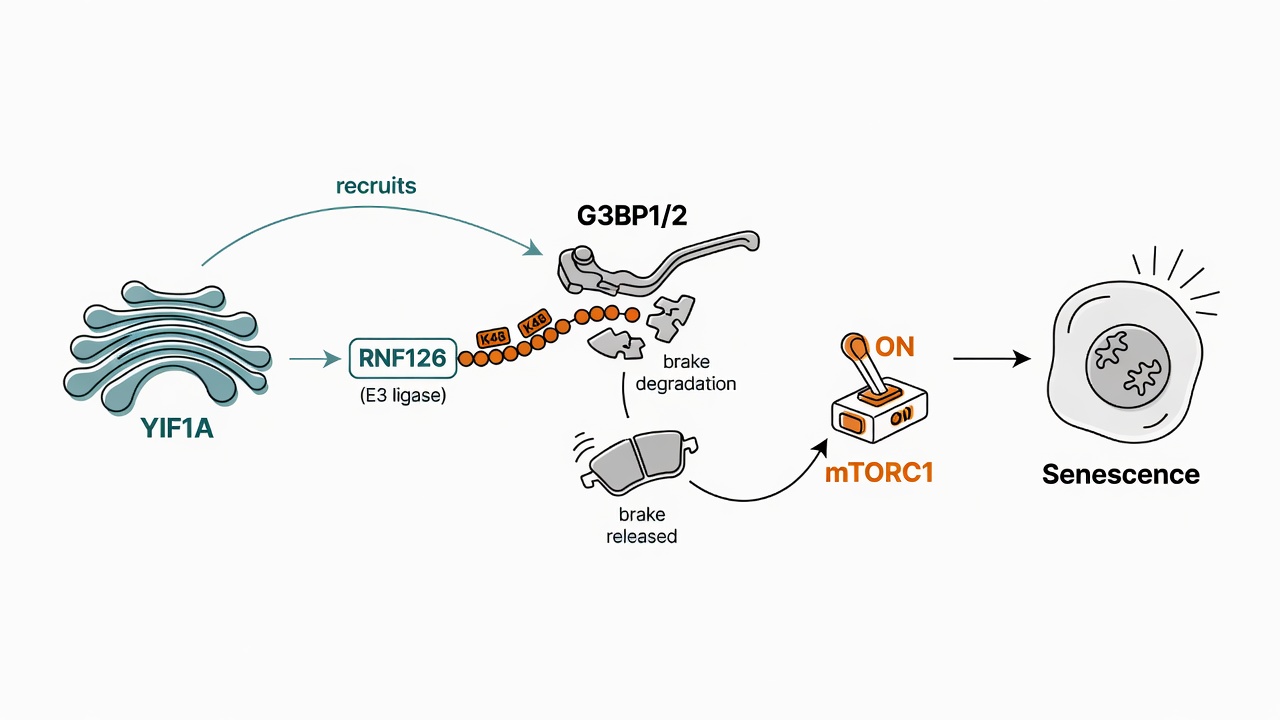 Figure 1. On the Golgi, YIF1A recruits RNF126 to tag and degrade G3BP1/2, releasing the brake on mTORC1 and driving cells toward senescence.
From Human Cells to Worms, the Same Switch
This pathway is not a trick unique to human cells. The team moved the scene to Caenorhabditis elegans: delete the worm version, yif-1, and lifespan extends; overexpress it, and lifespan shrinks.
A single switch that moves lifespan in both directions, and does so across species, is a strong signal in aging biology. Still, hold the excitement, because there are two ways to read this. The optimists will say we finally have a more precise handle than blunt mTOR inhibition. Rapamycin shuts down the whole mTOR pathway and brings a long list of side effects, whereas YIF1A governs only the Golgi station, which might allow something closer to surgical braking of senescence. The cautious will counter that the evidence stops at human cell lines and worms, with nothing yet in living mammals, let alone people. Reading "YIF1A knockdown resists senescence" as "a person who lowers it will age slower" jumps far too far ahead. Both sides are half right.
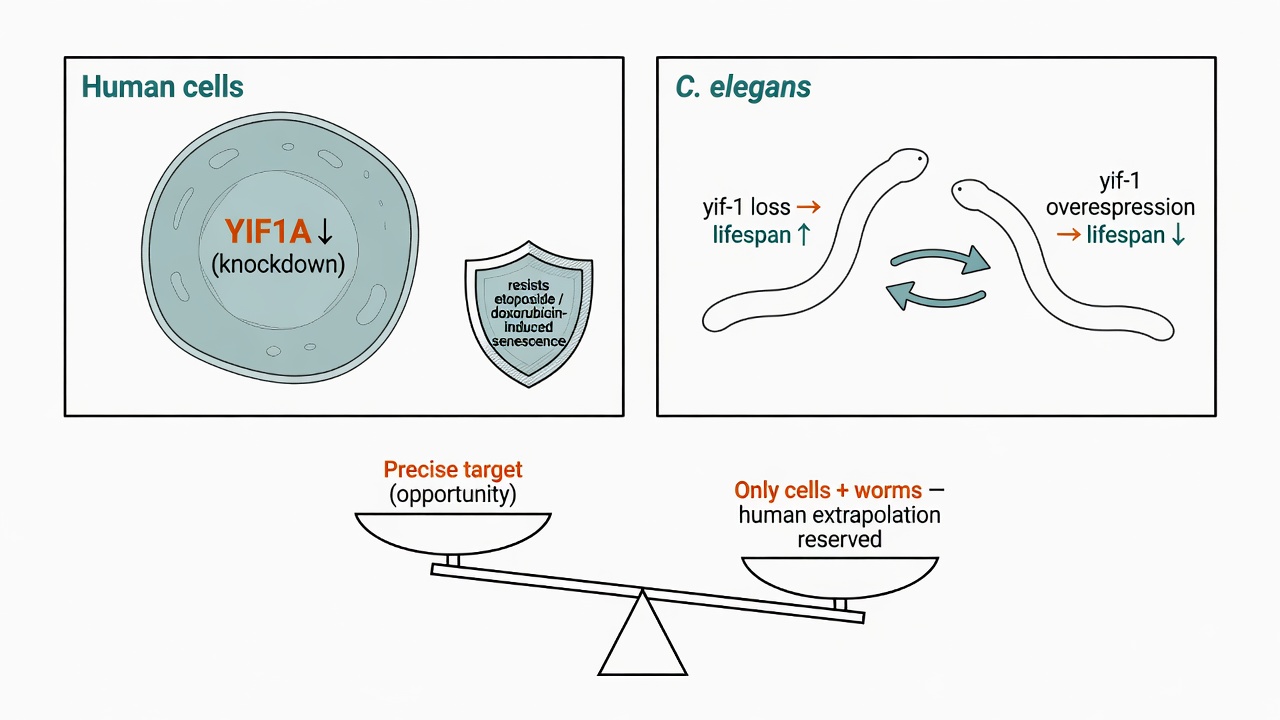 Figure 2. From human cells to worms: YIF1A tunes lifespan in both directions, along with the opportunity and the caveats of treating it as an anti-aging target.
So What Can This Switch Actually Do
Put the threads together and what YIF1A offers aging research is not one more miracle pill, but a finer coordinate: mTORC1 may not need to be shut down wholesale; perhaps it is enough to adjust the Golgi station that turns it on.
The value here is precision. Aging is not a single button but a whole row of them, and knowing which button, in which organelle, controlled by whom, is what gives you a chance to brake without damaging other normal functions. Right now YIF1A is a promising target, not a product you can swallow. What comes next is in vivo work, safety data, and whether anyone can build a tool specific enough to tune it. Until then, the line worth remembering from this study is simple: for the aging switch, someone has finally pointed to where the button is.
References
- Zhang et al. (2026). YIF1A activates mTORC1 signaling to promote cellular senescence. Cell Death & Disease. doi: 10.1038/s41419-026-09034-z