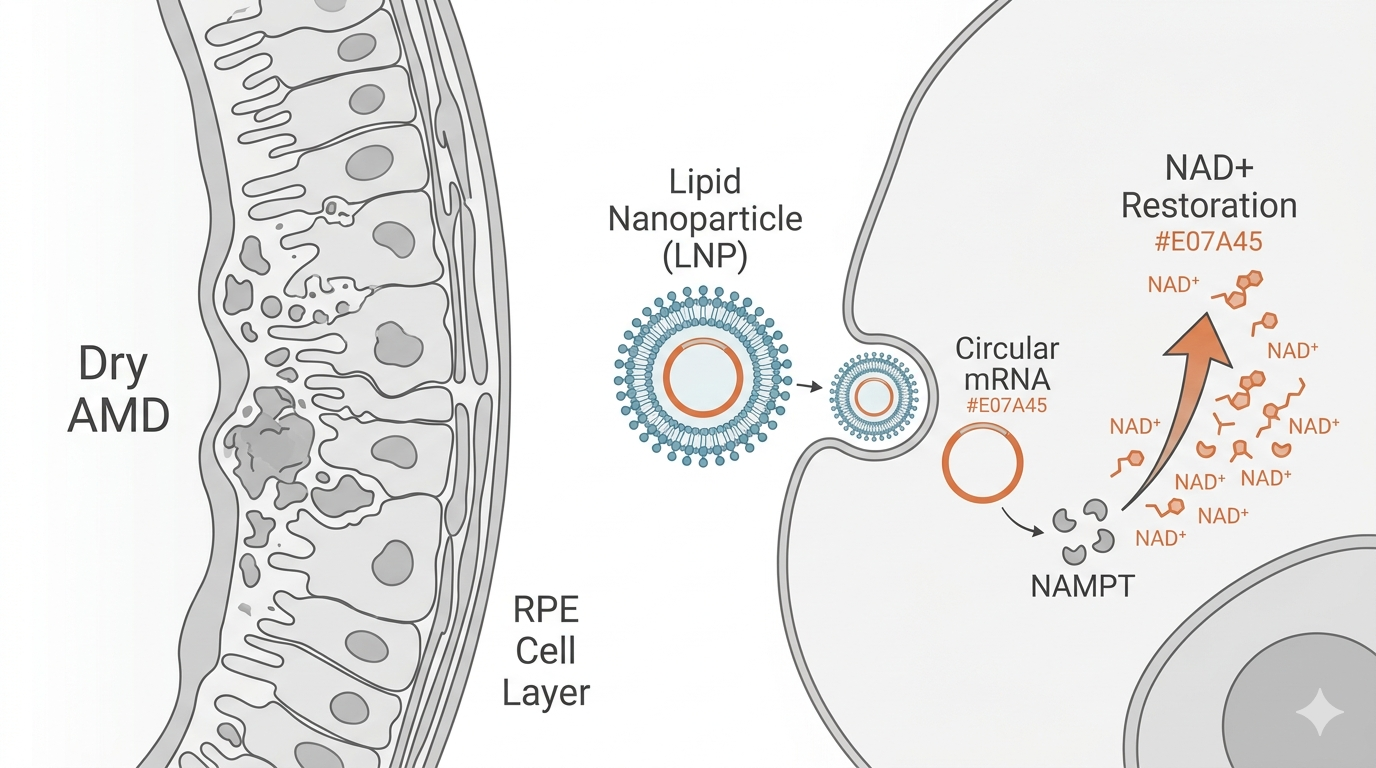
Age-related macular degeneration — in its dry form — has no approved treatment that meaningfully stops its progression. It affects tens of millions of people worldwide, with central vision slowly eroding over years as retinal pigment epithelium cells die and photoreceptors lose support.
The premise of a 2026 study in the Journal of Controlled Release is simple and provocative: what if the problem isn't that the eye lacks NAD+ precursors, but that it's missing the enzyme that makes NAD+ efficiently in the first place?
TL;DR: Li's team engineered circular mRNA encoding NAMPT — the rate-limiting enzyme in the NAD+ salvage pathway — delivered inside lipid nanoparticles (LNPs). A single intravitreal injection in a dry AMD mouse model achieved neuroprotective effects comparable to 14 consecutive days of intraperitoneal NMN. The conceptual shift: instead of repeatedly supplying a substrate, deliver the machinery.
The Problem With Continuous Supplementation
The dominant NAD+ supplementation story is substrate-based: give the body NMN or NR, let it convert those precursors into NAD+, and hope the increased NAD+ translates into better cellular function. This approach requires repeated dosing — the precursors are metabolized and cleared, so the top-up must be sustained.
For a systemic health goal, daily oral supplementation is manageable. For a localized disease inside the eye, the calculus changes. Repeated intraocular injections carry cumulative risks — infection, inflammation, mechanical trauma. The eye is a closed, sensitive compartment.
Li's team asked whether you could instead send in the worker, not just the raw materials. NAMPT is the enzyme that catalyzes the first — and rate-limiting — step of the NAD+ salvage pathway. If retinal cells are running low on NAMPT, adding more NMN is like stocking a factory's warehouse while its production line is understaffed. Getting the production line running would be more efficient.
The Delivery System: Why circ-mRNA + LNP
To get NAMPT expression into retinal cells, the team used two linked innovations.
Circular mRNA (circ-mRNA): Standard linear mRNA has exposed ends that cellular enzymes rapidly degrade. Circular mRNA — produced by joining the 5' and 3' ends into a loop — is structurally more resistant to that degradation. It can be translated for a longer period before being broken down, which means the NAMPT protein it encodes is produced for an extended window after a single dose.
Lipid nanoparticles (LNPs): The mRNA needs to cross cell membranes to reach the cytoplasm where ribosomes can translate it. LNPs — optimized here with β-sitosterol — encapsulate the circular mRNA in a lipid envelope that facilitates cellular uptake and endosomal escape. In vitro experiments confirmed that the circNAMPT-LNP formulation produced more durable NAMPT expression and a more sustained NAD+ elevation than equivalent linear mRNA constructs.
The Core Result: Single Injection vs. 14-Day Regimen
The key experiment used a sodium iodate model of dry AMD in mice — a standard way to induce retinal pigment epithelium damage that mimics key features of human dry AMD.
The comparison was direct: one intravitreal injection of circNAMPT-LNP versus 14 consecutive days of intraperitoneal NMN.
On measures of retinal tissue integrity and photoreceptor function, the single injection performed comparably to the 14-day NMN regimen. This is the paper's most striking finding — not because it "beats" NMN in an absolute sense, but because it demonstrates that one sustained-release intervention can match a prolonged daily one. Clinically, fewer interventions mean lower cumulative risk.
What This Is Not Yet
Interpreting this study requires honesty about what the mouse model can and cannot tell us.
First, sodium iodate-induced retinal damage is a model of convenience — it replicates some features of dry AMD but does not capture its full complexity, including the progressive geographic atrophy, drusen accumulation, and complement-mediated degeneration that characterize the human disease.
Second, NAMPT is one piece of dry AMD pathology. Oxidative stress, inflammation, complement dysregulation, and RPE cell death are all implicated. Boosting NAD+ production addresses some of those mechanisms but not all of them.
Third, intravitreal injection in clinical practice requires careful safety evaluation — the right dose, the right LNP formulation, the right interval between injections, and long-term monitoring for immune responses to the mRNA or the LNP components. None of that data exists yet for this specific formulation in humans.
There is also a reasonable question about whether sustained NAMPT overexpression could have unintended effects. NAMPT is not only involved in NAD+ synthesis — it has additional roles including cytokine-like activity (as eNAMPT) that could be relevant at high concentrations.
Why This Direction Matters
Despite these caveats, the paper represents something conceptually meaningful for the NAD+ biology field.
Most NAD+ interventions currently being tested — oral NMN, oral NR, IV NAD+ — treat the problem at the precursor level. They assume the enzymes are present and functional; they just need more substrate. This paper explores a different branch of the therapeutic decision tree: what if the enzyme itself is the limiting factor, and what if mRNA delivery can restore it?
If this approach progresses — through better models, optimized formulations, and eventually human trials — it could represent a new category of NAD+ therapy: not supplementing the chemistry, but restoring the biochemical capacity itself.
For patients with dry AMD, any treatment that could slow photoreceptor loss with fewer interventions than current standards would be meaningful. This paper is not that treatment yet. But it is a technically sophisticated step toward asking whether it might be possible.
References
- Li et al. (2026). Single intravitreal injection of lipid nanoparticles delivering circular mRNA of nicotinamide phosphoribosyltransferase protects against dry AMD. Journal of Controlled Release. doi: 10.1016/j.jconrel.2026.114691