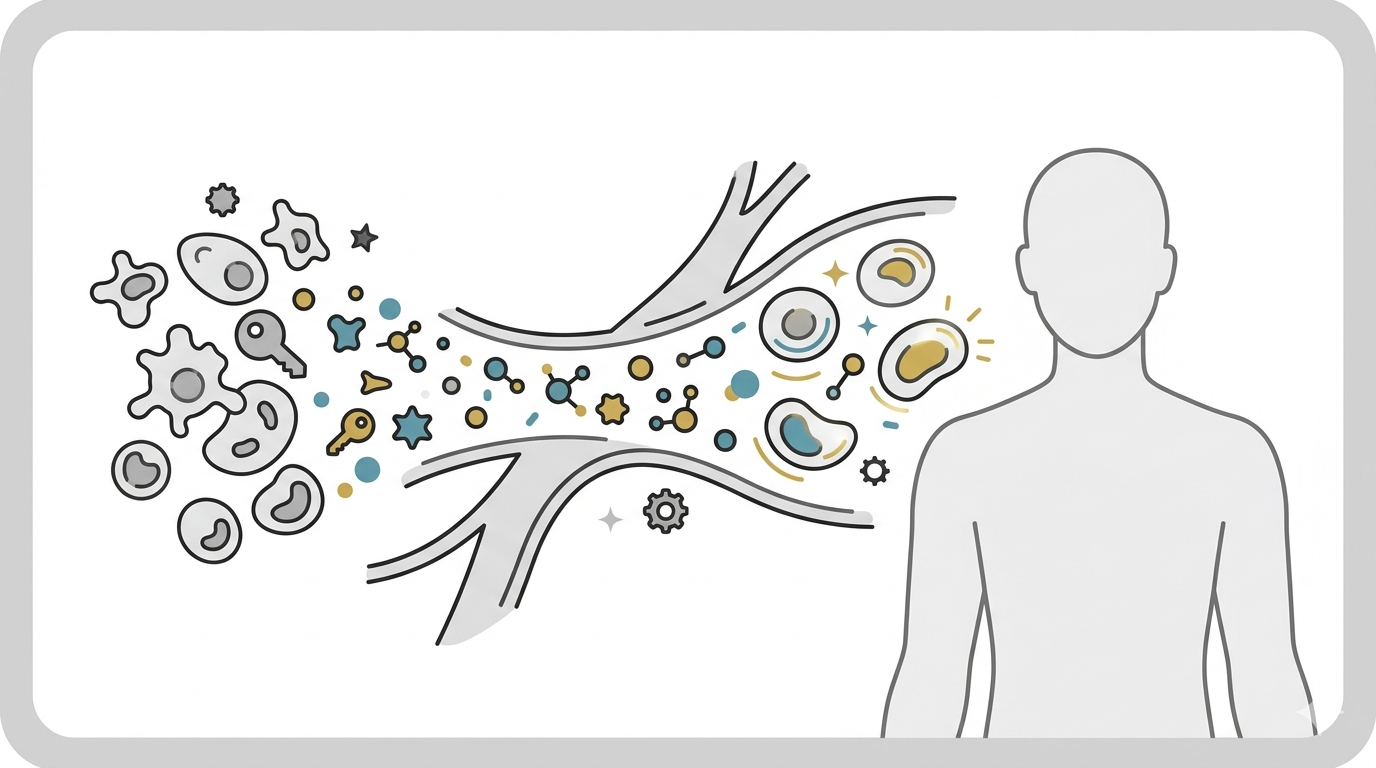
A few years ago, a startup was charging people tens of thousands of dollars to infuse them with plasma from young donors. The FDA eventually issued a statement: there was no proven clinical benefit. The startup eventually closed.
The idea that young blood contains something that can reverse aging is not pure fantasy — the biology behind it is genuinely interesting. But the gap between biological plausibility and clinical evidence is wide, and a 2026 review in the Journal of Advanced Research maps that gap carefully.
Takeaway: Liu's team surveys five categories of blood-based anti-aging approaches — heterochronic parabiosis, therapeutic plasma exchange (TPE), platelet-rich plasma (PRP), extracellular vesicles (EVs), and platelet factors. Most mechanistic evidence remains in animal models. TPE and PRP have established medical uses but lack clinical evidence for systemic anti-aging applications. EVs and platelet factors are technically promising but face standardization challenges. None can currently be called a proven anti-aging therapy.
Why Blood Is an Interesting Aging Target
Blood is not just a transport medium. It's a dynamic tissue containing cells, proteins, lipids, nucleic acids, hormones, inflammatory signals, and extracellular vesicles — all of which change in composition as we age.
The aging blood environment is characterized by elevated pro-inflammatory cytokines, altered growth factor profiles, changes in coagulation factors, and shifts in the EV cargo that cells release and receive. These changes don't just reflect aging — they can actively accelerate it in tissues that are exposed to aged blood.
The reverse hypothesis follows: if old blood contains "aging signals," then diluting them or replacing them with factors from younger blood might slow or partially reverse aging in recipient tissues. This is the biological foundation for all five approaches the review examines.
Heterochronic Parabiosis: The Most Striking Evidence, the Least Translatable
Parabiosis experiments connect the circulatory systems of two animals — typically an older and younger mouse — allowing their blood to intermingle continuously. Results have been striking: old mice in parabiosis with young mice show improvements in muscle regeneration, neural plasticity, and liver function in multiple studies. These findings generated enormous excitement and a flood of follow-up research.
But the experimental setup creates interpretive problems that remain unsolved. When two animals share circulation, it's impossible to cleanly attribute effects to a specific molecule, cell type, or even the direction of influence. Is the old mouse improving because it's receiving young factors? Or because its own aging factors are being diluted by the shared circulation? Or because of systemic homeostatic changes that emerge from the connection itself?
Even if you could answer those questions, heterochronic parabiosis cannot be translated to humans as a clinical intervention. Surgically connecting two humans' circulatory systems is not a therapy. The experiment's value is directional — it demonstrates that circulating factors influence aging — but the clinical implications require identifying and isolating the relevant components, which remains an active and unresolved research program.
Therapeutic Plasma Exchange: Logic Is Sound, Outcome Evidence Is Limited
TPE involves removing a portion of a patient's plasma and replacing it with albumin solution, fresh frozen plasma, or other substitutes. It's a real clinical procedure, already used for conditions like myasthenia gravis, TTP, and certain neurological autoimmune disorders.
The anti-aging rationale: if plasma from old individuals contains elevated concentrations of pro-inflammatory, pro-aging factors, then removing it systematically might reduce the aging signal burden. Unlike parabiosis, this doesn't require identifying the specific culprit molecules — it operates through dilution.
That's the appeal. But the anti-aging application of TPE runs well ahead of its evidence base. Which plasma components are actually driving aging effects in humans? How many exchanges are needed, and at what frequency? Which patients — age, health status, biomarker profile — would benefit? What are the long-term effects of repeat plasma removal? None of these questions have clinical trial answers for anti-aging endpoints.
TPE is medicine, not pseudoscience. But calling it an anti-aging treatment requires a evidence foundation that doesn't yet exist.
PRP: Useful Locally, Not Proven Systemically
Platelet-rich plasma is prepared by centrifuging a patient's own blood and concentrating the platelet fraction, which is then applied locally — injected into a joint, a skin layer, or a wound. The concentrated platelets release growth factors (PDGF, TGF-β, VEGF, among others) that can support tissue repair.
PRP has established — if variable — evidence in orthopedics, sports medicine, and some wound care applications. The local growth factor delivery logic is reasonable, and the outcomes, while inconsistent, have a meaningful literature base.
The problem comes when PRP is marketed for systemic anti-aging. Local platelet growth factor delivery into a specific injured tissue is a mechanistically distinct intervention from trying to reverse whole-body aging. The review acknowledges PRP's legitimate uses while making clear that the jump to "systemic rejuvenation" is not supported by its existing evidence base.
EVs and Platelet Factors: The Most Rational Direction, the Most Technical Challenges
If the whole-blood and whole-plasma approaches are too complex, the natural scientific response is to ask: what are the actually active components?
Extracellular vesicles — the membrane-enclosed particles that cells continuously release — carry proteins, lipids, and RNA that function as intercellular signaling molecules. Young cells release EVs with different cargo profiles than old cells, and there is evidence that young-cell-derived EVs can influence aging-associated gene expression and tissue function. The mechanistic basis for EV-based anti-aging intervention is more tractable than parabiosis or whole plasma exchange.
Similarly, specific platelet-derived factors — beyond the growth factor cocktail in PRP — include signaling molecules like RANTES, PF4, and various microRNAs that may have direct effects on aging processes in recipient tissues.
The rational approach: purify and characterize these components, understand their mechanisms of action, develop them as defined pharmaceutical entities with known composition, dose, and pharmacokinetics.
The practical challenges: EV isolation methods vary enormously across labs, introducing batch-to-batch inconsistency that makes comparing results difficult. Scale-up for pharmaceutical manufacturing is technically demanding. Biodistribution, immune responses, and long-term safety profiles are incompletely characterized. Identifying which specific EV cargo or platelet factor is responsible for observed effects — and demonstrating that those effects are causal, not correlational — requires substantial additional work.
The review's assessment: this is the most scientifically rational direction, but it's also the furthest from clinical readiness in terms of product development infrastructure.
What This Review Actually Establishes
The 18-page synthesis makes a consistent argument: mechanistic interest in blood-based aging interventions is scientifically justified. The clinical evidence for using any of these approaches as anti-aging therapies is not.
The path from interesting animal biology to proven human therapy runs through three gates that none of these approaches has fully passed:
- Mechanism identification: specifically, which components are doing what to which tissues, via which molecular pathways?
- Standardization: can the intervention be reliably reproduced with consistent composition, dose, and quality between preparations?
- Safety at scale: what happens with repeated interventions over years? Are there immune, cardiovascular, coagulation, or oncological risks that don't manifest in short studies?
A Practical Framework for Evaluating Blood Therapy Claims
When you encounter news stories about young blood, plasma infusions, or EV therapies for aging, three questions will help you evaluate the actual evidence:
First: Is this a cell study, an animal study, or a human clinical trial with pre-specified aging endpoints?
Second: Does the intervention involve whole blood, whole plasma, a concentrated fraction, or an isolated component? More defined is generally more scientifically credible.
Third: Is the claim about repairing a specific tissue or disease, or about making a person "younger" systemically? The former has more achievable evidence standards.
Most impressive-sounding blood therapy claims fail at least one of these filters. The biology is real. The clinical gap is equally real. And for therapies that involve direct manipulation of blood and immune systems, safety rigor matters as much as efficacy.
The answer to "can young blood really fight aging" is: possibly, in some ways, for some people, via mechanisms we're still identifying — and not yet proven in clinical trials to a standard that justifies broad use.
References
- Liu et al. (2026). Research progress on blood therapy for anti-aging. Journal of Advanced Research. doi: 10.1016/j.jare.2025.07.039