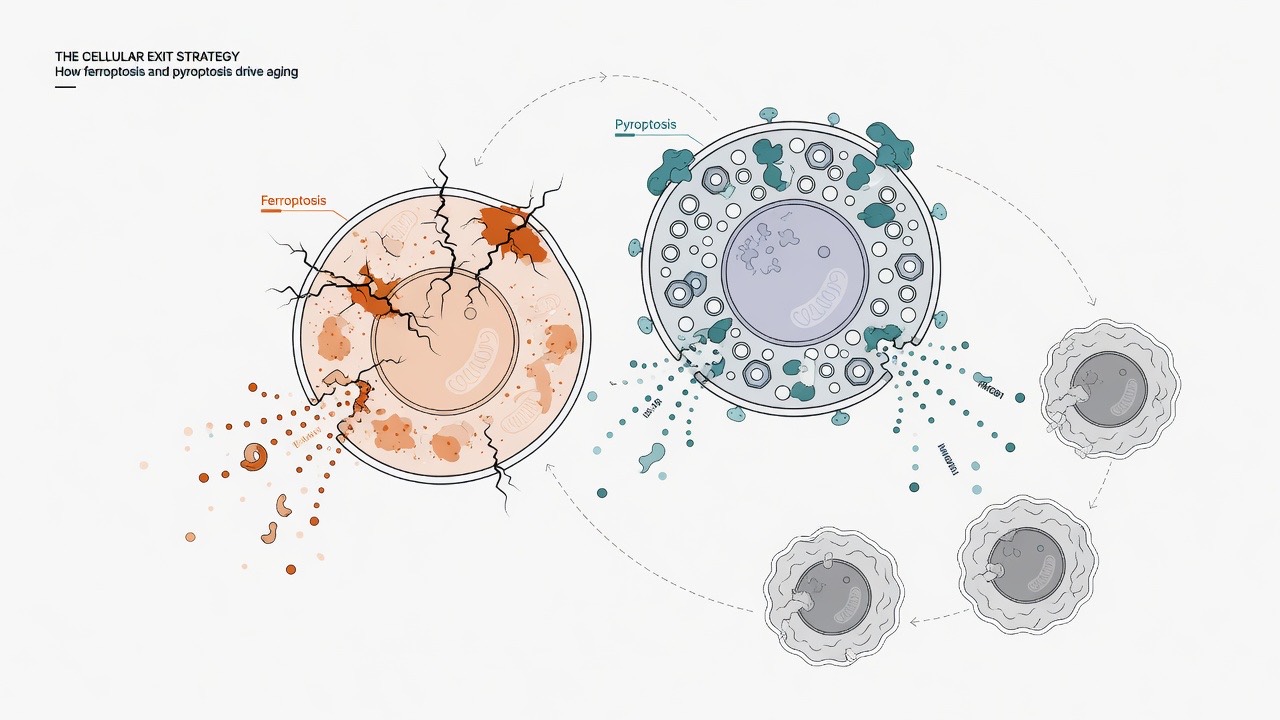
Beneath your skin, a cell is rusting. Brown-yellow stains creep across its membrane. Pop—the whole sheet tears open, splashing pro-inflammatory debris onto its neighbors. That is ferroptosis. The cell next door dies differently: a protein punches holes through the membrane, the cell swells and bursts—like a micro-grenade. That is pyroptosis. Four studies in 2026 converge on a single finding: these two "explosive" deaths can lock aging and inflammation into one loop—and that loop has brakes.
Why the way a cell dies shapes how fast you age
Billions of your cells die every day. Most go quietly, like autumn leaves drifting down, swept up by patrolling immune cells—a process called apoptosis. Ferroptosis and pyroptosis are different: they die like water balloons, membranes rupturing, contents splattering, dumping pro-inflammatory cargo into the surrounding tissue.
Neighboring cells, drenched in this "chemical splash," are pushed toward premature senescence. Senescent cells neither die nor leave; they just keep secreting inflammatory signals (scientists call this SASP). Those signals, in turn, push yet more cells toward rupturing death. The loop starts turning: death → inflammation → senescence → more death.
More than 1.4 billion people worldwide are now over 60. Chronic inflammation is the common backdrop of nearly every disease of aging. The question gets concrete: can we intercept the loop at the point of "how the cell dies"? Four studies in 2026—spanning skin, brain, and kidney—offer different facets of the same answer.
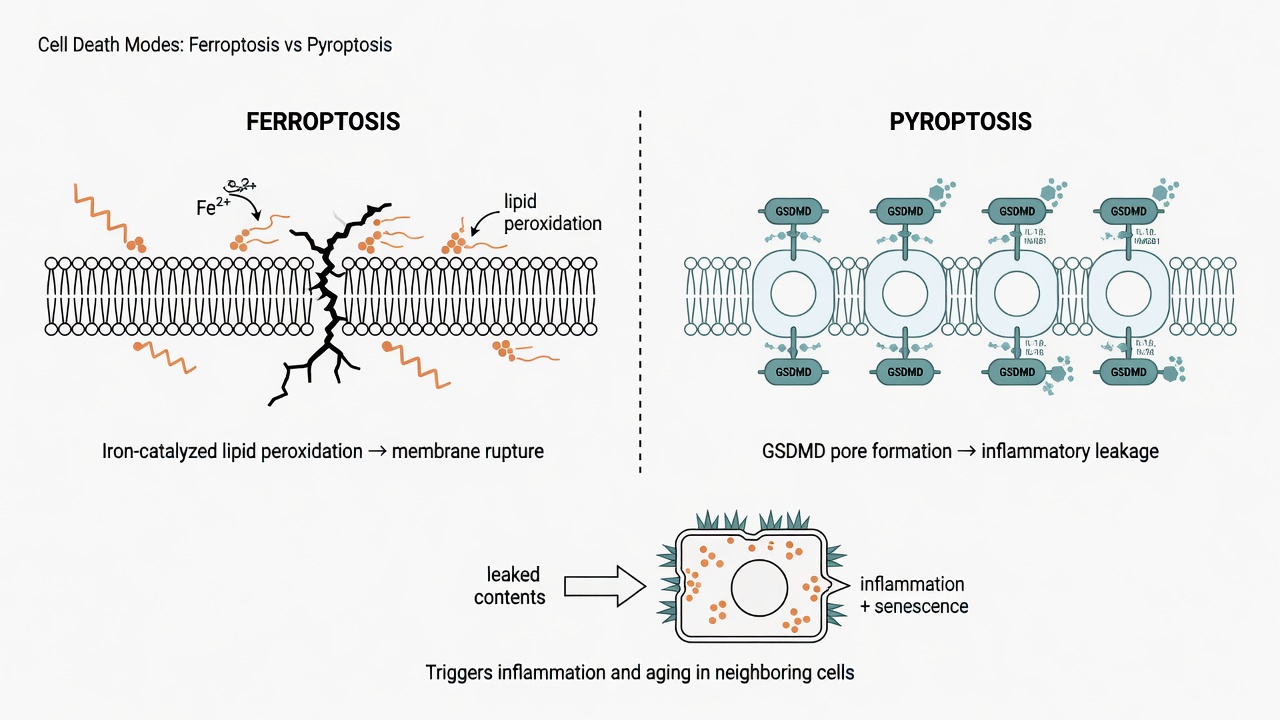 Figure 1: Two "rupturing" deaths—lipid peroxidation rusts the membrane apart (ferroptosis), or gasdermin punches holes through it (pyroptosis). Both splash pro-inflammatory cargo onto neighbors.
A rusting suicide in the skin: how ferroptosis breeds senescent cells
Your dermis is home to legions of fibroblasts—the cells that build collagen and hold your skin together. Under ferroptotic stress, they stumble onto a fork: they head toward death and toward senescence at the same time. The two bad outcomes are not coincidental; they are threaded onto the same signaling axis.
In 2026, Ng and colleagues found the valve on that axis—hypoxia-inducible factor HIF-1α. It damps the NF-κB–DPP4 pathway, letting fibroblasts dodge both ferroptosis and senescence features simultaneously. The core of ferroptosis is lipid peroxidation: iron-catalyzed oxidation rusts the membrane's fatty acids, like a seaside iron gate corroding in the salt wind, until the whole panel collapses.
When NF-κB ramps DPP4 up, fibroblasts become more prone to ferroptosis and more likely to enter senescence. Put differently, the senescent cells that linger in your aging skin—smoldering with inflammation—may have been pushed there by ferroptotic stress all along. Loosen the HIF-1α valve and both bad outcomes recede.
A self-spreading alarm in the brain: the two faces of pyroptosis
The most dangerous thing about pyroptosis is not that it kills a cell—it is that it relays itself.
In a 2026 brain-injury model, Li and colleagues traced a self-perpetuating circuit. When neurons undergo pyroptosis, the pore-forming protein GSDMD releases mitochondrial DNA (mtDNA). That stray mtDNA drifts like a lit match into the AIM2 inflammasome, igniting more neuronal pyroptosis and dragging cognition down with it. The product of death becomes the fuse for the next round.
A brake was found in the brain too. Xu and colleagues showed that TSG-6, secreted by bone-marrow mesenchymal stem cells, can modulate NLRP3 inflammasome activation in microglia—the brain's immune patrol officers, responsible for engulfing debris and monitoring threats. If the patrol officers themselves catch fire from pyroptosis, the blaze only spreads. TSG-6 acts like fireproof gear for those officers.
Read the neurons' relay fire alongside the microglia's role as fire-source manager, and two actionable intervention points emerge: block the mtDNA–AIM2 baton pass, or calm overactivated patrol officers.
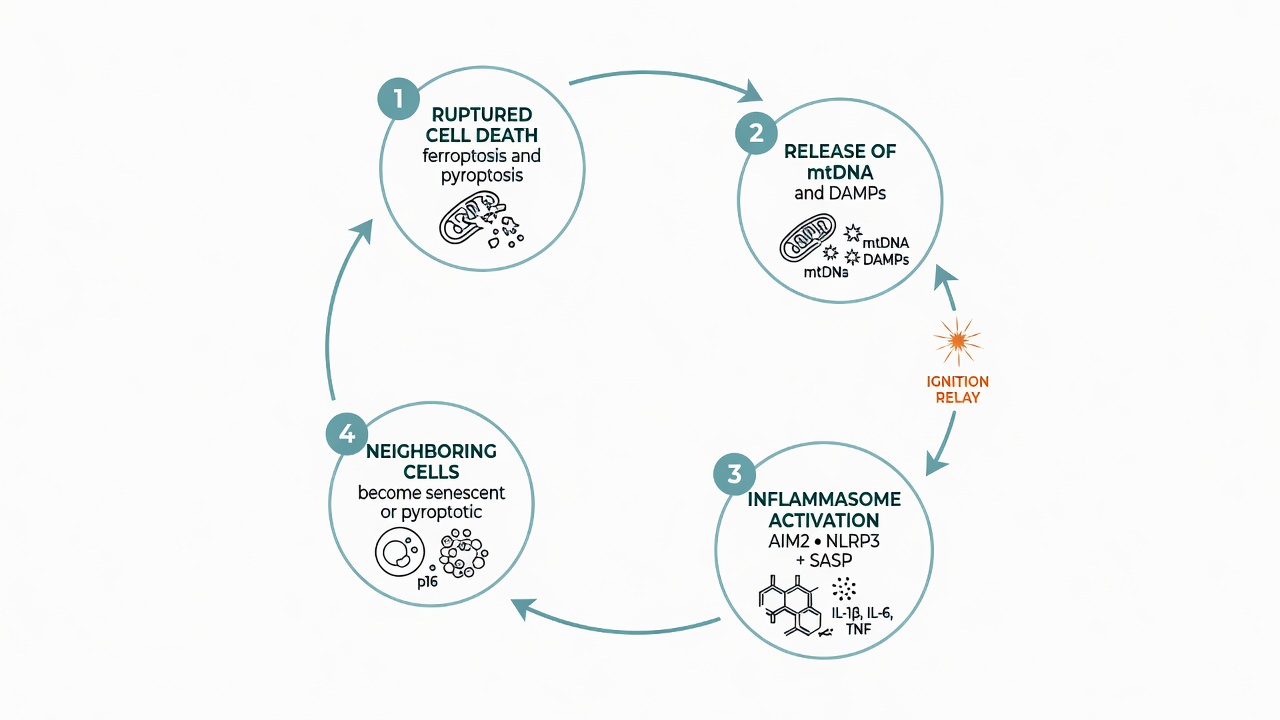 Figure 2: The self-spreading loop—rupturing death releases mtDNA and pro-inflammatory cargo, activating inflammasomes and SASP, pushing neighboring cells into senescence or pyroptosis, and reigniting more inflammation.
How to tap the brakes—and why you cannot slam them
The goal is not to abolish cell death but to turn down the volume on the rupturing kind. In a diabetic-nephropathy model, Sun and colleagues found that Pueraria lobata extract suppresses the NLRP3/Caspase-1 pathway, easing pyroptosis and inflammation in the kidney. Caspase-1 is one of pyroptosis's executioners; the extract effectively targets the executioner's wrist, handing natural-product intervention a precise molecular target.
But you may have already spotted a flip side: pyroptosis and ferroptosis are normal weapons of the immune system. Pyroptosis clears infected cells; a measured amount of cell death is part of anticancer defense. Shut these pathways down entirely and you disarm the immune system. As inflammasome inhibitors like MCC950 move toward clinical trials, dose windows and organ selectivity are what researchers worry about most. The deeper complication: the same pathway can play opposite roles in different organs—braking pyroptosis in the kidney may help, but in a tumor microenvironment it could let cancer cells slip past immune surveillance. A one-drug-fits-all approach is nearly impossible. Future strategies will likely target specific tissues and time windows.
As of 2026, at least four molecular pathways have been shown to regulate the "rupturing death → senescence" loop: HIF-1α–NF-κB–DPP4 (skin ferroptosis), GSDMD–mtDNA–AIM2 (neuronal pyroptosis relay), TSG-6–NLRP3 (microglial pyroptosis), and puerarin–Caspase-1 (renal pyroptosis). According to WHO, the global population over 60 has reached 1.4 billion and is projected to double to 2.1 billion by 2050. Chronic low-grade inflammation (inflammaging) is the shared substrate of cardiovascular disease, neurodegeneration, and type 2 diabetes. Ferroptosis and pyroptosis, as upstream drivers of inflammaging, are emerging as the second major anti-aging intervention track after senolytics.
These four studies remain largely in animal and cell models. Whether the benefits translate safely to humans, and at what dose windows, awaits clinical trials. The direction is clear: rather than waiting until senescent cells pile up, we can turn the inflammatory loop down at the very moment a cell decides how to die—like adjusting a thermostat, not ripping out the furnace.
You might also wonder
Q: How are ferroptosis and pyroptosis different from ordinary apoptosis?
Apoptosis is a quiet demolition job: the cell cuts itself into tidy parcels, which immune cells sweep away without triggering inflammation. Ferroptosis and pyroptosis are "explosive" deaths—the membrane ruptures, contents leak out, and the surrounding tissue is drenched in pro-inflammatory material. It is precisely this "dying loudly" quality that makes them a bridge between aging and chronic inflammation. All three are forms of regulated cell death; the difference lies in how the cell dies and what happens to its neighbors.
Q: Since ferroptosis is linked to aging, can I fight aging by cutting iron intake or loading up on antioxidants?
That leap is not supported. The key to ferroptosis is not "too much iron in the body" but a breakdown of lipid-peroxidation defenses inside specific cells. Indiscriminate iron restriction can cause anemia, and high-dose antioxidant supplements have not been shown in clinical trials to slow aging. Current research targets intracellular signaling axes (e.g., HIF-1α–DPP4), not systemic nutrient adjustment. Until molecular mechanisms translate into clinical recommendations, balanced nutrition and regular check-ups remain the practical advice.
References
- Ng et al. (2026). HIF-1α attenuates ferroptosis-associated dermal fibroblast senescence via modulation of NF-κB–DPP4 signaling. Journal of Translational Medicine. doi: 10.1186/s12967-026-08445-y
- Li et al. (2026). A self-perpetuating neuron-intrinsic GSDMD–mtDNA–AIM2 inflammasome axis drives neuronal pyroptosis and cognitive impairment after traumatic brain injury. Frontiers in Immunology. doi: 10.3389/fimmu.2026.1867920
- Xu et al. (2026). Bone marrow mesenchymal stem cell-derived TSG-6 regulates microglial pyroptosis via NLRP3 inflammasome. Stem Cell Research & Therapy. doi: 10.1186/s13287-026-05121-2
- Sun et al. (2026). Pueraria lobata extract mitigates diabetic nephropathy via NLRP3 inflammasome and Caspase-1 regulation. Scientific Reports. doi: 10.1038/s41598-026-57815-5