Most people know that poor sleep makes them feel older. But does it actually make them biologically older — in a way measurable in their blood?
A 2026 systematic review and meta-analysis published in Sleep Medicine Reviews attempted to answer this with unusual rigor: not by asking patients how they feel, but by looking at molecular markers in their blood and cells.
TL;DR: Chang's team reviewed 49 adult studies examining whether obstructive sleep apnea (OSA) or insomnia leaves measurable biological aging signatures in circulating markers. The clearest signal is shorter telomere length, with a statistically significant association to OSA. Other markers — DNA methylation clocks, mitochondrial function, sirtuins, autophagy proteins, and Klotho — show partial signals but the evidence remains thin and inconsistent.
What the Review Was Actually Measuring
This is not a paper about tiredness, cognitive performance, or even cardiovascular risk — all areas where sleep research is relatively robust. This review specifically sought out markers of biological aging: molecular indicators that something in the body is aging faster than its chronological age would predict.
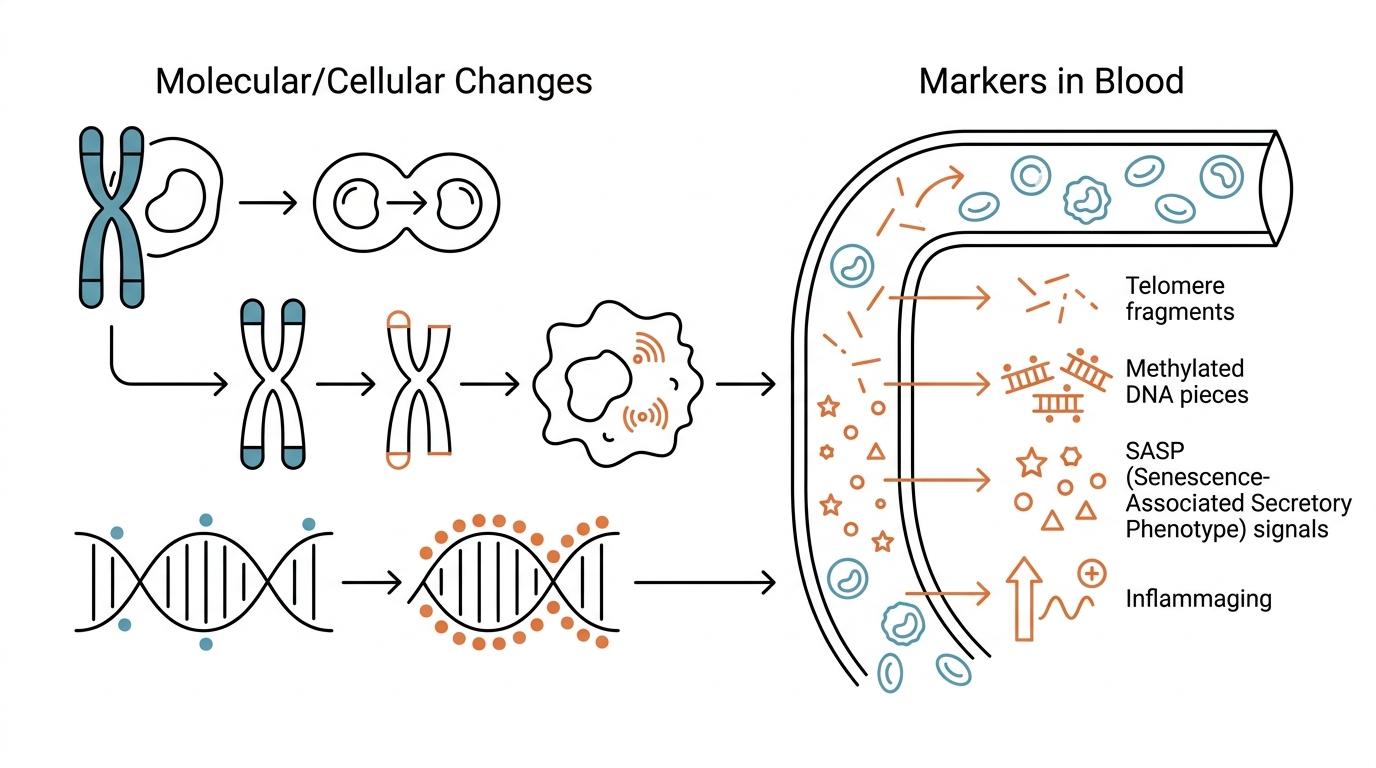
The research team searched multiple databases through October 2024, screening 1,839 deduplicated papers and ultimately including 49 adult studies. The biomarkers tracked included telomere length, DNA methylation-based "epigenetic clocks," mitochondrial DNA copy number and function, sirtuin activity, autophagy-related proteins, and Klotho expression.
The organizing question was precise: do sleep disorders — specifically OSA and insomnia — correlate with measurable signs of accelerated biological aging in the blood?
The Strongest Finding: Telomere Length
Among all the markers examined, telomere length has the most studies behind it and the most coherent meta-analytic result.
Telomeres are the protective end-caps on chromosomes — often compared to the plastic tips on shoelaces. They shorten with each cell division and with cumulative cellular stress. Shorter telomeres are associated with greater disease risk and earlier mortality in multiple large cohort studies.
For OSA specifically, Chang's team found a significant association with shorter telomeres. In unadjusted analyses, the standardized mean difference was -0.451 (95% CI: -0.688 to -0.215). After adjusting for confounders, the association remained: SMD -3.01 (95% CI: -4.98 to -1.04).
What does this mean in practice? It doesn't mean every person with OSA will have dramatically shorter telomeres. It means that in study populations, OSA is consistently associated with the lower end of the telomere length distribution. Chronic intermittent hypoxia — the signature feature of OSA — creates oxidative stress and inflammatory signaling that may accelerate telomere erosion. The body is being stressed repeatedly every night, and the cells accumulate wear.
Insomnia shows a similar directional signal: most studies link poor sleep quality to shorter telomeres, though the evidence is somewhat less consistent than for OSA.
The Other Markers: Promising But Fragmented
Beyond telomeres, the picture fragments considerably.
DNA methylation clocks are among the most hyped tools in biological aging research — algorithms that estimate a person's biological age from patterns of DNA methylation across hundreds of genomic sites. A few studies in this review applied these clocks to sleep disorder populations, and some found accelerated epigenetic aging. But there weren't enough consistent, well-powered studies to draw firm conclusions.
Mitochondrial markers — including mitochondrial DNA copy number — were also examined. Mitochondria are the cellular power generators, and their function declines with aging; sleep-related hypoxia and stress could plausibly worsen this. Again, some studies found associations. None established a clean, reproducible pattern.
Sirtuins and autophagy proteins — cellular maintenance and recycling systems that become less efficient with age — appeared in a small subset of studies. The signals were suggestive but based on very limited evidence.
Klotho, a protein associated with protection against age-related decline, showed some inverse associations with sleep disorders in several studies. But the research is preliminary.
The honest summary: beyond telomeres, these markers tell us there may be something interesting happening, but the evidence isn't yet strong enough to say what.
What This Study Can and Cannot Tell You
The temptation when reading this paper is to conclude: "sleep disorders age your blood." That framing is premature.
The review's own limitations are instructive. Study quality ranged from poor to good. Biomarker measurement methods varied substantially between labs — one study's telomere assay may not be directly comparable to another's. Sample sizes were often small. Confounders — obesity, cardiovascular disease, medications — are difficult to fully separate from OSA or insomnia effects.
Most importantly: association is not causation. OSA and insomnia correlate with shorter telomeres, but the directionality isn't fully established. Do sleep disorders shorten telomeres? Or do people with pre-existing accelerated cellular aging have worse sleep? Both are biologically plausible.
What the evidence does support: sleep disorders are not benign from a cellular perspective, and at least one robust molecular marker — telomere length — shows a consistent signal of greater biological wear in people with OSA.
What This Means for You
If you have OSA, chronic insomnia, or regularly experience non-restorative sleep, this review adds molecular context to what you may already know: the consequences aren't limited to daytime fatigue.
The practical implication is not "go get a special biological aging blood test." Those tests are not yet standardized enough to serve as individual clinical tools. The practical implication is: take the diagnosis seriously. OSA is treatable. Insomnia has evidence-based behavioral and pharmacological interventions. The evidence base for treating these conditions — reducing apnea events, improving sleep continuity — is substantially stronger than the evidence for any anti-aging supplement on the market.
For researchers, the call to action is clear: the field needs larger studies, standardized measurement methods, and longer follow-up periods. The telomere signal is robust enough to build on. The other markers deserve more rigorous investigation before clinical interpretation is possible.
The blood may remember your sleep quality. Right now, the most readable entry in that record is still the telomere.
References
- Chang et al. (2026). Circulating markers of biological aging associated with obstructive sleep apnea or insomnia in adults: A systematic review and meta-analysis. Sleep Medicine Reviews. doi: 10.1016/j.smrv.2026.102255