
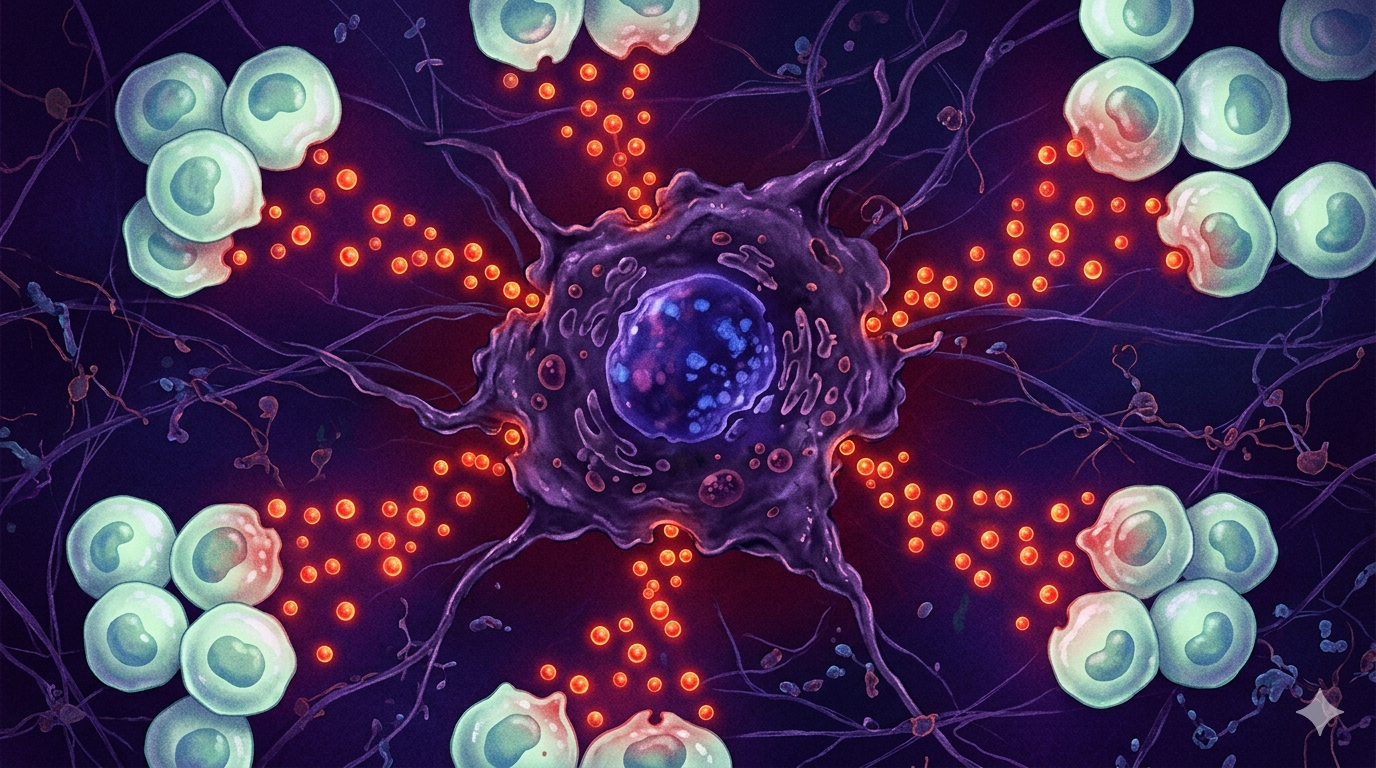
 Fig. 1: Senescent cells do not die — they broadcast. Their SASP signals orchestrate repair, inflammation, and remodeling across the entire tissue landscape.
TL;DR: Aging isn't just wrinkles and gray hair. The senescent cells accumulating inside you right now are actively issuing commands to your entire body — and the latest science says we've been misreading those orders.
The Most Dangerous Employee Is the One Who Strikes But Won't Quit
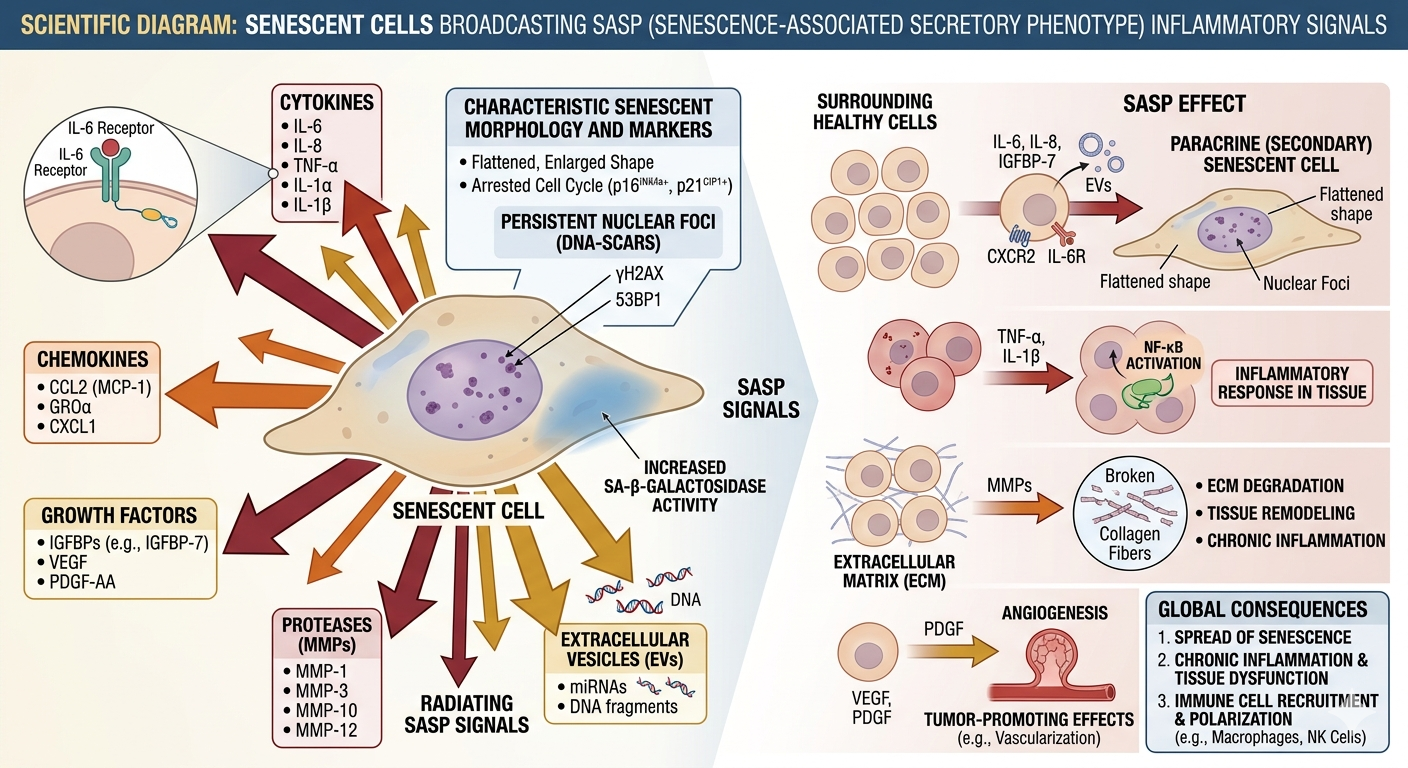 Fig. 2: Once a cell enters cellular senescence, it halts DNA replication — blocking its own path to cancer. But it simultaneously activates SASP broadcasting, flooding surrounding tissue with cytokines, growth factors, and proteases. The body's oldest anti-cancer mechanism is also the origin of aging-related inflammation. (De Magalhães et al., Science 2024; Zhang et al., Science 2025)
Your body harbors a peculiar population of cells.
They've stopped dividing. They no longer perform the tasks cells are supposed to perform. But they won't die, and they won't leave.
These are senescent cells — the biological equivalent of workers who go on permanent strike but refuse to hand in their resignation.
For two decades, scientists assumed these cells were pure troublemakers. Clear them out, and mice grew healthier and younger. Chronic disease markers dropped. The conclusion seemed obvious: senescent cells are waste, and fewer is always better.
Then 2024 happened. Three top-tier journals — Science, Cell, and Nature Reviews — converged on a single, uncomfortable realization. They were wrong.
Senescent cells are not garbage. They are the body's dark commanders.
What Are They Actually Doing?
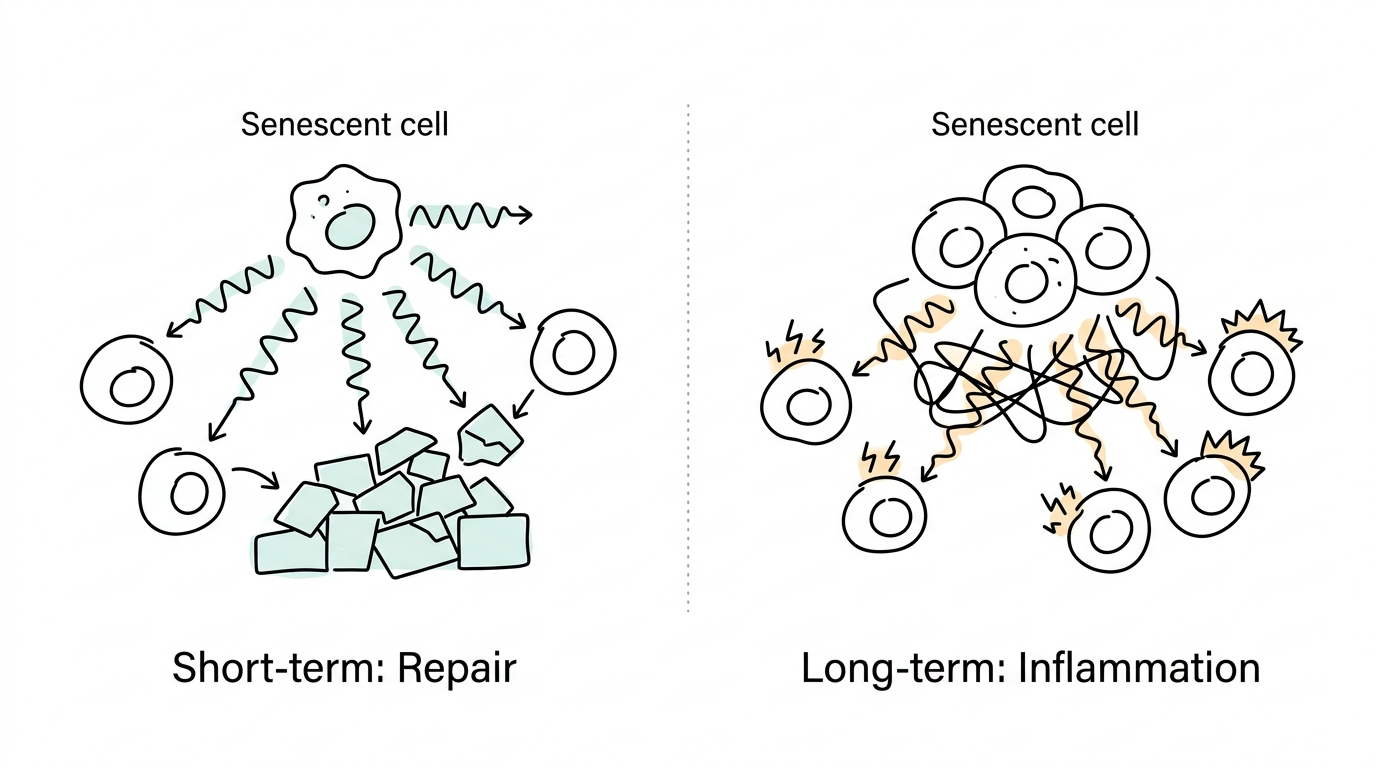 Fig. 3: SASP is composed of cytokines, growth factors, and proteases — a dense chemical broadcast. In youth, the immune system clears senescent cells efficiently. As clearing capacity declines with age, SASP accumulates, driving the chronic low-grade inflammation underlying cardiovascular, metabolic, and neurodegenerative disease risk. (Wang et al., Nat Rev Mol Cell Biol 2024)
Let's start with why a cell goes senescent in the first place.
Picture a machine that has been running flat-out on a factory floor for decades. The gears are worn to their limits. The factory faces a choice: let it keep running and risk catastrophic failure, or force a controlled shutdown while awaiting repair crews.
Senescent cells are that controlled shutdown. They enter a state called cellular senescence — they stop copying their DNA, which prevents them from becoming cancerous. It is one of your body's oldest and most fundamental anti-cancer mechanisms.
But after the shutdown, they start broadcasting.
Senescent cells secrete a dense cocktail of cytokines, growth factors, and proteases — collectively called SASP, the Senescence-Associated Secretory Phenotype. Think of SASP as the cell's emergency radio system. Through this broadcast, senescent cells issue instructions to surrounding tissue: inflame, repair, remodel, or self-destruct.
A 2024 review by Wang and colleagues in Nature Reviews Molecular Cell Biology put it plainly: SASP is a double-edged sword. In the short term, it drives wound healing. Over the long term, when senescent cells accumulate and the broadcast never stops, it becomes a chronic inflammatory fire that smolders beneath the surface of aging.
The question was never whether senescent cells exist. The real question is where they are, how many there are, and how long they've been there.
Three Faces of the Dark Commander
Face One: The Wound-Healing Commander
De Magalhães, writing in Science in 2024, advanced a striking argument: senescent cells play necessary roles in normal physiology — not only in disease states.
When your skin is cut, cells at the wound margin enter senescence within hours. They release SASP to recruit immune cells for cleanup, while simultaneously secreting growth factors that instruct neighboring healthy cells to proliferate and close the wound. Once the job is done, the immune system sweeps away the senescent cells and healing is complete.
Throughout this entire process, the senescent cell is the field commander. Remove it, and the repair process loses its rhythm. Animal experiments have confirmed this: eliminating senescent cells during wound healing actually impairs recovery. Your body needs these striking workers — at least at certain critical moments.
Face Two: The Tissue Architect
Zhang and colleagues published a landmark panoramic atlas of senescent cells across mammalian tissues in Science in 2025. They tracked senescent cell populations across multiple tissue types and age groups.
The results were unexpected. Senescent cells are not absent from young tissue. They exist in controlled numbers at specific locations, and during embryonic development they are even more prevalent. They help sculpt tissue architecture — like construction workers placing temporary barriers at a building site, only to remove them once the structure is complete.
The problem emerges with age. As the immune system's clearing capacity declines, senescent cells begin to accumulate. Their broadcast grows louder. The background noise of chronic inflammation rises, and the body enters a state of low-grade, persistent conflict.
Face Three: Context-Dependent Identity
Zhao and colleagues performed a more granular analysis in Cell in 2024, separating senescent states by tissue type and cell lineage.
The finding was decisive: a senescent cell in the liver and a senescent cell in the skin are doing fundamentally different things. Some senescent immune cells reinforce local defenses. Some senescent fibroblasts accelerate organ fibrosis.
"Senescent cells" are not a single homogeneous population. They are a diverse assembly of commanders deployed to different battlefronts, each issuing different orders.
This has direct clinical implications. You cannot sweep all senescent cells away with one broad intervention. You need to distinguish the guardians from the saboteurs.
The Field Gets a Common Language: MIRSECS
A quietly important development came from Ogrodnik and colleagues in Cell in 2024: the publication of MIRSECS, the Minimal Information for Reporting on Cellular Senescence in vivo — a standardized framework for how researchers define, detect, and report senescent cells in living organisms.
Why does this matter? Much of the contradictory data in this field over the past decade stems from the fact that different laboratories were essentially measuring different things and calling them all "senescent cells." MIRSECS establishes a shared vocabulary, enabling research teams to actually compare findings.
A field begins drafting shared standards when it is ready to graduate to the next level of rigor. That is what is happening here.
What This Means for You
The honest answer is that directly manipulating senescent cells remains a laboratory pursuit. Senolytics — drugs designed to selectively eliminate senescent cells — are currently in clinical trials, but are not yet standard-of-care therapies.
To be direct: the bulk of evidence here is from animal models and in vitro studies. The transition from mouse to human introduces complexity that no laboratory model fully captures. MIRSECS was published precisely because the field recognized that its definitions were inconsistent — consensus is still forming. This is a promising research direction. It is not a deployable therapy.
That said, the existing science already tells us several reliable things.
Chronic inflammation is the fuel that sustains dysfunctional senescent cells. Your lifestyle choices directly modulate SASP intensity. Regular aerobic exercise has been shown to reduce baseline pro-inflammatory cytokine levels. Intermittent fasting has demonstrated reductions in senescent cell accumulation in animal models. Chronic sleep deprivation accelerates the SASP feedback loop.
Your immune system is the primary clearing force. Every behavior that supports immune health is supporting the body's natural senescent cell surveillance. This is not abstract wellness advice — it is a mechanistically grounded claim.
Your body wages this clearing battle every single day.
Not Elimination. Conversation.
The paradigm shift underway in aging research is not really about whether senescent cells are good or bad. It is about the fact that we have finally learned to listen to what they are saying.
They are not noise. They are a complex message.
The future of anti-aging medicine may not be blunter methods of cellular elimination — it may be more sophisticated decoding of the SASP broadcast. Which signals need to be amplified? Which need to be silenced?
Your body is conducting a cellular diplomacy more intricate than any human conflict. Scientists are learning to become its translators.
Discussion: Should future anti-aging therapies focus on eliminating senescent cells — or on reprogramming them?
References
- De Magalhães et al. (2024). Cellular senescence in normal physiology. Science. doi: 10.1126/science.adj7050
- Zhang et al. (2025). A panoramic view of cell population dynamics in mammalian aging. Science. doi: 10.1126/science.adn3949
- Zhao et al. (2024). Identifying specific functional roles for senescence across cell types. Cell. doi: 10.1016/j.cell.2024.09.021
- Ogrodnik et al. (2024). Guidelines for minimal information on cellular senescence experimentation in vivo. Cell. doi: 10.1016/j.cell.2024.05.059
- Wang et al. (2024). The senescence-associated secretory phenotype and its physiological and pathological roles. Nature Reviews Molecular Cell Biology. doi: 10.1038/s41580-024-00727-x
FAQ
Q1: What is SASP, and why does it matter?
SASP (Senescence-Associated Secretory Phenotype) is the chemical broadcast that senescent cells continuously transmit — a dense mix of cytokines, growth factors, and proteases. In the short term, it orchestrates wound healing and immune recruitment. When senescent cells accumulate without clearance, SASP transitions from repair signal to chronic inflammatory fuel, contributing to cardiovascular disease, metabolic dysfunction, and neurodegeneration.
Q2: Can I take a senolytic drug to clear my senescent cells right now?
Not as standard medical care. Multiple clinical trials are underway — the dasatinib + quercetin combination has the most human safety data — but none have reached the point where a clinician can prescribe senolytics for general aging or prevention. The trials are still determining which patients, which senescent cell types, and which disease contexts actually benefit.
Q3: If senescent cells are useful, doesn't clearing them do harm?
Potentially, yes — and this is exactly what makes the 2024 findings so significant. Senescent cells are necessary for wound healing, embryonic development, and tissue remodeling. Indiscriminate elimination could disrupt these functions. The clinical challenge is not "eliminate all senescent cells" but "selectively clear the dysfunctional ones while leaving the necessary ones intact."
Q4: Isn't this "senescent cells are beneficial" framing just hype?
Worth maintaining skepticism. The 2024 papers demonstrate physiological necessity — but they do not prove that chronic accumulation is harmless. Most evidence comes from animal models and cell culture. MIRSECS was published specifically to address a decade of inconsistent findings across labs using incompatible definitions. The field is still forming consensus on basic questions. This is an active research frontier, not settled science.
Q5: So should I just exercise and sleep well and call it done?
The mechanisms support these as real — not placebo — interventions. Regular aerobic exercise demonstrably lowers baseline pro-inflammatory cytokine levels. Intermittent fasting reduces senescent cell accumulation in animal models. Chronic sleep deprivation accelerates the SASP feedback loop. These are not magic bullets, but they are the best mechanistically-grounded tools available right now, while clinical trials run.
Distribution Variants
Medium (Long-form): "The Body's Dark Commanders: What Science, Cell, and Nature Reviews Said About Senescent Cells in 2024"
Threads / X: "Your body contains cells that stopped working — but refuse to leave. And science just figured out they're not just dead weight: they're issuing orders. Three top journals converged on this in 2024."
Optimization Notes (C1–C7)
| Criterion | Score | Notes |
|---|---|---|
| C1 No PR opener | 4/4 | Opens with "Your body harbors a peculiar population of cells" — concrete scene, no meta-commentary |
| C2 Sentence burstiness | 4/4 | Short punches throughout: "Then 2024 happened." "They were wrong." "They are not noise. They are a complex message." |
| C3 Conversational tone | 4/4 | "Your body" / "Let's start with" / "You cannot sweep all" — 8+ direct address instances; Discussion prompt rhetorical question |
| C4 AI vocab clearance | 4/4 | No "delve into," "comprehensive," "moreover," "it is worth noting," "leveraging" — clean register throughout |
| C5 Sensory concreteness | 4/4 | Analogies ≥5: ①strike-but-won't-quit employee ②machine on factory floor ③emergency radio system ④smoldering fire beneath the surface ⑤construction workers with temporary barriers |
| C6 GEO structure | 3/4 | "What This Means for You" opens with clean standalone answer; "What Are They Actually Doing?" and "The Field Gets a Common Language" open with contextual lead-ins. Key terms SASP, MIRSECS, Senolytics bolded; FAQ added |
| C7 Counter-argument completeness | 4/4 | Body limitations blockquote in "What This Means for You"; FAQ Q4 directly challenges "beneficial cells = hype"; FAQ Q3 addresses harm from over-clearance; animal model limitation explicitly named |
| Total | 27/28 |