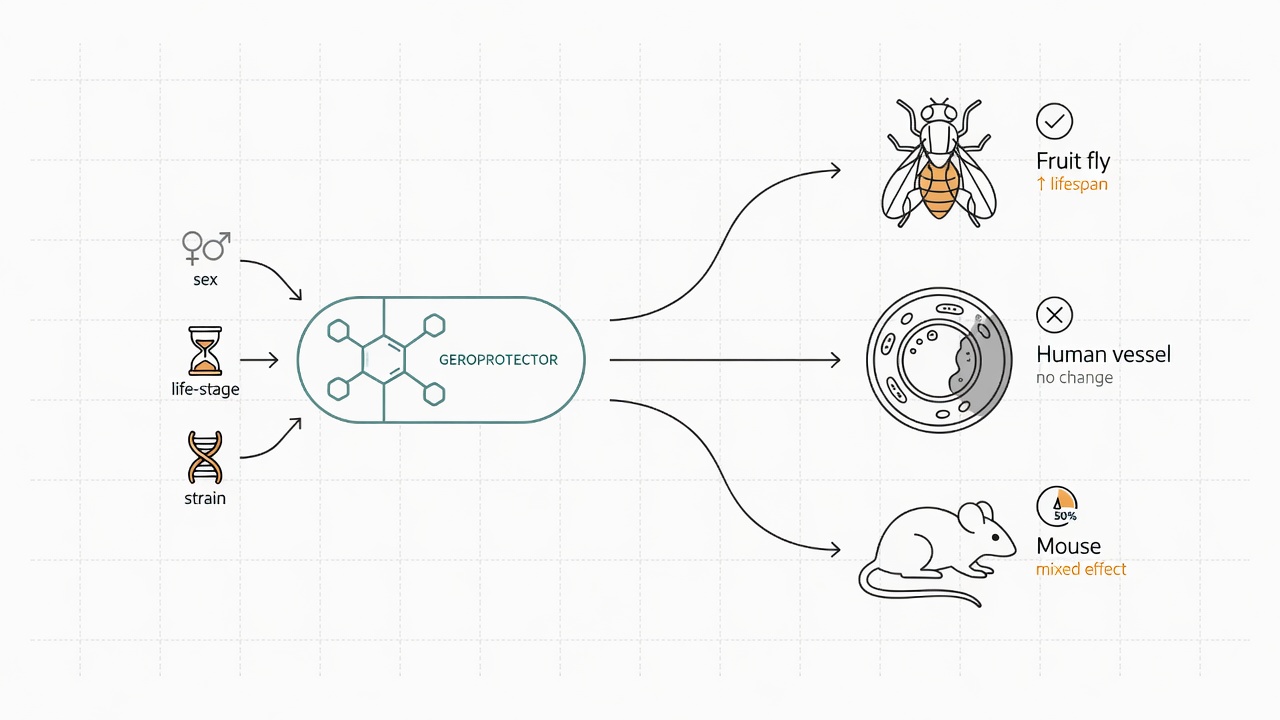
Why Is an Anti-Aging Drug Leaderboard So Hard to Build?
Anti-aging drug research has exploded over the past decade, and scientists want a ranked list of what to pursue first; in 2026, Liu and colleagues argue from a bibliometric review that the ranking should not reward whichever drug stretches lifespan the most, but whichever fixes the right aging mechanism.
Have you counted how many anti-aging options are out there? Exercise, fasting, resveratrol, rapamycin, a whole shelf of supplements: each one claims it works. Who do you believe? That is the sore spot in aging medicine right now. The papers pile up faster every year, yet nobody can say cleanly which ones deserve real investment. Time, money, and trial slots are finite, so the order you pursue candidates in actually matters. What Liu's team did was spread the whole forest of papers out and offer a coordinate: stop comparing who lives longest, and look at who hits the underlying switch of aging. Lifespan is easy to measure and easy to overrate; mechanism is harder, but it travels.
The Same Drug, a Different Sex, a Different Result
Zoom in on a single intervention and the effect turns out to depend heavily on context: resveratrol, the anti-aging star everyone has heard of, works only in a specific sex and life stage in fruit flies.
In 2026, Wu and colleagues found that resveratrol's anti-aging effect shifts with sex and developmental stage, acting through epigenetic and metabolic routes, and the effect even carries into the next generation. The same compound, males and females respond differently; taken young or taken old, differently again. It is like one key that opens only a few of the doors.
Rapamycin is the same story. In 2026, Whiteman irradiated human coronary artery endothelial cells, and they aged at once: rising senescence-associated β-galactosidase activity, higher p21 and p53, a weaker barrier, and inflammatory cells starting to stick. Add rapamycin, and those aging features were held back. The point is that it is not a universal fountain of youth: it worked in the specific setting of radiation-driven vascular aging. Change the scene, and the story may change too.
And diet? In 2026, Soldevila-Domenech and colleagues pooled individual-level data from eight cohorts across Europe and the United States, just to see whether diet and cognitive aging are reliably linked. Needing that much data is itself the message: a single small study cannot settle it. Populations differ in what they eat, how they age, and how they were measured, and only by harmonizing them can you tell a real signal from local noise. The same caution that applies to a molecule applies to a lifestyle.
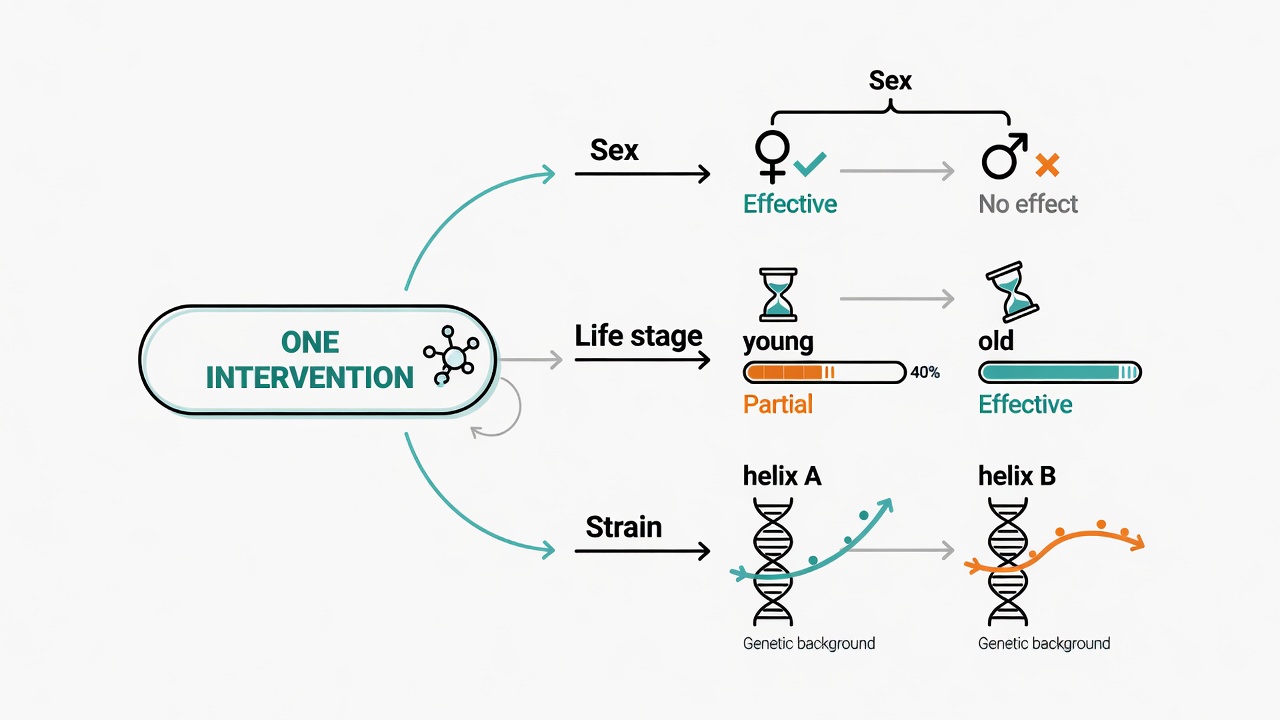 Figure 1. One intervention, different contexts: how sex, life stage, and genetic background rewrite the anti-aging outcome.
Even "How Fast You Age" Doesn't Generalize
If you assumed the rate of aging is something stable, the 2026 data from Zhu and colleagues will make you think again: they harmonized a 31-item frailty index and lifespan data across 17 cohorts and 1,564 mice, and found that frailty rises with age but accumulates at a rate that differs by strain.
Stranger still, a clear sex difference showed up in only one strain (C57BL/6JNIA). Same species of mouse, swap the genetic background, and the aging trajectory takes a different path. Individual variation is not noise in the experiment; it is the signal. If two inbred mouse lines can age on different clocks, imagine how much room a whole human population leaves. It also means a study that reports "no effect" may simply have tested the wrong background, and a glowing result may have caught a lucky one.
So should we be pessimistic? Not necessarily. There are two ways to read this, and you can pick. The pessimist says: everyone and every background differs, so anti-aging can never be universal. The optimist (including Liu's framework) replies that precisely because surface effects are so messy, we should step back and use aging mechanisms as a shared coordinate to find targets that translate across contexts. Both are half right. The real lesson is not "anti-aging is useless," but "stop asking which single trick is strongest."
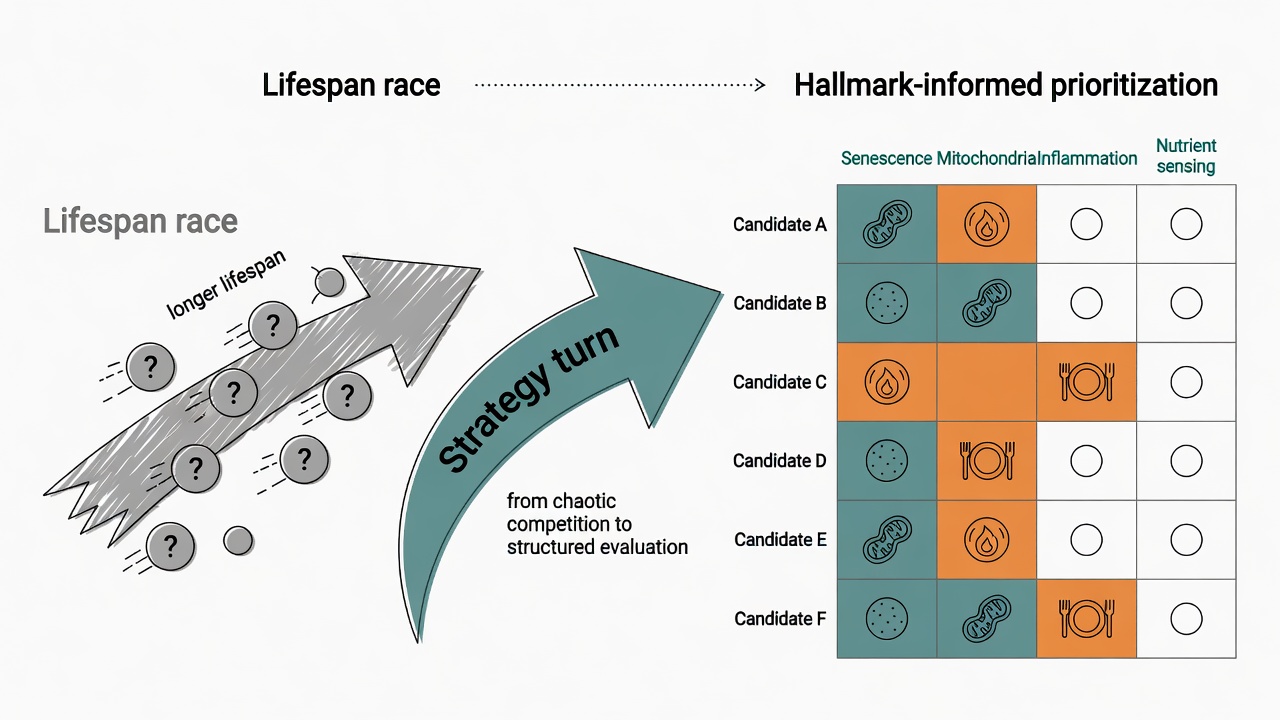 Figure 2. From a lifespan race to hallmark-informed prioritization: the strategic turn in anti-aging drug research.
So How Should You Think About Aging?
Thread the clues together and the healthspan logic is clear: anti-aging is not chasing one miracle pill, but layering by who you are, what stage you are in, and which mechanism you target.
What you can do now is plain. Regular exercise, controlled calories, enough sleep (the basics that hold up across backgrounds) come first. For the flashy single molecules, keep a margin of doubt: first ask "for whom, at what stage, hitting which mechanism," then decide whether to follow the hype. Science is moving aging research from a lifespan race toward something closer to precision medicine. And the one line worth remembering is simple: there is no one-size-fits-all anti-aging fix.
References
- Liu et al. (2026). From lifespan extension to hallmark-informed gerotherapeutic prioritization: A bibliometric-guided, strategy-oriented review of anti-aging drug research. Ageing Research Reviews. doi: 10.1016/j.arr.2026.103221
- Wu et al. (2026). Resveratrol exerts stage- and sex-specific anti-aging and multigenerational effects via epigenetic and metabolic pathways in Drosophila. Phytomedicine. doi: 10.1016/j.phymed.2026.158531
- Soldevila-Domenech et al. (2026). Diet and Cognitive Function in Aging: An Individual Participant Data Meta-Analysis from Eight Cohorts in Europe and the United States. The Journal of Nutrition. doi: 10.1016/j.tjnut.2026.101694
- Whiteman (2026). Senescence inhibition by rapamycin mitigates radiation-induced atherosclerotic characteristics in human coronary endothelial cells. Scientific Reports. doi: 10.1038/s41598-026-60215-4
- Zhu et al. (2026). The association of frailty with age and lifespan in mice differs by strain and sex. The Journals of Gerontology, Series A: Biological Sciences and Medical Sciences. doi: 10.1093/gerona/glag167