Most anti-aging narratives focus on fuel. Add more NAD+. Supplement more precursors. Keep the cellular engine running.
A 2026 paper in Phytomedicine asks a different question: what if the maintenance crew is the problem?
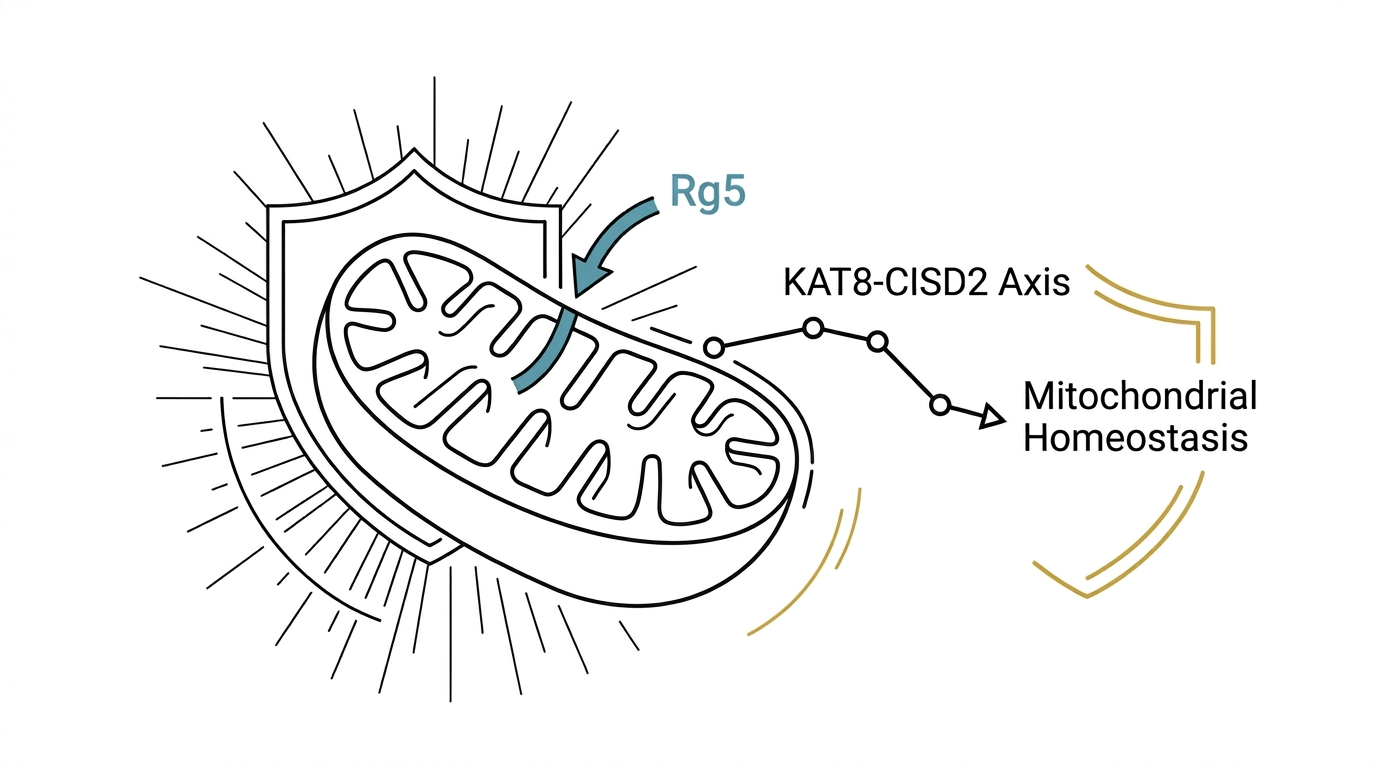
TL;DR: Chu's team found that ginsenoside Rg5 doesn't simply refuel cells — it preserves a mitochondrial outer membrane protein called CISD2 by promoting its acetylation at the K74 site via KAT8. This acetylation mark acts as a protective tag, shielding CISD2 from being sent to degradation via STUB1-mediated ubiquitination at K105. The result: more stable mitochondria, fewer senescence markers. Evidence is currently limited to senescent cells and C. elegans models.
The Setup: Why CISD2 Matters
Cellular aging isn't just about energy deficiency. Cells can have adequate fuel and still deteriorate — if the quality control and repair systems that keep mitochondria functional are themselves degrading.
CISD2 is a protein located on the outer mitochondrial membrane that has been associated with longevity across multiple studies. When CISD2 levels fall — which happens progressively with age — mitochondrial stability suffers. Membrane potential becomes erratic. ATP production fluctuates. Reactive oxygen species (ROS) levels rise. These conditions collectively push cells toward a state of senescence: a kind of arrested, dysfunctional existence that cells enter when they can no longer divide normally.
The interesting question this paper pursues is not just that CISD2 falls with age, but why — and whether that decline is reversible.
The Mechanism: Two Competing Chemical Tags
The answer turns out to involve a competition between two post-translational modifications on CISD2.
The research team found that the KAT8/MSL acetyltransferase complex places an acetyl group on CISD2 at the K74 position. Think of this as a protective quality tag — when it's present, the protein is more stable. When it's absent or overridden, CISD2 becomes vulnerable to a different marking system: STUB1-mediated ubiquitination, particularly at the K105 site, which routes proteins toward proteasomal degradation.
In other words: the same protein can receive either a "keep" signal or a "discard" signal, depending on which modification gets applied first. The balance between KAT8-driven acetylation and STUB1-driven ubiquitination determines whether CISD2 stays functional in the mitochondrial membrane or gets recycled prematurely.
Where Rg5 Enters
Ginsenoside Rg5 — a compound derived from Panax ginseng — was found to directly bind KAT8. The team demonstrated this using CETSA, pull-down assays, and competitive binding experiments. The binding appears to activate KAT8's acetyltransferase activity toward CISD2, effectively tipping the balance toward the protective K74 acetylation.
The effect isn't just biochemically interesting. When Rg5 was applied to senescent cells:
- Mitochondrial ROS levels decreased
- Mitochondrial membrane potential (assessed by JC-1 staining) stabilized
- ATP production improved
- Mitochondrial morphology was better preserved
- SA-β-galactosidase staining — a standard senescence marker — was reduced
Crucially, the team also compared normal CISD2 against a K74 mutant version that cannot be acetylated at that site. Cells with the mutant CISD2 showed worse mitochondrial homeostasis and stronger senescence phenotypes, directly linking the acetylation event to the functional outcome.
Extending the Finding: C. elegans Evidence
To test whether this mechanism operates beyond a cell culture dish, the researchers moved to Caenorhabditis elegans, a standard organism for aging research.
They suppressed mys-2 (the C. elegans homolog of KAT8) and cisd-1 (the CISD2 homolog) simultaneously. Worms with both genes reduced showed worse mitochondrial function and shortened lifespan compared to controls. This cross-species consistency makes the KAT8-CISD2 axis look more like a conserved biological principle than an artifact of a particular cell line.
What's Still Missing
The mechanism is unusually well-characterized for a single study. The evidence chain from Rg5 → KAT8 binding → K74 acetylation → CISD2 stability → reduced senescence is coherent and multiply validated.
What's absent is the clinical layer. The current evidence comes entirely from senescent cell cultures and C. elegans. Questions that remain unanswered:
- What doses of Rg5 are needed in a mammalian system to achieve meaningful KAT8 activation?
- What are the pharmacokinetics — how much Rg5 actually reaches relevant tissues after oral intake?
- Are there off-target effects from sustained KAT8 activation?
- Does protecting CISD2 translate to measurable improvements in tissue aging in mammals, let alone humans?
None of these questions have answers yet. Rg5 cannot be presented as a proven human anti-aging intervention on the basis of this study.
The Conceptual Contribution
Even setting aside the question of clinical application, this paper contributes something conceptually valuable: it reframes where anti-aging intervention might be most effective.
Instead of refueling cells — the dominant strategy in NAD+ supplementation — this work suggests targeting the maintenance infrastructure itself. CISD2 is not an energy molecule. It's a structural guardian of mitochondrial integrity. Preserving it means the mitochondrial system doesn't need to operate in crisis mode in the first place.
If the anti-aging field has spent much of the past decade focused on fuel, this paper is an argument for also looking at the maintenance crew. The question is not only "how much energy can we put in" but "how long can we keep the repair systems working."
References
- Chu et al. (2026). Ginsenoside Rg5 targets the KAT8-CISD2 axis to maintain mitochondrial homeostasis and antagonize senescence. Phytomedicine. doi: 10.1016/j.phymed.2026.157923