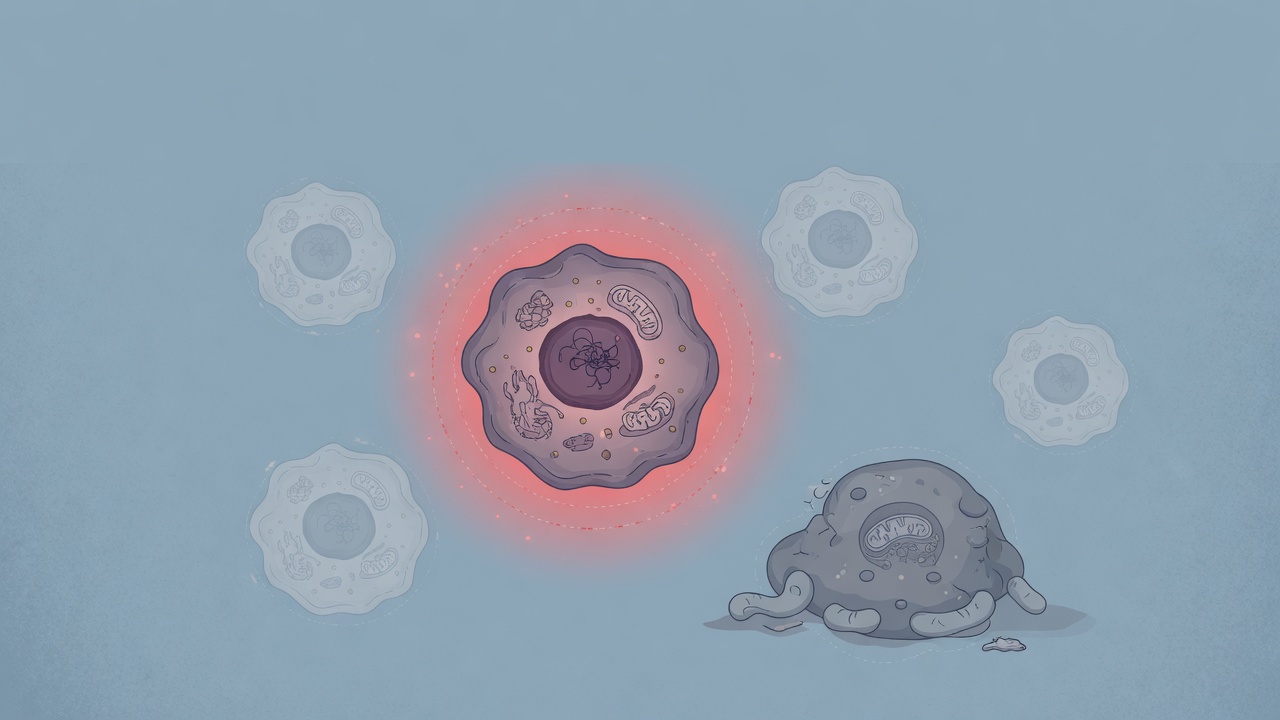
Senescent cells don't vanish on their own — the immune system is supposed to remove them. When that cleanup crew falters with age, the smarter move may be to quiet the cells rather than wipe them out.
Senescent cells pile up with age not because they have become immortal, but because the immune cells that once swept them away have aged first. Several 2026 reviews shift the question from "how do we kill senescent cells" to "why can't the body clear them," and they point to a more practical route: instead of using senolytic drugs to kill these cells outright, repurpose old drugs such as niclosamide to turn down their inflammatory output. This "senomorphic" approach is rewriting the playbook for anti-aging intervention.
A senescent cell is one that overstays and keeps shouting
The danger of a senescent cell is that it stops dividing yet refuses to die, while continuously releasing dozens of inflammatory and tissue-degrading signals that drag healthy neighbors into decline.
These cells slam on two molecular brakes, p16 and p21, to exit the cell cycle permanently. The trouble is that they don't leave quietly. They switch on a program called SASP (the senescence-associated secretory phenotype), spraying out inflammatory cytokines, proteases, and growth signals. The 2026 mechanistic review by Hussain and colleagues in Cell & Bioscience frames this clearly: a single senescent cell acts like one rotten apple slowly spoiling the whole basket.
Young immune systems clear them; aged ones can't keep up
The immune system is the body's built-in cleanup crew, actively recognizing and removing senescent cells — but that surveillance weakens with age, letting the cells accumulate.
The 2026 review by Zubova and colleagues in the Journal of Translational Medicine lays out the relationship. Natural killer (NK) cells and macrophages detect surface signals on senescent cells and clear them, and this immune surveillance works well in youth. The problem is twofold: the immune cells themselves grow senescent and lose clearance capacity, while the accumulating senescent cells use SASP to suppress immune responses in return. One side can't clean; the other side jams the signal — a vicious circle in which the cells just keep building up.
So why not just kill them all?
Killing senescent cells looks impressive in animal studies but runs into two real obstacles: drugs struggle to hit only senescent cells, and some senescent cells are actually needed for tissue repair.
The clearance route is not hypothetical. In 2018, Xu and colleagues reported in Nature Medicine that a senolytic combination of dasatinib and quercetin extended the median post-treatment lifespan of aged mice by 36%. But the move into humans has been far more cautious — the first-in-human senolytic trial, by Justice and colleagues in 2019, enrolled just 14 patients with pulmonary fibrosis, a small proof-of-concept. The deeper difficulty is off-target damage: drugs that kill senescent cells often harm normal cells too, and transient senescent cells are useful during wound healing and embryonic development. Wiping them all out indiscriminately may not be worth the cost.
The new idea: don't kill, domesticate
The senomorphic strategy doesn't try to kill senescent cells. It suppresses their SASP output, so the cells that overstay at least fall silent and stop poisoning their neighbors.
The 2026 review by Alameen and colleagues in Inflammation Research repositions the old antiparasitic drug niclosamide as a candidate against inflammaging. Its appeal lies in being multi-target: it acts on master inflammatory switches such as NF-κB to lower the SASP volume, rather than detonating cell death. For a drug with decades of human safety data, this repurposing route is faster and steadier than building a precise senolytic from scratch.
Neither path is a miracle cure. A senomorphic acts like a long-term "mute button" — inflammation may rebound once you stop, so it needs continuous dosing — while a senolytic is "hit and run" but stuck on off-target risk and safety. The real direction is probably not either/or: first identify which kind of senescent cell you face, in which organ, playing hero or villain, then decide whether to kill it, tame it, or leave it alone. The notion of treating senescent cells as a single villain to be eliminated in one sweep is being steadily revised by this work.
References
- Zubova, A. et al. (2026). Immunological consequences of senescence in physiology and pathology. Journal of Translational Medicine. doi: 10.1186/s12967-026-08335-3
- Alameen, A.A.M. et al. (2026). Repurposing niclosamide to mitigate inflammaging: a review of multi-target mechanisms in cellular senescence and age-related decline. Inflammation Research. doi: 10.1007/s00011-026-02293-8
- Hussain, A. et al. (2026). Molecular mechanisms and recent advances in cellular senescence. Cell & Bioscience. doi: 10.1186/s13578-026-01596-x