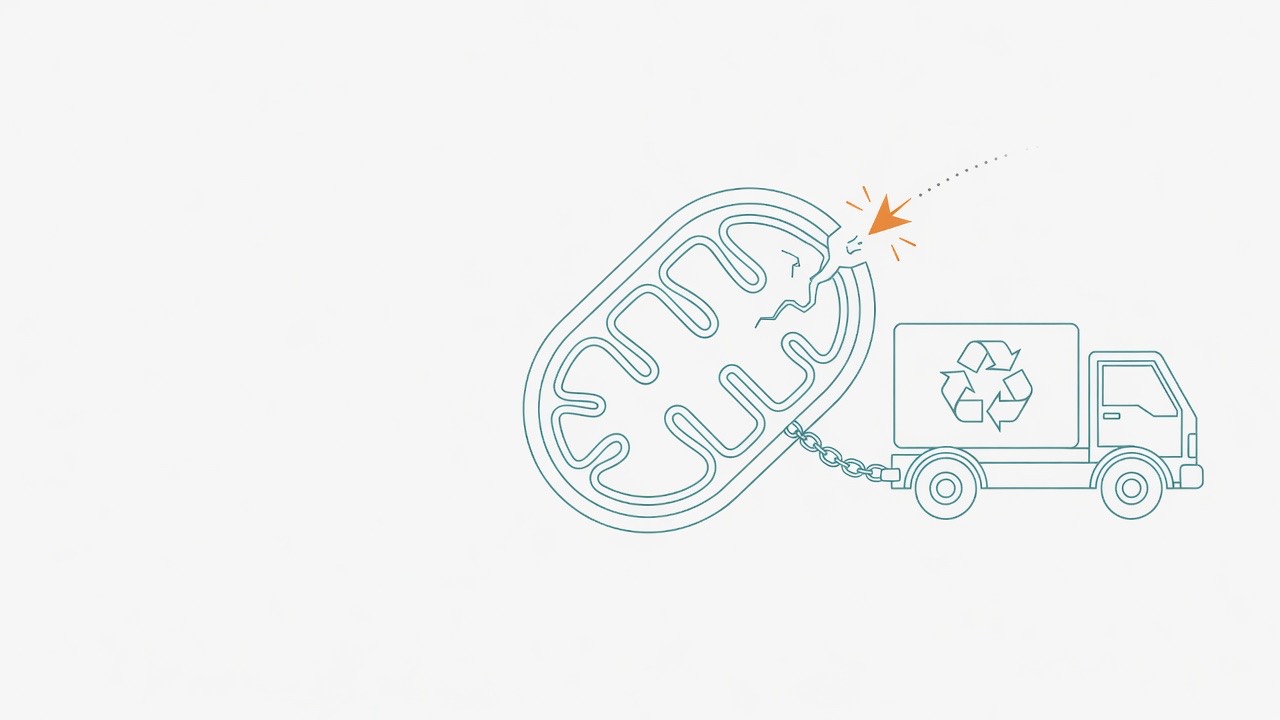
You have probably heard that mitochondria are the cell's power plants. What gets less airtime is that power plants break down, and the cell runs a dedicated recycling truck to haul the broken ones away. The trouble is simple: as we age, that truck starts running late.
The aging problem isn't fewer mitochondria — it's the broken ones that stay
The real problem in an aging cell isn't a shortage of mitochondria; it's that damaged ones don't get cleared. A mammalian cell holds roughly several hundred to a thousand mitochondria, and normally a recycling system called mitophagy tags worn-out, leaky units, wraps them up, and ships them off for breakdown. When that truck slows down, broken mitochondria pile up in place — and the rest of the cascade follows from there.
How the truck works: the PINK1/Parkin tagging system
Mitophagy relies on two proteins, PINK1 and Parkin, to stamp a "recycle me" label on damaged mitochondria so the cell knows which units to remove. A 2026 study in Autophagy (Wang et al.) showed in a rheumatoid arthritis model that when the PINK1/Parkin pathway is restarted and damaged mitochondria are cleared, downstream NLRP3 inflammasome activation drops and joint inflammation eases. Fix the truck, and the fire shrinks.
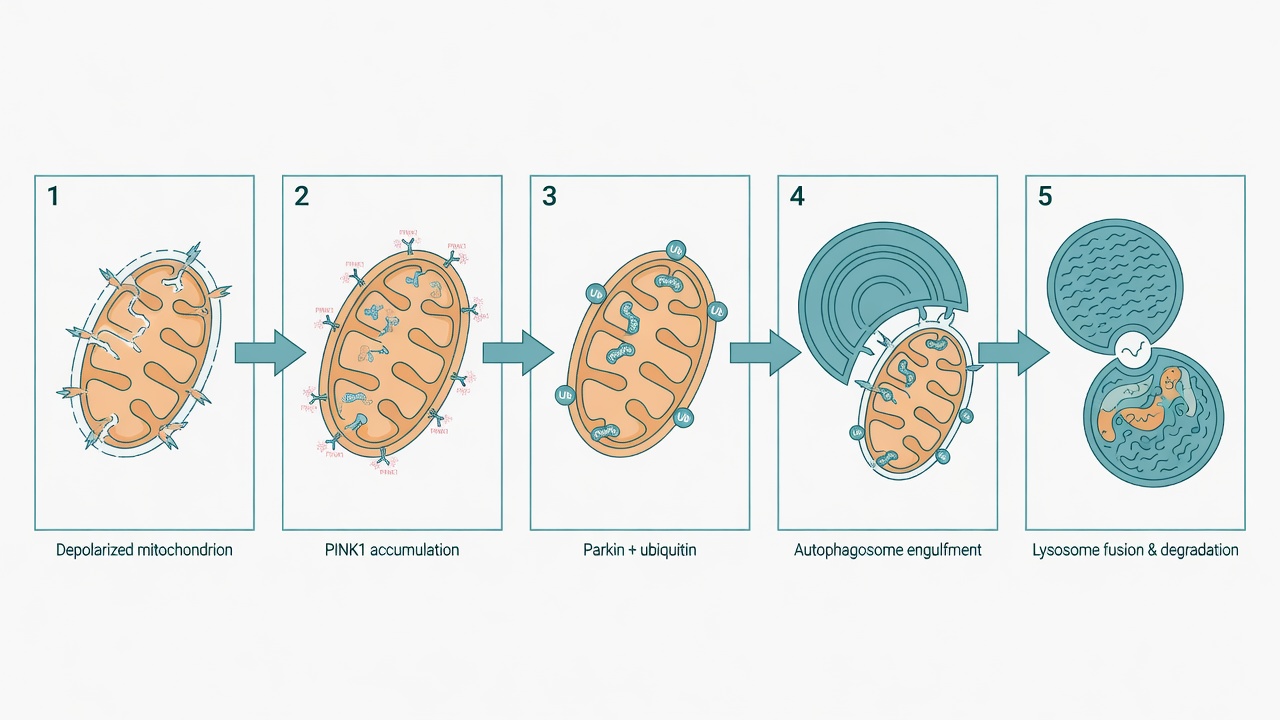 Figure 1: The mitophagy recycling truck — PINK1/Parkin tag, wrap, and ship damaged mitochondria off for breakdown.
The cost of not clearing: leaking a "bacterial signal"
A broken mitochondrion left in place is, to the cell, a hidden bomb. Mitochondria carry their own loop of DNA — mtDNA — a circular, roughly 16,500-base-pair genome that looks like a bacterial one, because mitochondria descend from bacteria once swallowed by an ancestral cell. When a damaged mitochondrion leaks mtDNA into the cytoplasm, immune sensors treat it like an invading pathogen. Li et al. (2026, Frontiers in Immunology) described a self-perpetuating loop: leaked mtDNA activates the AIM2 inflammasome, drives neuronal pyroptosis, and the resulting inflammation generates still more broken mitochondria. That is the price of "can't clear." One caveat: the Li et al. study used a traumatic brain injury model, and whether the same loop operates in ordinary aging still needs more data.
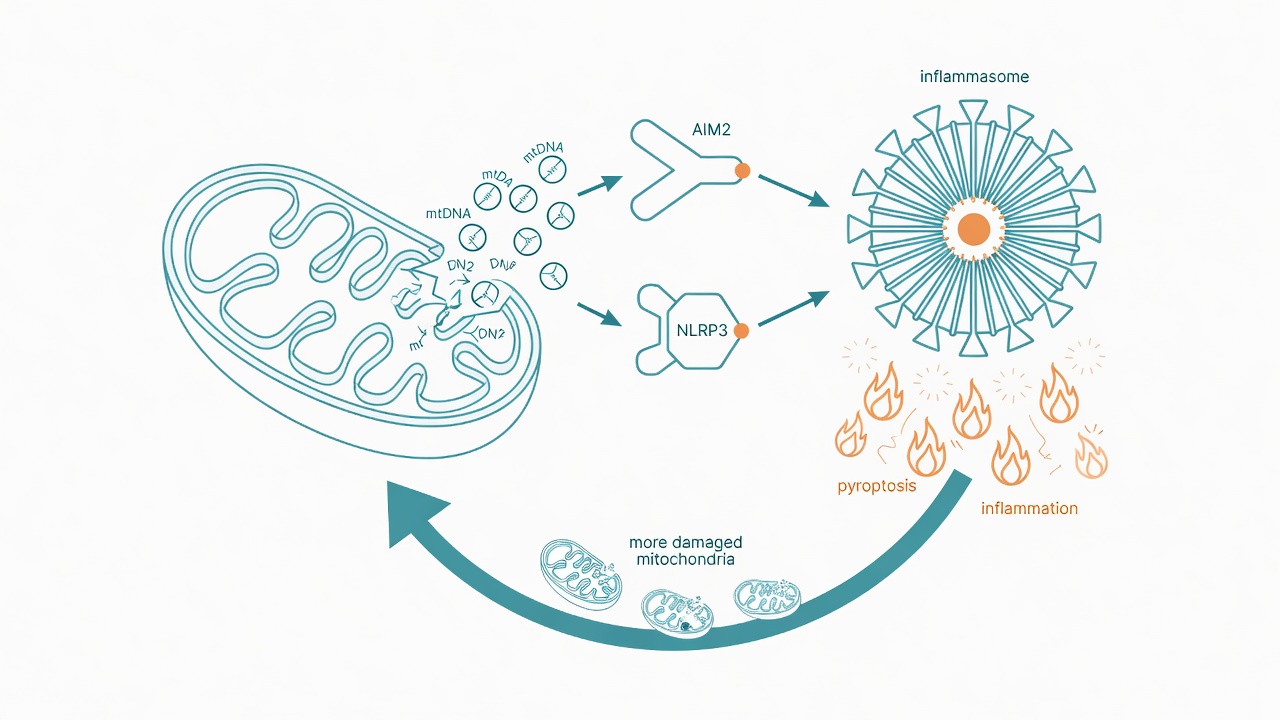 Figure 2: A broken mitochondrion leaks mtDNA, which is mistaken for a bacterial signal and ignites the inflammasome loop.
The same off-switch across two very different diseases
The idea that fixing the truck puts out the fire isn't confined to one disease. Beyond the arthritis model, Huo et al. (2026, Journal of Functional Foods) used APP/PS1 Alzheimer's mice to test a food–medicine formula and likewise saw induced mitophagy suppress the NLRP3 inflammasome and protect neurons. Two very different diseases, two independent studies, one shared pathway: clear the broken mitochondria and inflammation falls. That cross-model consistency is worth more than any single result. That said, mouse models and human aging are not the same thing — we should not equate "consistent in animals" with "proven in humans."
Mitochondria aren't the only thing with a dedicated truck
Cells are more precise about recycling than you might expect. Hoslett et al. (2026, Nature Cell Biology) found another form of selective autophagy — nucleophagy — that specifically removes PARP1 trapped on DNA, a protein that becomes toxic when stuck. Mitophagy clears power plants; nucleophagy clears toxic debris in the nucleus. Both belong to the same family of targeted disposal. The lesson: autophagy doesn't clean indiscriminately — there's a separate truck for each route.
Don't rush to crank autophagy to the maximum
It's tempting to jump to "then let's max out autophagy." This is where to tap the brakes. Too much autophagy causes its own problems — a cell can dismantle parts it still needs, and in some settings excessive autophagy promotes cell death rather than preventing it. The four studies above come mostly from cell and animal models, and the melatonin and food–medicine formula mentioned are not approved therapies for aging or inflammaging. A more grounded reading: failing mitophagy is one upstream node of inflammaging, which gives future interventions a clear target — but "boost recycling to age better" remains a research hypothesis, not a conclusion. Keeping up habits already known to gently induce autophagy, like exercise and regular sleep, beats chasing any single supplement.
FAQ
Q: Can more exercise and fasting speed up mitophagy and slow aging? Exercise and intermittent fasting do induce autophagy, but direct measurements of mitophagy efficiency in humans remain limited. Treating these habits as reasonable daily maintenance is fine; claiming they "guarantee anti-aging" goes beyond the current evidence.
Q: Can melatonin or supplements fix the recycling truck? The melatonin and food–medicine formula cited here are still at the animal-experiment stage, with insufficient human data on safety and side effects. Purchasing supplements to "boost autophagy" currently lacks clinical validation for either safety or efficacy.
Q: Is mitophagy failure the sole cause of aging? No. Aging is multifactorial — telomere attrition, epigenetic drift, stem-cell exhaustion, and other mechanisms all contribute. Failing mitophagy is one increasingly well-supported upstream node, but treating it as the only explanation is an oversimplification.
References
- Wang, B. et al. (2026). Melatonin alleviates rheumatoid arthritis via elimination of damaged mitochondria through the PINK1/Parkin pathway and NLRP3 inflammasome inhibition. Autophagy. doi: 10.1080/15548627.2026.2689419
- Li, T. et al. (2026). A self-perpetuating neuron-intrinsic GSDMD–mtDNA–AIM2 inflammasome axis drives neuronal pyroptosis and cognitive impairment after traumatic brain injury. Frontiers in Immunology. doi: 10.3389/fimmu.2026.1867920
- Huo, H. et al. (2026). Uncovering the neuroprotective mechanisms of the food–medicine homologous Zhengchan Formula in APP/PS1 mice: Mitophagy-mediated inhibition of NLRP3 inflammasome activation. Journal of Functional Foods. doi: 10.1016/j.jff.2026.107401
- Hoslett, G. et al. (2026). Nucleophagy removes cytotoxic trapped PARP1. Nature Cell Biology. doi: 10.1038/s41556-026-01961-5