The Repair Material You Need Most Is As Old As You
Fat-derived stem cells from elderly donors, after a short course of two old drugs, showed clearly lower senescence markers and recovered differentiation — meaning better repair material for the older patients who need cell therapy most.
Picture the cartilage in your knee wearing out. Your doctor offers to pull out your own stem cells, grow them, and put them back where it hurts. Sounds ideal. The catch: you are 70, and your stem cells have lived every one of those years. They are fewer in number, tired, and poor at repair. Yet the people who need this therapy most are exactly the elderly. That is the wall autologous cell therapy keeps hitting.
An Iranian team, writing in Scientific Reports in 2026, proposed something direct: instead of struggling with old cells, rejuvenate them first, then send them in.
Aging Is a Loop That Gets Stuck
Your cells run on two key switches. One saves energy, the other builds. When they fall out of balance, aging starts to snowball.
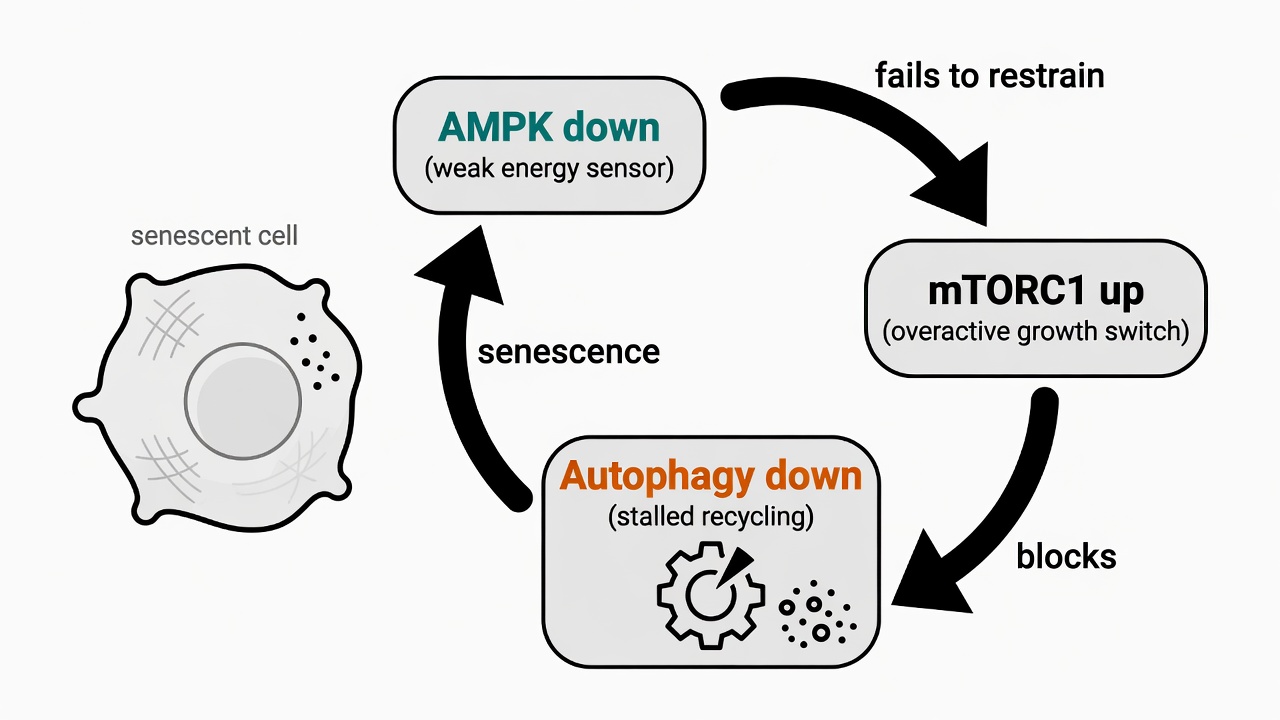
The energy sensor is AMPK. The builder is mTOR, which drives growth. In youth they take turns. With age, AMPK grows sluggish while mTOR stays jammed on. The fallout is nasty: the cell's own recycling system, autophagy, grinds to a halt. Garbage piles up, the cell gets dirtier, and eventually it quits and turns senescent.
It is a vicious loop. Think of a kitchen where the dishwasher breaks — dirty plates stack higher and higher until the whole counter is unusable.
The team wanted to break that loop. They chose two off-the-shelf drugs: rapamycin, a familiar face in longevity research, and nicotinamide, a form of vitamin B3 and a precursor of NAD+. The doses were 10 nM and 5 mM, added straight to the culture medium of aged stem cells.
Two Roads, One Brake
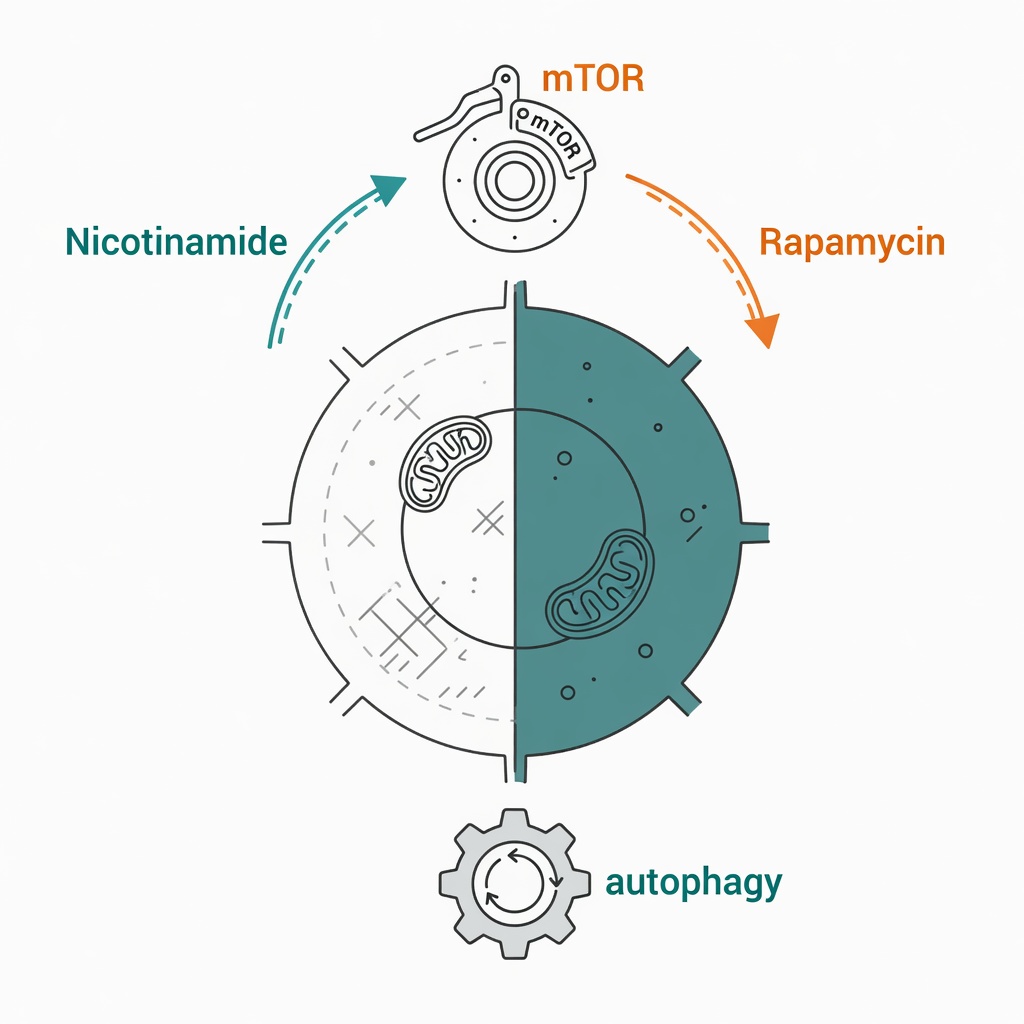
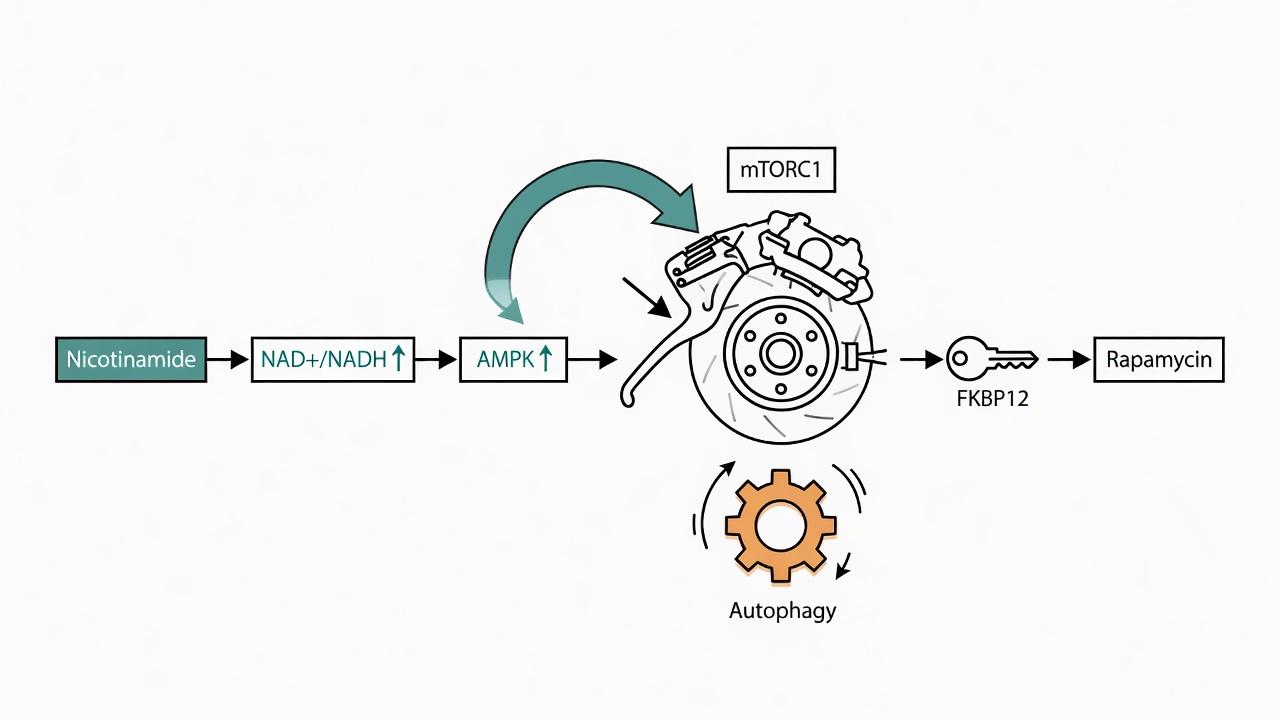
Nicotinamide and rapamycin travel different roads yet press the same brake: they push overheated mTOR down and let autophagy start up again.
Nicotinamide first raises the NAD+ to NADH ratio inside the cell, waking that sluggish AMPK; the roused AMPK then reins in mTOR. Rapamycin is more direct — it slots like a key into mTOR's lock and stops it turning. One rouses the energy sensor upstream, the other seals the growth switch downstream. Two roads, one destination.
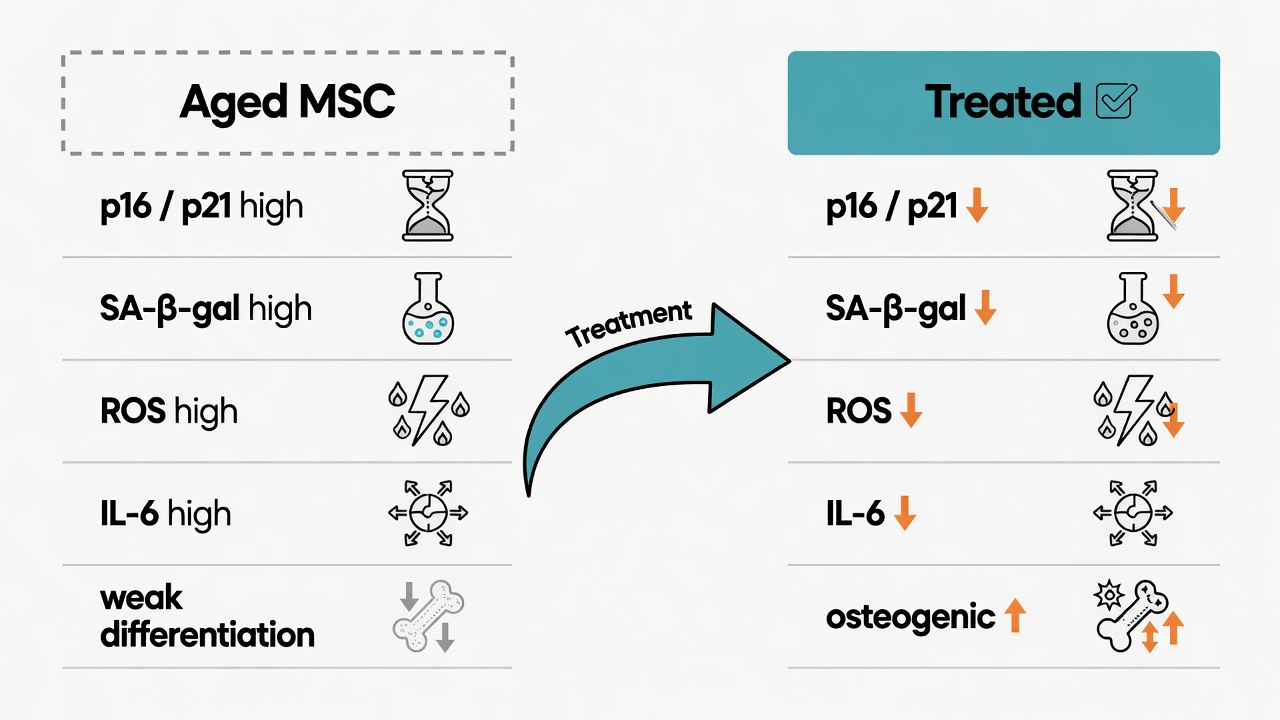
Did it work? The team took fat stem cells from 7 healthy elderly donors (55 to 70 years old) and treated them for a single passage, about 6 to 8 days. In that short window the old cells shifted: division capacity climbed, the senescence-brake proteins p16 and p21 dropped, the β-galactosidase stain typical of senescent cells faded, reactive oxygen species fell, and bone-forming differentiation improved. Even the inflammatory cytokines that senescent cells love to secrete, IL-1β and IL-6, came down. Your cells, in effect, got a garbage cleanout.
Still, let's be clear. These are cells in a dish, not a living person. There were only 7 donors, all women, all lean, none with metabolic disease — a narrow sample. Treatment lasted just a week, and no one knows whether the gains rebound over time. The authors themselves stress these are preliminary in vitro findings that need further preclinical work. The reversal is partial, too, not a turn back into infancy.
What We Can Say, and What We Can't
What science can tell you now: in a dish, a short course of two old drugs makes aged stem cells noticeably better. Whether it carries over to the human body is still undecided.
The real value here is not an "anti-aging miracle drug" but a practical direction. If elderly patients ever receive autologous cell therapy, perhaps the cells drawn from them could be conditioned for a week first, then reinfused, so the treatment is no longer dragged down by age. This optimizes stem cells as raw material, rather than telling you to swallow a pill.
So might you be tempted to take a rapamycin tablet with a fistful of vitamin B3 to fight aging? Hold on. These doses were added to a culture dish as pretreatment, which is nothing like swallowing them. Cells rejuvenating in a dish are several unverified steps away from your body doing the same.
Aging may have no one-tap undo button. But this study is a useful reminder: the loop that ages your cells is not fully locked.
References
- Khorraminejad-Shirazi et al. (2026). Rapamycin and nicotinamide treatment attenuates senescence-associated features in mesenchymal stromal cells isolated from elderly donors by modulating autophagy. Scientific Reports. doi: 10.1038/s41598-026-58275-7
Frequently Asked Questions
So if I take rapamycin with vitamin B3, can I fight aging and rejuvenate my stem cells?
No — this is the most common misreading. The doses were a pretreatment added to a culture dish, not something swallowed. The 10 nM rapamycin and 5 mM nicotinamide acted on aged stem cells in a dish, which is nothing like the whole-body concentration and metabolism after you take them orally. Cells rejuvenating in a dish are several unverified steps away from your body doing the same. Rapamycin itself is a prescription immunosuppressant, and self-medicating carries real risk; it is not a supplement.
Does this count as "reversing aging"?
Only as a partial reduction, and only at the cellular level. After treatment, aged stem cells showed lower senescence markers such as p16 and p21, reduced IL-1β and IL-6, and improved differentiation — but this did not turn old cells back into young ones, and it was not tested in live animals or people. The study had only 7 donors, all healthy women aged 55 to 70, treated for just 6 to 8 days, so long-term durability is unknown.
What is the real significance of this study?
It points to a practical direction: optimizing the "raw material" of autologous cell therapy. Elderly patients most need their own stem cells to repair tissue, yet those cells are old and scarce. If, in the future, cells drawn from a patient could be conditioned for a week before reinfusion, the therapy might no longer be held back by age. The point is to improve stem cells as material, not to tell you to take drugs.
Found this useful?
Follow for new AI × biomedical research notes:
Or buy me a coffee to keep new content coming.
☕ Buy Me a Coffee