Against the hardest breast cancer, a desert shrub hits two brakes at once
If you have heard that breast cancer can be treated by "reading its hormone receptors" or "hitting HER2 with a targeted drug," then triple-negative breast cancer (TNBC) is the opponent that has stripped those options away. It carries no estrogen receptor, no progesterone receptor, and no HER2 amplification, so hormonal therapy does nothing for it, leaving only chemotherapy and radiation with their heavy side effects. Fresh leads matter here.
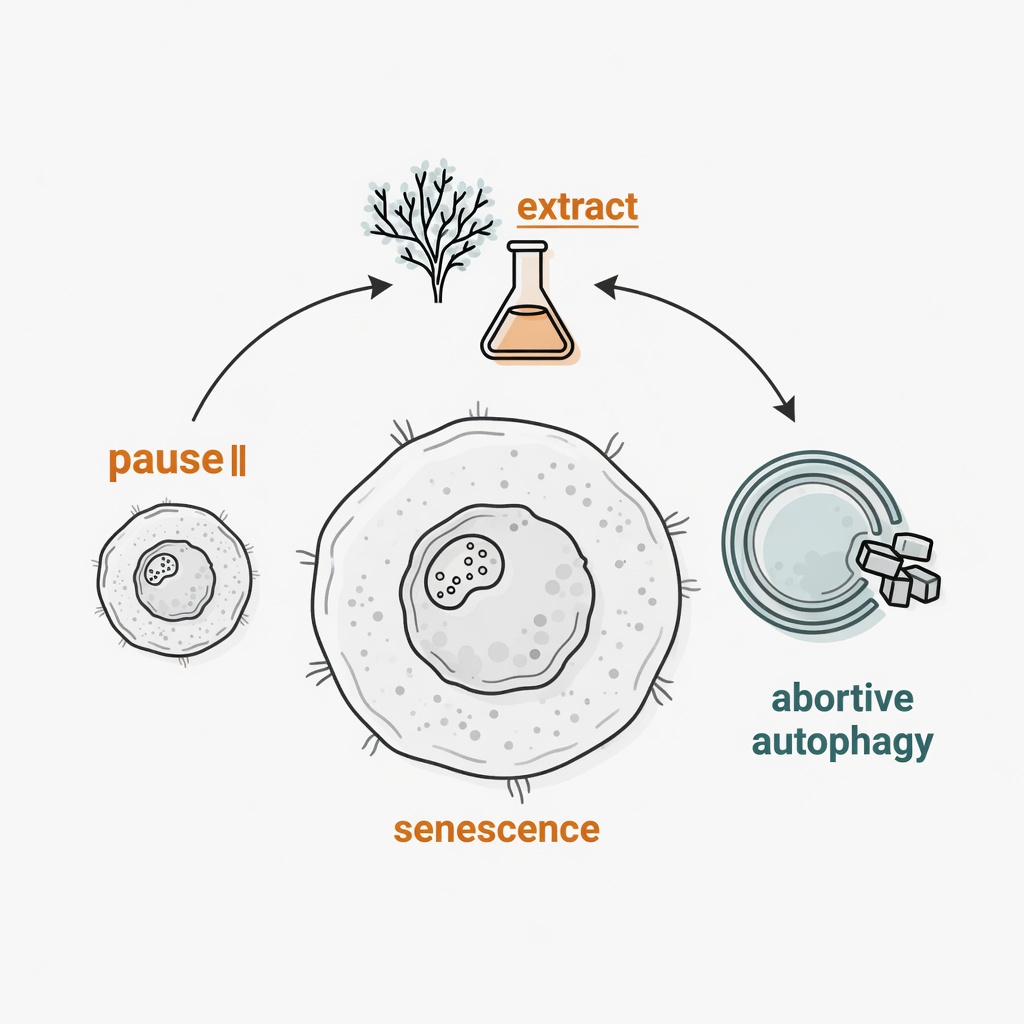
A 2026 study in Scientific Reports turned to a desert plant called Acridocarpus orientalis, long used in local folk medicine for a range of complaints. The researchers added its ethanolic extract (AOEE) to breast cancer cells and asked which brakes inside the cell actually move. The answer is not a single clean kill. The extract presses two brakes at once: one forces the cell into premature old age so it stops dividing; the other jams its recycling so the cleanup run never finishes.
Old and jammed: one brake stops division, the other clogs recycling
AOEE does not wipe the cancer cell out in one stroke. It forces early retirement and a jammed recycling line at the same time.
Start with old. The team applied AOEE to three breast cancer lines: two triple-negative (MDA-MB-231 and Hs578T) and one luminal A (MCF-7). The higher the concentration and the longer the exposure, the more cell growth was suppressed. Just before DNA synthesis sits a checkpoint called G1/S, and AOEE parks the cell there: p21 and p27 go up, while Cyclin D1, PCNA, and phospho-Rb all come down. In the triple-negative MDA-MB-231 cells, the extract also triggered p16-dependent senescence, a near-irreversible permanent pause confirmed by the classic stain SA-β-gal. The cells were not killed on the spot; they were pushed into premature old age, unable to grow back.
Now for jammed. Your cells run autophagy to clear worn-out parts and reuse the pieces. AOEE switched on LC3-II and Beclin-1, so recycling looked open for business. Yet p62, instead of falling, piled up. p62 normally dwindles as recycling finishes; its accumulation means the run stalls halfway. The study calls this "open but never finished" state abortive autophagy. Cancer cells often lean on autophagy in a crisis, and jamming it closes one exit.
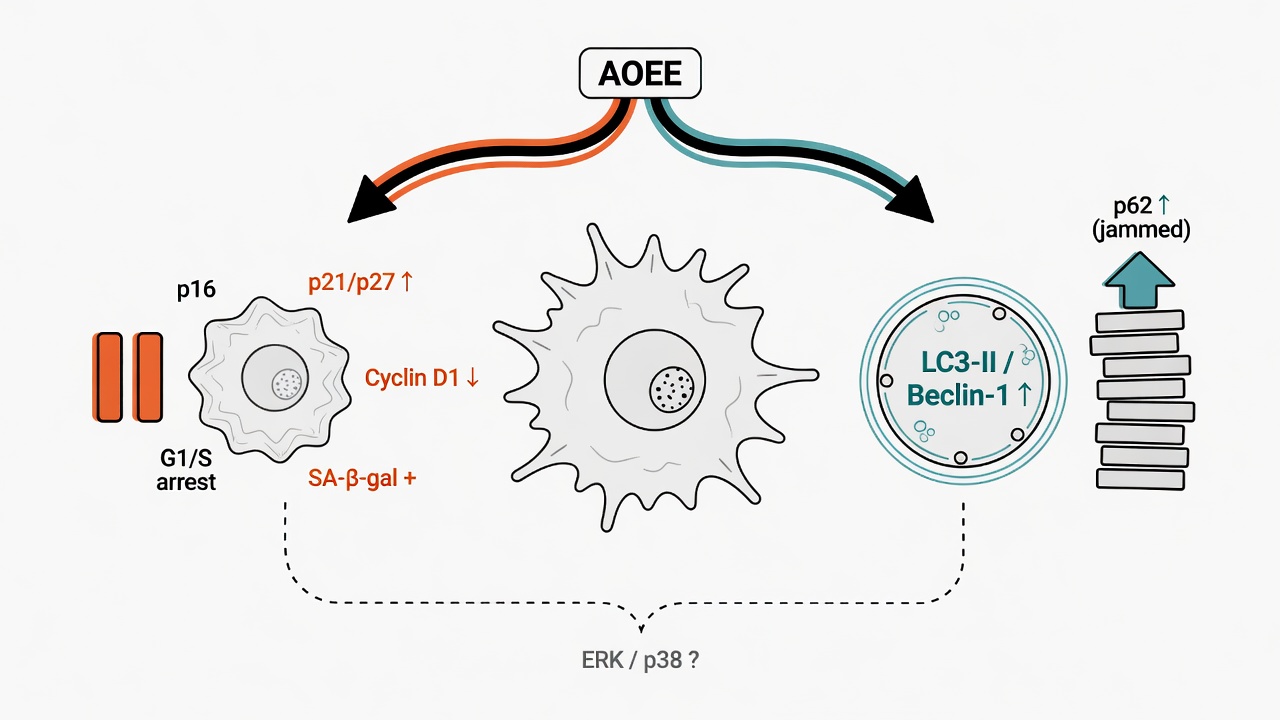 Figure 1. Dual-brake mechanism: the desert-plant extract (AOEE) drives breast cancer cells into p16-dependent senescence (p21/p27 up, Cyclin D1/PCNA down, G1/S arrest, SA-β-gal positive) while making autophagy start but stall (LC3-II/Beclin-1 up, yet p62 accumulates); the ERK and p38 pathways may be involved.
An interesting lead, but several steps short of a cancer drug
The study tells a clean mechanistic story, but do not read it as "a new cancer drug found." The distance in between is longer than you think.
All of this happened in cultured cell lines, with no animals and certainly no people. Working on a dish is not the same as working in a living body. The material is also an ethanolic extract, a crude brew of hundreds of molecules rather than a single purified compound, so which molecule is doing the work, and whether they interfere with one another, is not yet taken apart. The mechanism has question marks too: the study says the ERK and p38 pathways might be involved, but it only saw those pathways activated. It did not block them one by one to see whether the effect vanished. That keeps the claim at correlation, not proven cause.
Both senescence and jammed autophagy cut both ways. Cells forced into old age stop dividing, but they can secrete a load of inflammatory factors (a program called SASP) that, over time, may worsen the surrounding environment. Blocking autophagy can starve a cancer cell in some settings and spare it in others. Follow-up work still has to untangle both edges; it is far too early to conclude.
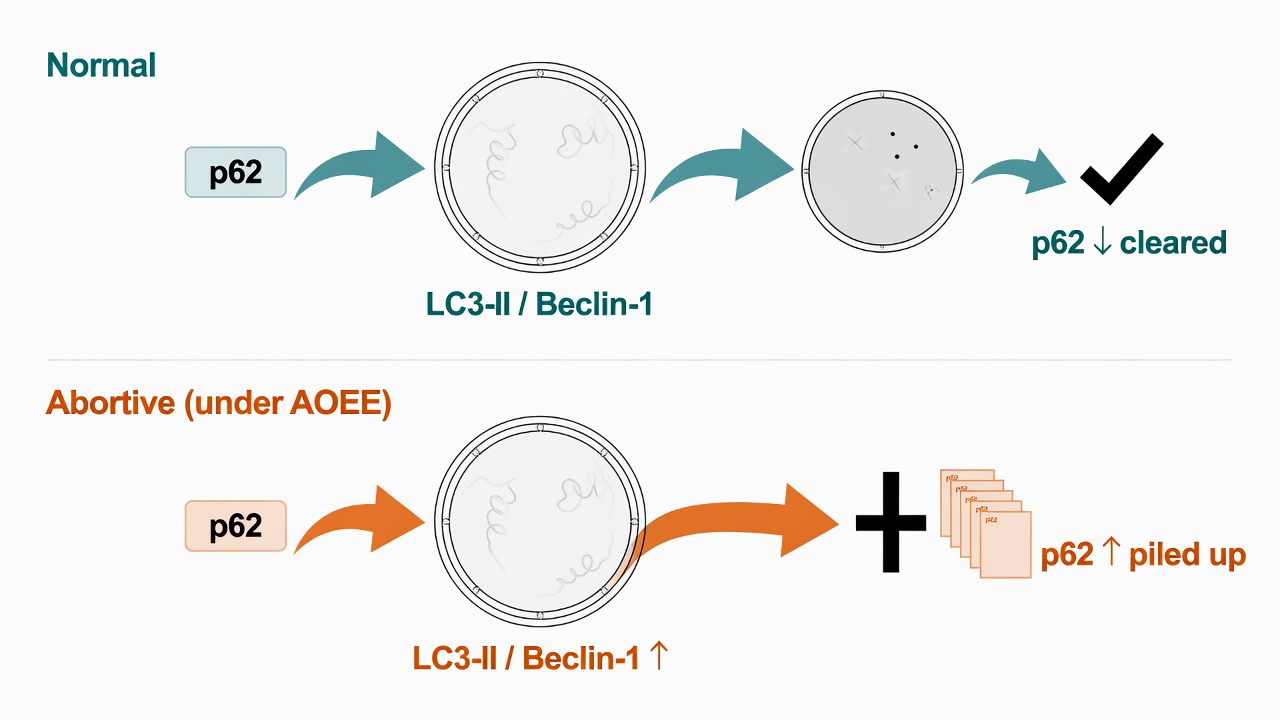 Figure 2. Normal vs abortive autophagy: normally the autophagosome completes degradation and the cargo p62 is cleared, so p62 falls; under AOEE the autophagosome still forms (LC3-II/Beclin-1 up), but degradation stalls and p62 accumulates, so the recycling run never finishes.
What it means for you: don't put the desert shrub on your plate
What this paper offers is a lab lead worth chasing, not a recipe you can eat.
For drug developers, "triggering senescence and jamming autophagy at once" is an uncommon double mechanism worth validating. Isolating the active ingredient and moving it into animal models is the road ahead. For the rest of us, the practical line is simple: do not read "a desert-plant extract suppresses cancer cells on a dish" as "this thing fights cancer, so I can eat it." Dose, safety, and human metabolism are questions this paper does not answer, and sourcing the plant to eat on your own has neither its backing nor a known safety margin.
The parts still in your hands against breast cancer are ordinary ones. Keep up the screening you are due for, know your family history, tend to your weight and exercise, and see a doctor early if something feels off. None of that makes headlines, but it is the part that lowers your risk today. The drug is still far up the road; this stretch is the one you can walk now.
References
- Altabbal et al. (2026). Acridocarpus orientalis ethanolic extract induces senescence and abortive autophagy in human breast cancer cells. Scientific Reports. doi: 10.1038/s41598-026-58859-3