Disease trials measure illness; aging runs on a parallel track
Most clinical trials ask a single question: did the disease improve?
Many age-related conditions share biological machinery with how bodies age. Whether a therapy built for pulmonary fibrosis might also shift biological age is a question standard trial protocols rarely track.
Zhavoronkov and colleagues nested six proteomic aging clocks inside a 12-week phase 2a study of rentosertib, a candidate anti-fibrotic, so the same serum samples could speak to disease and aging at once. Their 2026 Nature Biotechnology paper does not crown human rejuvenation. Instead, it demonstrates that disease-focused trials can carry geroprotective readouts.
One wristwatch can lie. Six watches moving together are far harder to dismiss.
Proteomic clocks read the crew on site
Epigenetic clocks score DNA methylation, like notes on a construction blueprint: informative, but one step removed from what the crew is doing. Proteomic clocks measure circulating proteins, closer to an active roster of workers: who is remodeling matrix, who is restocking metabolic parts, captured in real time.
The team compared six recent models: ProtAge, OrganAge (chronological and mortality-trained), PAC, ipfP3GPT, and PAOPAC. Some predict calendar age, others mortality risk; some use classical machine learning, others deep learning. Distinct feature sets and objectives mean six supervisors holding different clipboards.
Data came from the idiopathic pulmonary fibrosis (IPF) trial NCT05938920: randomized, double-blind, placebo-controlled, with longitudinal Olink Explore 3072 serum profiles. N=42 participants with complete timepoints entered this ancillary analysis (mean age 67.1, predominantly Asian). At baseline, four chronological clocks tracked actual age (Spearman r ∈ 0.70–0.84); two mortality clocks correlated weakly with calendar age (r ∈ 0.16–0.23), as expected when models price disease burden over birthdays.
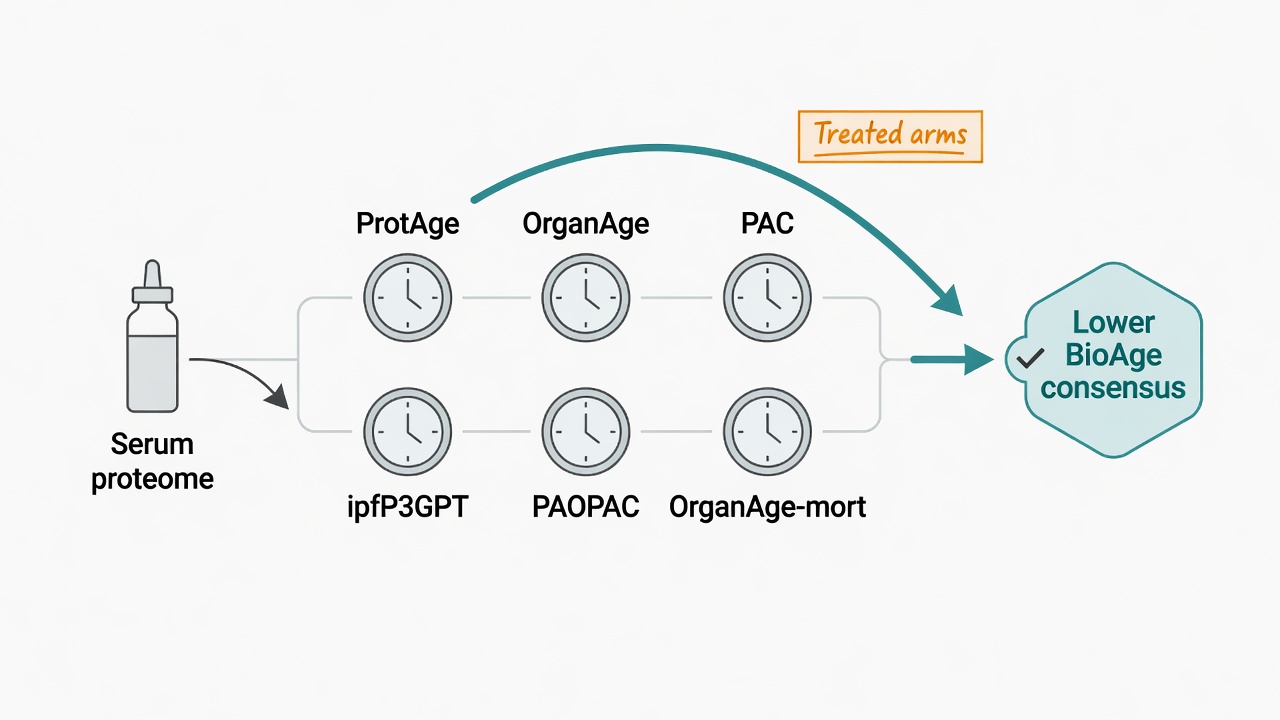
Across methodologically different clocks, treated arms showed lower predicted biological age relative to placebo. Concordance raises the bar against single-model quirks.
Week-4 signal, dissociation, and senescence marks
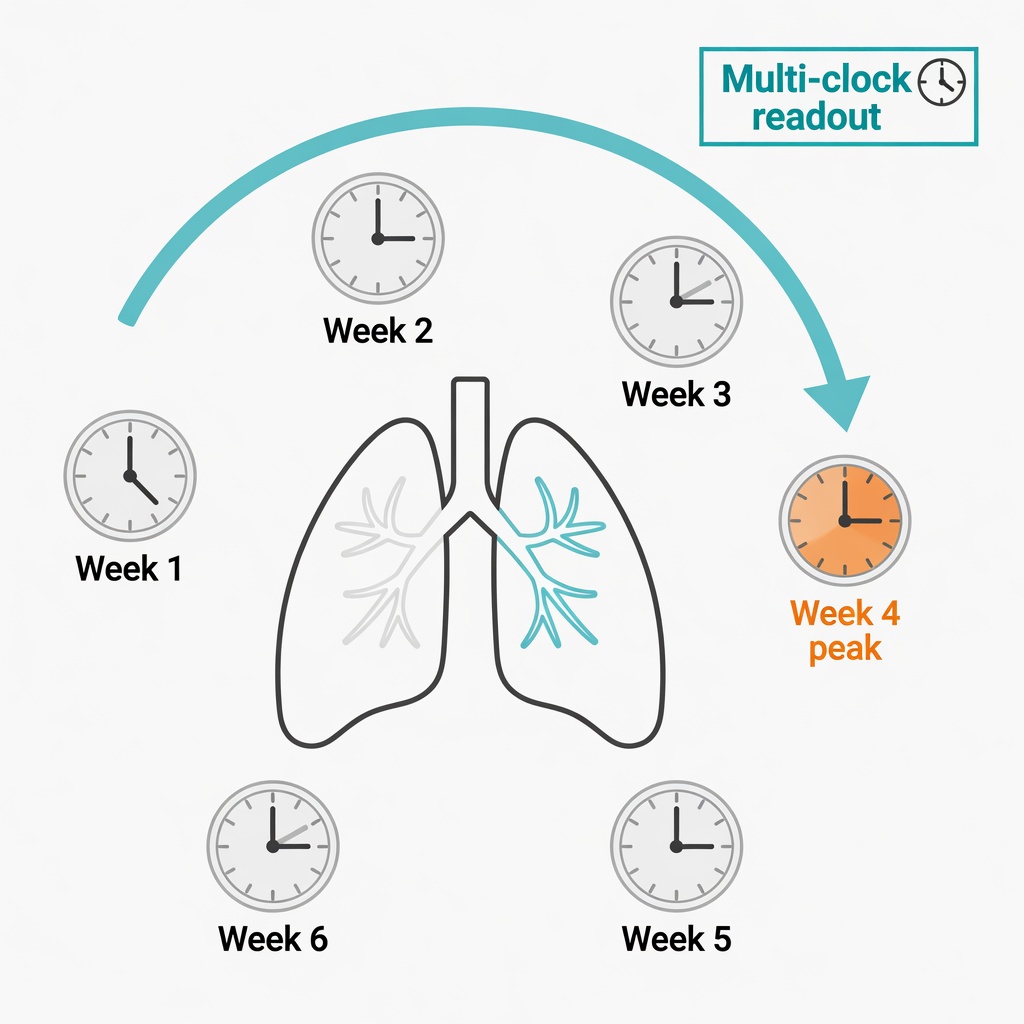
Change from baseline in predicted age (ΔBioAge) was compared with placebo across six clocks × three visits × three regimens (54 tests). 21 reached Q<0.10, clustering most densely at week 4. At that visit, 60 mg once daily (QD) shifted four chronological clocks by −2.71 to −3.46 years; 30 mg twice daily (BID) produced the broadest agreement across chronological and mortality clocks. By week 12, statistically significant hits thinned; the authors favor a “plateau” reading over a clean rebound.
Linear mixed models found 326 proteins with treatment-altered trajectories versus 2 on placebo. Fibrosis and matrix proteins such as COL1A1, MMP10, and FAP fell; metabolic and stress-resistance proteins including NAMPT (rate-limiting for NAD+ biosynthesis), SOD2, and ALDH1A1 rose.
Clocks alone cannot split aging biology from anti-fibrotic cleanup. A critical check: if clock shifts were only disease shadows, the regimen with the largest forced vital capacity (FVC) gain should dominate aging signals. It did not. While 60 mg QD led FVC improvement in the parent report, cross-clock consistency favored 30 mg BID. ΔFVC explained little of ΔBioAge (median R²=0.06). Against age-associated protein directions in 55,319 UK Biobank adults, 30 mg BID correlated negatively (r=−0.30), as if opposing typical aging slopes; 60 mg QD did not show the same link.
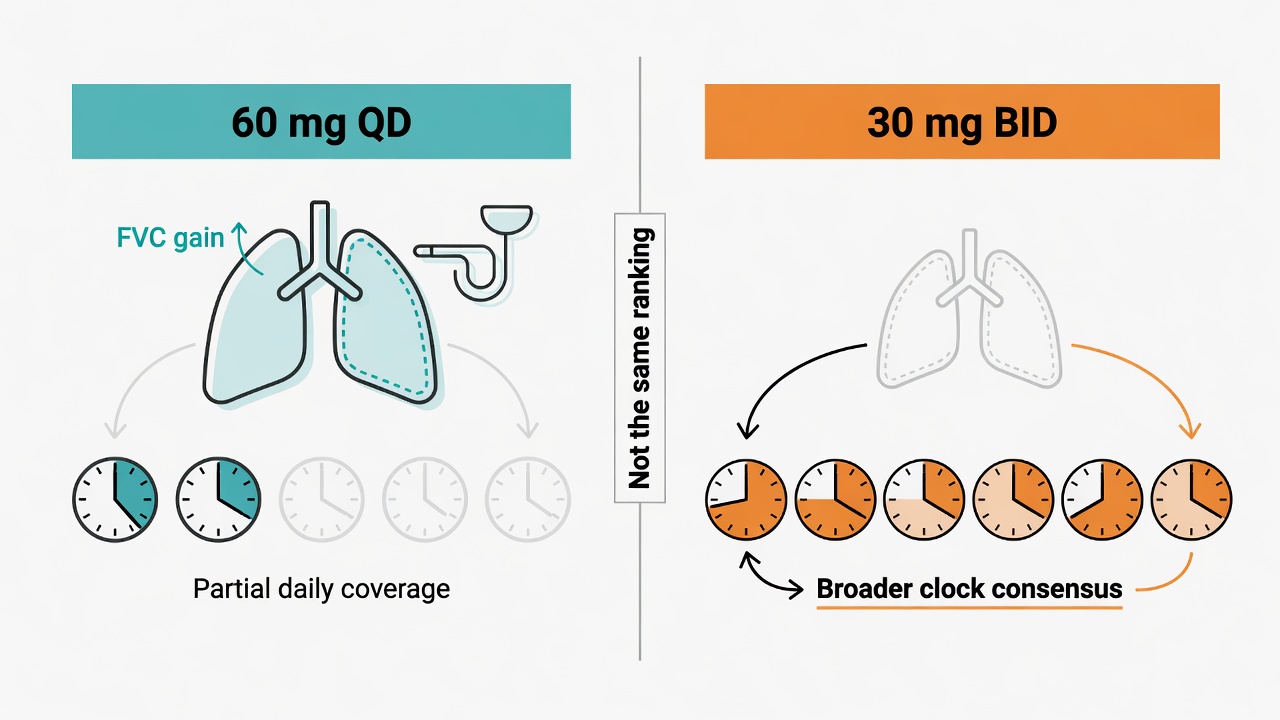
Respiratory gains and clock reductions can part company by dose, like the shift that best tunes the engine not lighting every “whole-car age” gauge. That pattern supports a component beyond fibrosis relief, though still indirectly.
GSEA on senescence gene sets moved in the same direction: SenMayo rose on placebo and reversed on treatment, while CellAge-down features rose; EREG, IGFBP4, MMP10, and others recurred on leading edges. The authors describe this as a circulating senomorphic hint, aligned with prior in vitro work. It is not a direct tissue census of senescent cells.
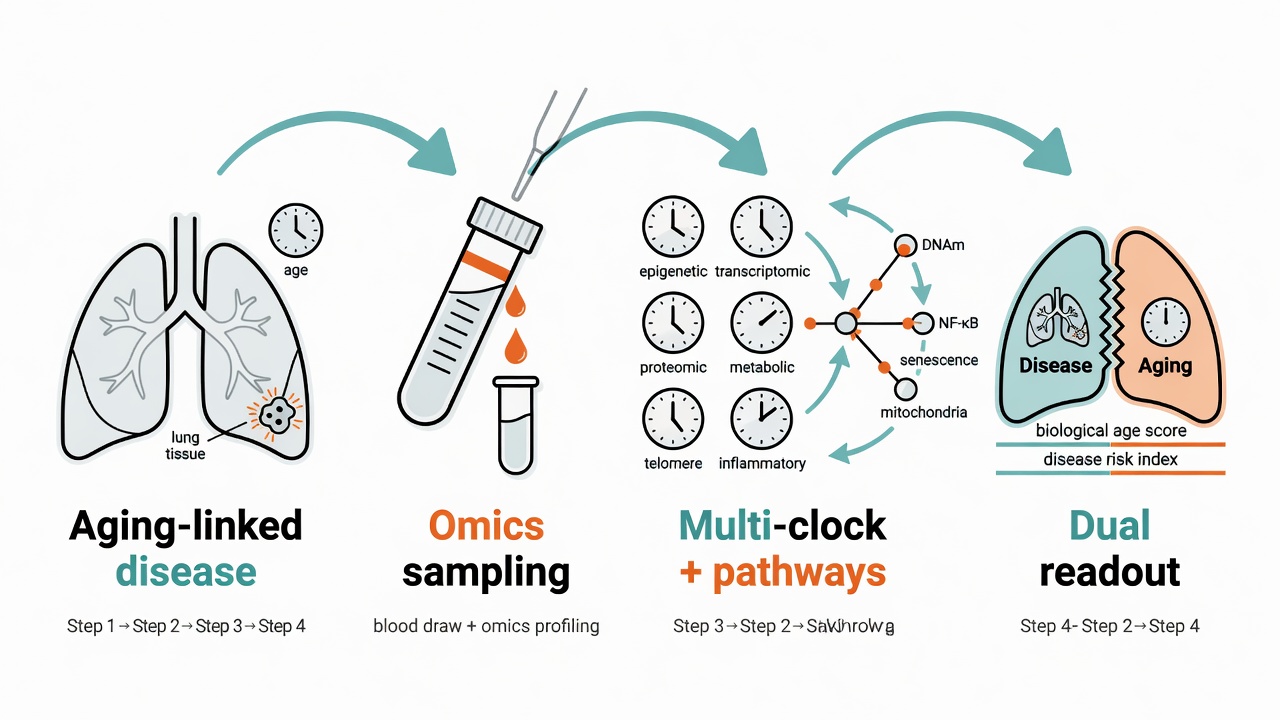
The design idea is plain: pick an aging-linked indication, collect omics, and read disease and aging with multi-clock and pathway tools. In practice, this remains exploratory ancillary analysis.
Boundaries of dual-purpose trials
One takeaway worth keeping: disease trials can ask an aging question, and proteomic clocks can show a concordant direction within 12 weeks.
Claims not supported by the evidence: that rentosertib is proven to rejuvenate humans by several years, or that six clocks are ready for personalized clinical prescribing. Each arm contributed roughly 9–11 analyzed participants; the cohort is IPF-only and short; the Olink panel omits TNIK itself; and GSEA thresholds and protein coverage constrain interpretation. Several authors are affiliated with Insilico Medicine, which develops the drug. Conflicts belong on the table, not in a drawer.
Separating disease resolution from systemic rejuvenation will require non-IPF populations, healthier older adults, and orthogonal tissue-level evidence. Multi-clock agreement filters single-model noise, but it is not a final court.
Next time a headline promises an “anti-aging clinical endpoint,” look beyond the claim: are the dials moving in unison, or is a single clock simply tracking the shadow of disease?
Frequently Asked Questions
How do proteomic aging clocks differ from DNA methylation clocks?
Methylation clocks read regulatory “annotations” on DNA; proteomic clocks read circulating proteins closer to immediate effectors and pathway stories. This paper cross-checks six proteomic models. It does not retire epigenetic clocks and does not run a head-to-head on the same samples.
Could the biological-age drop just be fibrosis getting better?
Clocks alone cannot split the two. The authors note the best FVC regimen was not the broadest aging-clock consensus, median R² of ΔFVC explaining ΔBioAge was about 0.06, and 30 mg BID more clearly opposed UK Biobank aging directions. That is dissociation evidence, still indirect; an IPF-only cohort cannot settle it.
Does this prove an anti-aging drug already works?
No. It is an exploratory ancillary analysis (N≈42, 12 weeks, IPF only, ~9–11 per arm) with industry affiliations disclosed. The claim worth keeping is methodological: disease trials can embed aging endpoints. It is not personal medical advice.
Found this useful?
Follow for new AI × biomedical research notes:
Or buy me a coffee to keep new content coming.
☕ Buy Me a Coffee