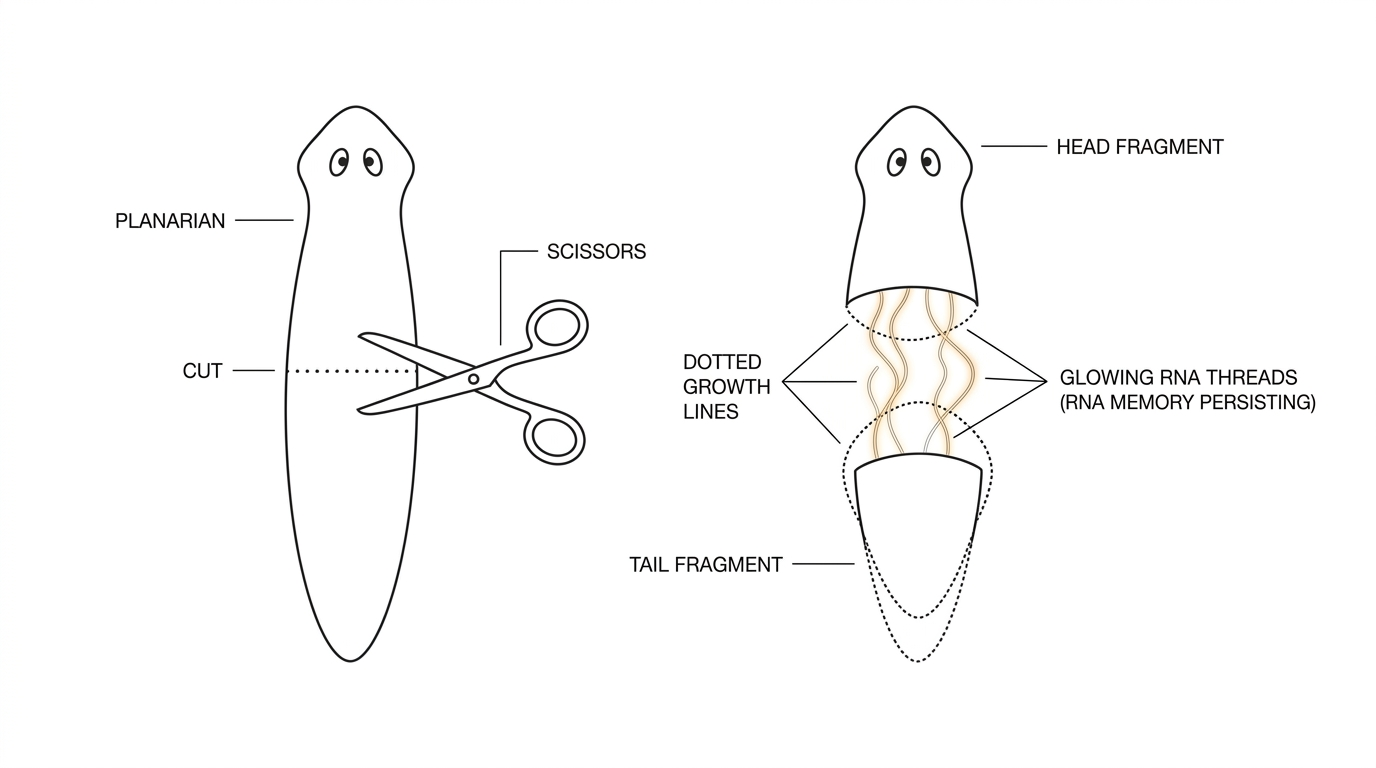
Cut a planarian flatworm in half.
Both halves grow back into complete animals. The head end sprouts a new tail; the tail end grows a new head. You've probably seen this in a textbook, filed under "boring regeneration facts."
But here's where things get genuinely strange.
Feed that planarian a stretch of double-stranded RNA — dsRNA — targeting a specific gene. The gene goes silent. Eyes disappear. Extra heads sprout. Whatever the silencing effect is, it takes hold visibly, dramatically. Then cut the worm in half. Wait for it to regenerate. Cut it again. Regenerate again. Do this over a dozen rounds.
The silencing is still there.
No brain. No neurons carrying the information. No original tissue left — each round of regeneration grows brand-new cells from scratch. And yet whatever was encoded by that eaten RNA signal somehow survives every rebuilding of the body.
This is the finding from a March 2026 preprint posted to bioRxiv, out of the Rechavi Lab at the Weizmann Institute of Science, in collaboration with the Rink and Wurtzel labs. And it forces a genuinely uncomfortable question: what exactly counts as biological memory?
It Started With a Scientist Who Got Bombed
In 1973, psychologist James V. McConnell made an extraordinary claim: he had ground up trained planarians and fed them to untrained ones — and the untrained worms learned faster. His conclusion was blunt. Memory, he said, could be transferred through RNA.
The scientific community laughed. The results couldn't be replicated. The mechanism was nonsense. The entire line of inquiry collapsed.
Then, in 1985, McConnell received a package bomb at his home, sent by Ted Kaczynski — the Unabomber. His assistant was injured. McConnell spent the rest of his life dealing with the aftermath. The violence didn't just end a career; it poisoned the atmosphere around the whole field.
Fifty years later, Rechavi's team walked back into the same question — this time with modern molecular tools, sequencing technology, and the kind of mechanistic rigour that McConnell never had access to.
Two-Phase Memory: RAM and SSD
Here's the problem with RNA-based memory on paper: every time a cell divides, RNA gets diluted. Messenger RNA (mRNA) has a half-life of hours to days. By all standard logic, any RNA signal should get washed out across regeneration cycles. There's nothing to hold it.
But the planarian RNA memory wasn't getting washed out. So the researchers asked why.
What they found is a two-phase system — and it maps surprisingly well onto how we think about memory in the brain.
Phase One: Systemic broadcast. After the worm ingests dsRNA, it triggers a body-wide RNA interference (RNAi) response. The silencing signal spreads everywhere, fast. But this phase is temporary. It depends on the original dsRNA molecules still being present and circulating.
Phase Two: Cell-autonomous maintenance. Days later, the broadcast fades — but something else takes over. Inside individual cells, antisense small RNA molecules begin suppressing the target gene's mRNA directly. No external signal required. Each cell is now maintaining the silenced state on its own.
Think of Phase One as RAM: fast, volatile, gone when you restart. Phase Two is the write to an SSD — it survives the reboot.
Planarian regeneration is, effectively, a reboot. New cells, new tissue, new body. But the template information carried by those antisense small RNAs gets copied during stem cell division and passed along through every round of rebuilding.
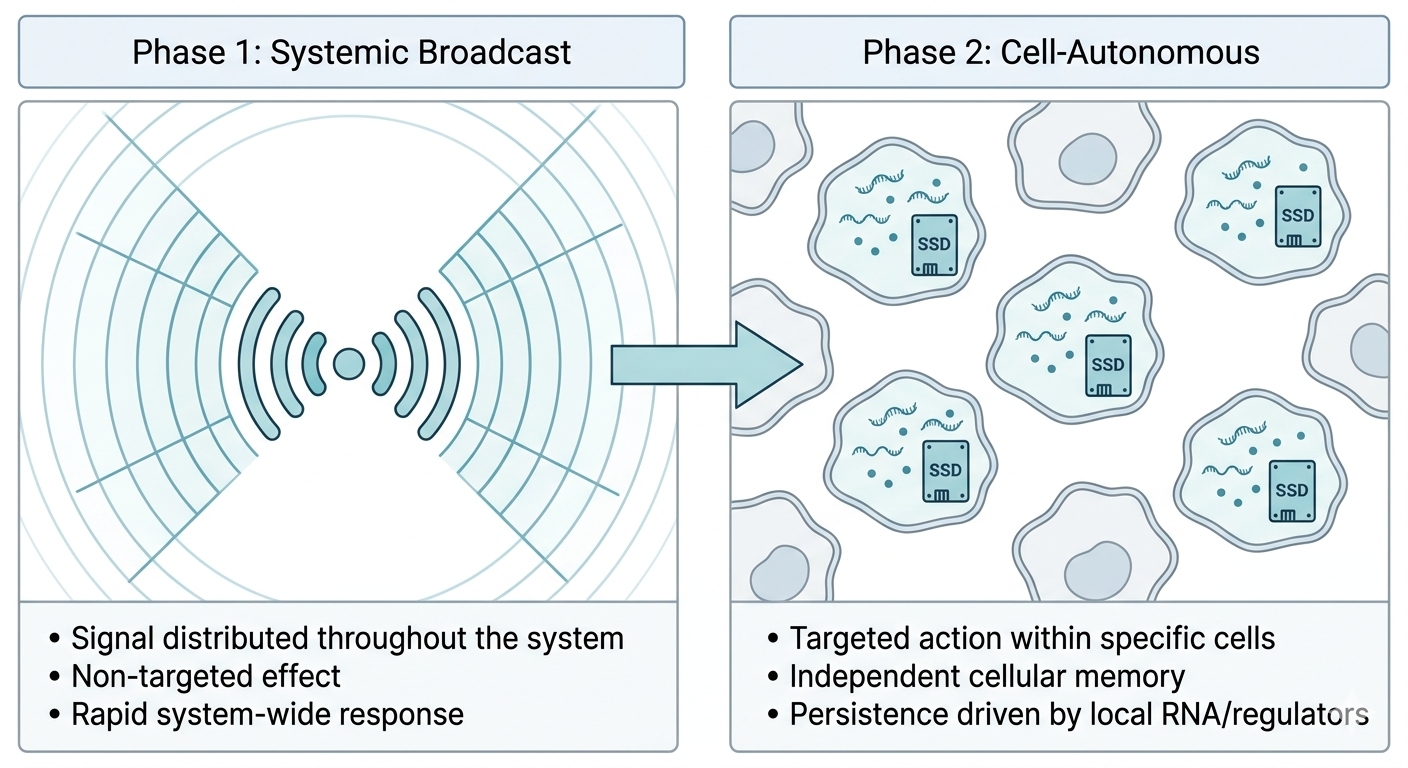 Figure 1: The two-phase RNA memory mechanism. Left: systemic dsRNA broadcast phase (RAM). Right: cell-autonomous maintenance via antisense small RNA (SSD), persisting across regeneration cycles.
No Known Amplification Tool — and It Still Works
In the nematode C. elegans, transgenerational RNA inheritance depends on RNA-dependent RNA polymerase — RdRP — a protein that continuously amplifies small RNAs to prevent dilution across generations.
Planarians don't have RdRP.
That single fact is what makes this paper genuinely shocking. There is no known molecular mechanism in planarians that should be able to keep a small RNA signal stable for months across repeated regenerations. And yet it happens.
The researchers also found something unusual in the planarian small RNAs themselves: untemplated polyA tails — additions to the RNA molecules that aren't encoded in the genome. In the known small RNA world, this is a rare variant. It may be part of how these molecules resist degradation and maintain their silencing activity even without an amplification system.
And there's one more piece. The silencing state can be transplanted. When researchers grafted tissue from RNAi-treated worms into untreated animals, the silencing transferred along with the cells. That's a direct experimental echo of McConnell's claim — that memory could be transferred between worms — except now there's a mechanism, reproducible data, and a rational explanation sitting behind it.
The rehabilitation of a fifty-year-old scientific heresy, done quietly, in a preprint.
What If RNA Silence Could Be Made Permanent?
Planarians and humans share very little evolutionary history. This mechanism isn't about to be directly applied to medicine tomorrow.
But the implications extend well beyond "flatworms are weird."
RNAi therapeutics are already in clinical use. Inclisiran, for example, is an approved drug for high cholesterol that works by using siRNA to suppress a gene in liver cells. Patients need two injections per year — because the silencing effect gradually fades as cells turn over and the siRNA molecules get metabolised away.
Now imagine a version of that therapy that behaves more like a planarian.
Phase One: the drug delivers the silencing signal systemically. Phase Two: the cell-autonomous maintenance kicks in, encodes the silenced state into the cell's own molecular machinery, and passes it along every time the cell divides. One injection. The gene stays silenced.
For patients with rare genetic diseases. For conditions where repeated dosing is medically difficult, financially prohibitive, or simply not possible in resource-limited settings. The planarian isn't just a curiosity — it's a proof of concept. Evolution has already found this path. Life has already solved this problem, in a small flatworm with no brain, using a mechanism we're only now beginning to describe.
Do you think a "permanent" version of RNAi therapy is achievable within our lifetimes? The comment section is below.
DNA Is a Blueprint. RNA Is Something Else Entirely.
For decades, the standard model was simple: DNA encodes the genome; RNA is the messenger; proteins do the work. Heredity flows in one direction, through DNA, and experience doesn't get written into it.
That model has been fraying at the edges for years. Epigenetics, chromatin remodelling, transgenerational stress responses — all of these suggested that cells carry information beyond what's in the sequence of bases.
The planarian study pushes the edge further.
DNA tells a cell what it is. RNA, in this system, can tell a cell what its predecessors encountered — and ensure that the response persists, copied faithfully through regeneration cycles, without a single nucleotide of the genome changing.
The genome is a blueprint. RNA, in this framing, is an oral tradition — a molecular lineage passed between cells, encoding lived experience in a form that survives even when the body itself is rebuilt from scratch.
And that oral tradition, it turns out, is considerably more durable than we assumed.
Further Reading
- Original preprint: Cherian P., Aviram I. et al., "Trans-regenerational RNAi Memory in Planarians," bioRxiv, DOI: 10.64898/2026.03.11.711021v1
- Rechavi Lab, Weizmann Institute of Science — over 15 years of research on transgenerational RNA inheritance
- McConnell, J.V. (1962). "Memory transfer through cannibalism in planarians." Journal of Neuropsychiatry