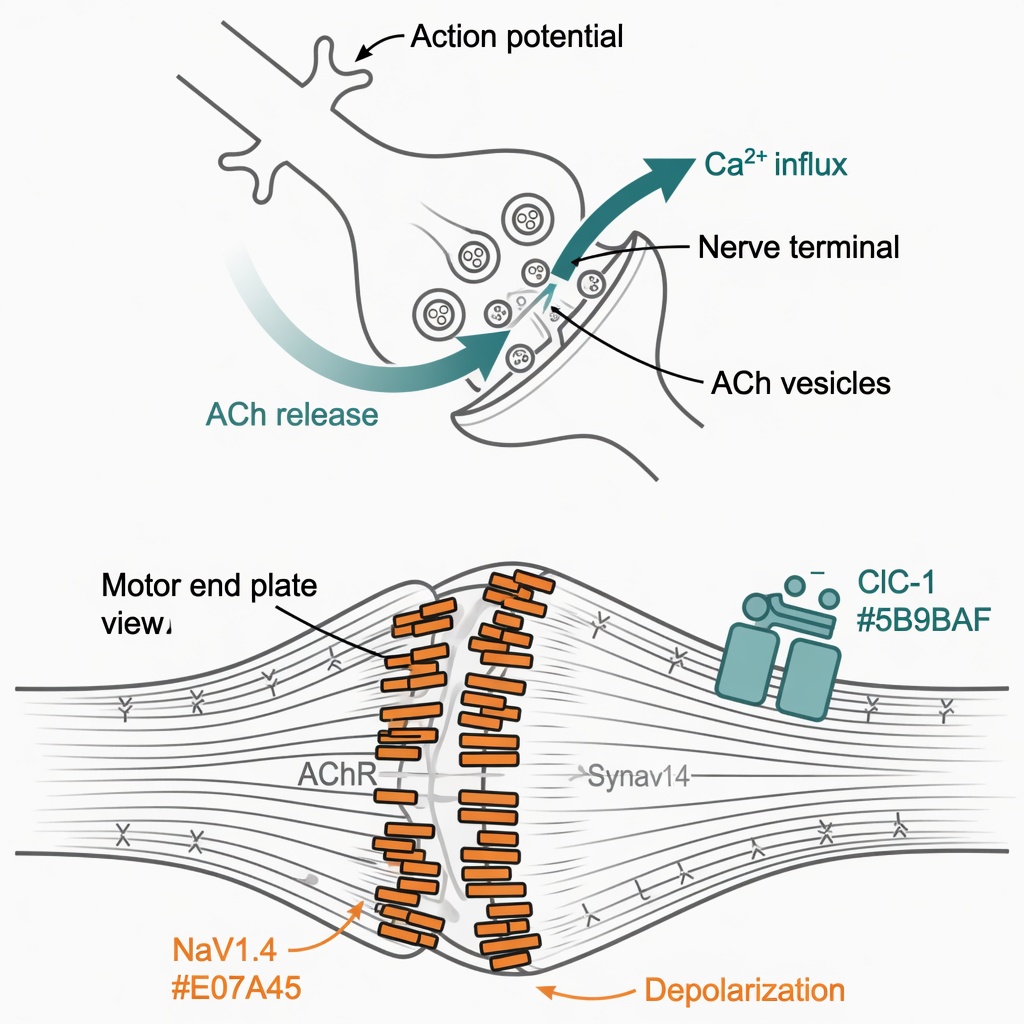
Executive Summary: Why do aging adults often experience sudden weakness or difficulty standing from a low chair, even when their daily protein intake and light activity seem adequate? Historically, clinical medicine attributed sarcopenia primarily to muscle mass atrophy or motor neuron loss (denervation). However, a landmark study published in The Journal of Clinical Investigation (JCI) challenges this dogma. Combining human single-fiber electromyography (SFEMG), neuromuscular junction (NMJ) confocal morphometry, toxin models, and targeted pharmacology, researchers demonstrated that age-related force decline is predominantly driven by postsynaptic transmission failure at the NMJ. Loss of voltage-gated sodium channels (NaV1.4) at junctional folds blunts synaptic safety margins, causing frequent signal dropouts. Strikingly, pharmacologically releasing the skeletal muscle "brake" via oral ClC-1 chloride channel inhibition rescued more than 50% of the transmission-related muscle force deficit and elevated grip strength by 11.2% in aged rodents without provoking myotonia.
1. The Paradox of Sarcopenia: When Force Drops Twice as Fast as Muscle Volume
In geriatric physiology, clinicians have long puzzled over a stark discrepancy: an 80-year-old individual may exhibit only a 15% to 20% reduction in thigh muscle cross-sectional area, yet their voluntary force production (e.g., knee extensor peak torque) is routinely cut by over 50%. The concept of "muscle quality" (force normalized to functional muscle volume) plummets by more than 40%.
If the cylinders of the engine remain largely intact, why is the motor stalling when stepping on the accelerator?
A collaborative research team led by Dr. W. David Arnold (The Ohio State University), Dr. Brian C. Clark (Ohio University), and Prof. Thomas Holm Pedersen (Aarhus University) tackled this mystery in their milestone paper in The Journal of Clinical Investigation (July 2026). Their findings establish that the core bottleneck in frailty lies not in wholesale myocyte death, but in electrical transmission failure across the synaptic gap of the neuromuscular junction (NMJ).
2. Electrical Cross-Talk in Chaos: Evidence from Human Single-Fiber EMG
To interrogate synaptic fidelity in living humans, the investigators performed single-fiber electromyography (SFEMG) in the vastus lateralis of weak older adults (average age 85.9 years) versus healthy young controls (average age 29.5 years).
By applying micro-stimulation (10 Hz) to individual motor nerve terminals and recording action potentials from single muscle fibers, SFEMG provides an unparalleled window into transmission dynamics:
- Dramatic Elevation in Jitter (+250%): In young controls, the transmission latency between nerve stimulation and muscle action potential onset is exquisitely tightly timed. In weak older adults, transmission variability (jitter) jumped by 250% (P = 0.003), signaling marginal safety factors.
- Postsynaptic Blocking: Crucially, aged muscle fibers frequently exhibited complete failure of action potential initiation in response to nerve discharge (P = 0.005).
- Direct Correlation with Weakness: Both SFEMG jitter and blocking rates correlated significantly with real-world functional decline in specific muscle strength (P < 0.002 and P = 0.007).
In weak older humans, between 20% and 30% of descending motor commands evaporate at the threshold of the muscle membrane.
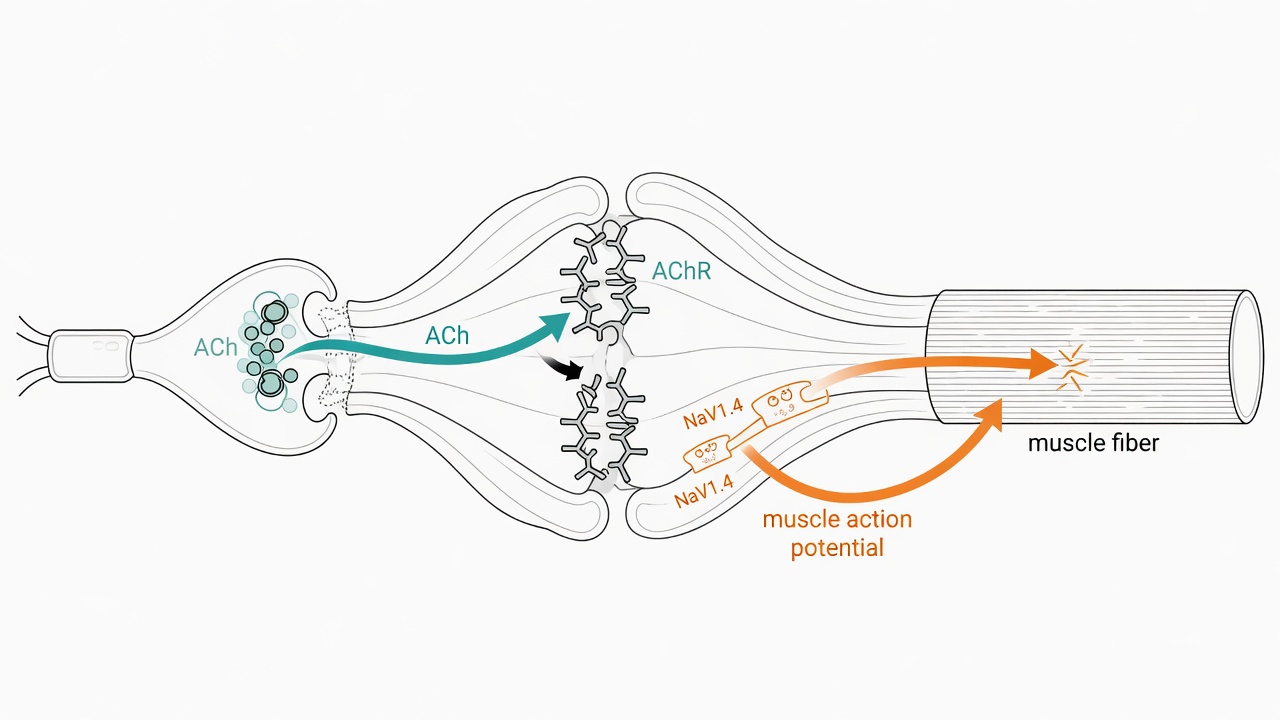
3. The Molecular Culprit: Local Loss of NaV1.4 Channels at Junctional Folds
Why does transmission fail? Classic pathology predicted denervation—the physical detachment of nerve terminals from motor endplates.
However, high-resolution confocal microscopy on human first dorsal interosseous biopsies demonstrated that structural endplate metrics (nerve terminal area, acetylcholine receptor [AChR] area, and nerve-endplate overlap) remained completely intact between young and older donors. There was no widespread structural denervation.
The investigators then probed the postsynaptic landscape. In healthy muscle, the postsynaptic membrane forms intricate secondary synaptic folds: AChRs reside at the crests, while voltage-gated sodium channels (NaV1.4, encoded by SCN4A) cluster in the deep valleys and along the parajunctional rim. This micro-architecture creates massive "synaptic gain": the local endplate potential (EPP) induced by AChR activation is amplified into a robust, all-or-none action potential with a 2- to 3-fold safety margin.
When comparing young versus aged tissue across humans, mice (26–28 months), and rats (21–23 months), the team made an astonishing discovery:
- Postsynaptic and parajunctional NaV1.4 protein density was markedly diminished in aged NMJs (P < 0.001 in humans; P < 0.01 in rodents).
- Surprisingly, total skeletal muscle Scn4a mRNA expression showed no significant change.
Thus, the factory is transcribing the mRNA, but aged muscle fibers fail to properly traffic, assemble, or anchor NaV1.4 channels into the synaptic membrane. The electrical socket looks intact from the outside, but its internal conductive prongs have eroded.
4. Closing the Causal Loop: μ-Conotoxin Mimics Aging in Youth
To determine whether NaV1.4 depletion is truly causal rather than an innocent bystander of aging, the authors utilized μ-conotoxin GIIIB, a potent and selective pore blocker of skeletal muscle NaV1.4 channels.
Intramuscular injection of micro-dose μ-conotoxin into the gastrocnemius of young adult rats instantly recapitulated the aged phenotype:
- Marked increases in SFEMG jitter;
- Severe frequency-dependent blocking at 10 Hz and 20 Hz (P < 0.01);
- Significant decrement during repetitive nerve stimulation (RNS).
This pharmacology closed the causal loop: functional depletion of NaV1.4 is alone sufficient to precipitate NMJ failure and replicate sarcopenic transmission deficits.
5. The Biophysical Workaround: Easing the ClC-1 Chloride "Brake"
With NaV1.4 depleted, how can transmission be rescued? Rather than relying on complicated gene therapy to re-anchor sodium channels, the team engineered an elegant biophysical workaround.
In skeletal muscle, membrane excitability represents a tug-of-war:
- Excitatory drive: Sodium influx through NaV1.4;
- Inhibitory stabilization (Brake): Mediated by the muscle-specific chloride channel ClC-1 (encoded by CLCN1), which accounts for 70% to 80% of total resting membrane conductance ($G_m$).
In young muscle, this massive chloride conductance stabilizes the membrane against aberrant twitches. But in aged muscle with compromised NaV1.4, this same high chloride conductance shunts away the modest endplate potential, preventing it from crossing firing threshold.
Pedersen and colleagues hypothesized that partially inhibiting ClC-1 with selective small molecules (NMD1226 and NMD653, developed by NMD Pharma) would increase muscle input resistance ($R_{in}$). By Ohm's law ($V = I \times R$), a higher input resistance allows even reduced sodium currents to generate a sustained, suprathreshold depolarization, restoring the synaptic safety margin.
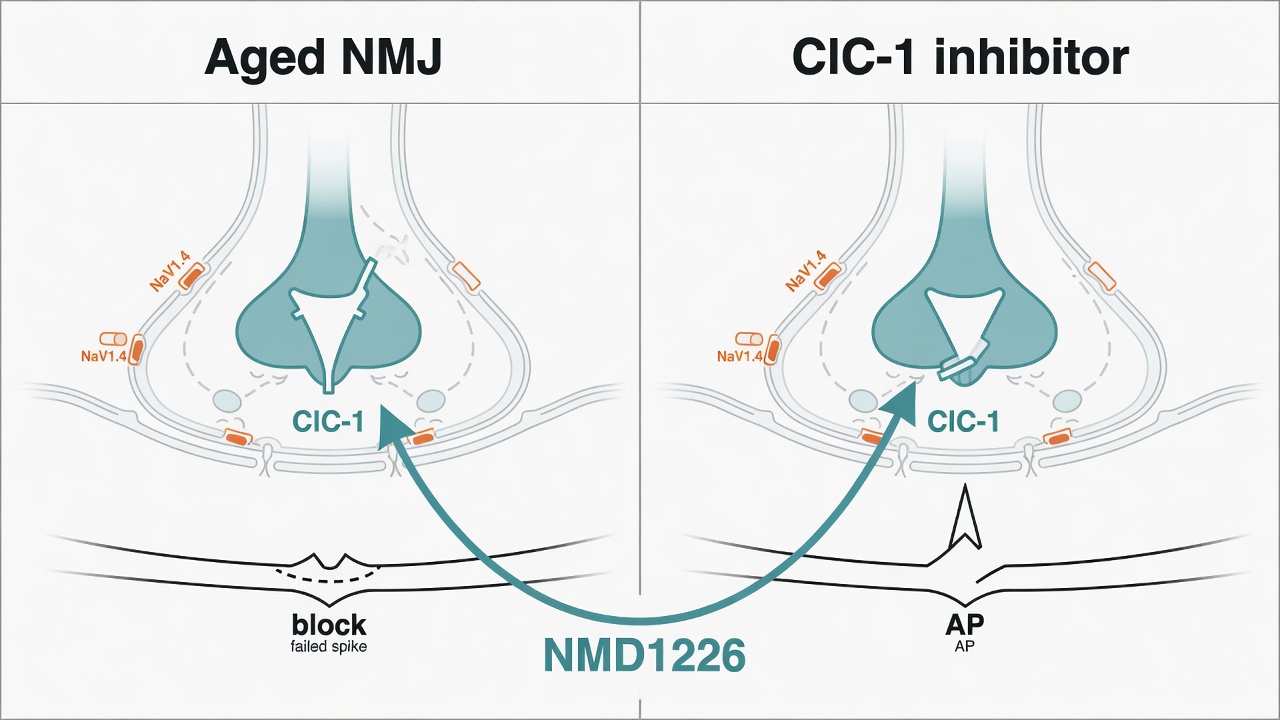
6. Functional Restoration: Rescuing Over 50% of the Force Deficit
The therapeutic validation proved remarkably successful across in vitro, ex vivo, and in vivo assays:
- Acute Electrical Evocation: In 22-month-old rats exhibiting severe NMJ transmission failure, continuous nerve stimulation (80 Hz, 1 s) generated 26% less force than in adult rats. A single oral dose of NMD1226 (60 mg/kg) increased aged muscle force output by 14.4% (P = 0.0002), effectively recovering more than 50% of the age-related force deficit. Healthy adult rats showed negligible alterations (+2.96%), confirming targeted efficacy.
- 7-Day In Vivo Grip Strength Trial: In a blinded, randomized trial, aged rats receiving twice-daily oral NMD1226 gained 11.2% in normalized forelimb grip strength by day 4 and maintained this benefit through day 7 (P = 0.03 vs. vehicle, which declined by 9.7%).
- Safety and Reversibility: Following a 26-hour drug washout on day 8, grip strength returned cleanly to baseline without evidence of residual stiffness or myotonia.
- Mouse SFEMG Jitter Rescue: In aged mice, NMD653 significantly depressed SFEMG jitter (from 20.42 μs down to 13.66 μs) and alleviated RNS decrements.
7. Implications: Moving Beyond Hypertrophy to Electroneuromodulation
This landmark JCI publication delivers several paradigm-shifting takeaways:
- Redefining Muscle Quality: Diagnostics must expand beyond dual-energy X-ray absorptiometry (DXA) lean mass to incorporate functional electrophysiology of the motor unit and NMJ.
- Electroneuromodulation as a Novel Drug Class: Rather than struggling with the safety and efficacy hurdles of anabolic steroids, SARMs, or myostatin inhibitors, transient chloride channel inhibition reactivates dormant, existing muscle fibers immediately.
- Clinical Training Insights: While walking benefits cardiovascular health, high-frequency, explosive resistance training remains critical to drive high-threshold motor unit firing and preserve synaptic plasticity at the NMJ.