Ten Thousand Hits a Day — And Your DNA Survives
Right now, every cell in your body is under bombardment.
Reactive oxygen species (ROS) — byproducts of breathing — launch roughly ten thousand oxidative attacks on each cell's DNA every single day. Most get repaired. Not all. The damage that slips through accumulates into the seeds of cancer, aging, and neurodegeneration.
How do your cells survive this relentless assault? Not just repair. Detection.
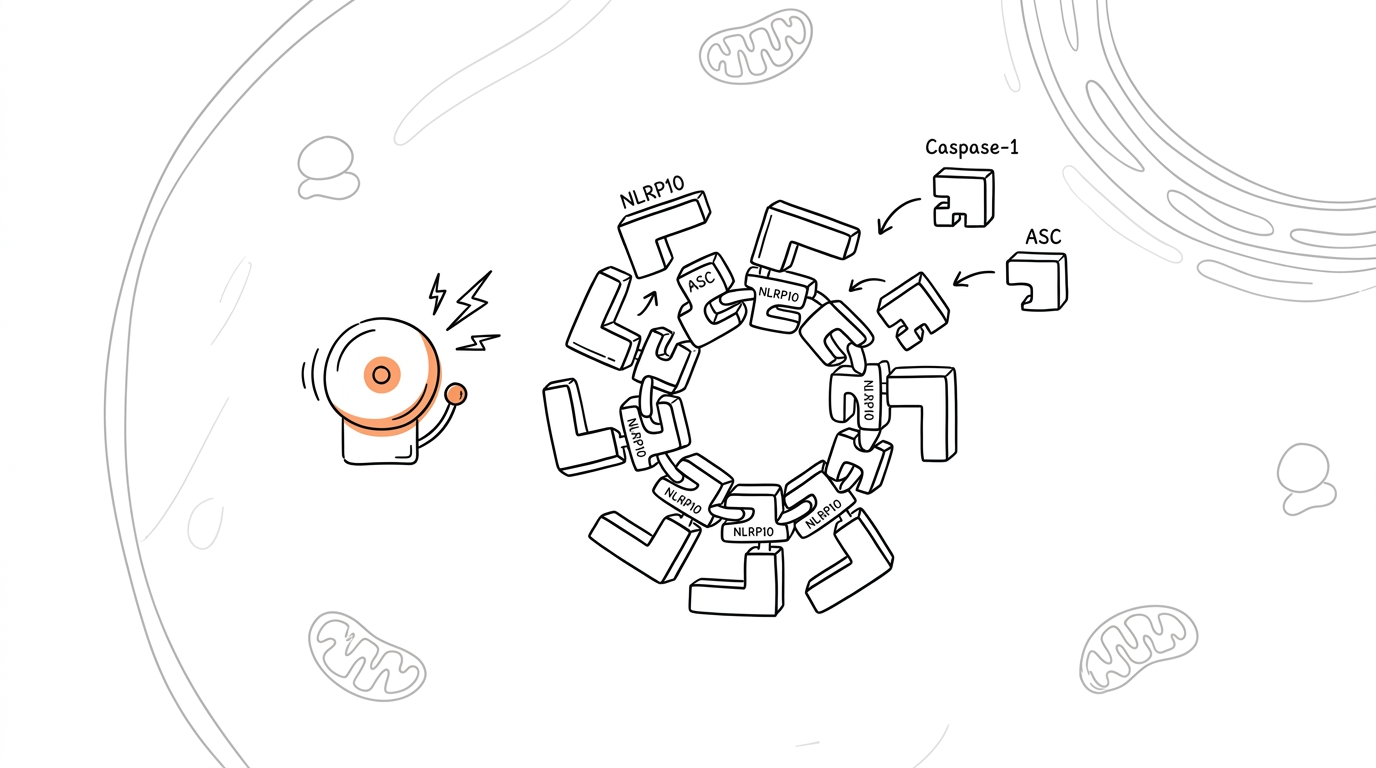
NLRP10 — a quiet member of the inflammasome family — stands guard in the cytoplasm. Its job isn't fixing DNA. It's making the call: How bad is the damage? Sound the alarm, or detonate?
The Inflammasome: A Cellular Emergency Command Post
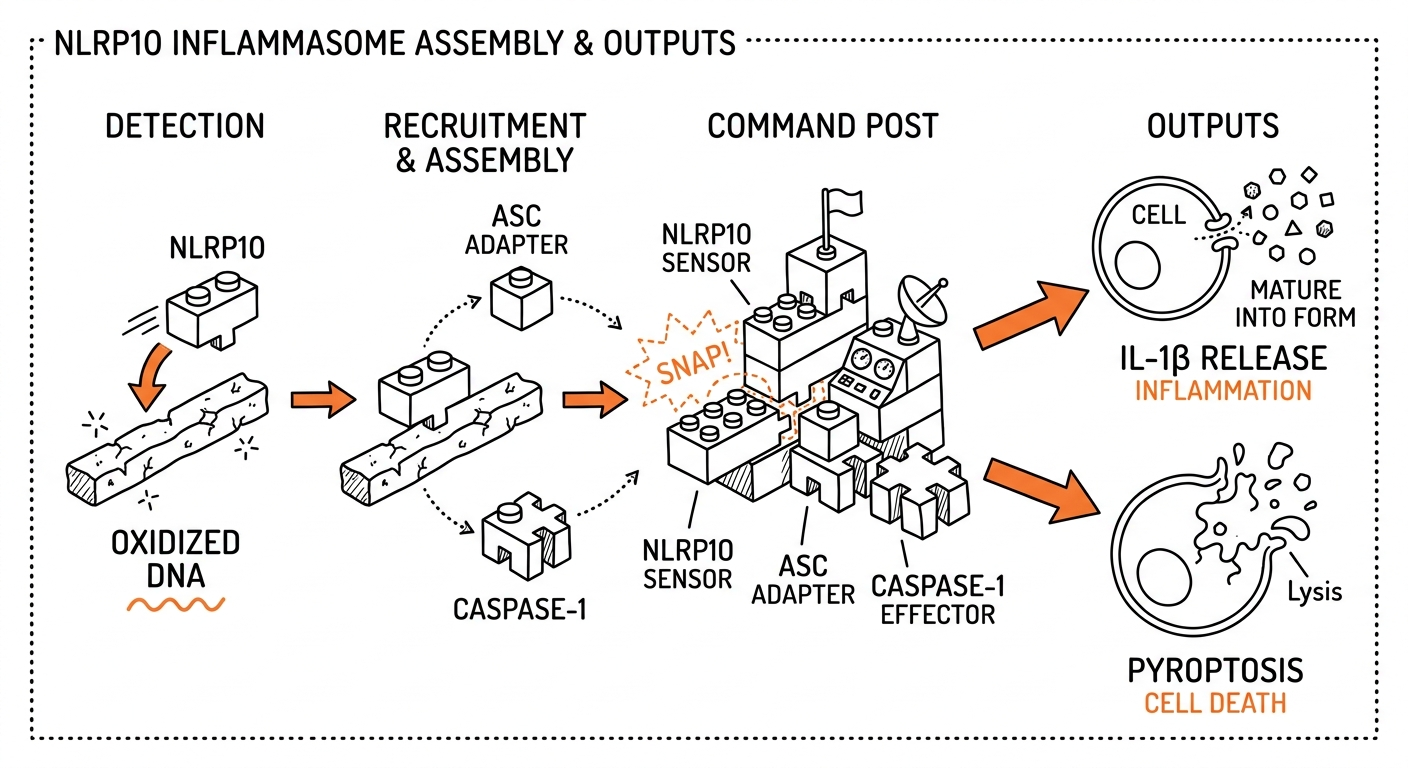
An inflammasome isn't a single protein. It's a multi-protein complex assembled on demand — a temporary war room.
When NLRP10 detects oxidized DNA (8-oxo-dG), it recruits ASC adaptor protein and caspase-1 enzyme. The three assemble into a complex and issue two commands:
Command one: Send for help. Cleave pro-IL-1β and pro-IL-18 into active forms, release them outside the cell. This is a molecular SOS signal calling immune cells to the scene.
Command two: Self-destruct if necessary. When DNA damage is beyond repair, caspase-1 triggers pyroptosis — the cell blows itself open in a controlled manner, laying its contents out for immune system cleanup. Better than becoming cancer.
Why Not Let NLRP3 Handle This?
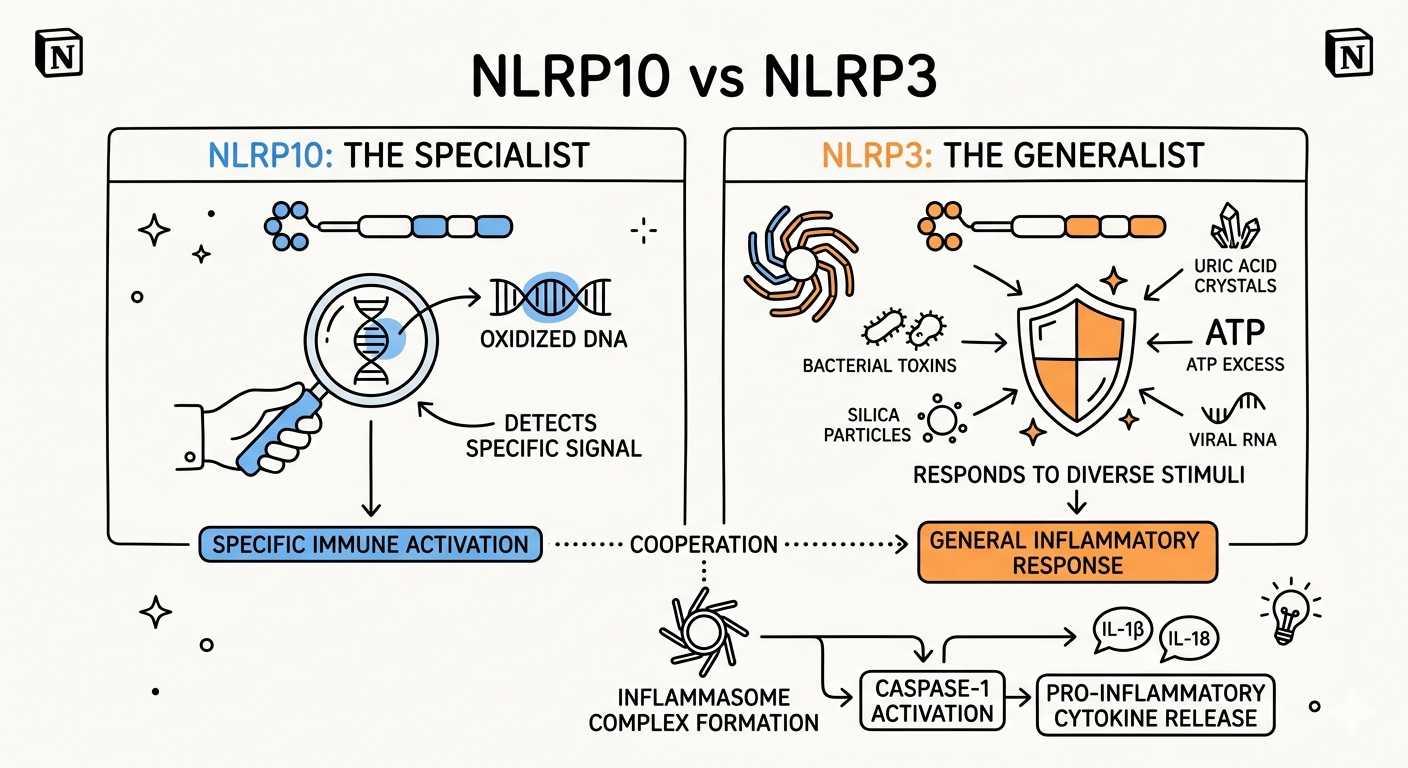
NLRP3 is the inflammasome celebrity. Bacteria, viruses, uric acid crystals — it responds to everything. But NLRP3 has a weakness: no specificity for oxidized DNA. It reacts to all "danger signals" without distinguishing DNA damage from metabolic waste.
NLRP10 is different. Through Schiff base chemistry, it recognizes only oxidized DNA. Normal DNA passes unnoticed; damaged DNA gets flagged instantly.
This precision makes NLRP10 the "first responder" for oxidative stress. NLRP3 handles the broader cleanup afterward. Brothers with different specialties.
What Happens When It Fails?
- Accelerated aging: Weakened NLRP10 leaves damaged cells uncleaned, becoming "zombie cells" that secrete inflammatory factors
- Cancer double-edged sword: Early protection (clearing mutant cells) → late risk (tumors hijack inflammatory environment for metastasis)
- Neurodegeneration: Brains are hypersensitive to oxidative stress; NLRP10 dysfunction → uncontrolled neuroinflammation → cognitive decline
Have you ever checked your oxidative stress markers? Urinary 8-OHdG concentration might be the next number worth knowing.
The Scout's Sensitivity Decides How Fast You Age
NLRP10 doesn't repair DNA, kill viruses, or fight bacteria. It does one thing: assess oxidative damage severity and decide the next step.
That decision — inflame or self-destruct, repair or abandon — plays out billions of times daily inside your body. The cumulative precision of those calls is your aging rate.
Scientists are developing selective NLRP10 modulators. Not shutdown — fine-tuning. Perhaps one day your health report will include an "NLRP10 activity score."
That will be the day you truly understand how fast you're aging.
References
- Eisenbarth, S.C. et al. (2012). Journal of Immunology, 188, 2884–2893.
- Schroder, K. & Tschopp, J. (2010). Cell, 140, 821–832.
- Broz, P. & Dixit, V.M. (2016). Nature Reviews Immunology, 16, 407–420.