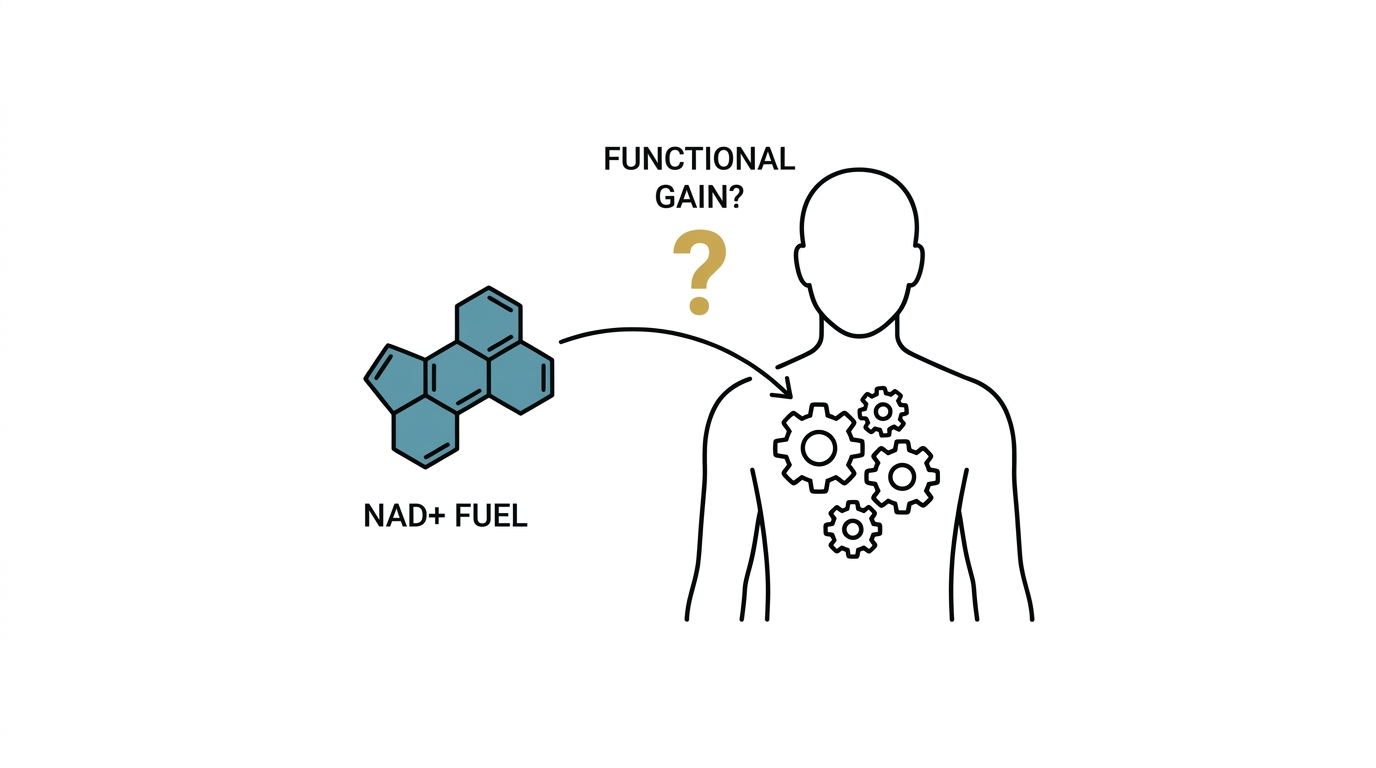
The supplement industry has a gift for turning a promising molecule into a simple story: your NAD+ declines with age, so you take a precursor like NMN or NR to top it up, and your cells recover. Clean, intuitive, sellable.
A systematic review published in 2026 looked at 113 studies spanning 15 years of research and offered a considerably more complicated picture.
TL;DR: Gallagher and colleagues confirmed that NR and NMN supplementation can raise NAD+-related biomarkers in humans — that part holds. But when researchers looked at what actually matters to patients — physical performance, metabolic function, vascular health, subjective wellbeing — the results were inconsistent. Raising a number on a lab report is not the same as reversing biological age.
What the Review Actually Examined
The scope is worth noting. Gallagher and Emmanuel reviewed literature from 2010 to 2025, ultimately including 113 studies: 33 human studies (among them 28 randomized trials) plus 80 rodent studies. This isn't a cherry-picked reading of the most promising data — it's an attempt to synthesize what the field actually knows.
Their core question was not "does NAD+ sound plausible as an aging mechanism?" The biology is genuinely interesting. The question was harder and more practical: after supplementation, do biomarkers change, and do people actually improve?
The answer splits cleanly in two.
What the Evidence Supports Clearly
Oral NR and NMN do appear to raise NAD+ metabolites in humans. This isn't nothing. The authors describe it as clear "biochemical target engagement" — meaning the supplement crosses the gut, enters circulation, and something measurable changes in the body. For a field that often debates whether oral precursors even reach meaningful tissue levels, this is a genuine finding.
Short-term tolerability also looks reasonable across most studies. The compounds don't appear to be broadly toxic at typical doses.
Where the Evidence Breaks Down
Here is where the story becomes instructive. When researchers look beyond biomarkers to clinical function — exercise capacity, insulin sensitivity, blood pressure, cardiovascular markers, overall sense of health — the picture becomes inconsistent.
Some studies find effects on individual endpoints. Many do not. Effects do not replicate consistently across study designs, populations, or dosing regimens. The review's overall assessment: there is no stable pattern of clinical benefit that holds across the human literature.
This gap between biomarker change and functional benefit is not unique to NAD+ research, but it is particularly pronounced here. The usual explanations apply: most human studies run for only weeks or months — long enough to see biochemical changes but not necessarily long enough for tissue-level function to shift in a measurable way. Study populations vary enormously. Endpoints are scattered across many possible outcomes, which means any single trial rarely has statistical power to detect moderate effects on any one of them.
What About IV NAD+ Drips?
The marketing for intravenous NAD+ infusions often implies that bypassing digestion delivers something more potent. The review is blunt: there are no qualified clinical outcome trials for intravenous or intramuscular NAD+ that support anti-aging or wellness effects. The authors identified a single non-randomized IV NMN study, which provided short-term safety and biomarker data only. For IV NAD+ itself, the existing data is limited to pharmacokinetic pilot work — no usable clinical outcome evidence.
The argument that "direct delivery must be better" is not supported by outcome data, because the outcome data essentially doesn't exist yet.
What This Means for People Considering These Supplements
The practical takeaway is simpler than the science: calibrate your expectations carefully.
Current evidence more reliably supports: certain NAD+ metabolites will rise in your bloodstream, and short-term tolerance is generally acceptable.
Current evidence does not yet reliably support: that your muscles, blood vessels, brain, or subjective aging experience will improve in a clinically meaningful way.
There is also a structural problem with how this literature was generated. The 33 human studies in this review cover wildly different populations — healthy adults, individuals with metabolic conditions, different age ranges — using different doses, durations, and outcome measures. Synthesizing across that heterogeneity is genuinely difficult. The reviewers can see the outline of something potentially interesting. They cannot yet assemble it into a clear clinical recommendation.
The Larger Point
For researchers, the call to action is straightforward: the field needs larger, longer, better-powered human trials with pre-specified primary endpoints. More preclinical mechanism work is not what's missing. Rigorous clinical data is.
For consumers, the more important lesson may be about the pace of wellness narratives versus the pace of science. NAD+ supplementation became a multi-billion-dollar category before its clinical benefit was established. This review doesn't declare those products useless — it simply notes that the evidence base hasn't caught up to the commercial story.
"Biochemically effective" and "clinically proven to slow aging" are two different claims. Right now, the evidence supports the first. It does not yet support the second.
References
- Gallagher et al. (2026). NAD⁺ supplementation for anti-aging and wellness: A PRISMA-guided systematic review of preclinical and clinical evidence. Ageing Research Reviews. doi: 10.1016/j.arr.2026.103057