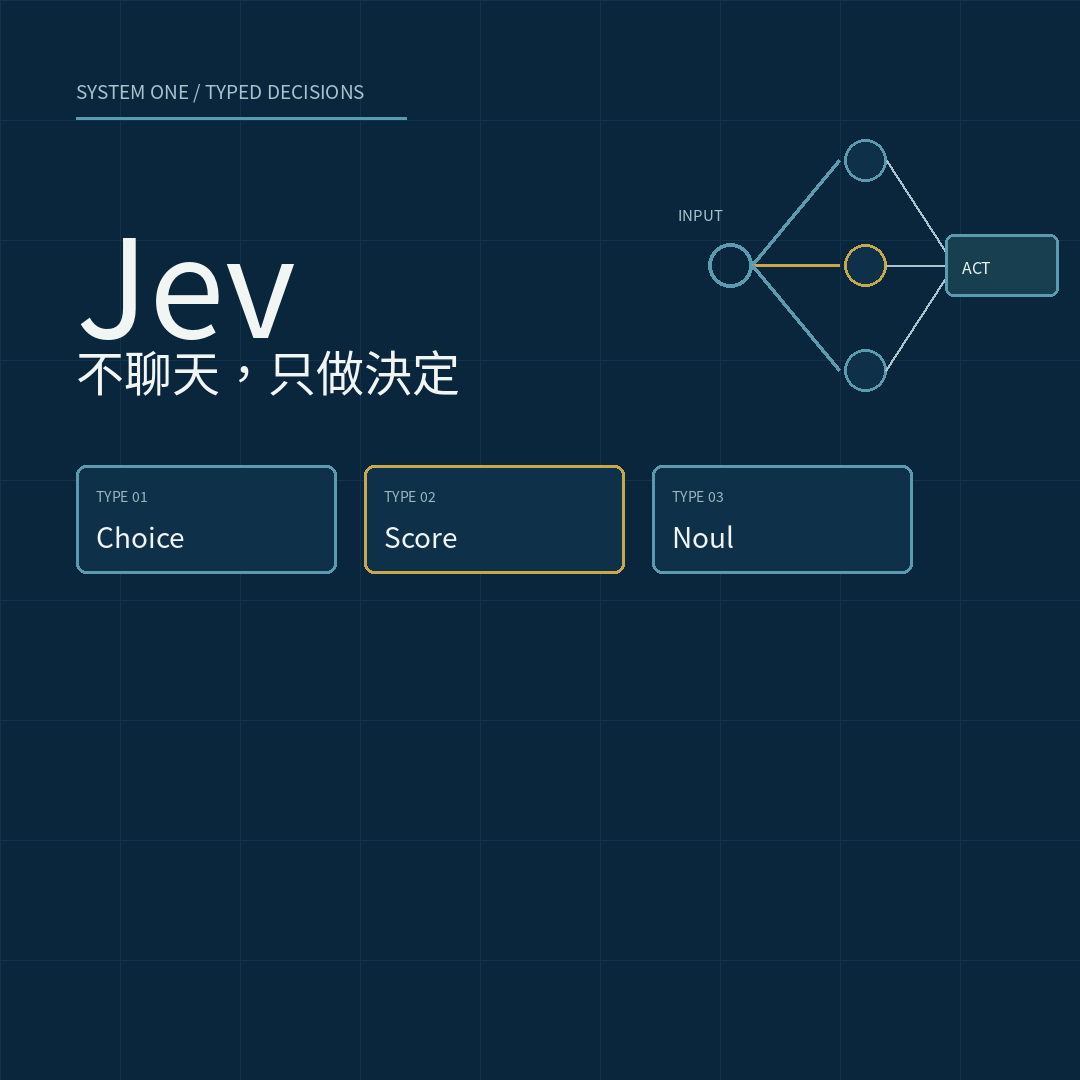
If you've seen Jev and TypeSafe.ai go around on X or developer chat or agent-tool updates, it's not because they're writing a prettier essay. Rather they barely write and they are specialized to do fast, narrow, and wire-in-code judgments.[1][5]
Here's one sentence for Jev: Jev is not a chatbot, it's a semantic decision engine for programs. You give it the current state and a set of type-question. It gives you options, scores, and probabilities. You then branch your code, weight, escalate to person, or hand off to a larger LLM.[1][3]
What is it?
TypeSafe AI is positioning Jev as first public System One model.[3][6] They've borrowed System 1 from Kahneman's Thinking, Fast and Slow: fast, intuitive, and a decision a skilled person can make in seconds. This is in contrast to the slow System 2 mainstream LLM outputs token-by-token.[3][5]
Founder Diogo Almeida said chat models are now powerful, but there's a gap in the large-scale automation space. TypeSafe took ~2 years to rebuild the architecture, parallel sampler, and a training objective called RLCD (Reinforcement Learning for Calibrated Decisions). The goal isn't a nice-sounding sentence, it's a calibrated decision that you can trust in software.[5][13]
The name Jev came from the 19th-century economist William Stanley Jevons. Jevons paradox: when efficiency goes up, total use may not go down because more uses come. TypeSafe betting that if a useful AI judgment is fast and cheap enough, people will put it in the path that isn't worthwhile calling a frontier LLM today.[15][9]
What does one call look like?
The typical request consists of two parts:
- State: the current situation. A support message, ticket + order history, agent tool output, structured JSON.[1][3]
- Questions: problems whose answer shape you pre-declared. For now, the official primitives are:[1][3]
Type What it asks What it gives back Choice Pick one thing from the fixed list Selected item, option probabilities, confidence Score Grade it against your rubric Score, level probabilities, confidence Noul How likely is this statement true? Probability 0 to 1 You can run multiple questions on one API call, evaluate the same state in parallel, and they're independent. The official language is that adding more questions hardly slows the response, and stacking them is less likely to cause context-rot.[1]
The return value is not a paragraph. It might look like this:
{
  "choice": "technical",
  "probabilities": { "billing": 0.08, "technical": 0.85, "sales": 0.07 },
  "confidence": 0.82
}
You can if / switch / route on this without a JSON-repair retry parser.[1][8][16]
Why is it suddenly hot?
Three things, stacked:
- Agents often spend money on judging, not writing In a modern agent loop, you keep calling a large model to pick the next tool, decide whether to retry, whether output is good enough, get someone to judge, or stop. These are mostly bounded judgments, but they're often stuffed into a frontier model that wants to write.[7][10][16]
On this pain point, the Jev product story is: Let the maker (write, plan, edit code) be handled by LLM; let the checker / router (judge, pick path, gate) be replaced by a decision model.[7][10]
- The public numbers tickles the developer nerves TypeSafe's site has about 193.6× faster and 444.6× cheaper (on their own System One workflows).[6] The current public pricing is about $0.042 per million input tokens ($42 per billion), and output is free. Public specs also mention responses in a millisecond to hundreds-of-milliseconds product narrative.[2][5][10]
Take those numbers as a ceiling and marketing upper bound, not a promise for your project. Both launch posts and independent reviews point out that often, the measurements are very close to the service, that capable teams designed the workflows, and that changing the baseline model can change the multiple a lot. Some reviewers repeated the comparison with cheaper models you'd really use as classifiers, and the real edge shrunk to tens times, rather than hundreds.[5][10][15]
- Fast toolchain connection In days, the developer tools had pass-through / gateway paths added. LangChain posted a harness write-up, LiteLLM added TypeSafe System One pass-through (their own evaluate endpoint, rather than /chat/completions), Vercel added Jev to an AI Gateway changelog.[7][8][17] It was cheaper to try than a paper or demo, so the heat goes faster.
Strengths: A semantic if in the software
Strength 1: the output is born wired
You declare the answer space. TypeSafe is stressing the model won't output an option of wrong type (4 departments means it won't hallucinate a 5th).[5] For agent / backend, it's more like a real control-flow primitive than "please answer in JSON" + 3 layers of validation.[1][16]
Title trap: "Zero Hallucinations" in the official language mainly refers to guaranteed schema alignment, not that the pick is correct. It may still say a technical ticket is a billing one. It just won't output billing. or a paragraph saying "this may be a billing issue..."[5][16]
Strength 2: probability and confidence are first-class
Each answer has a distribution. Choice / Score also has confidence, as a second axis of "should it run automatically?".[1][12] So you can write engineering policy like:
- high confidence -> auto-route
- middle range -> add one more question/call a larger model
- low (or high impact) -> human review
Per the official docs, they say that calibration means long-run frequency over a set of predictions, not a guarantee for one answer.[3][13]
Strength 3: questions in parallel, when one event has many faces
One support ticket can ask whether it's urgent, which department, frustration level, refund likely. Your code then weights these answers, rather than stuffing all these dimensions into one huge prompt and ask to summarize.[1][14] This is friendly for composite score, intent-routing, and speculatively fan-out.[14]
Strength 4: the cost and latency helps at high-frequency, small judgments
You pay for input tokens, output is free, you ask questions in parallel, and you don't have long-form generation. If this is really a lot of classifications, scores, and guardrails per second / per request, unit economics can beat asking a reasoning model to write a paragraph and then parse it.[2][5][7]
Strength 5: business rules in code, rather than a huge prompt
The design philosophy repeats: break down complex judgment into atomic questions, and compose them in code.[1] Weights, thresholds, and compliance rules become coefficients. You don't rewrite a wandering natural language policy every time.[14][15]
Limits: Narrow is the feature and the boundary
Limit 1: not generation, explanation, planning
Jev does not generate a reply text / code / a reasoning trace.[3][5] If you want a customer email, or a paper abstract, or a refactoring diff, or to brainstorm, you won't use it. The standard stack is LLM + Jev + deterministic code + people, not "replace ChatGPT with Jev".[15][16]
Limit 2: text only (for now)
In the public model specs, it's text only (string/json object/text array). For images, audio, and video, you'll need to convert them to text/structured fields first, before they go into state.[2][3]
Limit 3: English is better; CJK need your own tests
Per the official language, English is the main training language, and currently the most accurate. Other languages, including CJK, work, but not to the same level. Non-English workloads should be self-tested before going live, and be more strictly read the confidence before auto-execution.[2] This is important for a Taiwan team. Chinese support, internal tickets, medical/legal Chinese, can't inherit English-benchmark comfort
Limit 4: hard edges for context & question design
The public model specs are about 64k tokens per request total, about 32k for state and longest single question.[2] Questions should be atomic, a call a skilled person can make in seconds. Complex, entangled problems, you should break them up, compose in code, rather than stuffing it into one philosophical essay.[1]
Note that the choice cardinality has a cap (often they mention about 255, and higher cardinality might go two-stage and slow).[16] They are not comfortable with ultra-high-cardinality classification, open-label discovery.
Limit 5: no customer fine-tune; it's request design for personalization
Official: Jev will not fine-tune/LoRA on customer data. All accounts have the same set of weights. Domain fit is by putting proprietary data in state, write rules in instructions/criteria, and break up large judgments for downstream classical models to consume probability features.[2]
Limit 6: calibration, architecture, training details mostly unpublished; access still early
There's almost no paper-quality disclosure on RLCD, parallel sampler, and the full architecture. Whether calibration stands on your distribution, is something only your labeled set can tell.[13][16] Also moving early rate limits. Direct API keys could still be a waitlist/early access, so practice may start at the gateway/proxy.[2][8][16]
Limit 7: composing multiple "calibrated" answers with thresholds/weights doesn't mean the entire workflow is calibrated
This is easy to miss in engineering. You have three stable-looking probabilities, go through your 0.7 / 0.9 thresholds and weight formula, the end-to-end error and uncertainty changes shape. Also, the independent reviews warn, calibrated single judgments ≠ calibrated workflow.[16]
Limit 8: the gap vs. LLM structured output is sometimes inflated by marketing
Major LLMs already have strict schema/structured output. Jev's difference story is a native decision interface + calibrated probabilities + latency/cost shape + questions in parallel, not just "it can finally output a legal enum". If you make 100 judgments per day and have the structured output already stable, you might get less from model switch than refactoring the 10k checker calls inside the agent.
Where it is actually used (as of 2026-09)
The below map is from the official use case map & patterns, plus shapes that appeared in the ecosystem write-ups.[4][7][14][15]
A. A semantic decision layer in software automation
- Support/ITSM: department routing, urgency, refund, human needed
- Tickets/CRM: intent, priority, lead scoring
- Content review: score predefined policy classes, or flag violation
- Ops alerts: severity, play-book match, escalate or not
Common traits: answer set is known in advance, high call frequency, and mistake must degrade to a person/rules engine.
B. Agent harness: routing, guardrails, done-or-not LangChain and such write-ups put Jev in an agent harness: pick a tool/sub-agent, choose continue/retry/ask user/stop, score risk before action, validate output.[7][16] The official use-cases also mention Harness Engineering: model routing, semantic retrieval, LLM error detection, reasoning trace classification.
One architectural slogan:
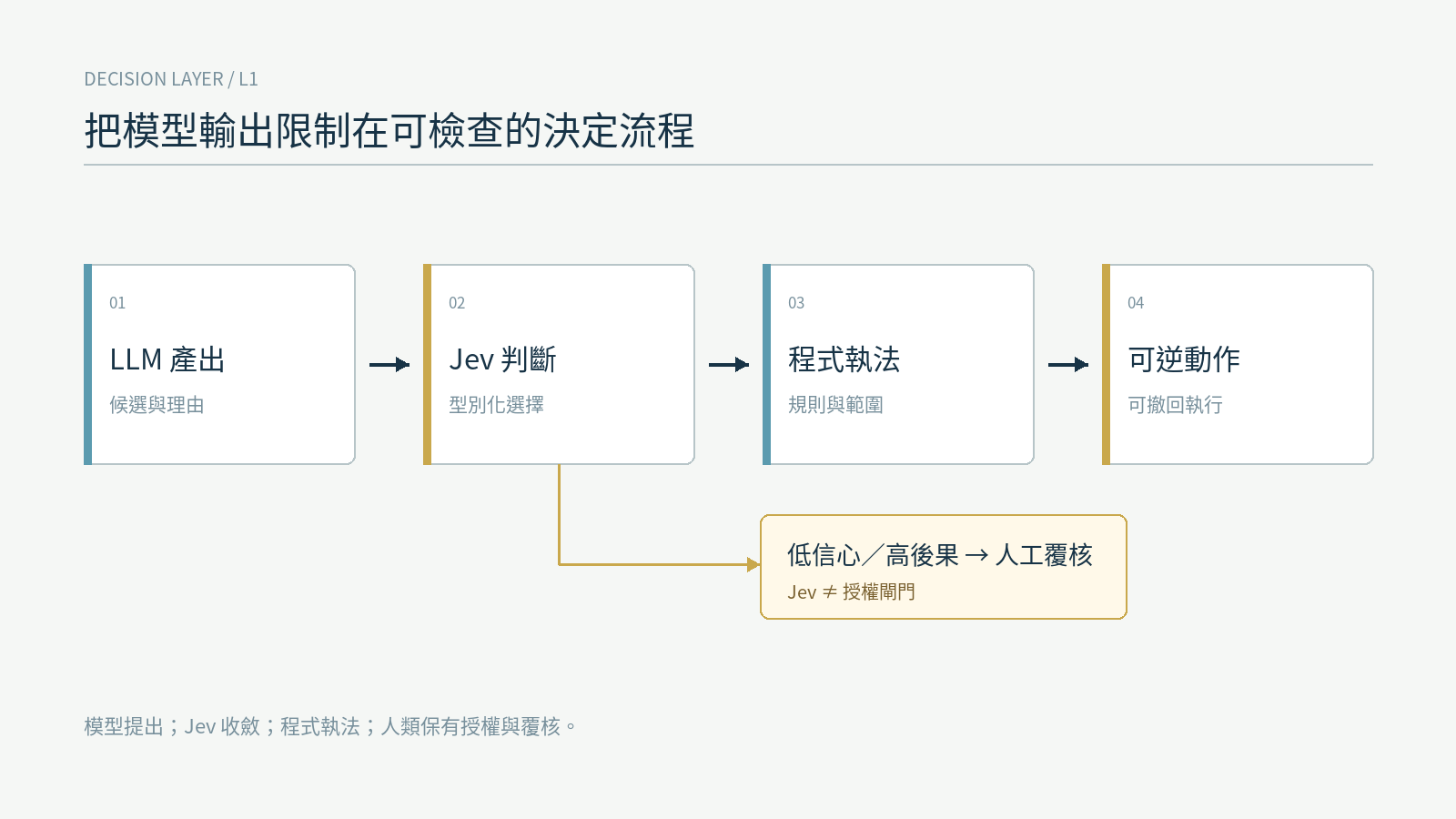
The LLM produces, Jev votes at the fork, code enforces, people handle high-consequence exceptions.
C. A cheap verifier for other AI Official name: Universal Verification. Check prompt, extraction, reasoning trace, tool call, citation is valid, whether looks like jailbreak/hallucination. Cost is far lower than calling other similar class generator.[4] It's attractive when the gen cost is high and you can do check often.
D. Large-scale map-reduce / semantic processing for data When the single judgment is cheap enough, it's more practical to score relevance, rerank, classify agent traces, or extract features for a classical model on a huge corpus.[4] Also, community experiments try semantic filter/score on rows in SQL/analytics paths. The core idea is still high-throughput, bounded-label judgment.
E. Real-time interaction, in-UI decision The official materials say real-time (a ~100ms narrative) is a class: games, in-UI intelligence, decisions that must beat user-perceived latency.[4][5] The Doom demo around launch didn't go viral because Jev "plays you a story". But it demonstrated that you can run code + fast decision model in a loop that LLM latency can't hold.[5][16]
F. Screening in research/knowledge work, not writing Official examples include include/exclude for a systematic review, tagging themes in qualitative interviews, whether cited passage supports a claim, whether methods details are missing.[4] Jev is a screening/labeling help in this case. The paper writing/statistical interpretation/final science conclusion still goes to a generative model, stats pipeline, and a person.
G. Search/RAG support Use score/pairwise compare for query-document relevance, rerank, picking downstream context, to patch coarse embedding recall.[4]
In two days, the ecosystem split into three tracks
The number of community projects using Jev/System One exploded in days. Here are the three layers in a dozen examples of representative repos so far:[18]
- Official SaaS and standard gateways: based on TypeSafe's hosted API (e.g.
POST /v1/systemonewithjev-1.13.0); cloud decision endpoints with LangChain, LiteLLM, Vercel AI Gateway.[1][7][8][17] - Local open-weight Jev-like baselines: an attempt to circumvent a single cloud API. SemIf (formerly OpenJev) experiments with option-logit inference and a port to 4B weights in MLX;[19] NanoJev trains a 0.6B lightweight head for decode-free decisions;[20] open-alternative-jev (so1) demonstrates a Jev-like interface for any open weights with a single forward pass and option letter logits.[21] Most of these baselines are very early experiments, but point to a data-does-not-leave-the-machine way.
- Workflow consumers (apps and agent harnesses): atomic decisions linked in actual flows. fast-jev-compaction tries a decision model to keep or cut tool output, rather than lossy natural-language summary;[22] jev-browser and jev-ultrafast fork browser automation to let Jev decide action and target node, LLM just fill text;[23][24] jev-search decide search sources and rerank results, no generated answer in the frontend;[25] jev-sift batch classify before read, like MCP;[26] jev-security-scan combines static rules and Jev for Skill/MCP review;[27] pi-jev, hermes-jev-skills experiment with Jev as tool call gatekeeper, output judge, or skill picker in a harness.[28][29]
Most of the entries in community lists like awesome-jev-projects are incredibly new. Runtime reliability, adversarial robustness, and real safety are mostly unverified (verified=false). The split helps differentiate the core pattern and experimental prototypes.[18]
Our decision: adopt the decision-layer pattern, start with a controlled trial
After the capabilities and ecosystem mapping, we decided to integrate Jev's decision-layer pattern into our workflow. "Adopt" is not a blanket production rollout, and it is not a statement that the method is a proven general solution. Our rules:
- Controlled, reversible trial: early use is 100% shadow-first. Jev works alongside the current path, logging and observing only, with no write or irreversible side effects.
- Pin versions: lock on a concrete release, like
jev-1.13.0. Don't followlatestto keep the inference reproducible and auditable.[2] - Measure on a representative labeled set: don't trust vendor hundred-fold numbers. Construct our own and measure calibration, latency, per-call cost, escalation rate, false positives, false negatives.
- Hold the data and safety line: flows with sensitive data, personal privacy, patents, or credentials don't leave to a cloud API. Jev is an advisory signal only. It should not be the authorization point for irreversible actions, or a replacement for deterministic code or human review.
- Publish an implementation piece only if it is stable: we won't claim success on first API contact. Only when the trial shows long, stable measurements, engineering-reproducible experience, we will write a follow-up implementation article.
When to use it, and when not to
| Situation | Lean |
|---|---|
High frequency, known answer set, result goes to if |
Worth considering Jev, or at least an atomic-question + structured-decision pattern |
| Lots of checker / router / guardrail logic in an agent | Shadow-test first; often the biggest ROI |
| Writing, coding, multi-step reasoning, open exploration | Use an LLM, don't reach for Jev |
| Chinese-first, heavy domain terms | Try it out, but make a labeled set and confidence thresholds |
| Few decisions per day, structured output already stable | Improve prompts, cache first; no rush to switch |
| Medical, finance, security, or other high-consequence auto-execution | Advisory layer at most; threshold, audit, and human review stay |
A practical order of adoption (and also consensus in several independent reviews):[10][15][16]
- Convert existing LLM checkers into atomic questions (even if you keep the old model).
- Shadow on production-representative samples: Jev + current behavior, no side effects.
- Measure more than accuracy: calibration, latency, per-case cost, escalation rate, false positives / false negatives.
- Pin a version (e.g.
jev-1.13.0). Don't follow an alias. Re-estimate thresholds on your data before switching traffic.[2]
A healthier frame
Calling Jev "a 2026 super classifier API" or "a semantic switch" is 50% true. Correctly:
TypeSafe / Jev is pushing an interface contract: intelligence does not need to look like a chat box. It can look like a function: state in, type decision with uncertainty out.[1][5][13]
It's not killing LLMs. It's productizing the last two years of "reply YES/NO only" and "reply JSON only" prompts, and adding latency, cost, parallel questions, probability calibration. The engineering lesson worth remembering doesn't even need Jev:
Wherever a result enters control flow, don't ask a model for prose.
If Jev's numbers work on your data, you'll have a cheaper, faster, easier-to-wire decision layer. If not, you still have a cleaner set of atomic questions and testable routing, which should be there anyway.[16]
Snapshot (at writing)
- Product: TypeSafe AI's Jev (System One), public versions like
jev-1.13.0; aliases:jev-latest/jev-preview.[2] - Interface:
state+ type questions → type answers + probabilities (+ confidence).[1] - Price: around $0.042 / MTok input, free output (see the official models page, may change).[2]
- Limits: text only, English better, no customer fine-tune, early access / moving quotas, no text generation.[2][3]
- Role: a decision / verification layer in automation and agents, not a general chat model.[3][6]