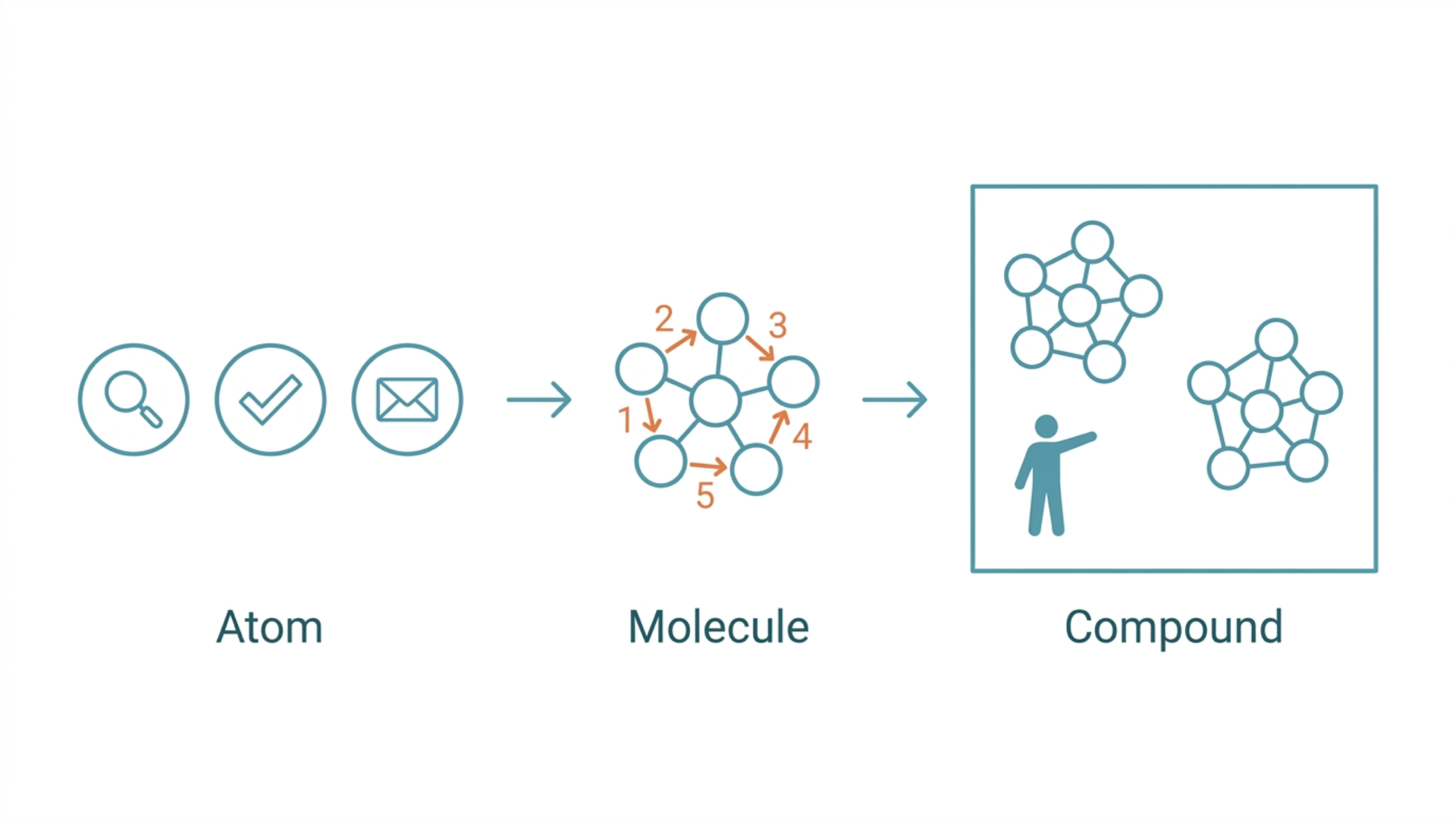
TL;DR: A single AI Agent is reliable for one task, but your brain can only steer about 5 Agents at once. Steer 5 atoms, you get 5 units of output. Steer 5 compounds, you get 500. The difference is how you compose your skills.
The Problem: Why Skill Graphs Break Down
When AI skill dependency chains exceed 2–3 layers, agent judgment degrades rapidly — causing skipped steps, repeated calls, or infinite loops.
The AI community loves linking Markdown files to build "skill graphs." Skill A depends on Skill B, which depends on Skill C. Sounds logical. But once the chain hits a third layer, agents start misbehaving: skipping skills, calling the same one twice, or spinning in circular dependencies.
Why? Because you've handed too much judgment to the agent, and its decision-making quality decays with depth. Think of it like a game of telephone — every relay doubles the odds of distortion.
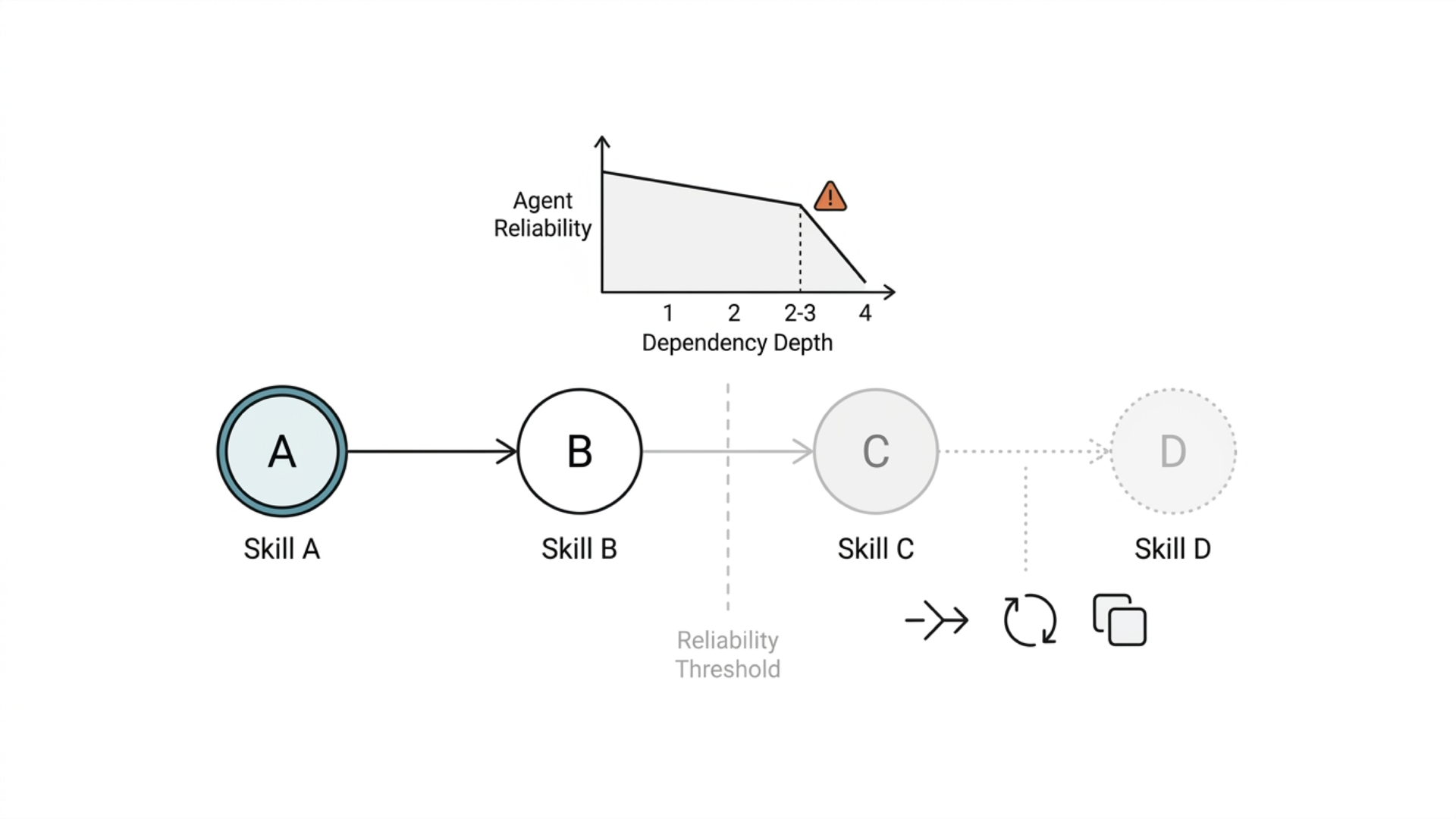 Fig 1. When dependency chains exceed 2–3 layers, agent reliability drops sharply.
Chemistry Thinking: A Three-Layer Skill Architecture
Splitting AI skills into atoms, molecules, and compounds gives each layer increasing autonomy with tighter reliability controls.
The fix isn't abandoning composition. It's layered composition.
Atoms: The smallest single-purpose skills. "Scrape a LinkedIn profile." "Validate an email format." "Search a topic." Atoms never call other skills. They're near-deterministic and require almost zero agent judgment.
Molecules: Compose 2–10 atoms into a scoped task. "Find prospects → validate emails → enrich data → add to spreadsheet." Molecules hard-code which atom fires when and in what order. The agent gets minimal discretion; the workflow skeleton is fixed.
Compounds: High-level orchestrators driving multiple molecules. "Run the outbound sales playbook." "Plan, build, review, and QA a feature." This is the layer where agents finally get meaningful autonomy — and where things are most uncertain, most in need of a human at the wheel.
Can you tell them apart? Atoms are screws. Molecules are components. Compounds are entire machines. Screws don't fail. Components occasionally jam. Machines need an operator watching.
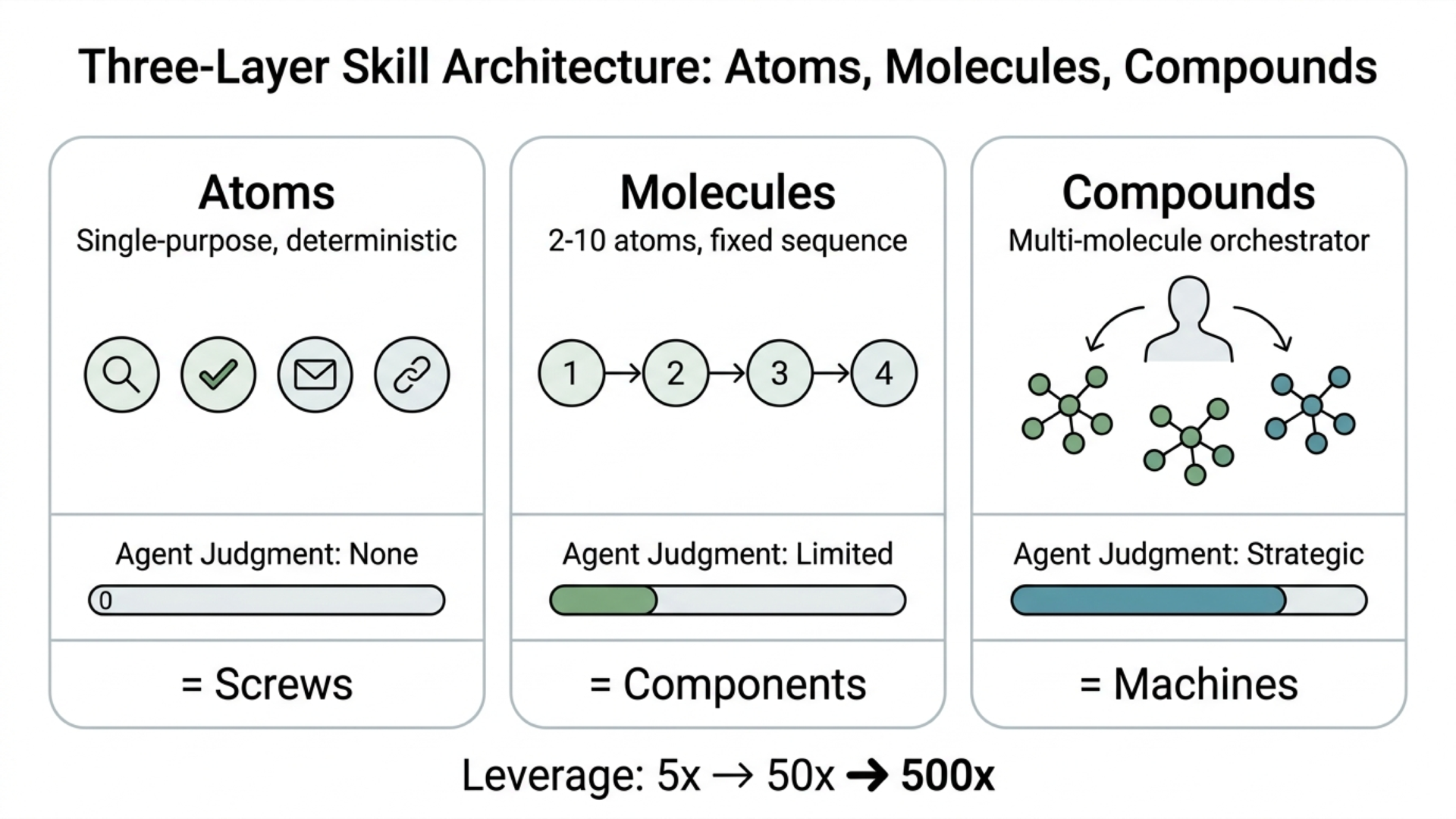 Fig 2. Atoms, molecules, and compounds: each layer trades autonomy for reliability.
The Leverage Math
Managing 5 threads with atoms yields 5 work units. With compounds, that same cognitive load yields 500 — a 100x difference.
Your brain can juggle roughly 5 parallel agents at once. That's a hard cap on cognitive bandwidth. Assume each compound orchestrates 10 molecules, and each molecule orchestrates 10 atoms:
Steering 5 atoms = 5 work units. Steering 5 compounds = 5 x 10 x 10 = 500 work units.
The brain-hours invested are nearly identical, but output differs by 100x. You shouldn't be manually steering a self-driving car. Let atoms and molecules run themselves. You handle direction at the compound layer.
Practical Operating Principles
First, atoms must be rock-solid. Every atom skill needs independent testing to ensure predictable output for consistent input. One flaky atom can cascade-fail the entire chain.
Second, molecules need explicit choreography. Don't write "use your judgment to decide when to search." Write "Step 1: search with Atom A. Step 2: filter with Atom B. Step 3: output with Atom C." Push composition logic into the skill itself. Minimize runtime decisions by the agent.
Third, compounds need a human driver. For now, compounds with more than 8–10 molecules hit a reliability ceiling. The human's job is strategic judgment at the compound layer: handling exceptions, confirming direction, course-correcting.
What if you skip compounds entirely and just use molecules? That doesn't work either. Molecules are rigid pipelines — they freeze when facing exceptions or strategic pivots. The compound layer's value is concentrating uncertainty into a single tier where a human drives. That's actually easier to control than uncertainty scattered everywhere.
Real-World Example and Limitations
The Gooseworks team has built a public skill library using this framework, with their own naming: Capabilities (atoms), Composites (molecules), Playbooks (compounds). They report the structure "works pretty well so far."
The biggest bottleneck isn't architecture design — it's testing. Every layer's reliability and consistency demands heavy testing investment. The framework also lacks standardized evaluation methods; different teams define "atom granularity" differently. One team's atom is another team's molecule. Automated testing solutions (like autoresearch-style frameworks) may eventually address this, but for now, manual testing remains unavoidable.
Why This Matters to You
AI tools are evolving from "one question, one answer" into "continuously running workflows." Whoever decomposes their daily work into atoms, assembles molecules, and orchestrates compounds fastest will be first to capture the 100x productivity leverage.
You don't need to code. But you do need to learn how to decompose and compose workflows.
What's one repetitive task in your daily work that could be broken into an "atom"? Think about it — then try automating it.
References
- Sakhuja, S. (2026). A new way to think about composing skills to increase leverage: Skill Graphs 2.0. X thread.
- Gooseworks Skills Library. skills.gooseworks.ai