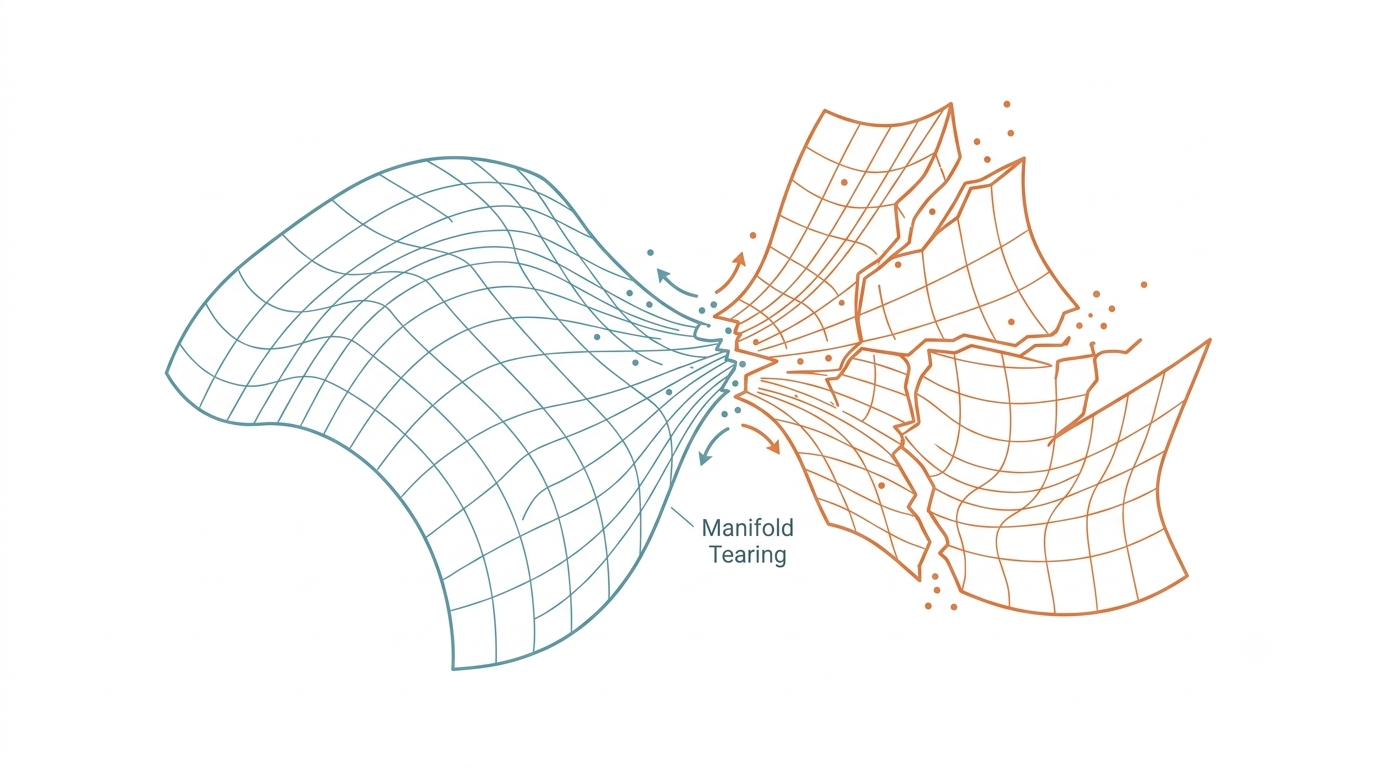
Three Months of Training, Destroyed on Day 47
You spent three months training a large language model. Loss was dropping steadily. Then on day 47, it spiked to the ceiling. The entire run, wasted. Not bad luck. A structural design flaw.
Mixture of Experts (MoE) is one of the most efficient model architectures today: 8 experts, only 2 active at a time, achieving near-dense-model performance at a quarter of the compute cost. Sounds perfect? This elegant design hides a ticking time bomb. The DeepSeek V4 team's 2026 technical report dissected it using the language of differential geometry. They call it manifold tearing.
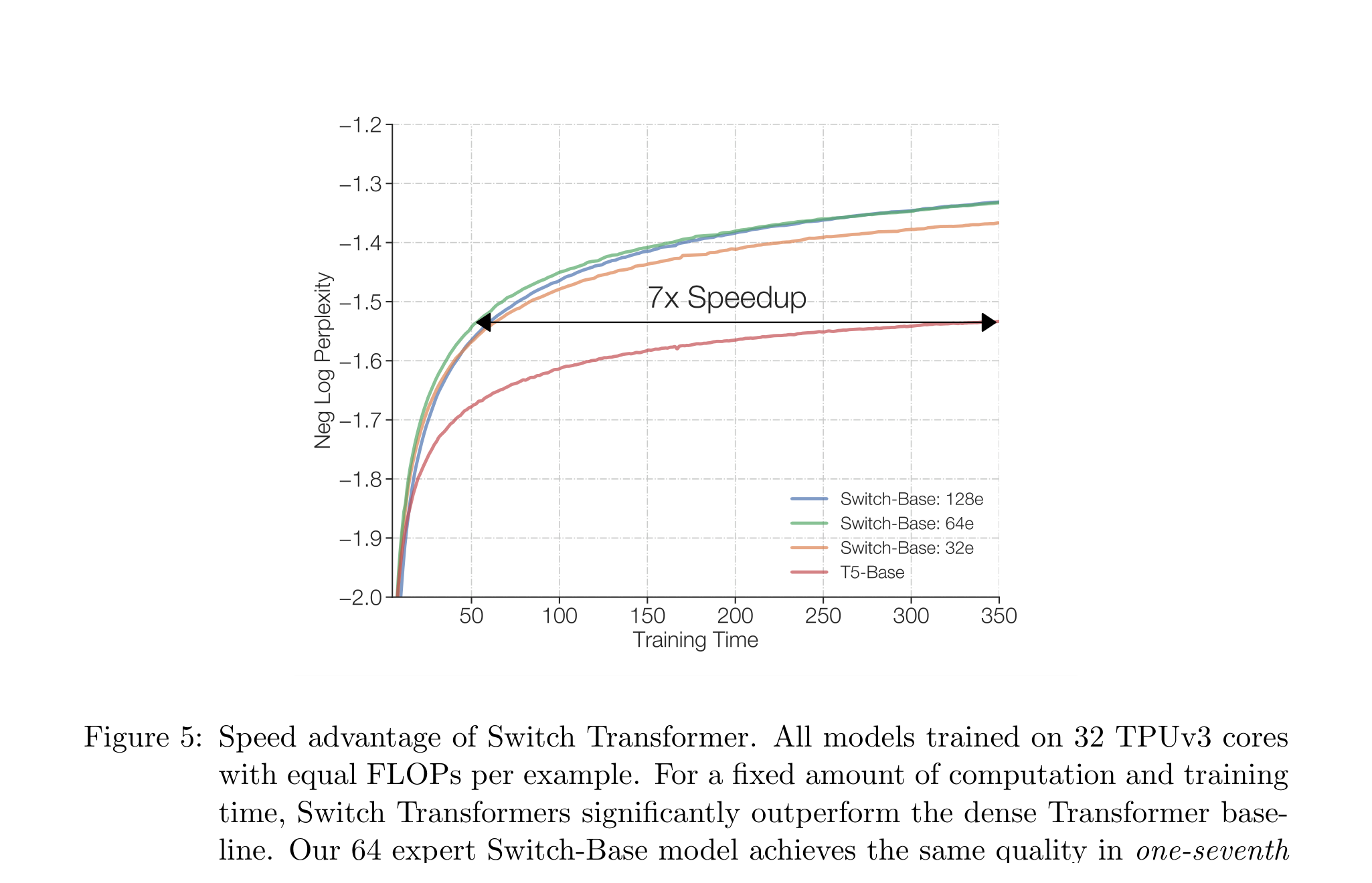 Figure 3: With equal compute resources, a 64-expert Switch Transformer reaches T5-Base quality seven times faster. The efficiency advantage of MoE is clear, but it comes with structural training stability risks. Adapted from Fedus et al. (2022), JMLR, Figure 5.
A Rubber Sheet Is All You Need to Understand
What is manifold tearing? Picture the model's representation space as a soft rubber sheet. Training gradually deforms this sheet so that inputs map to correct outputs.
In a dense model, all parameters share the load. Force is distributed. The sheet stretches smoothly. No problem.
MoE works differently. The router makes an instant decision for every token: you go to Expert A, you go to Expert B. Adjacent tokens get tossed to different experts, which is like pulling the same small patch of the rubber sheet in completely opposite directions.
Pull long enough, and it tears. Representation continuity breaks. Gradient signals can't propagate. Training collapses.
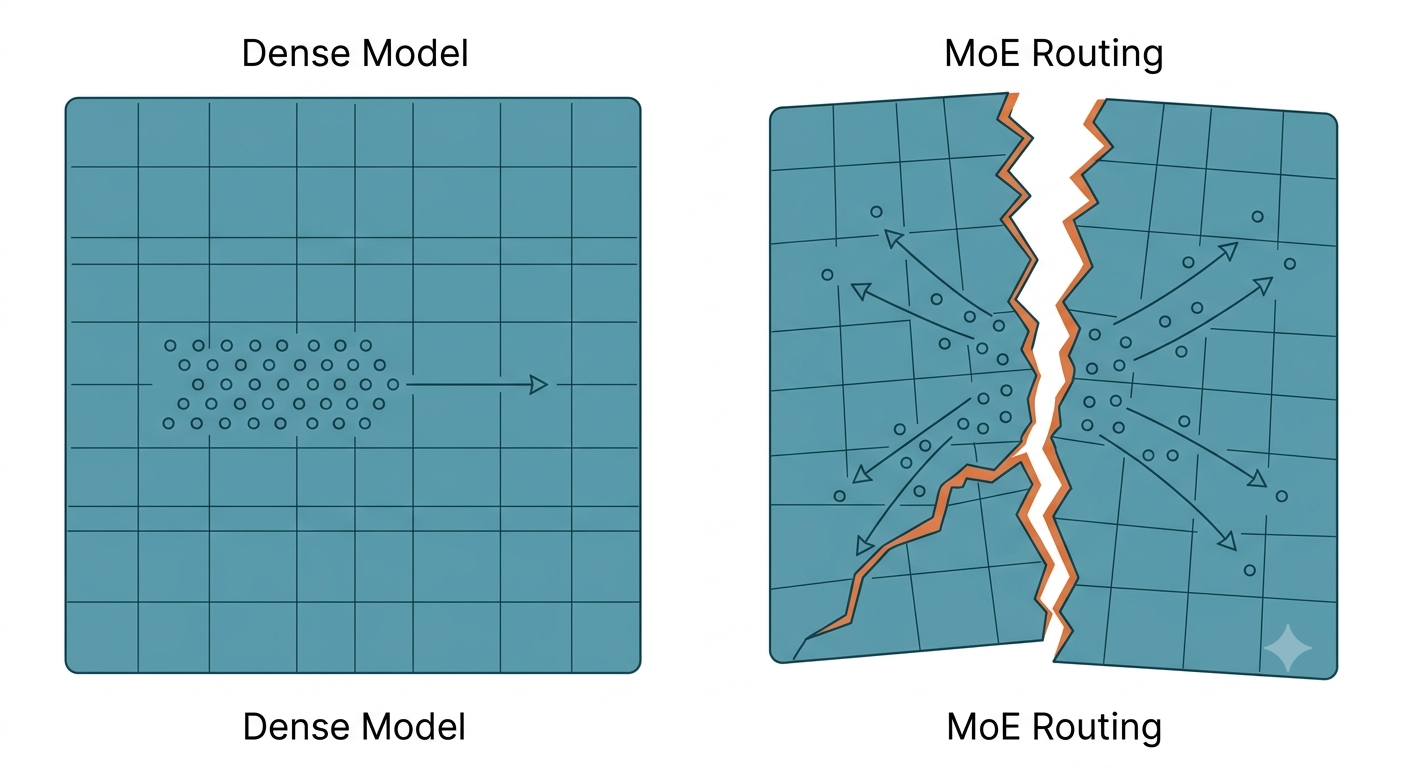 Figure 1: MoE routing switches cause adjacent tokens in representation space to be pulled in opposing directions, leading to manifold tearing.
How DeepSeek V4 Stitches the Sheet Back Together
Chopping Off the Spikes: SwiGLU Activation Clamping
The SwiGLU activation function can produce enormous outputs at extreme inputs. These outliers are like spikes on the rubber sheet, where tears begin. DeepSeek's fix is blunt: hard-clamp the output. Mathematically, it caps local curvature. A small sacrifice in expressiveness for global stability.
Stop Shredding Sentences: Anticipatory Routing
Traditional routers only see the current token, ignoring context. Semantically continuous sentences get randomly sliced apart. It's like having a conversation cut in half mid-sentence, with each half sent to a different translation agency. Good luck getting coherent output.
Anticipatory Routing lets the router consider surrounding context tendencies, keeping semantically related tokens on the same expert group. Geometrically, this smooths the routing boundary from a sharp fracture into a gradual transition zone.
Allowing Short-Term Unfairness: Modified Birkhoff Constraint
MoE's load balancing loss demands equal expert utilization. But overly strict fairness forces the router to violate semantics. Expert A is clearly the best fit, but A is full, so it gets shoved to Expert C.
The mHC Birkhoff Constraint relaxes this: short-term imbalance is fine, as long as long-term statistics converge to equilibrium. Think of it as a flexible work schedule. Today one team member takes extra shifts; tomorrow they get compensated.
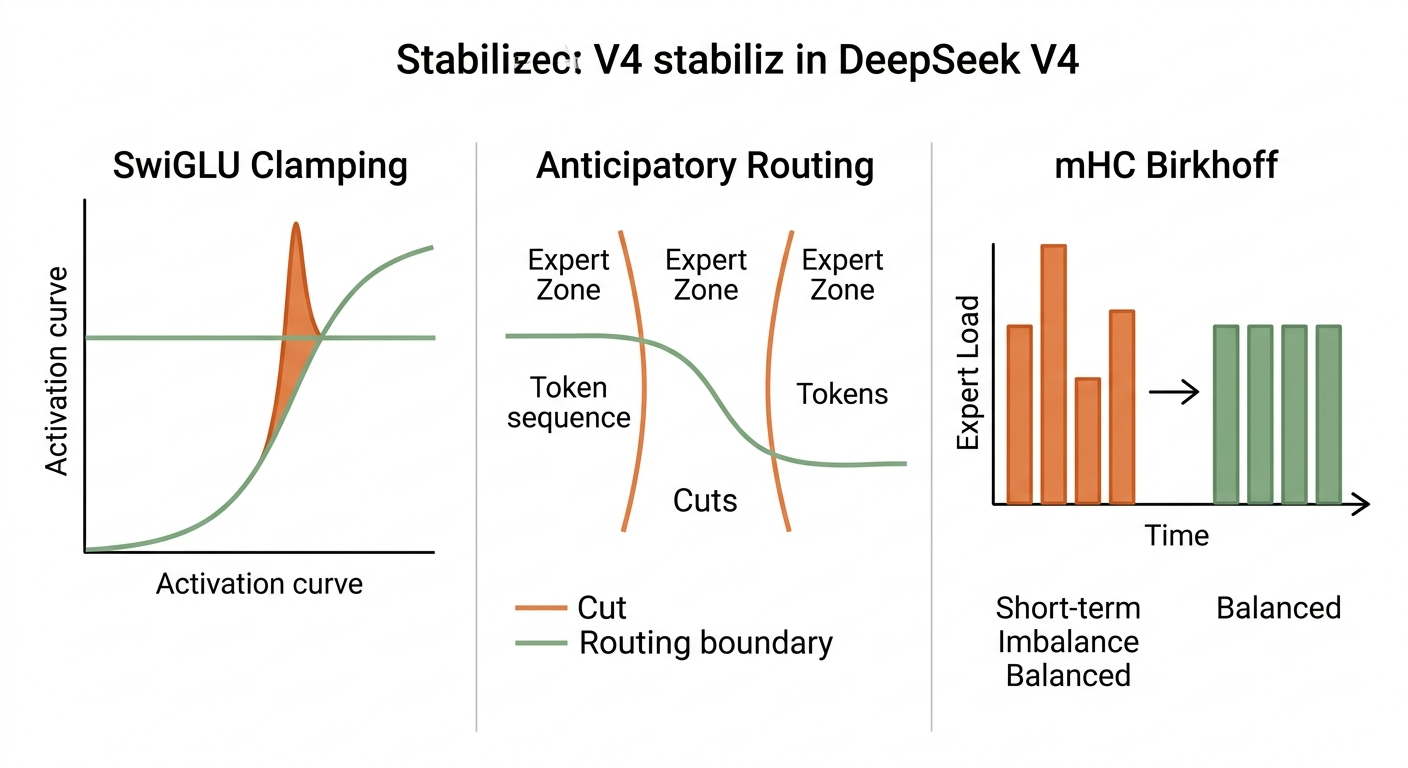 Figure 2: DeepSeek V4's three-pronged stabilization: activation clamping, anticipatory routing, and modified Birkhoff constraint, each preventing manifold tearing from a different angle.
But These Three Moves Aren't a Silver Bullet
Can this approach completely eliminate manifold tearing? Probably not yet. DeepSeek V4 was validated at a specific scale: 256 experts, 671B parameters. Whether it holds at larger scales remains an open question with no public data.
Another concern: SwiGLU Clamping fundamentally truncates information. Could this accumulate into subtle quality degradation on generative tasks? Several independent reproduction reports hint at 0.3-0.5% perplexity regression, but the DeepSeek team hasn't directly addressed this.
The research scope is also limited. All three techniques were tested exclusively on Transformer decoder-only architectures. Whether they apply to encoder-decoder or emerging SSM hybrid architectures remains an open question.
Two Takeaways for You
Using MoE for fine-tuning? Most open-source models are already MoE. If your run mysteriously crashes, don't rush to change the random seed. Check whether your learning rate conflicts with routing dynamics. Rule of thumb: MoE safe learning rates are typically 50-70% of dense model rates.
A biologist? This geometric framework extends beyond AI. During cell differentiation, stem cells at fate decision points get pushed toward different attractor basins. When transitions are too abrupt without intermediate state buffers, the cliff on the Waddington landscape is essentially the biological version of manifold tearing.
FAQ
Q: Do all MoE models experience manifold tearing? No. Small-scale (<10B parameters) MoE with few experts (≤8) have much lower tearing risk. The problem concentrates in large-scale architectures with more than 64 experts.
Q: Can MoE fine-tuning also crash? Yes. When learning rates are too high or batch sizes don't match routing dynamics, gradient explosions can occur. Use a lower learning rate (50-70% of dense model rates) with 500+ steps of warm-up.
Q: What does Waddington landscape have to do with AI training? Both involve bifurcation on a manifold. Cell differentiation and expert routing face the same structural challenge of being pushed in different directions at decision points. The difference: biology has built-in epigenetic buffering, while AI requires engineered stabilization.
References
- DeepSeek AI. "DeepSeek V4 Technical Report." arXiv, 2026.
- Fedus, W., Zoph, B., & Shazeer, N. "Switch Transformers: Scaling to Trillion Parameter Models with Simple and Efficient Sparsity." JMLR, 2022.
- Birkhoff, G. "Three Observations on Linear Algebra." Univ. Nac. Tucuman Rev., 1946.
- Waddington, C. H. The Strategy of the Genes. Allen & Unwin, 1957.