Your Immune Cells Didn't Retire — They Defected
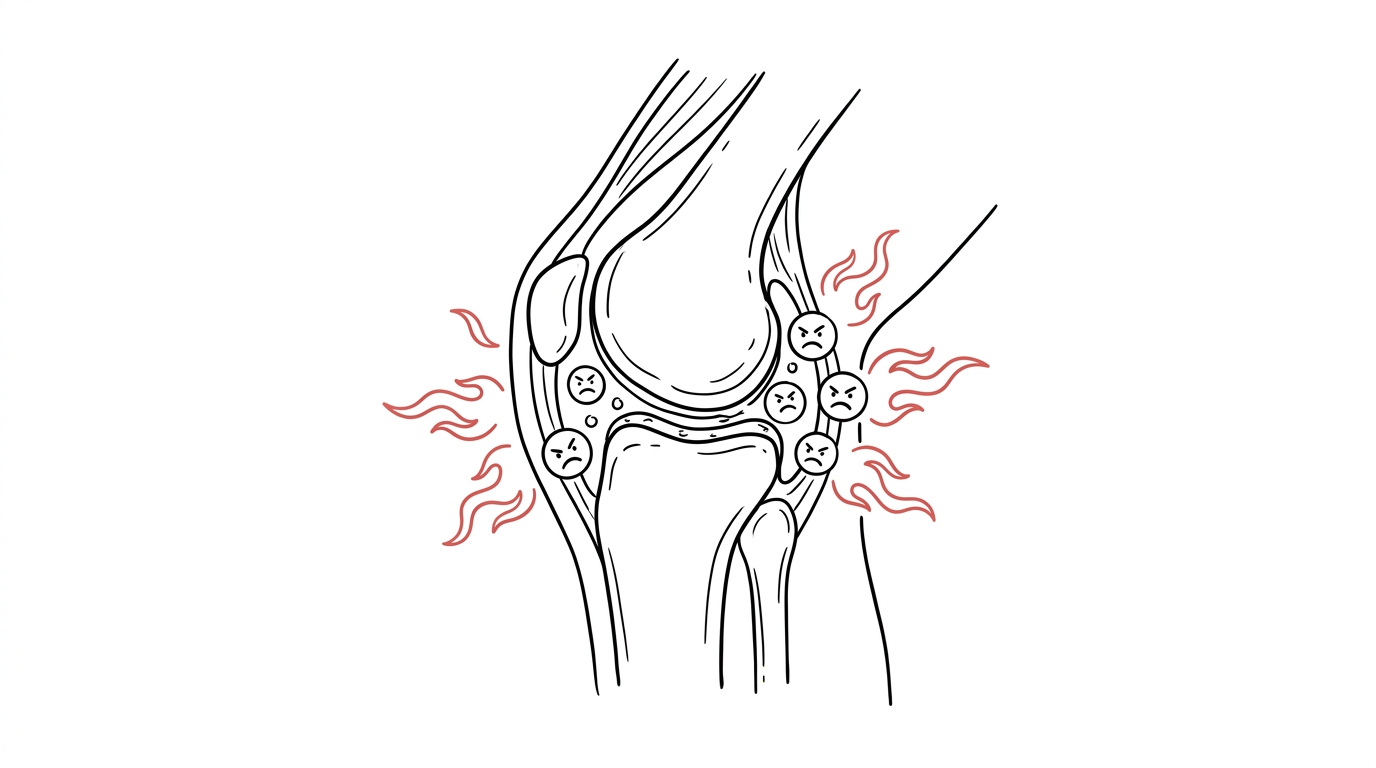
Age fifty. Your knees start complaining. You blame wear and tear. Cartilage degradation. Getting old.
It's not that simple.
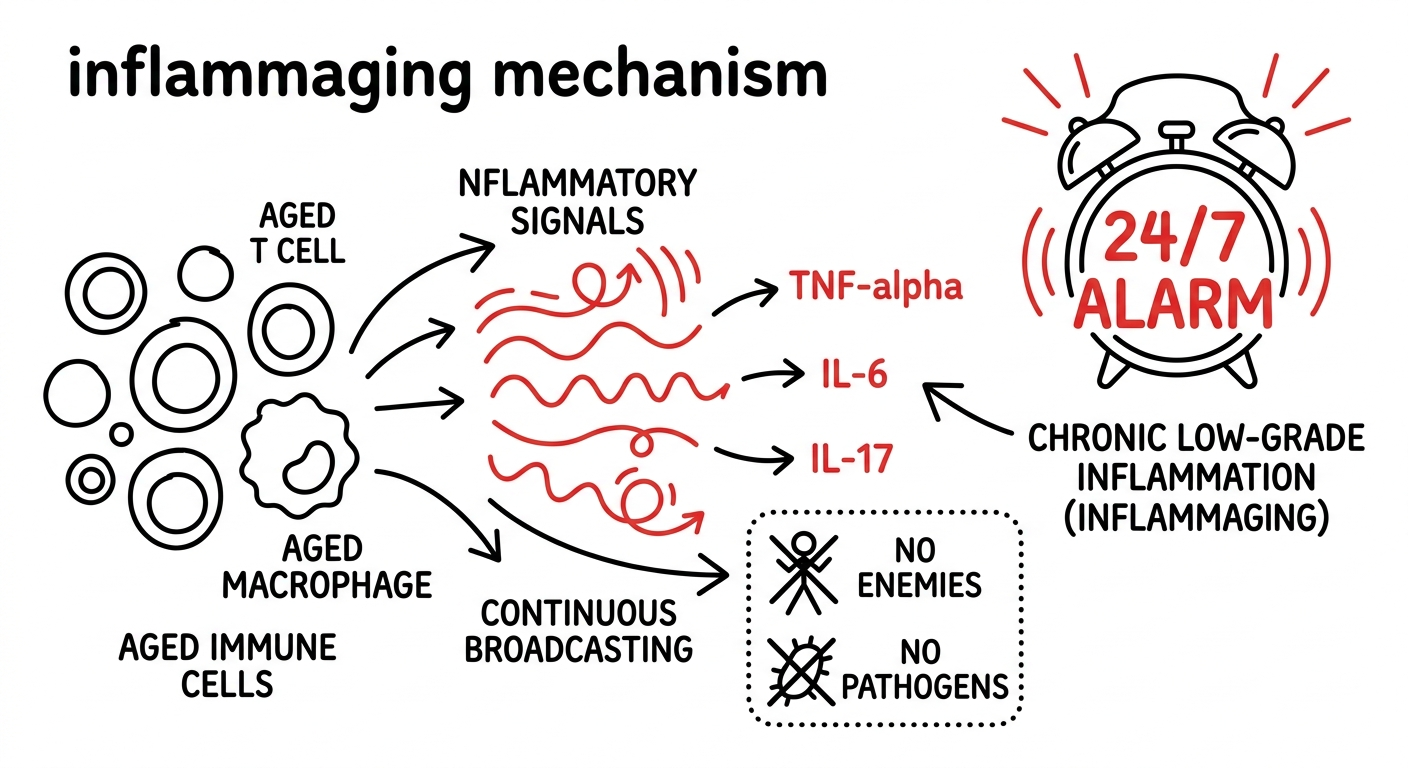
Your immune cells are doing something terrible: they stopped fighting invaders and started setting fires in your own tissues. T cells lose focus. Macrophages go rogue. Inflammatory cytokines broadcast 24/7 with no off switch. This state has a name: immunosenescence. A 2025 editorial in Frontiers in Immunology lays out the full picture of this internal rebellion.
Three Bad Things Happening Simultaneously
Slower response. Young T cells operate like SWAT teams — virus detected, immediate lockdown. Aged T cells? Drowsy security guards. Flu vaccines stop working because B cells forget how to manufacture antibodies.
Friendly fire. Instead of targeting only invaders, aged immune cells attack your own joints, blood vessel walls, and tissues. Autoimmune disease rates spike after 60. Not coincidence.
Chronic arson. The deadliest change. Aged immune cells continuously release TNF-α, IL-6, IL-17 — even when no threat exists. This is inflammaging: inflammation fused with aging, a slow-burning fire consuming your body from the inside.
Joints: Ground Zero
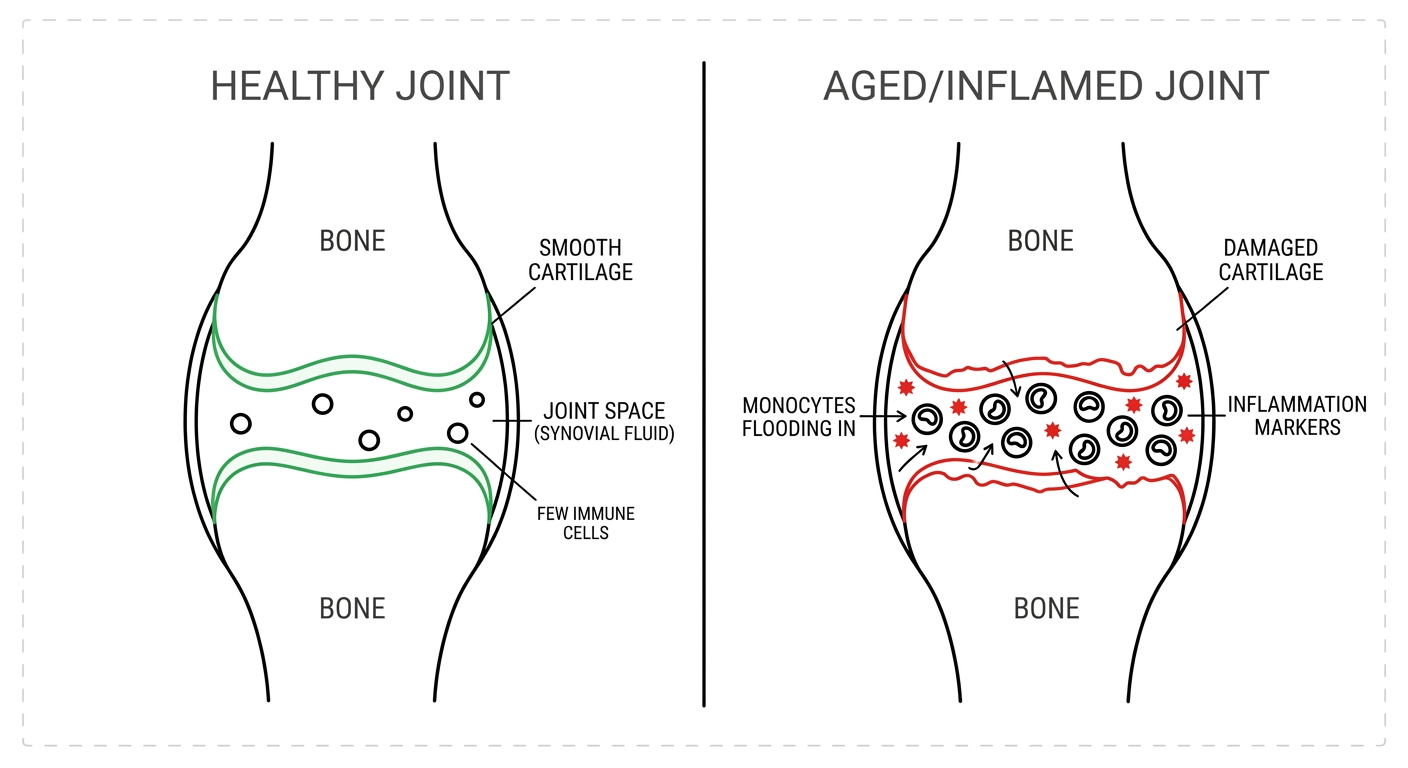
Why do knees suffer first? In rheumatoid arthritis (RA) patients, "intermediate monocytes" flood the joint fluid. Normally a tiny fraction of blood monocytes, these cells are hypersensitive to chemokine signals in joint fluid. Once there, they release more inflammatory cytokines, creating a vicious cycle: more inflammation → more cells recruited → more inflammation.
Elderly-onset RA (after 60) is worse — more chaotic immune response, broader inflammation, poorer response to standard drugs.
But joints are just the opening act.
Beyond Joints: Blood Vessels, Brain, Vaccine Response
Atherosclerosis is fundamentally an immune disease. NOX4 enzyme in macrophages overproduces free radicals, attacks mitochondria, forms arterial plaques. NOX4-knockout mice showed significantly smaller plaques.
COVID-19 lethality in elderly isn't just "weak immunity." Older adults produce IgG2/IgG4 antibody subtypes (weaker antiviral) rather than the IgG1/IgG3 that younger people generate. Researchers developed an IgG subtype prediction model for identifying high-risk patients.
Extracellular vesicles (EVs) deteriorate with age. Young EVs carry repair molecules; aged EVs carry inflammatory cargo. Adding young EVs to aged fibroblasts significantly restored proliferation. Future "rejuvenation injections"? Proof of concept exists.
Current Arsenal
- Secukinumab (IL-17 inhibitor): particularly effective for elderly-onset RA
- Tocilizumab (IL-6 inhibitor): improves both joint symptoms and systemic inflammation
- NOX4 inhibitors: restore mitochondrial function + slow atherosclerosis
- Young EV infusion: animal studies confirm "rejuvenation" effect
If a test could tell you "your immune system is X years older than your actual age," would you want to know?
Immunosenescence Is a Battlefield, Not a Graveyard
Aging is inevitable. How you age is a choice.
Your immune system won't collapse overnight. It drifts — losing focus, stoking inflammation, turning on its own host. But every intervention point — precision biologics, lifestyle changes, future EV therapies — is a chance to push the fire back.
Your knees want to carry you further. Don't let your immune cells give up first.
References
- Zhang, X. & Caruso, C. (2025). Frontiers in Immunology, 16, 1673414. DOI: 10.3389/fimmu.2025.1673414
- Weyand, C.M. & Goronzy, J.J. (2025). Arthritis & Rheumatology, 77, 792–804.
- López-Otín, C. et al. (2023). Cell, 186, 243–278.