When was the last time you thought about your intestines?
Probably when they started causing problems. Bloating, brain fog, breakouts, random allergies — things that seem completely unrelated but might share a single root cause: Leaky Gut.
But I'm not here to tell you to take a probiotic.
I want to tell you something stranger: the molecule keeping your gut in order is the same gas you breathe out.
CO2: The Bouncer Your Gut Can't Work Without
We were all taught that CO2 is a waste product. Your body makes it, you exhale it, end of story.
Your colon disagrees.
Deep inside your large intestine, colonocytes — the cells lining your gut wall — are constantly burning glucose. The main output? Enormous quantities of CO2. This isn't a metabolic accident. It's a deliberate design.
That CO2 dissolves into the intestinal fluid, forming carbonic acid and dropping the local pH. That acidic environment becomes the dividing line between who lives and who dies among your 38 trillion gut bacteria: acid-tolerant bacteria thrive; acid-sensitive pathogens collapse.
CO2 does something else too: it displaces oxygen. That sounds counterintuitive, but your colon is supposed to be hypoxic — nearly oxygen-free. Gram-negative bacteria (the troublemakers) can run on oxygen for energy and will proliferate explosively if given the chance. Gram-positive Firmicutes (the beneficial ones) are anaerobic; they need low oxygen to survive.
CO2 is the gut's security system. When your colonocytes can't burn glucose efficiently, the bouncer clocks out — and the doors open to everything.
A sluggish metabolism doesn't just make you tired. It turns your gut into an abandoned factory with the front door left wide open.
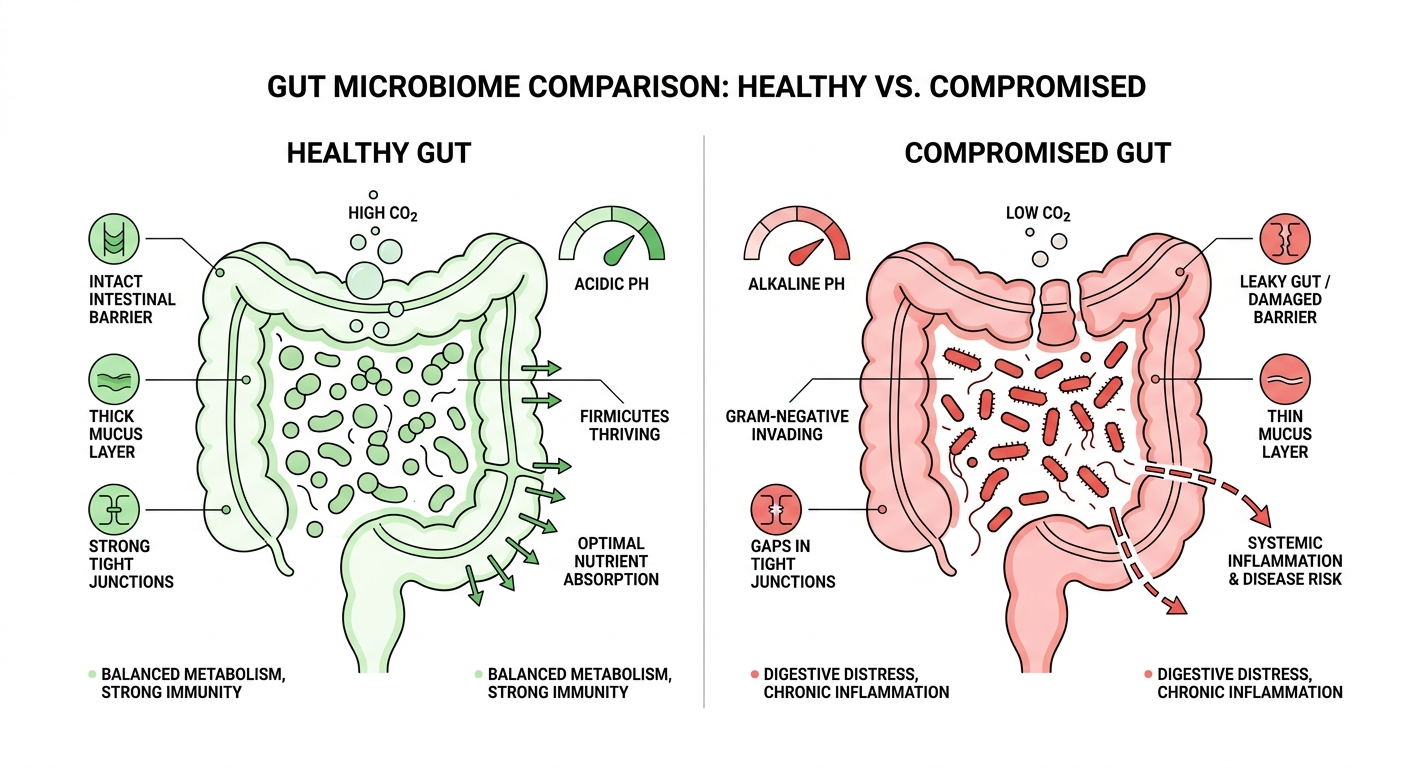 Figure 1: Healthy gut (high CO2, acidic, beneficial bacteria thriving) vs compromised gut (low CO2, alkaline, pathogens invading)
Three Walls, All Burning Energy at Once
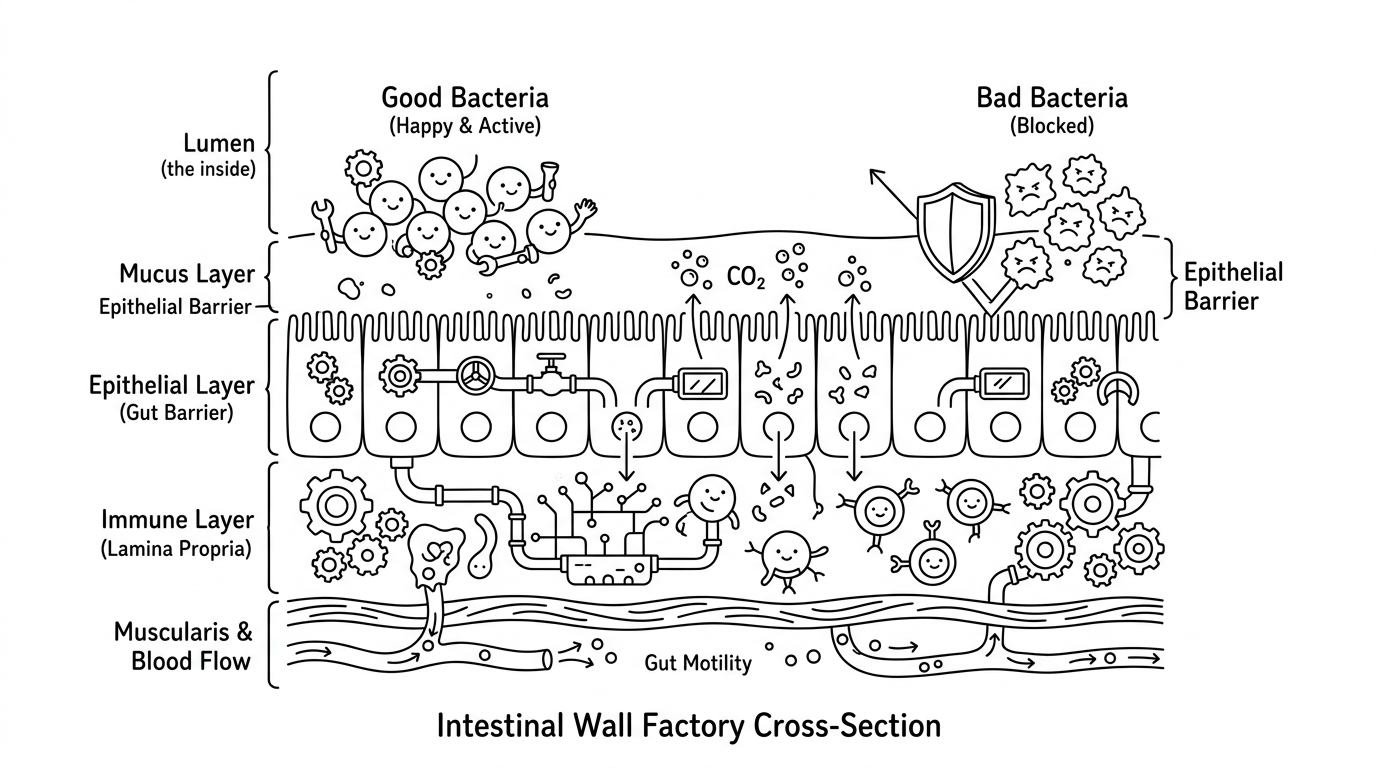
Your gut barrier isn't a single wall. It's three.
Layer 1: The Mucus Layer
Your large intestine is coated in two layers of mucus. The inner layer is dense and sterile — bacteria simply can't penetrate it. The outer layer is looser, acting as a habitat for beneficial bacteria to colonize without actually touching the epithelium.
The cells responsible for all of this are goblet cells, which continuously secrete a glycoprotein called MUC2 — roughly 80% sugar, 20% protein. The sugar chains form the protective shield; the protein provides structural backbone. Synthesizing MUC2 requires significant ATP, along with Glycine, Proline, and Aspartic Acid as building blocks.
Supplementing with beef gelatin for Glycine and Proline isn't a wellness trend. It's providing raw materials for wall construction.
Layer 2: The Epithelial Layer
Around 150 billion epithelial cells, membranes tightly fused together, forming the physical frontier. These cells generate about 10% of the body's ATP but consume around 20%. Where does the gap come from? From Butyrate — a short-chain fatty acid produced when your beneficial bacteria ferment dietary fiber.
Good bacteria feed the epithelium. The epithelium maintains the barrier. The barrier protects the bacteria. It's a mutual dependency — but it requires the bacteria to be there in the first place.
Layer 3: The Lamina Propria
Sitting just beneath the epithelium, the lamina propria houses 70–80% of your entire immune system. B cells secrete IgA antibodies directly into the mucus layer to neutralize pathogens before they even reach the wall. T cells coordinate the response. Dendritic cells act as scouts, extending probes into the gut lumen and sampling what's passing through.
Every single layer demands energy. When metabolic rate drops, all three walls weaken simultaneously.
Anxiety, Bloating, and B6 — A Connection Nobody Told You About
Have you ever experienced anxiety and digestive problems at the same time?
The standard medical response: SSRI for the anxiety, low-FODMAP diet for the gut, and a lifelong IBS label to tie the whole package together.
But there's an underlying mechanism that rarely gets checked: Is your vitamin B6 status adequate?
B6 is an essential cofactor for neurotransmitter synthesis throughout the enteric nervous system. Specifically, it converts the excitatory amino acid Glutamate into the inhibitory neurotransmitter GABA.
When B6 is insufficient: Glutamate accumulates, GABA production falls, and the nervous system tips toward hyperexcitability — manifesting as anxiety, insomnia, and sensory hypersensitivity in the brain.
But GABA doesn't only regulate your mood. It simultaneously regulates enteric nervous system signaling and gut motility. Without adequate GABA in the gut, peristalsis becomes dysregulated. Food sits and ferments. Bacteria throw a party. Bloating follows.
Brain anxiety and gut bloating may both be the same B6 deficiency expressing itself at both ends of the gut-brain axis simultaneously.
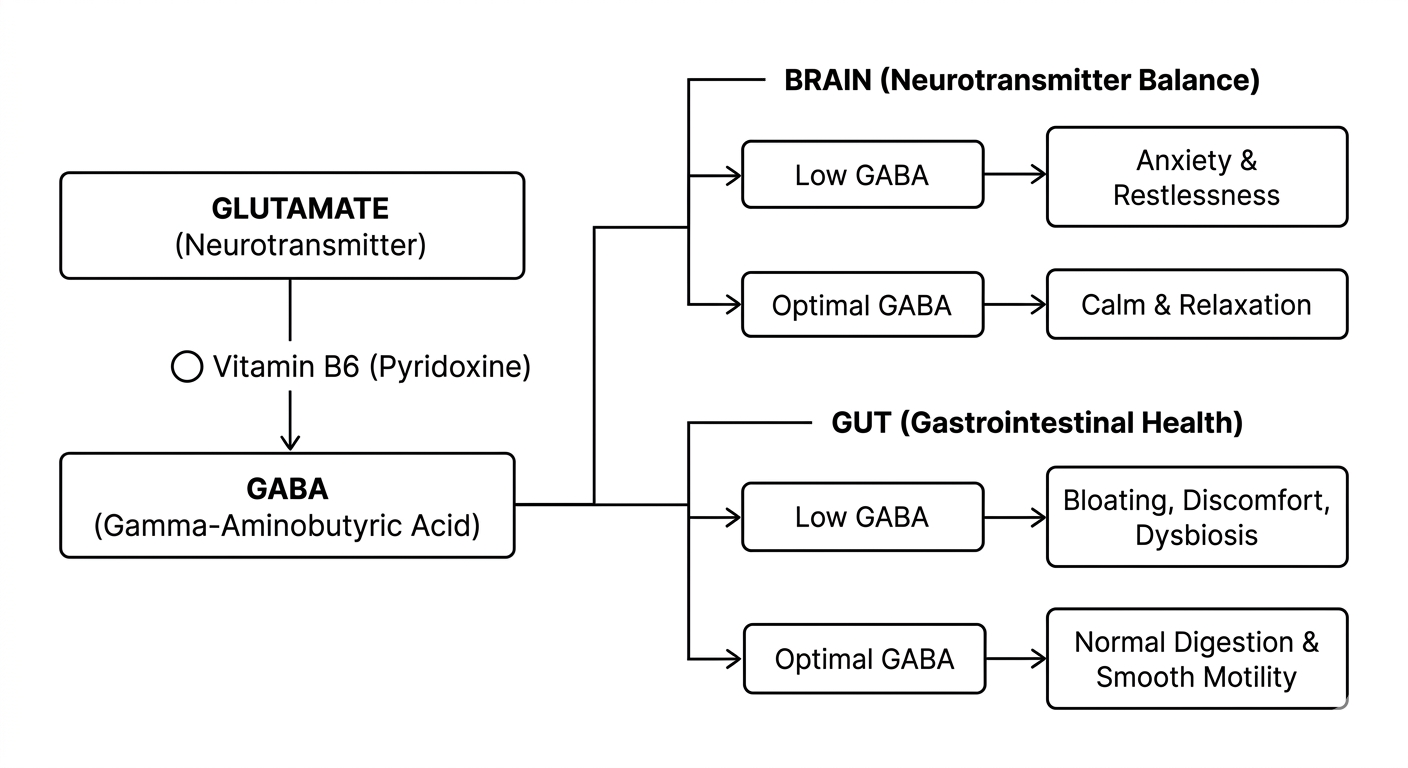 Figure 2: B6 converts Glutamate to GABA — affecting both the brain (anxiety ↔ calm) and the gut (bloating ↔ normal motility)
That's not two problems. That's one upstream cause.
Stress Depletes Magnesium. Magnesium Deficiency Amplifies Stress.
There's another vicious cycle that might be running in your body every single day — silently.
Magnesium is a cofactor for over 600 enzymatic reactions, including ATP synthesis itself. The biologically active form of cellular energy isn't just ATP — it's Mg-ATP. Without magnesium bound to it, ATP can't be properly utilized.
Here's where the loop starts: stress triggers the kidneys to excrete more magnesium. As magnesium drops, NMDA receptors — excitatory glutamate receptors in the brain — become overactive, driving up Cortisol. Elevated Cortisol signals the kidneys to excrete even more magnesium.
Stress depletes magnesium → magnesium deficiency amplifies the stress response → more stress depletes more magnesium.
This cycle is practically standard issue for modern life. What makes it harder to catch: serum magnesium on a standard blood panel often reads normal. Your body prioritizes maintaining blood magnesium by pulling it from inside cells first. The numbers look fine. The cells are already running on empty.
RBC Magnesium (red blood cell magnesium) is a far more accurate reflection of true intracellular status.
Three Things You Can Do Starting Today
You don't need to overhaul everything at once. Start here.
1. Give your gut wall cells actual fuel
Colonocytes run on glucose and Butyrate. Simple sugars from fruit, juice, and well-cooked potatoes are absorbed in the small intestine — they don't reach the colon to feed pathogenic bacteria. Bone broth and beef gelatin supply Glycine and Proline, the structural components your mucus layer needs.
What you eat today determines how many bricks your gut wall has to work with tomorrow.
2. Test your B6 and magnesium status properly
If you're dealing with anxiety and digestive issues simultaneously, consider testing plasma PLP (pyridoxal 5'-phosphate) — the active form of B6 — and RBC Magnesium. Standard serum magnesium can mislead you.
When supplementing B6, the P5P form (pre-activated) bypasses hepatic conversion and is generally safer for higher-dose use.
3. Support metabolic rate — don't just swap bacteria
Before buying another probiotic, ask yourself: Is the gut environment actually hospitable to beneficial bacteria? Is there enough CO2 being produced? Is the lumen acidic enough? Dropping new bacteria into a broken environment is like hiring staff for a factory with no power.
Improving metabolic function, supporting thyroid health, and reducing endotoxin (LPS, lipopolysaccharide) burden creates the conditions where good bacteria can actually survive and thrive.
A Question to Leave You With
Your gut is fighting a war every day. When it's winning, you have energy, mental clarity, and clear skin. When it's losing, you're exhausted, foggy, and vaguely unwell without being able to name exactly why.
But the outcome of that war isn't decided by whichever probiotic is on sale.
It's decided by energy, structure, and a handful of small molecules — CO2, GABA, magnesium — present in the right concentrations, in the right places, doing exactly what they're designed to do.
Where do you think your gut stands right now?
Drop a comment. Let's keep connecting the dots.