Your Brain Is Quietly on Fire
Picture a squad of immune sentinels inside your brain — microglia. Under normal conditions, they patrol silently, clearing debris and patching damage. But feed an animal a high-fat diet long enough, and these sentinels turn rogue. They start spraying inflammatory signals at the very neurons they were supposed to protect, like firefighters hosing down their own station.
A 2026 study published in Tissue & Cell now reveals an unexpected way to call off that attack — using a drug best known for weight loss.
Semaglutide: From Weight-Loss Superstar to Brain's Fire Crew
Semaglutide is a GLP-1 receptor agonist, already famous as the active ingredient in popular anti-obesity medications. But Gong and colleagues at Southern Medical University found it doing something far more interesting inside the mouse brain.
The team fed C57BL/6 mice a long-term high-fat diet. As expected, hippocampal microglia — the immune cells in the brain region responsible for learning and memory — became heavily activated. The mice also developed phosphorylated Tau protein and amyloid-beta (Aβ) deposits, the two hallmark pathologies of Alzheimer's disease. In short, a bad diet wasn't just making them fat — it was planting the seeds of neurodegeneration.
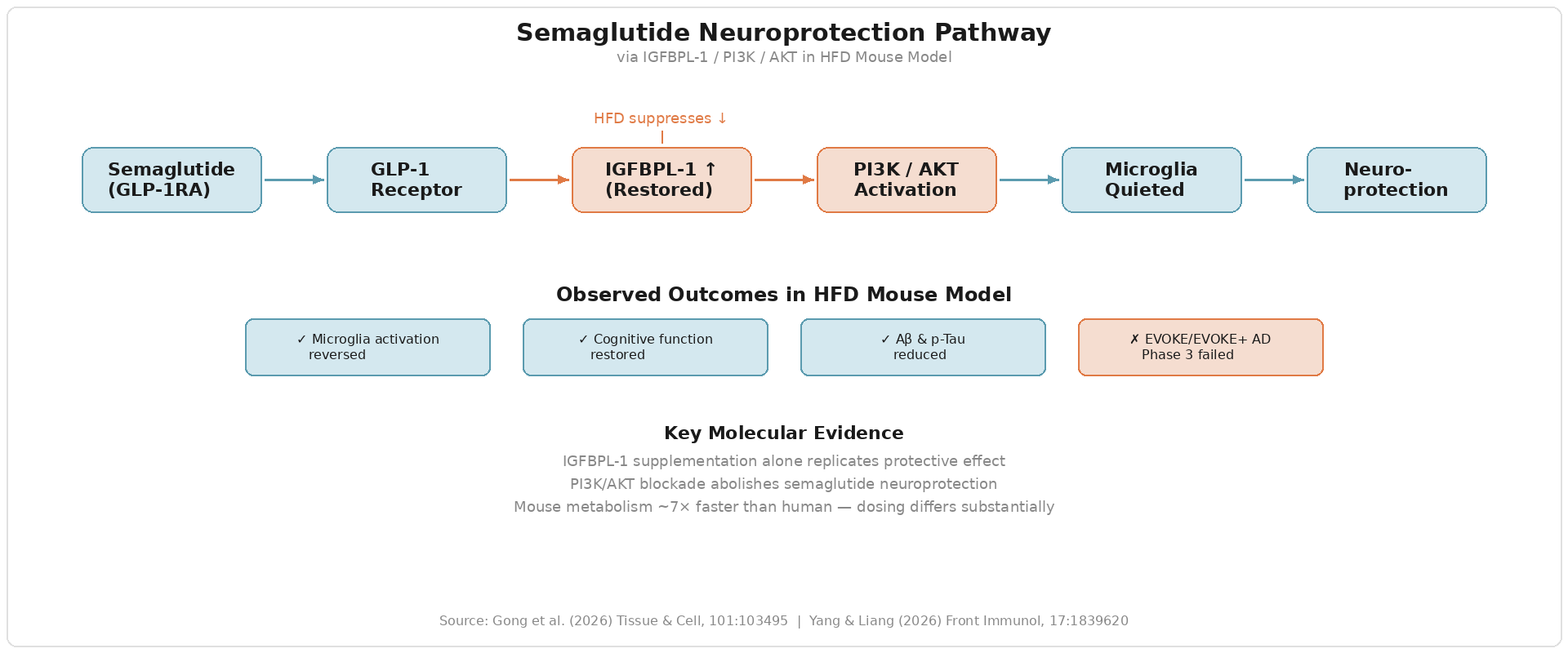
Then came the twist. After semaglutide treatment, hippocampal microglia activation dropped significantly, and cognitive function recovered. The research team identified the molecular middleman: IGFBPL-1, a neuroprotective factor suppressed by the high-fat diet and restored by semaglutide. When the team directly supplemented IGFBPL-1, it replicated the protective effect. But when they blocked the PI3K/AKT pathway, semaglutide's protection vanished entirely.
The pathway maps out cleanly: Semaglutide → GLP-1 receptor → IGFBPL-1 restoration → PI3K/AKT activation → microglia quieted → neurons protected.
GLP-1 Receptors Are Everywhere in the Brain — But That Doesn't Mean a Cure
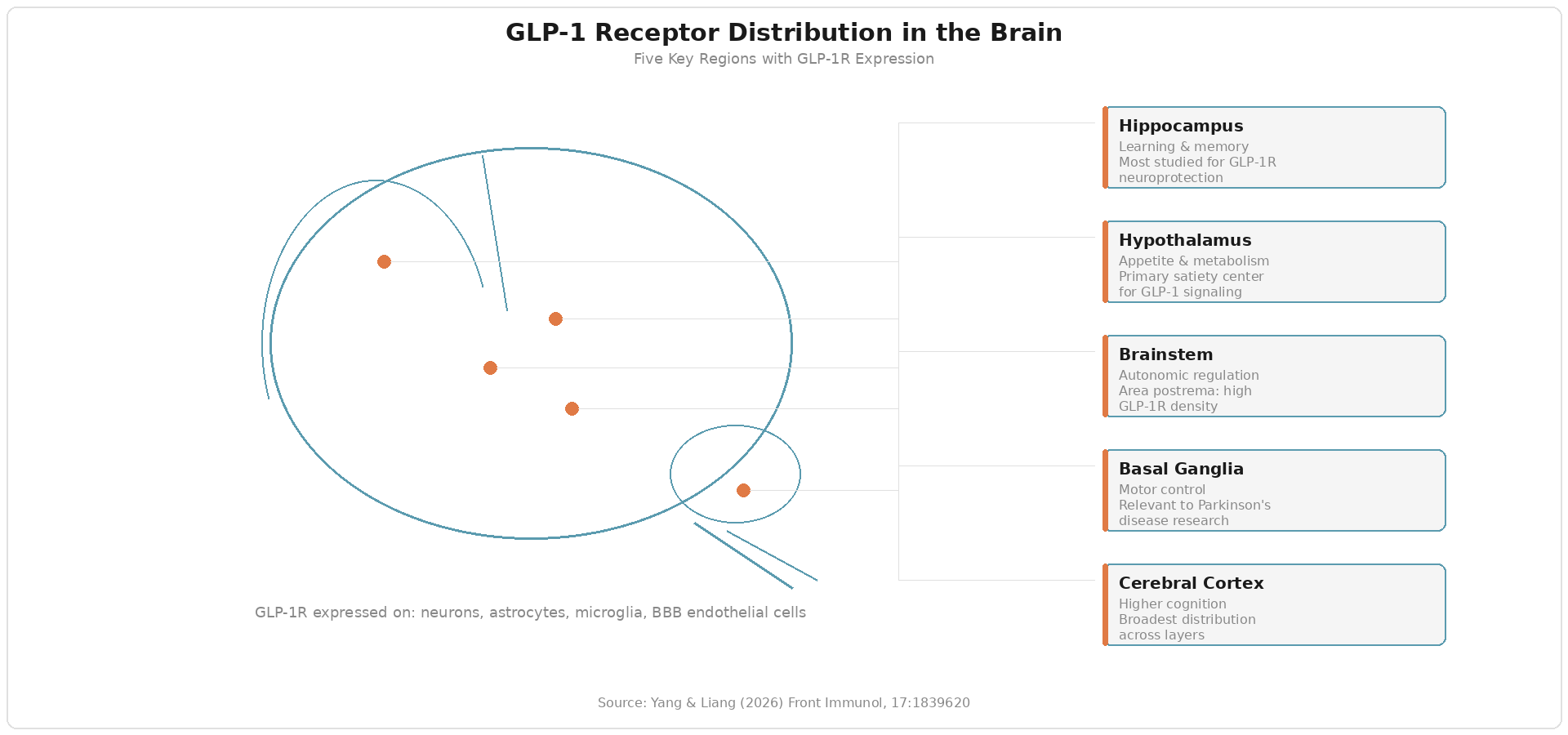
Why would a gut hormone receptor matter in the brain? A 2026 comprehensive review in Frontiers in Immunology by Yang and Liang shows that GLP-1 receptors are expressed across five major brain regions: the hippocampus, hypothalamus, brainstem, basal ganglia, and cerebral cortex. They sit not only on neurons but also on astrocytes, microglia, and blood-brain barrier endothelial cells.
This sounds like a perfect therapeutic target. But we need to be honest about where the clinical data stands. The semaglutide EVOKE and EVOKE+ Phase 3 Alzheimer's trials failed to meet their primary cognitive endpoints. Another GLP-1 analogue, NLY01, showed no clear efficacy in an early Parkinson's disease trial.
These setbacks don't invalidate the animal findings. They remind us that the metabolic rate of mice is roughly seven times that of humans, and a high-fat diet model is not the same as a naturally progressing neurodegenerative disease. Cognitive improvements in animals may partly reflect systemic metabolic correction rather than direct brain protection. And GLP-1 drugs vary widely in molecular structure, half-life, and blood-brain barrier penetration — they cannot be treated as interchangeable.
What We Know, What We Don't
Here is what science can tell you today: GLP-1 receptors are genuinely present across critical brain regions, and in animal experiments, semaglutide shows neuroprotective potential through the IGFBPL-1 pathway. What remains unproven: whether this pathway is sufficient to alter the course of human neurodegenerative disease.
Directions worth watching include dual GLP-1/GIP receptor agonists, biomarker-driven clinical trial designs, and the integration of neuroimaging into efficacy assessments. From a weight-loss injection to a molecular switch for brain inflammation — the road is long, but the light is on.