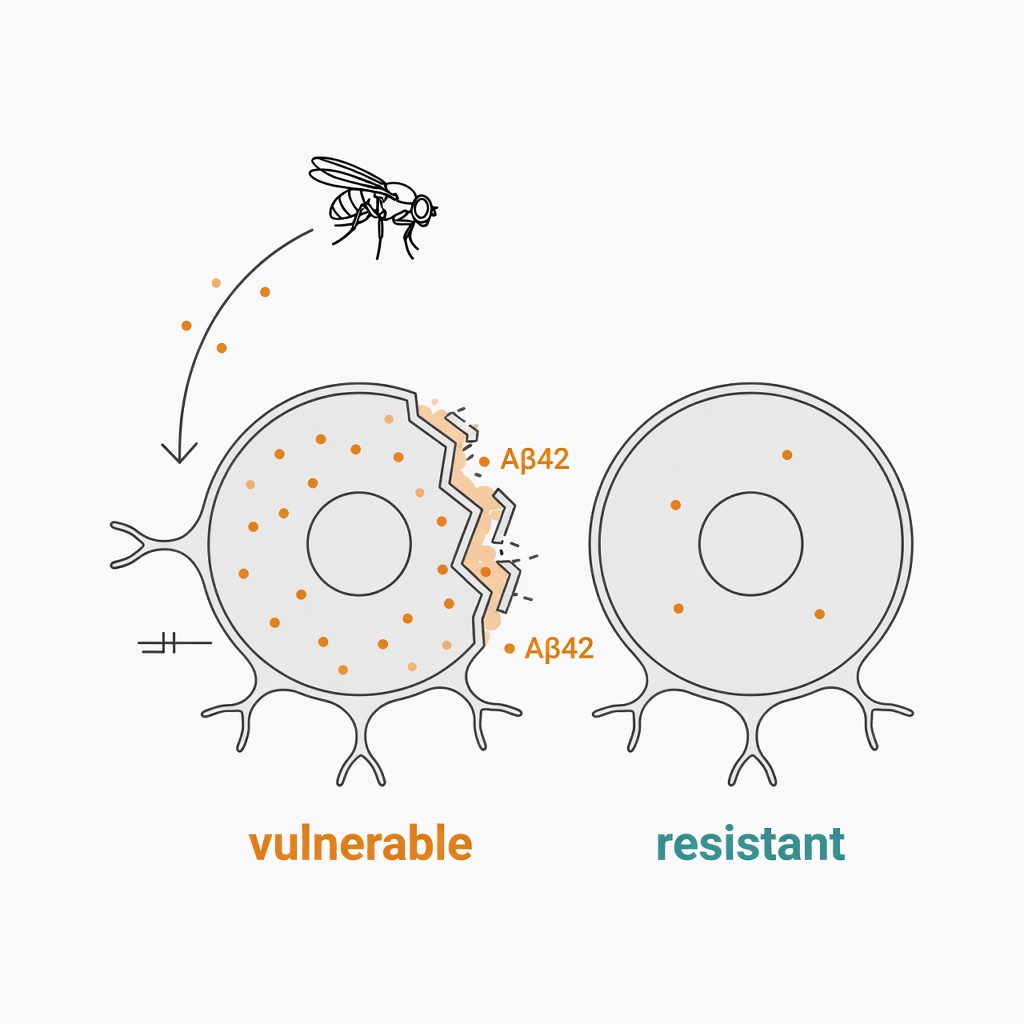
Why does one toxic protein spare some neurons and destroy others?
Amyloid-beta, the protein at the heart of Alzheimer's, does not kill every neuron identically. Some cells are far more vulnerable than others, and even the way they die is not the same.
You have probably heard that an Alzheimer's brain fills up with sticky fragments of a protein called amyloid-beta, or Aβ. Alzheimer's is the most common cause of dementia, accounting for roughly 60–70% of cases, so this protein has sat in the crosshairs of research for decades. The old mental image was of Aβ as a shotgun blast, spraying every neuron equally. Whichever cell got hit fell down. But the clinic has long shown a puzzle: separate brain regions and different neuron types degenerate at very different rates. A 2026 study in Cell Death & Differentiation went straight at that puzzle.
A fruit-fly window that watches the damage live
To see how Aβ actually harms neurons, the team pulled off something that had been hard to do before: watching it kill neurons inside a living animal, in real time.
They built a new Drosophila (fruit fly) model in which the nervous system secretes the most toxic stretch of the protein, Aβ42, the 42-amino-acid fragment, and then observed the effects in vivo and as they happened. A fly brain is small, but it shares a surprising amount of its genetics and cell-death machinery with ours, which makes it a good live viewing window. The result was not flat: distinct neuronal populations differed clearly in how susceptible they were to Aβ42 deposition. Some got coated fast. Others held out longer. And even when they did die, the death "program" they ran was not the same.
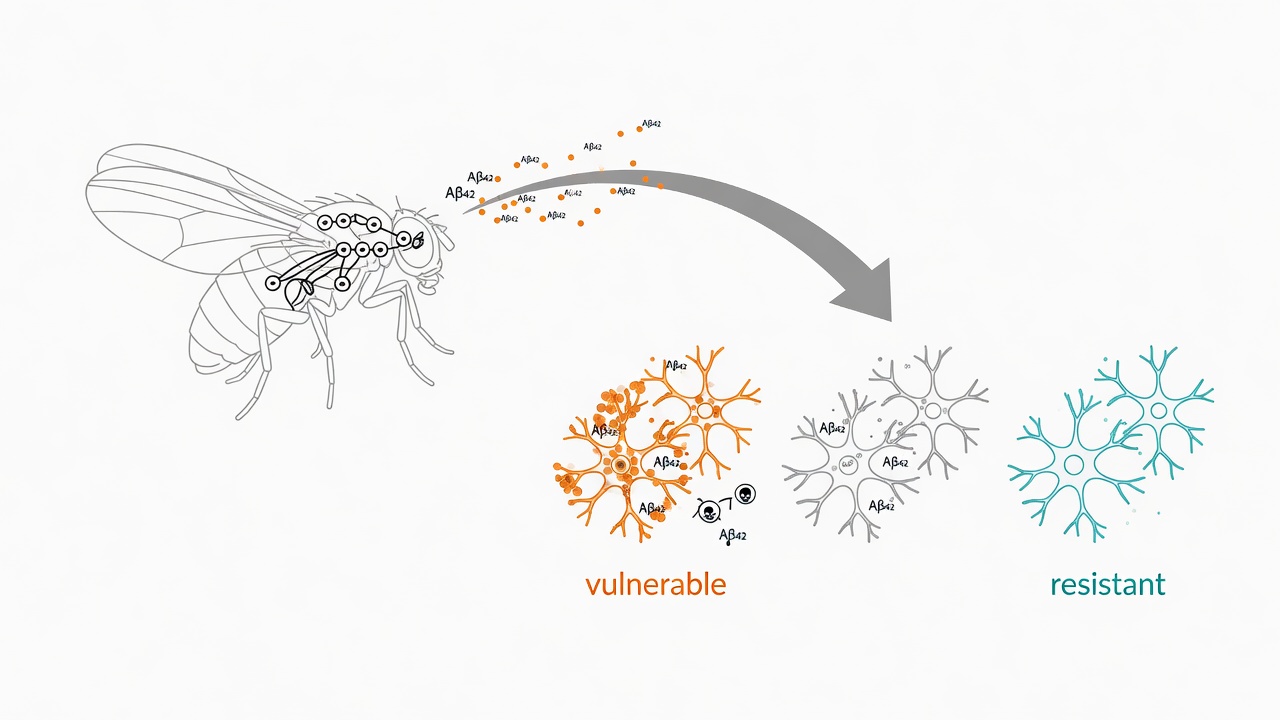 Figure 1. A live fruit-fly model: the nervous system secretes Aβ42; neuronal populations differ in their susceptibility to deposition and in the mode of cell death triggered.
Different neurons, different deaths — and one can be blocked
The key finding is that neurons do not die in a single way: at least 2 distinct death programs were switched on in separate cells.
One of them is ferroptosis, a much-discussed form of death that relies on iron to drive the peroxidation of fats in the cell membrane. Picture oil going rancid, or metal rusting when it meets water; ferroptosis is the membrane being burned through by that kind of "rusting fire." The team then ran a neat test in reverse: they used small-molecule inhibitors to block the ferroptosis route, and the flies' impaired larval crawling behaviour, damaged by Aβ42, recovered. When you shut the death pathway and the behaviour comes back, that says far more than observation alone.
Do not read this as "Alzheimer's is solved." A fly is not a human brain, so its evidence is a mechanistic clue, not a clinical conclusion; Aβ toxicity is only one piece of the Alzheimer's puzzle, and tau protein, chronic inflammation, and vascular damage all count too. And ferroptosis is only one of the deaths seen here, not the whole story. What this paper adds is a new piece: that different neurons take different roads to death, plus a platform you can watch live and use to screen drugs.
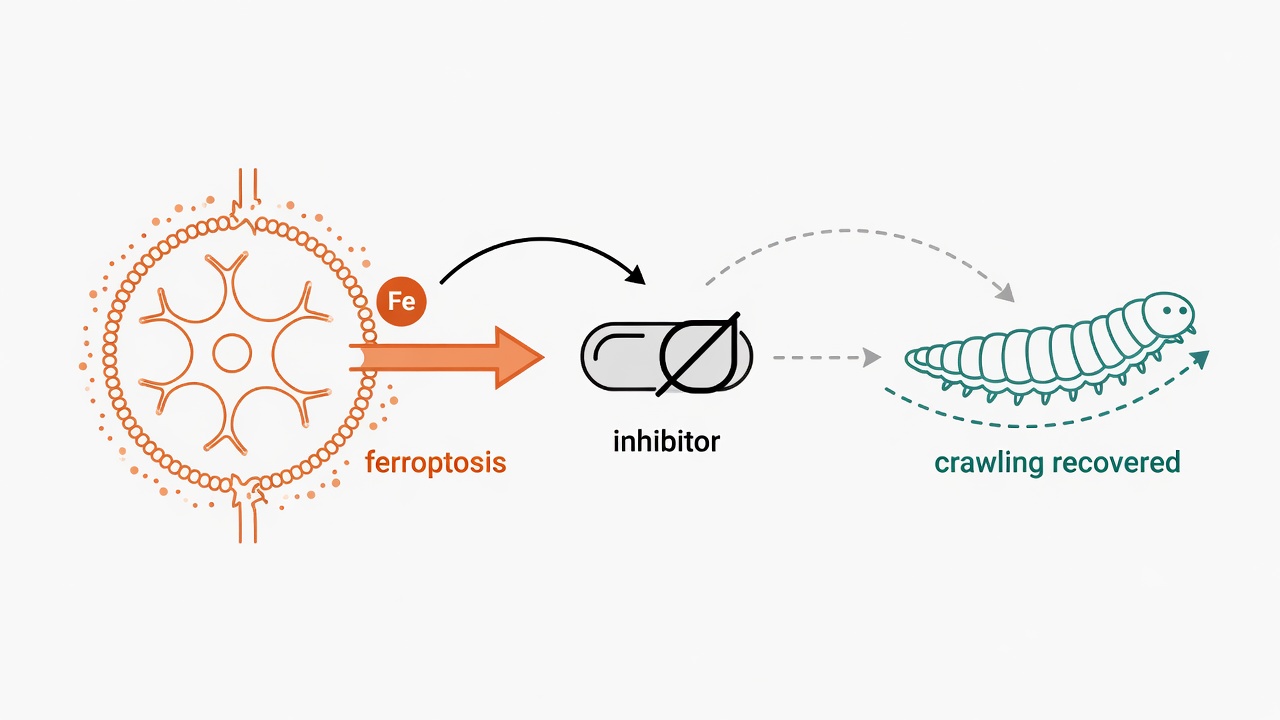 Figure 2. Selective death and rescue: different neurons take different death routes, one of them ferroptosis; blocking ferroptosis with small-molecule inhibitors restores impaired crawling behaviour.
What it means: treatment may have to be tailored
If different neurons die in different ways, then an effective therapy may not be one move for all, but something aimed at specific cells and specific death pathways.
For researchers, the value of this fly platform is that it turns "which neuron, which death route, and which block restores function" into a question you can work through one cell type at a time. For the rest of us, the plain lesson is that Alzheimer's is not a single switch but several roads converging on a bad outcome. Future drugs may need to strike as a combination. Ferroptosis inhibition and Aβ immunotherapy are both still on the road, at a distance from everyday life.
So what is in your hands before the drugs arrive? The answer is not glamorous but reliable: tend to the modifiable risk factors. Keeping blood pressure, blood sugar, and lipids in check, exercising regularly, sleeping enough, staying mentally active, and looking after hearing and social connection are all linked to lower dementia risk. None of that is a cure, but it is the part you can hold onto right now, and it is worth doing.
References
- Heron et al. (2026). Amyloid-beta induces distinct forms of cell death in different neuronal populations. Cell Death & Differentiation. doi: 10.1038/s41418-025-01649-7