Finding the paper when you can't remember the keyword
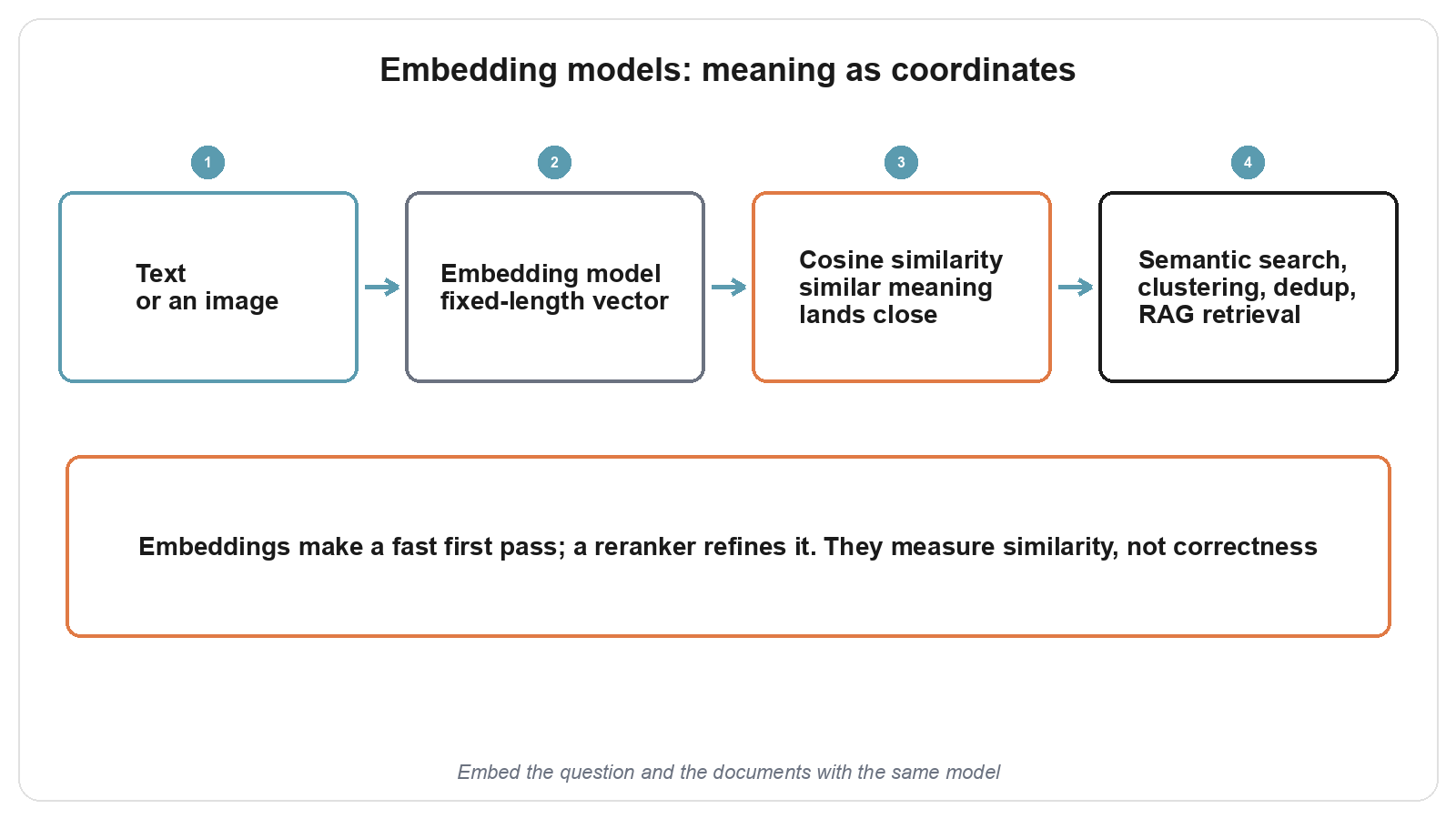
An embedding model turns a passage of text into a fixed-length list of numbers, so a computer can compare passages by what they mean.
Say you have a few hundred papers saved, and you remember one about memory getting worse after too little sleep. You can't recall whether the authors wrote "sleep deprivation" or "sleep loss". Keyword search matches spelling, so the wrong word finds nothing. With an embedding model you type a question and get back the passages closest in meaning. This piece takes one square of a map of AI model types and covers what an embedding model takes in, what it returns, and how it divides the work with rerankers, large language models and encoder classifiers.
What goes in and what comes out
The output is a vector, a list of numbers that keeps the same length whether you feed in one word or a whole paragraph.
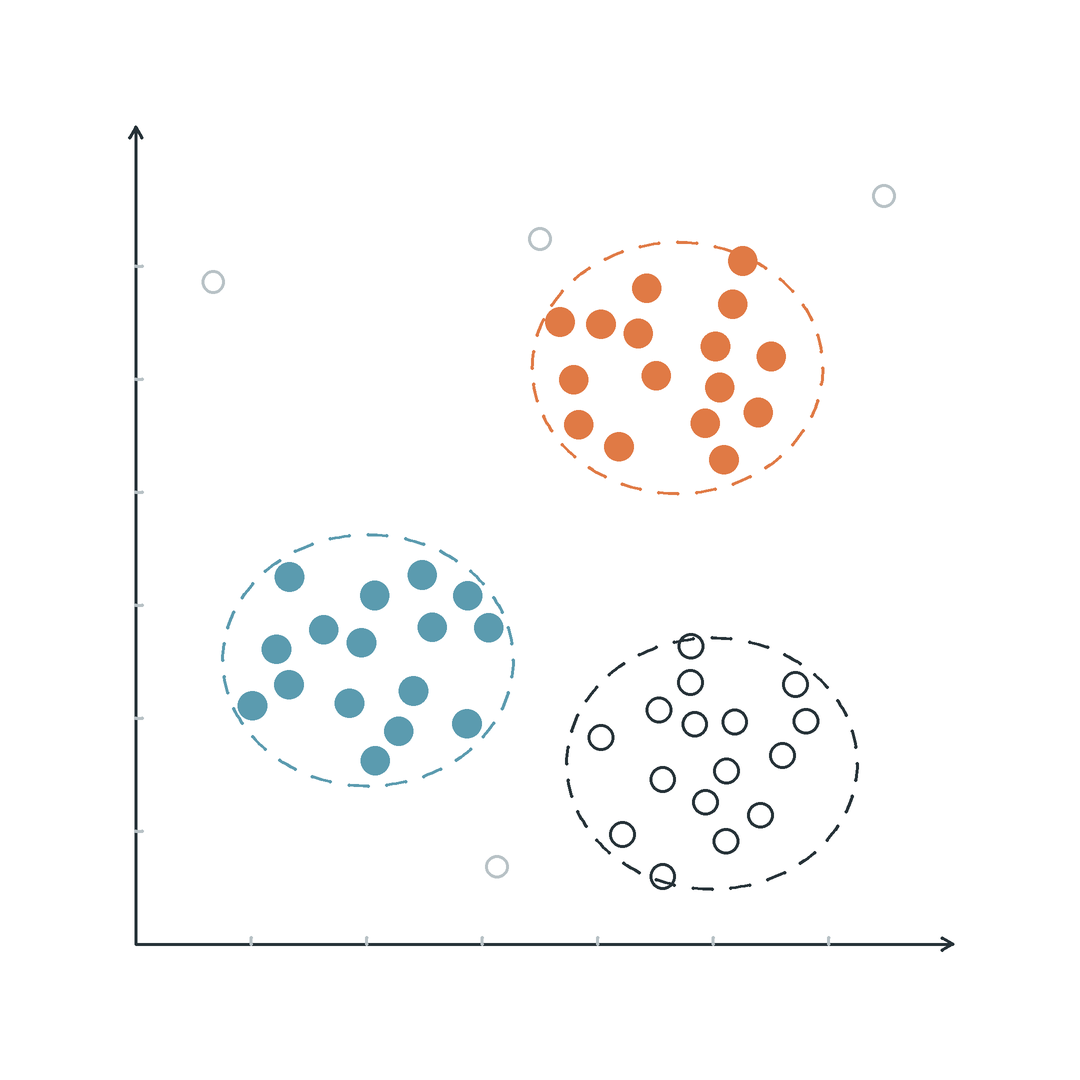
Think of the vector as a coordinate on a map that has hundreds or even thousands of directions instead of two. word2vec learned one vector per word, and words with related meanings ended up near each other [2]. Sentence-BERT carried the idea over to whole sentences by fine-tuning BERT on pairs of sentences, so that two sentences with similar meaning produce nearby vectors [1]. The model writes no text. Its only job is to hand out coordinates.
Similar meaning lands close together
Whether two passages are alike is judged by how closely their vectors point in the same direction, a measure called cosine similarity.
Picture each vector as an arrow from the origin. The smaller the angle between two arrows, the closer the cosine gets to 1 and the more alike the passages are. At a right angle the value is near 0, and the two passages have little to do with each other. Document vectors can be computed once and stored, so a search only needs to embed the question and compare. The Sentence-BERT paper gives a sense of the gap: finding the most similar pair among 10,000 sentences takes about 65 hours when BERT reads every pair together, and about 5 seconds when each sentence is embedded once and the vectors are compared [1].
What it is good for
Once content can be measured by distance, you can search it, group it, catch duplicates in it, and fetch material for a language model.
Back to the papers. Split each one into passages and embed every passage. Now the question "does lack of sleep affect memory?" can find a passage that says "sleep deprivation", even though the two share no words. The same vectors let you cluster your library into rough topics or flag near-identical files. The retrieval step of RAG (retrieval-augmented generation) works the same way: pull the relevant passages by vector, then hand them to a large language model to answer from [3]. The retriever in DPR, for example, uses two encoders, one for questions and one for passages [4]. CLIP trains images and text into the same space, which is how a short description can find a matching photo [5].
Where it falls short
An embedding measures how close two passages are in meaning. It has no way to tell whether either one is correct.
A wrong explanation and a right one on the same topic can sit almost on top of each other. Domain mismatch causes trouble too: a model trained on general web text may blur biomedical abbreviations and gene names, so try a model trained on your field or spot-check with your own documents. The question and the documents must also be embedded by the same model, because coordinates from different models don't line up. And chunking takes judgement. Squeeze a whole paper into one vector and the details average out; cut it too fine and sentences lose their context.
When to pick it, and when to reach for something else
Pick an embedding model when you need to pull a likely relevant handful out of a large collection quickly. It works as the first pass.
It is fast because the question and each document are processed separately, which also means the two are never read side by side. A reranker reads the question together with each candidate, so its judgement is finer and slower, and it usually reorders only the top few dozen results the embedding search returned. Last, a large language model writes the answer from the chosen passages. If what you actually need is a fixed label on each document, such as "clinical study" or "animal study", an encoder classifier trained on labelled examples is the more direct tool. For a retrieval approach that skips vectors altogether, see our introduction to DecisionRAG.