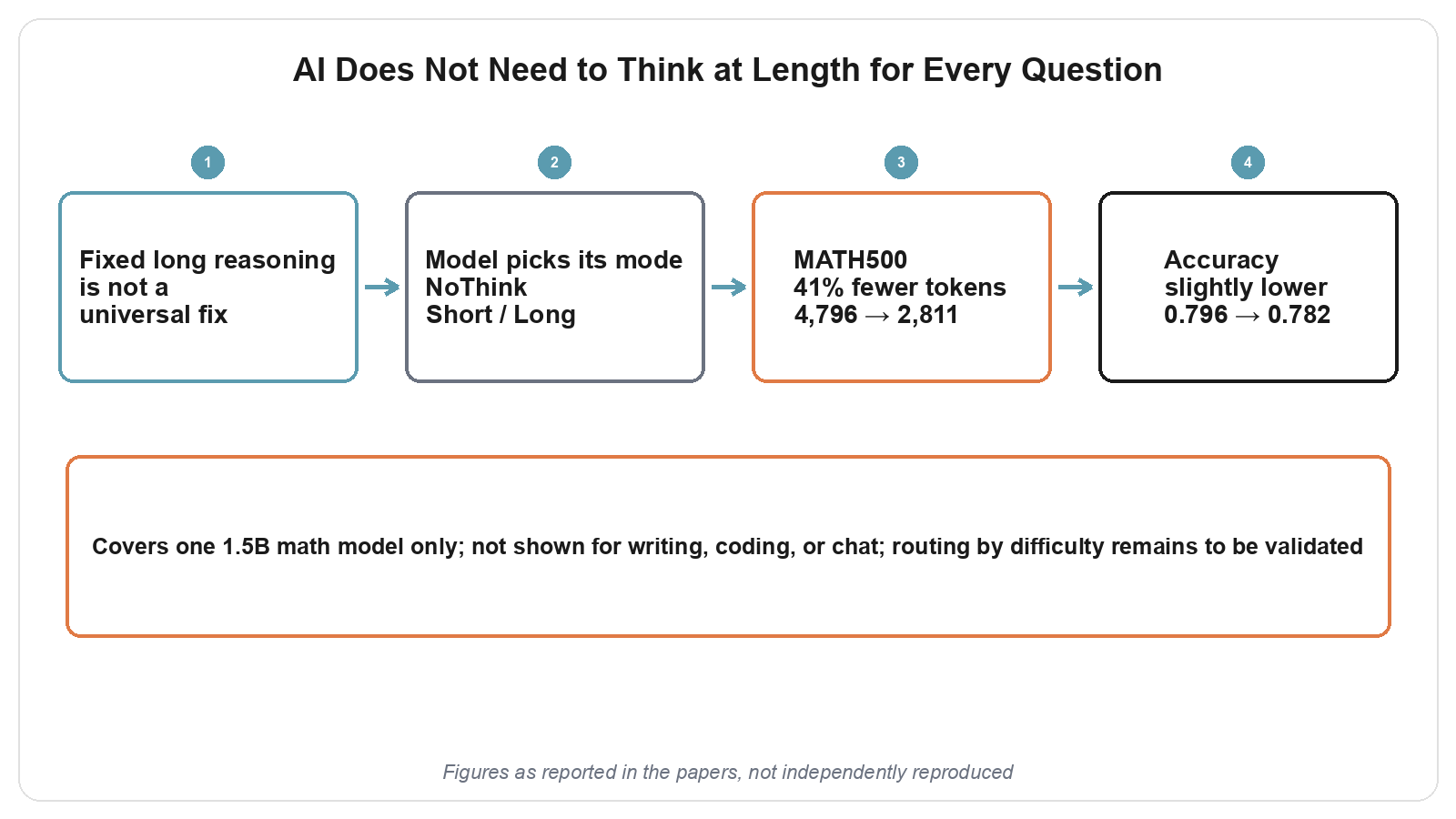
The useful question is not whether longer reasoning is always better, but how much test-time compute a task deserves. A 2026 math-reasoning study trained a model to select among three response modes. On held-out MATH500, the policy used 41% fewer response tokens, with accuracy slightly below its base model [1].
Fixed long reasoning is not a universal solution
The best test-time scaling method can depend on prompt difficulty; one 2024 study reported more than 4x efficiency for its compute-optimal strategy versus a best-of-N baseline in a specific comparison [2]. That result is not a universal fourfold saving.
The 2026 policy selected a first response token for NoThink, Short, or Long. It was trained with GRPO, shaped rewards, and mode-specific token caps, without a separate router [1]. In the authors' three-seed MATH500 evaluation, base accuracy was 0.796 and adaptive-policy accuracy was 0.782; mean response length fell from 4,796 to 2,811 tokens, a reported 41% reduction [1]. The authors also reported 76% fewer tokens on GSM8K and higher accuracy than baselines at similar response length [1].
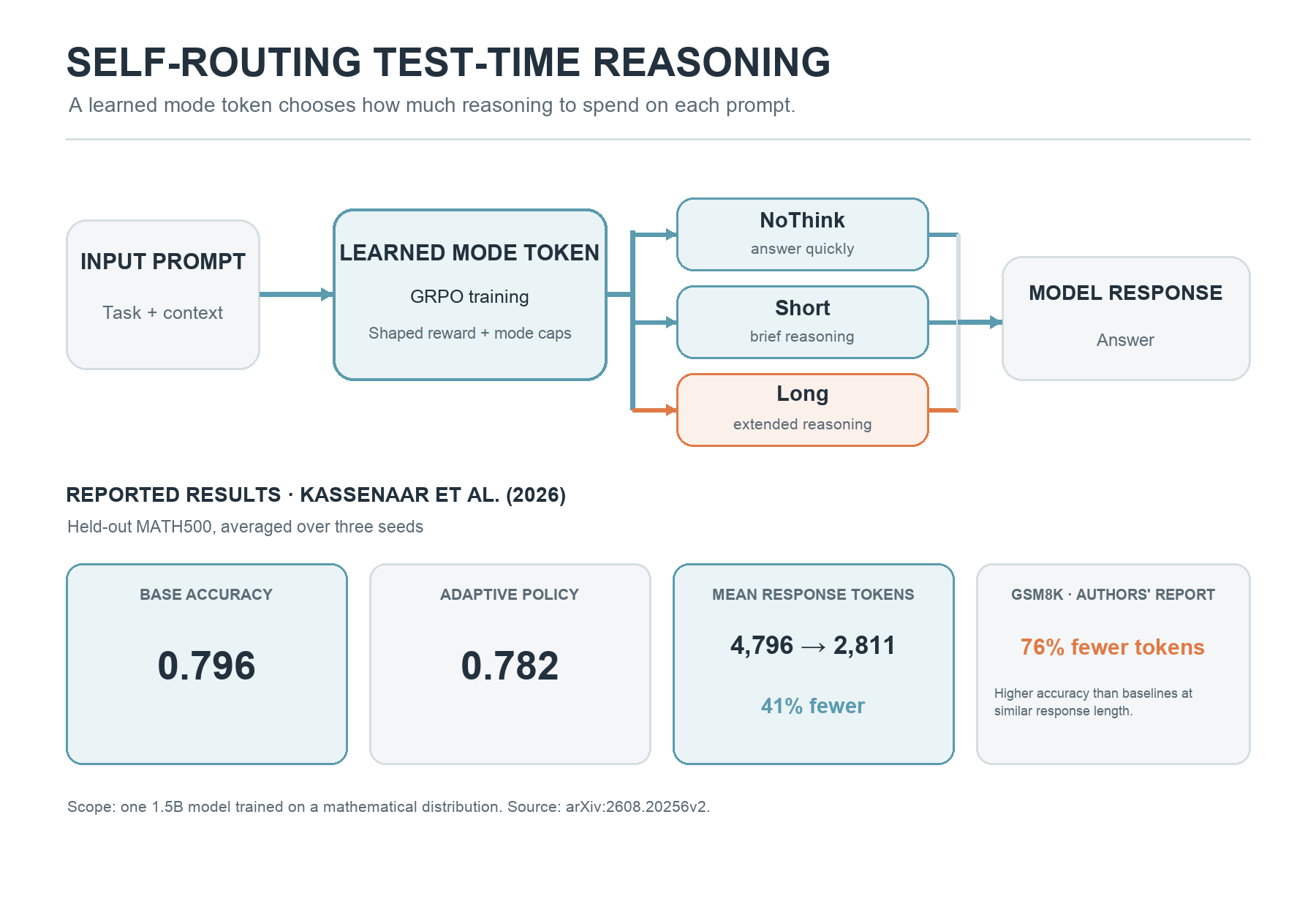
Figure 1. Programmatic redraw of the method and reported results in source [1]; not an independent reproduction.
More thinking can also overrun
A 2025 study across models and benchmarks observed initial gains from additional thinking followed by a decline, which the authors called overthinking [3]. This examined extended reasoning traces, not the 2026 adaptive router, so the two results should not be conflated.
The new routing result covers one 1.5B model trained on a mathematical distribution and three seeds; it does not establish similar savings for writing, code, or general chat [1]. Figure 2 keeps the three studies separate rather than treating them as a shared benchmark.
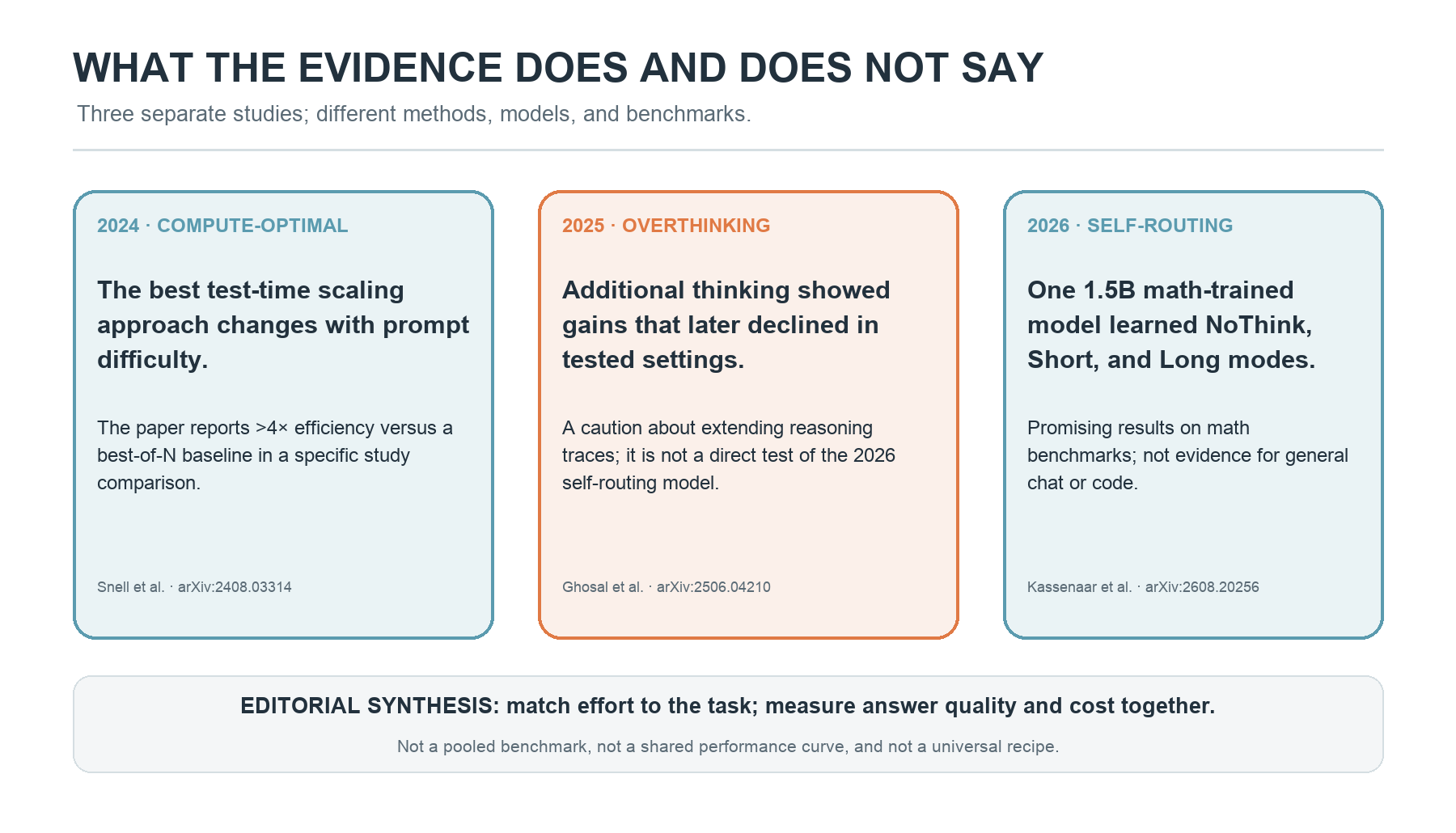
Figure 2. Evidence boundaries across three separate studies; not a pooled benchmark or shared performance curve [1][2][3].
For a product or local-LLM evaluation, compare accuracy by task difficulty and record tokens and latency together. Treat difficulty-based routing as a candidate policy to validate on representative tasks, not a universal default [1][2][3].