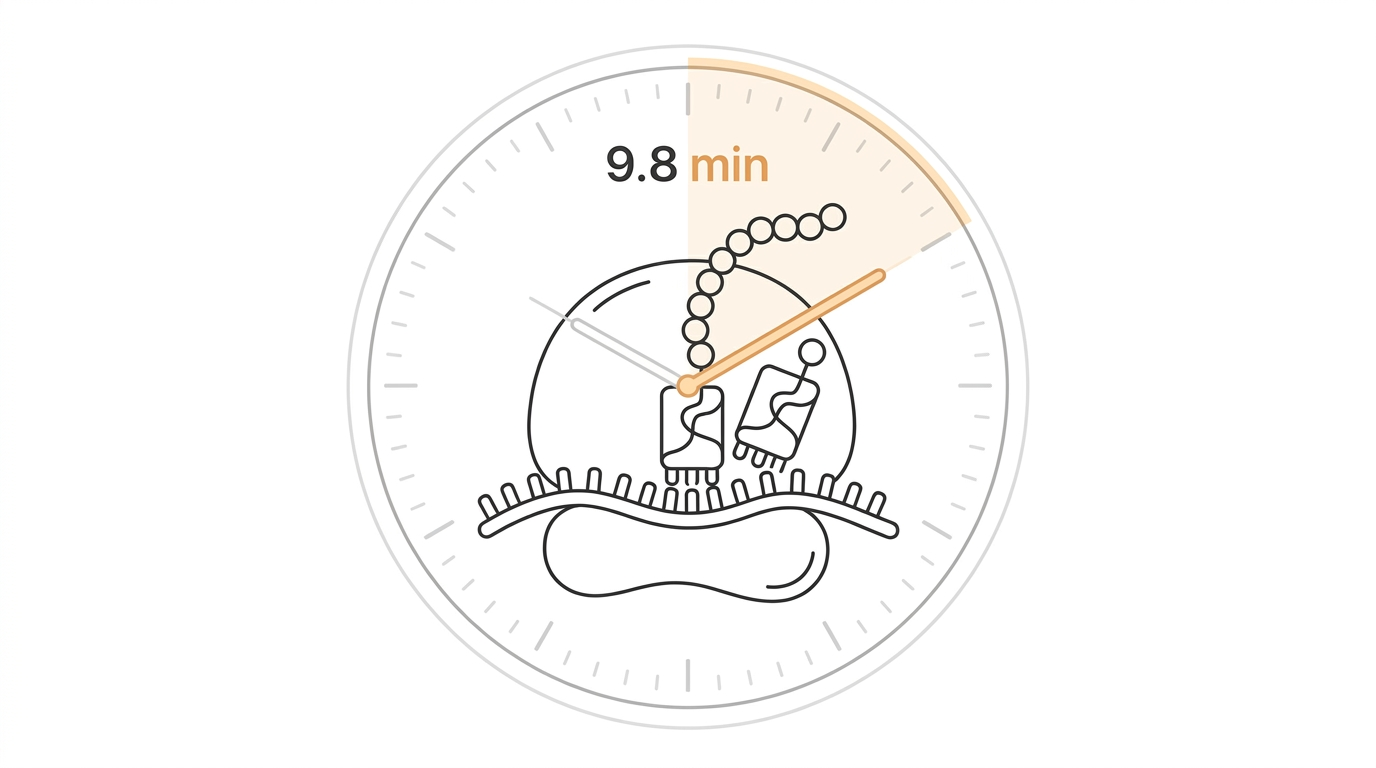
 Every 9.8 minutes, one cell becomes two.
Not every hour. Not every 20 minutes. Every 9.8 minutes.
That is the division rate of Vibrio natriegens, a nondescript bacterium dug out of coastal mud in Georgia, USA. In 1962, microbiologist R.G. Eagon dropped it into a broth of blended pig heart and brain, shook it at 37°C, and measured a number that probably surprised even him.
For context: the average bacterium divides roughly every three hours. Ancient microbes buried deep in Earth's crust take years. Vibrio natriegens is nearly 20 times faster than the typical microbe — and for over 60 years, nothing has beaten it. It holds the known speed record for cellular division on this planet.
So what is it doing that nothing else can match?
The Obvious Suspect Is Wrong
Most people — including many biologists — instinctively point to DNA.
The logic seems airtight: before a cell divides, it must duplicate its entire genome. Bigger genome, longer copy time, slower division. Vibrio natriegens carries a genome of 5.17 million base pairs. A single DNA polymerase — the enzyme responsible for copying DNA — works at roughly 1,000 bases per second. Just copying the longer chromosome alone would take about 54 minutes.
But the cell divides in 9.8 minutes. DNA replication simply cannot be the bottleneck.
Cells solved this problem long ago: multiple DNA polymerases fire simultaneously from different starting points, copying in both directions at once. The next round of replication begins before the previous one finishes. Daughter cells inherit not just a complete genome but also mid-replication backup copies already in progress.
DNA is not the limiting factor. So what is?
The Ribosome Paradox
The real answer hides inside the cell's most unwieldy factory.
Ribosomes are the molecular machines that translate genetic code into proteins. Each ribosome is an enormous complex — 54 proteins plus strands of RNA, totaling roughly 7,500 amino acids. At its working speed of about 16 amino acids per second, building a single ribosome from scratch takes:
7,500 amino acids ÷ 16 per second ≈ 468 seconds — just under 7 minutes 48 seconds.
That is how long it takes one ribosome to manufacture another ribosome.
The entire division cycle of Vibrio natriegens is 9.8 minutes.
The gap between those two numbers — roughly two minutes — is all the time the cell has left to do everything else: copy its DNA, grow its membrane, synthesize the enzymes that keep metabolism running.
Before a cell can divide, it must double its ribosome count so each daughter cell receives an adequate supply. That "ribosome doubling" is the single most time-consuming step in the entire division process. No exceptions.
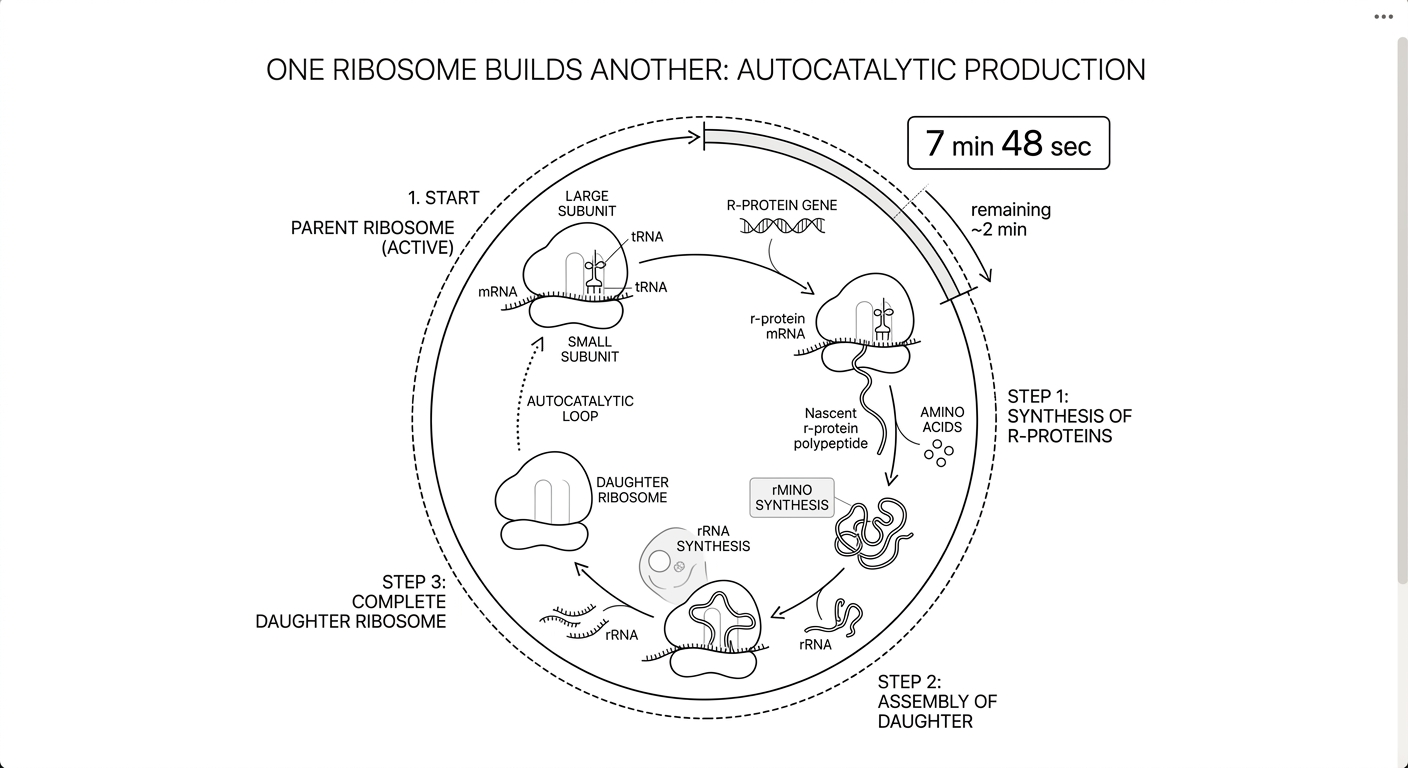 Figure 1: The ribosome self-replication bottleneck — every ribosome must be built by another ribosome
You might wonder: a cell contains tens of thousands of ribosomes — can't they all work in parallel?
They can, but a hard constraint remains. To grow from R ribosomes to 2R ribosomes, the cell must produce R new ones. The workforce available to do that job is exactly R. On average, every ribosome must manufacture one copy of itself. Parallelism speeds up the details but cannot escape the underlying arithmetic of doubling.
This is the ribosome paradox: the tool that builds everything must first build itself.
Four Dials, One Equation
Researchers at Caltech compressed this entire picture into a single equation:
$$ \lambda = \frac{r_t \cdot f_a \cdot \Phi_R}{L_R} $$
Here, lambda represents the number of cell divisions per hour. The four parameters on the right are four adjustable dials:
- r_t — translation elongation rate (amino acids/second); most bacteria land between 15 and 30
- f_a — fraction of ribosomes actively translating at any moment (typically around 85%; the rest are idle)
- Phi_R — fraction of the cell's total protein mass that is ribosome (roughly 50% in Vibrio natriegens)
- L_R — total amino acids per ribosome (approximately 7,500)
Plug in Vibrio natriegens values: lambda = 4.08 per hour, corresponding to a division time of about 10.2 minutes — almost exactly matching Eagon's 1962 measurement.
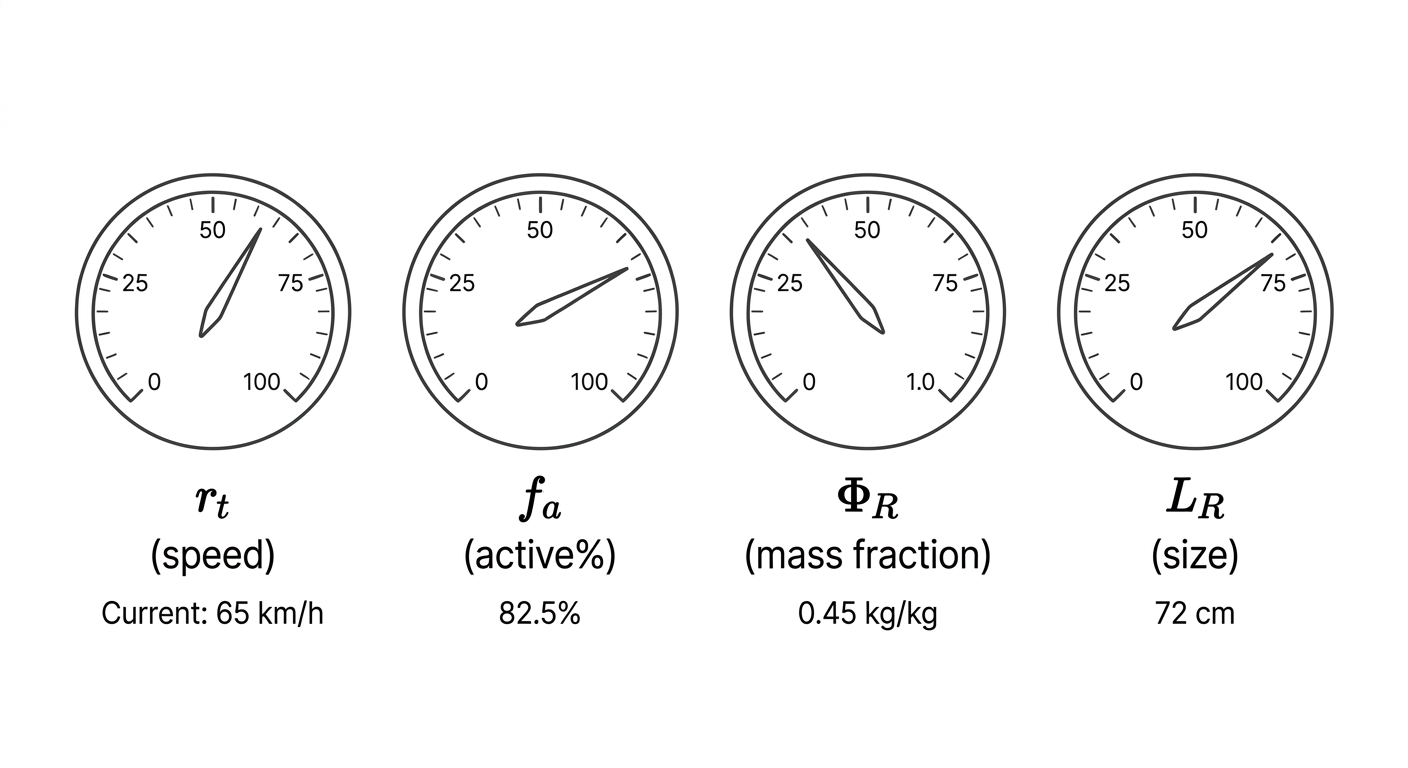 Figure 2: Four parameters, four adjustable dials — each pointing toward a different engineering strategy
The equation does more than explain the past. It functions as a treasure map, marking precisely where room for improvement still exists.
If You Are an Engineer
Four parameters means four dials to turn.
Dial one: accelerate translation (r_t). Some organisms carry naturally faster ribosomes. Could those genes be transplanted? In principle, yes — but each amino acid addition requires precise proofreading, and higher speed tends to trade off against error rates.
Dial two: keep more ribosomes active (f_a). E. coli carries "hibernation factor" proteins that push ribosomes into dormancy when nutrients are scarce. Delete those genes, force ribosomes to run at full capacity at all times — would the cell divide faster? Nobody has run this experiment.
Dial three: pack in more ribosomes (Phi_R). Vibrio natriegens already carries more than 12 ribosomal RNA gene clusters; E. coli has 7. Its promoter sequences are exceptionally strong, driving continuous high-level transcription of ribosomal RNA. This is millions of years of evolutionary optimization. Is there still headroom? Unclear.
Dial four: build smaller ribosomes (L_R). Of the 54 ribosomal proteins, about 21 are found exclusively in bacteria and are absent from archaea and eukaryotes. These may be evolutionary relics that could be trimmed. Reduce ribosome mass by 20%, and the same manufacturing line completes each cycle faster. No one has tried this yet.
Vibrio natriegens itself is a natural platform waiting to be rewritten. It has already begun displacing E. coli in synthetic biology labs as the organism of choice for protein production. Engineers are using it to express proteins that E. coli handles poorly, to manufacture virus-like particles for vaccine development, and to explore whether it could serve as an ideal chassis for cell-free protein synthesis systems.
Speed is only the starting point.
How Much Room Is Left?
Vibrio natriegens divides in 9.8 minutes. The theoretical minimum, by the equation's calculation, sits near 8 minutes. The gap is less than two minutes.
Those two minutes represent the time ribosomes spend building everything else the cell needs to stay alive — not just more ribosomes. Even in the fastest-growing bacteria, only about one-third of ribosome capacity goes toward ribosome production; the rest sustains the cell's ongoing operations.
Evolution has not closed this two-minute gap across millions of years.
Can a few years of deliberate engineering close it?
That is not a rhetorical question. It is an open one, still without an answer.
The finest divisions of time are written in the choreography of molecules. A nameless microbe from coastal mud, dividing every 9.8 minutes, delivers one quiet message: the speed limit of life is not a wall. It is an equation — and equations can be renegotiated.