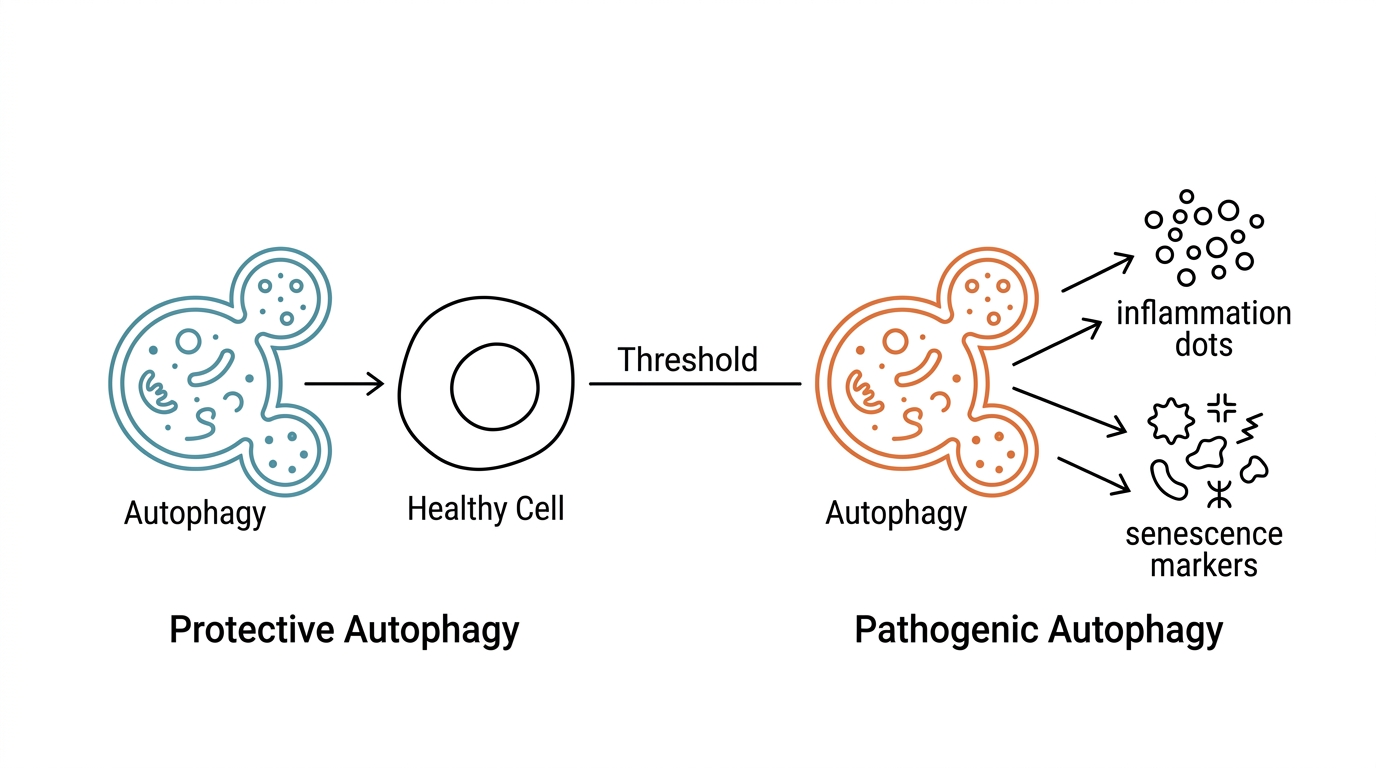
There's a contradiction sitting at the center of anti-aging biology that doesn't get explained enough: some researchers are working hard to increase autophagy in aging cells, while others are trying to block it. Both camps cite legitimate science. Both produce experimental results that support their position.
How can the same cellular process be protective in one context and harmful in another?
A 2026 review in Redox Biology by Bahar and colleagues provides the most coherent answer yet: autophagy's role in aging is not fixed. It depends on whether the cell has crossed a critical damage threshold.
TL;DR: Bahar's review proposes a threshold model for the autophagy-senescence relationship. Before the threshold — when cells are under reversible stress — autophagy acts as a protective housekeeping system, clearing damaged proteins and organelles and preventing cells from entering senescence. After the threshold — when cells have committed to a senescent state — autophagy gets reprogrammed to support that state, fueling the metabolically active, inflammatory output that characterizes senescent cells. The same process. Two different jobs.
Autophagy Below the Threshold: The Protective Mode
In healthy, stressed-but-recoverable cells, autophagy performs a crucial quality control function. It identifies and degrades damaged proteins, dysfunctional mitochondria (via mitophagy), and other cellular debris that would otherwise accumulate and drive oxidative stress and signaling dysfunction.
When autophagy is working well in this mode, cells are more resilient. Mitochondria maintain stable membrane potential. ATP production stays more consistent. Reactive oxygen species remain within manageable ranges. The cell can handle stress without activating irreversible senescence programs.
This is the context in which boosting autophagy makes sense. If a cell is struggling with accumulating damage but hasn't committed to senescence, improving its cleanup capacity can meaningfully improve its function and delay the transition to a senescent state. The city's drainage system is still functional — making it more efficient prevents flooding.
The Threshold: When the System Flips
The key insight of the review is that there is a tipping point.
When damage accumulates beyond a certain threshold — driven by chronic inflammation, mitochondrial dysfunction, DNA damage, or other sustained stressors — cells undergo irreversible senescence. Once that commitment is made, the role of autophagy changes fundamentally.
Senescent cells are not inactive. They're metabolically demanding, producing large quantities of cytokines, chemokines, growth factors, and proteases collectively called the SASP (senescence-associated secretory phenotype). This secretome remodels the surrounding tissue, amplifies local inflammation, and can push neighboring cells toward senescence — a process that drives tissue aging, fibrosis, and chronic disease in multiple organ systems.
Producing all these secreted factors requires energy and raw materials. And here's the problem: autophagy provides exactly that. In senescent cells, autophagy gets reprogrammed to serve as a supply chain for SASP production, recycling intracellular components into the amino acids and metabolites needed for sustained secretory output.
The review highlights the TASCC (TOR-Autophagy Spatial Coupling Compartment) as a representative structure: a cellular organization where autophagic degradation and mTOR-dependent translation are spatially coordinated to efficiently recycle cellular debris into SASP building blocks. Autophagy is working. But it's working for the senescent state, not against it.
Organelle-Level Evidence
The review also examines how specific subtypes of autophagy contribute to this post-threshold dysfunction.
Mitophagy failure is particularly consequential. When dysfunctional mitochondria aren't cleared, they continue producing excessive ROS and releasing mitochondrial DNA into the cytoplasm. Cytoplasmic mtDNA activates the cGAS-STING innate immune pathway, driving interferon responses and chronic inflammation — a cycle that both reinforces senescence and amplifies SASP.
Lipophagy dysfunction allows accumulation of toxic lipid species that stress the ER and membrane systems. Selective autophagy failure for nuclear components lets misfolded proteins and DNA damage signals accumulate, continuously triggering stress responses. These organelle-level failures feed into NF-κB activation and other master inflammatory regulators.
The picture that emerges is that autophagy below the threshold is a net positive because it prevents these failures. Above the threshold, these failures have already occurred; the remaining autophagy functions primarily as a metabolic supply chain for an already-damaged cell's inflammatory output.
Therapeutic Implications
The threshold model has direct implications for how to think about autophagy-targeted interventions in aging and disease.
Before the threshold — in early disease states, or in tissues not yet substantially burdened by senescent cells — boosting autophagy is likely beneficial. Interventions like rapamycin, caloric restriction mimetics, or exercise-induced autophagy induction make sense in this context.
After the threshold — in tissues with established senescent cell burden, or in advanced disease — blindly pushing autophagy higher could paradoxically worsen the situation by fueling senescent cell survival and SASP output. In these contexts, the review suggests that inhibiting autophagy may be more appropriate, potentially in combination with senolytics (compounds that selectively eliminate senescent cells) to reduce the senescent cell load that autophagy would otherwise be sustaining.
The paper maps this framework across four disease contexts — cancer, neurodegeneration, metabolic liver disease, and fibrosis — each of which involves senescent cells and dysregulated autophagy in distinct ways.
The Honest Limitations
This is a review paper, not a clinical trial. The threshold model is conceptually compelling and supported by mechanistic evidence, but it also has important practical gaps.
Most significantly: we don't yet have good clinical tools for measuring where an individual patient's cells are relative to the threshold. The theory predicts that the same autophagy-boosting intervention should have opposite effects on either side of that threshold, but without reliable threshold biomarkers, applying this insight in clinical practice is difficult. That's a solvable problem in principle — identifying methylation patterns, senescence marker panels, or proteomics signatures that reliably indicate the pre- vs. post-threshold state — but it remains largely unsolved.
The other caution: senescent cell populations are heterogeneous, and autophagy regulation varies across cell types. A blanket statement about "autophagy in aging" will inevitably be an oversimplification of what is actually a collection of cell-type-specific and context-specific regulatory systems.
The Real Value of This Review
Bahar's framework doesn't resolve the autophagy-in-aging debate. It reframes it. The question is no longer "is autophagy good or bad for aging?" — that framing was always too simple. The more useful question is: "where in the disease process is this cell, and what is autophagy currently doing for it?"
That's the kind of precision the field needs. And it points directly toward the next research priority: developing the dynamic biomarker tools that can answer the threshold question in real patients, in real time.
References
- Bahar et al. (2026). The autophagy-senescence axis as a threshold model of aging and therapeutic targeting. Redox Biology. doi: 10.1016/j.redox.2026.104079