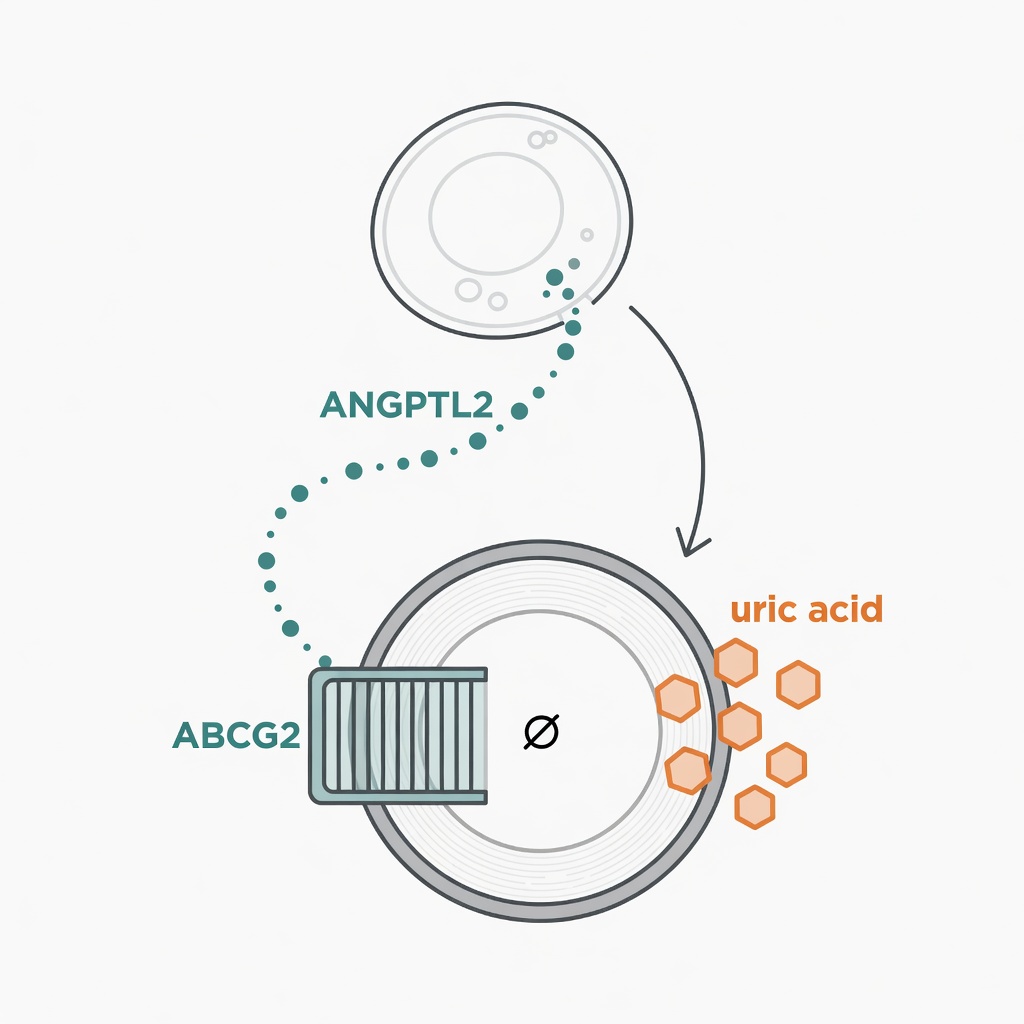
You cut the seafood, so why is your uric acid still high?
Most high uric acid is not something you ate: roughly 90% of the problem is a kidney unable to flush urate out, and obesity is a badly underrated driver. A 2025 study points the finger straight at your fat.
You know the story. You quit the shellfish, you eased off the beer, and the blood test still comes back red. That is not a failure of willpower. Where your uric acid lands depends mostly on whether your kidney can pump it out; what you eat is a small slice. The real lever is whether the drain at the exit stays open, and in people carrying extra weight, that drain is often half-shut.
Your fat is sending orders to your kidney
Fat is not a quiet storage tank. It is an endocrine organ that gives commands, and the ANGPTL2 it secretes rides the bloodstream to the kidney and quietly narrows the urate drain.
Many people picture fat as a passive blob of oil. Wrong. Fat is one of the largest endocrine organs in your body, releasing a whole family of signaling proteins called adipokines; in 2025, Yang and colleagues examined people who were both obese and hyperuricemic and pulled a suspect out of their omental fat: ANGPTL2. The higher the ANGPTL2 in their blood, the higher their serum uric acid, and the link was clearest in men.
But here is the puzzle. Fat sits on the belly; urate is excreted in the kidney. How does one reach the other? By remote control. Fat-derived ANGPTL2 travels to the renal tubule, dampens the AKT signal inside those cells, and switches down a protein known as ABCG2, the drain that ships urate out of your system. Narrow that drain, and urate piles up in the blood.
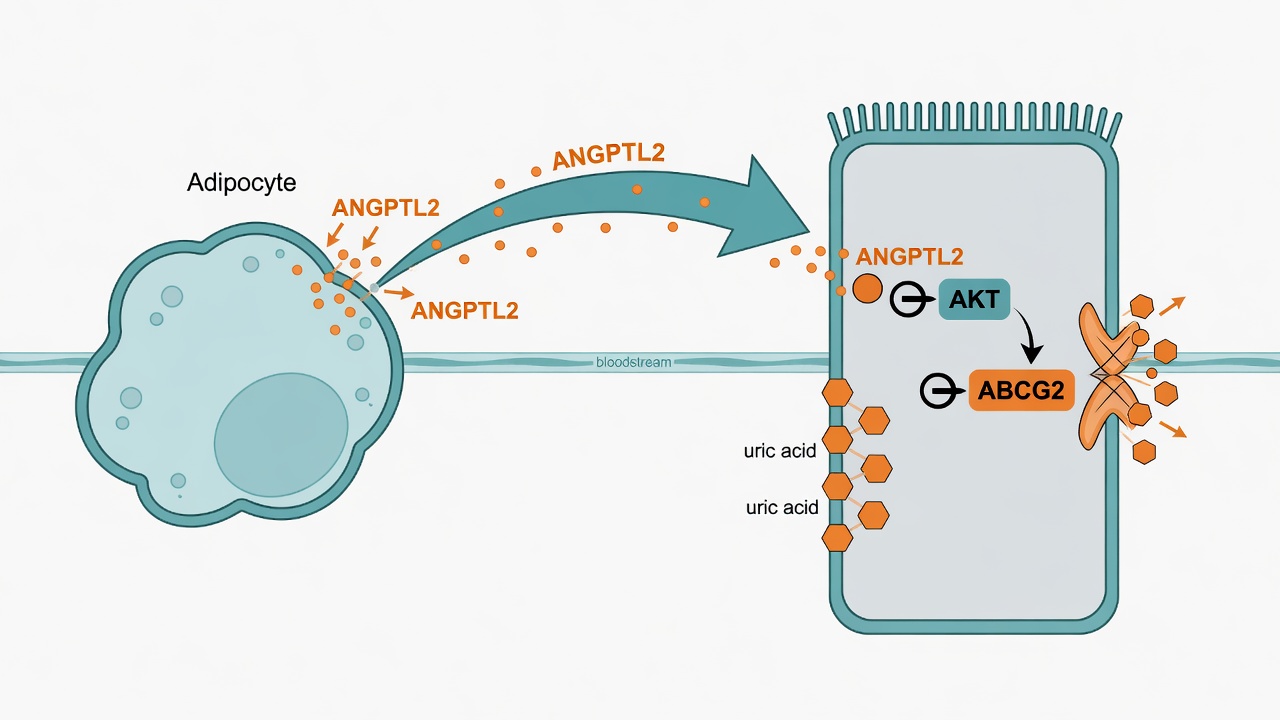 Figure 1. The fat-to-kidney axis: adipocyte-secreted ANGPTL2 suppresses tubular AKT/ABCG2, blocking urate excretion.
A tug-of-war between two movers
The kidney runs 2 urate movers: ABCG2 ships urate out, GLUT9 pulls it back into the blood, while ANGPTL2 tips the balance toward buildup.
Correlation alone would not convict fat, so the team leaned on 4 experimental systems, including mice in which they knocked out Angptl2 and saw blood urate drop as kidney ABCG2 rose and GLUT9 fell. Flip it around: mice engineered to overproduce ANGPTL2 from fat saw blood urate climb, with ABCG2 down and GLUT9 up. Push one way, pull the other; the direction is as clean as a switch.
Underneath sits a tug-of-war: ABCG2 exports urate, while GLUT9 reabsorbs it back into circulation. Normally the two movers are evenly matched, but ANGPTL2 weakens the export and strengthens the reuptake at the same time, so the balance tilts toward accumulation.
Still, do not crown fat the sole villain: this study adds a new piece to the puzzle, not the whole picture. Urate imbalance runs on many tracks: the purines you eat, your genes, your kidney function, and the drugs you take all count. Fat's role is to explain why heavier people are especially prone, not to replace the other causes, and in humans, what we see so far is an association; the causal chain still needs clinical work to nail down.
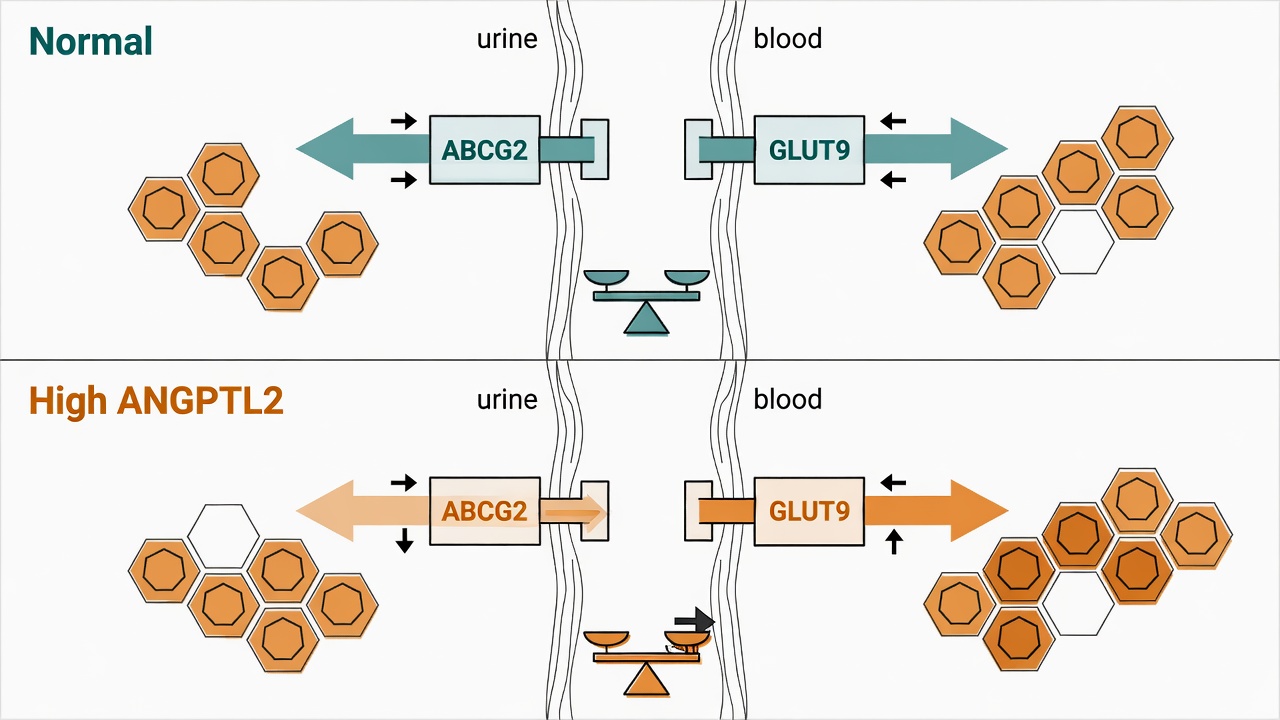 Figure 2. Two movers in tension: ABCG2 exports urate, GLUT9 reclaims it, and ANGPTL2 tips the balance toward buildup.
Losing fat may be repairing that drain
If fat can shut the urate drain, then losing fat may be the very thing that reopens it for your kidney, which makes weight control the most grounded step toward lower uric acid.
Line the clues up and what you can do is refreshingly plain: instead of staring only at the seafood on your plate, mind your waistline too. Less visceral fat means fewer ANGPTL2 orders telling your kidney to close the gate, and regular exercise, calorie control, and keeping your weight in a sensible range are old advice that may land squarely on this newly mapped pathway.
As for ANGPTL2 itself, scientists have already flagged it as a potential drug target, but make no mistake: turning that into an actual pill is a long way off. The lever truly in your hands right now is the least glamorous, most reliable answer of all: manage your fat, and your kidney will thank you.
References
- Yang et al. (2025). Adipocyte-secreted ANGPTL2 promotes hyperuricemia through inhibiting AKT/ABCG2 signaling. Free Radical Biology and Medicine. doi: 10.1016/j.freeradbiomed.2025.03.048
Frequently Asked Questions
Isn't high uric acid caused by what you eat?
Diet is only a small slice. About 90% of high uric acid comes from a kidney that cannot flush urate out. This 2025 study shows obese fat secretes ANGPTL2, which narrows ABCG2, the kidney's urate drain.
How can fat affect urate excretion in the kidney?
By remote control. Fat-derived ANGPTL2 travels through the blood to the renal tubule, suppresses the AKT signal inside the cells, and switches down ABCG2 — the exporter that ships urate out — so urate builds up in the blood.
Do the animal and cell results apply to humans? (common misreading)
Treat them as clues only. In humans, the finding is an association between circulating ANGPTL2 and uric acid; the push-pull causality comes from mouse and cell experiments. Reading "works in mice" as "works in people" is the classic error and still needs clinical validation.
What can I actually do now?
Controlling body weight and visceral fat is the lever in your hands. Losing fat means fewer ANGPTL2 orders telling your kidney to close the gate; pair it with regular exercise and calorie control. ANGPTL2 is flagged as a potential drug target, but a real pill is a long way off.
Found this useful?
Follow for new AI × biomedical research notes:
Or buy me a coffee to keep new content coming.
☕ Buy Me a Coffee