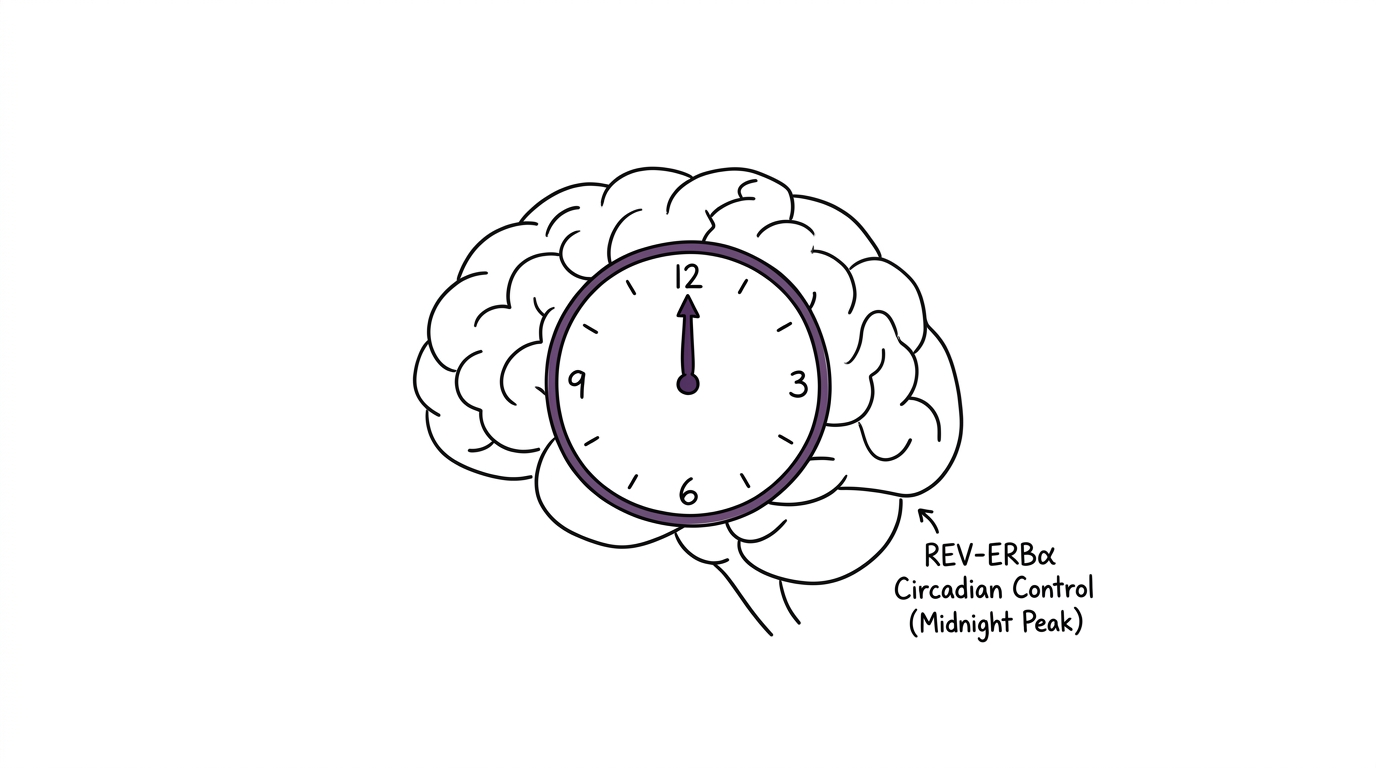

3 AM — What's Your Brain Doing?
You think your brain rests when you sleep? Wrong. It's pulling overtime — flushing metabolic waste, repairing damaged synapses, consolidating everything you learned today. And the shift manager coordinating this nightly cleanup crew? A group of "clock proteins."
One of them, REV-ERBα, was recently caught moonlighting.
A 2025 study in Nature Aging reveals that REV-ERBα doesn't just regulate your circadian rhythm. It directly controls NAD+ metabolism in the brain — and NAD+ levels determine whether your neurons can withstand tau protein attacks. Tau is the prime suspect behind Alzheimer's disease.
One clock protein. One energy molecule. One war against dementia. The connections run deeper than you'd expect.

Your Circadian Clock Doesn't Just Manage Sleep — It Decides Whether Your Brain Breaks Down
Imagine your brain as a 24-hour building. Daytime is office hours — neurons processing information, firing signals. Nighttime is maintenance shift: cleaning crews sweeping metabolic debris, electricians repairing DNA damage, security running immune patrols.
REV-ERBα is the building's shift manager. It tells every department what time it is and what needs doing.
As you age, the shift manager starts losing focus. Its expression drops. The night crew doesn't get orders. Cleanup goes half-done. Metabolic waste accumulates. Tau proteins tangle into clumps — the early pathology of Alzheimer's.
The research team found a critical link: REV-ERBα directly regulates NAMPT, the rate-limiting enzyme for NAD+ synthesis. When REV-ERBα functions normally, NAMPT oscillates with circadian rhythm, keeping NAD+ supply steady. When REV-ERBα fails, NAMPT expression goes haywire, and NAD+ plummets.
Without NAD+, the Sirtuin family of deacetylases shuts down. Their job? Suppressing hyperphosphorylation of tau protein — in plain terms, they're the brake pads preventing tau from going rogue. Brakes fail, tau tangles spiral, neurons die.
Astrocytes: The Hidden Gatekeepers

Past research focused on neurons, but this study turns the camera toward astrocytes — the brain's logistics corps. They feed neurons, maintain the blood-brain barrier, and clear excess neurotransmitters.
The team found that astrocytes show particularly high REV-ERBα activity — they're the main drivers of NAD+ rhythmic regulation. When researchers knocked out REV-ERBα specifically in astrocytes, tau pathology worsened dramatically and cognitive function crashed. Conversely, pharmacological activation of REV-ERBα effectively suppressed tau accumulation.
A clock protein, in a group of "supporting" cells, controlling the fate of dementia.
What Time You Sleep Tonight May Decide Your Memory in Twenty Years
Short term: Maintaining a stable sleep schedule may matter more than total sleep hours. Shift workers face 20-30% higher dementia risk.
Medium term: REV-ERBα agonists (SR9009, SR9011) already show results in animal models. Human trials are being planned.
Long term: Combining NMN supplementation with REV-ERBα activation could create a "dual-track" prevention strategy, potentially starting a decade before Alzheimer's symptoms appear.
Is your schedule regular? If your brain's clock repairman is working overtime for you, would you cooperate with its shift schedule?
The Clock Won't Stop, But You Can Help Calibrate It
Dementia isn't simply "brain damage." It's the simultaneous breakdown of three systems: circadian rhythm, energy metabolism, and protein quality control. REV-ERBα stands at the intersection of all three, working quietly like a maintenance engineer.
What you can do is not make its job harder. Regular sleep. Stable light exposure. Moderate exercise. These sound like tired advice, but behind them lies an entire molecular apparatus. Your brain clock recalibrates every day — as long as you let it run properly.
References
- Nature Aging (2025). DOI: 10.1038/s43587-025-00950-x
- Imai, S. & Guarente, L. (2016). Science, 350, 6265.
- Gomes, A.P. et al. (2013). Cell, 155, 1624–1638.