TL;DR: NAD+ declines with age. NMN and NR supplements do raise blood NAD+ levels. But the metabolic route they take is nothing like what supplement companies tell you — and the clinical evidence for real functional improvement in humans remains thin.
How Much Have You Spent Chasing Youth?
Is there a bottle of NMN capsules in your shopping cart right now?
Over the past few years, NMN (Nicotinamide Mononucleotide) has become the darling of the anti-aging supplement market. Online claims range from "Harvard professors take it daily" to "feel twenty years younger." A single bottle can cost hundreds of dollars, selling not just a molecule but the promise of youth wrapped in a lab coat.
But what do the latest papers in Science Advances, Nature Aging, and Ageing Research Reviews actually say? The answer is more complicated than any advertisement would have you believe.
First, the Basics: What Is NAD+ and Why Does It Matter?
If your cells were a city, NAD+ (Nicotinamide Adenine Dinucleotide) would be the power grid.
It serves as a cofactor for over 500 enzymes — from mitochondrial energy production and DNA repair to the regulation of Sirtuins (longevity proteins) and PARP (DNA damage repair enzymes). A 2026 review in Mechanisms of Ageing and Development (Pei et al.) positions NAD+ as the central metabolic hub regulating fourteen hallmarks of aging: genomic instability, epigenetic drift, mitochondrial dysfunction — NAD+ is involved in virtually all of them.
The problem: NAD+ levels begin a noticeable decline around age 40, potentially dropping to half of youthful levels by 60. This observation sparked an obvious question: if we could replenish NAD+, could we slow aging?
In theory, it sounds like a perfect solution. In practice, the journey of an NMN capsule through your body is nothing like a straight line.
The Unexpected Truth: Your NMN Doesn't Go Where You Think
In 2025, Yaku and colleagues published a startling metabolic tracing study in Science Advances.
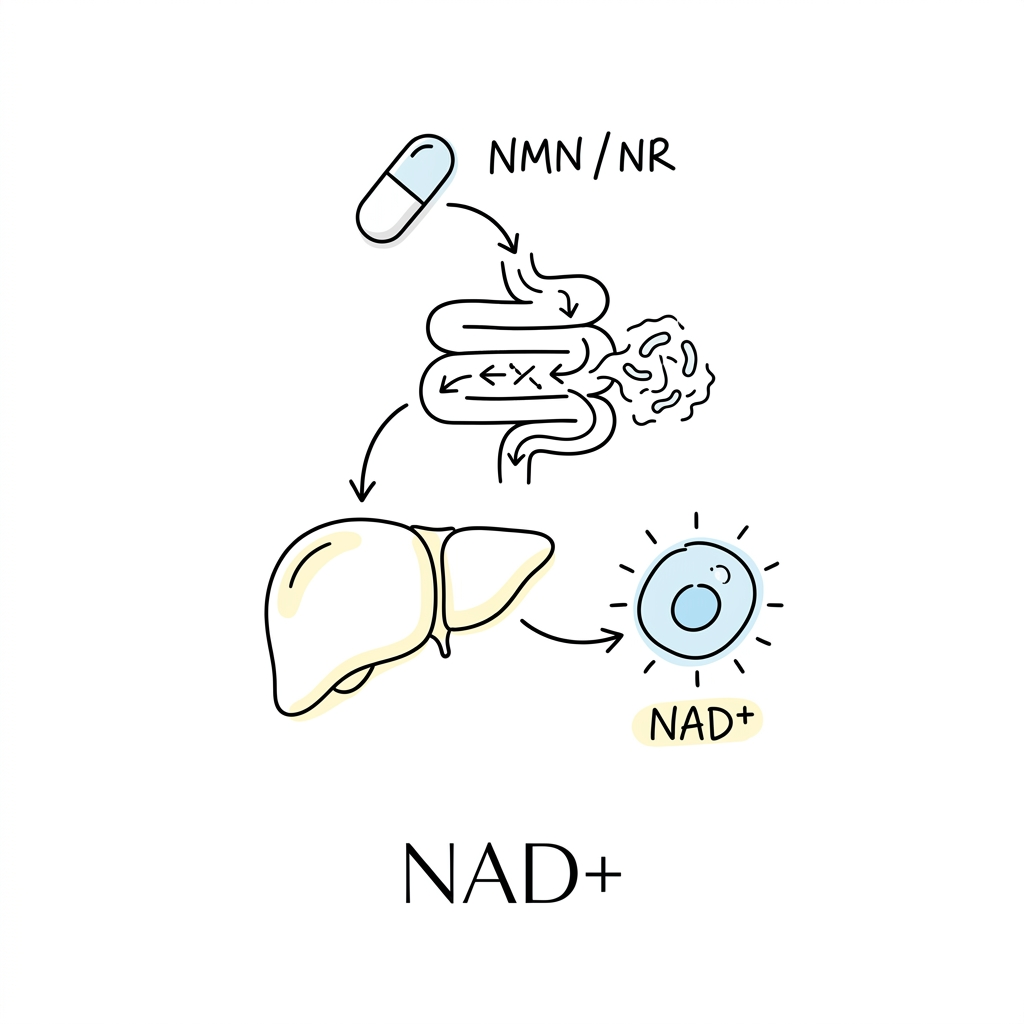
Using isotope-labeled compounds, they tracked the complete fate of orally administered NMN and NR in mice. The conclusion was unexpected: the vast majority of oral NMN and NR is not directly absorbed from the small intestine. Instead, gut bacteria convert it into nicotinic acid (NA), which then enters the enterohepatic circulation — taking a long detour through the liver before finally being reconverted to NAD+.
In other words, what you swallowed did not take the express train. It boarded a city-wide bus transfer system.
Even intravenously injected NMN and NR cannot escape this fate — they are rapidly degraded to nicotinamide in the bloodstream, secreted into bile, deamidated by gut bacteria, and routed back through the liver (Yaku et al., 2025).
This does not mean NMN is useless. It means the mechanism we assumed was operating is not the mechanism that is actually operating. Different supplements travel different routes and reach different tissues with different efficiencies — which is precisely why precision matters more than enthusiasm.
What Does the Clinical Evidence Say? Effects Exist, But Remain Limited
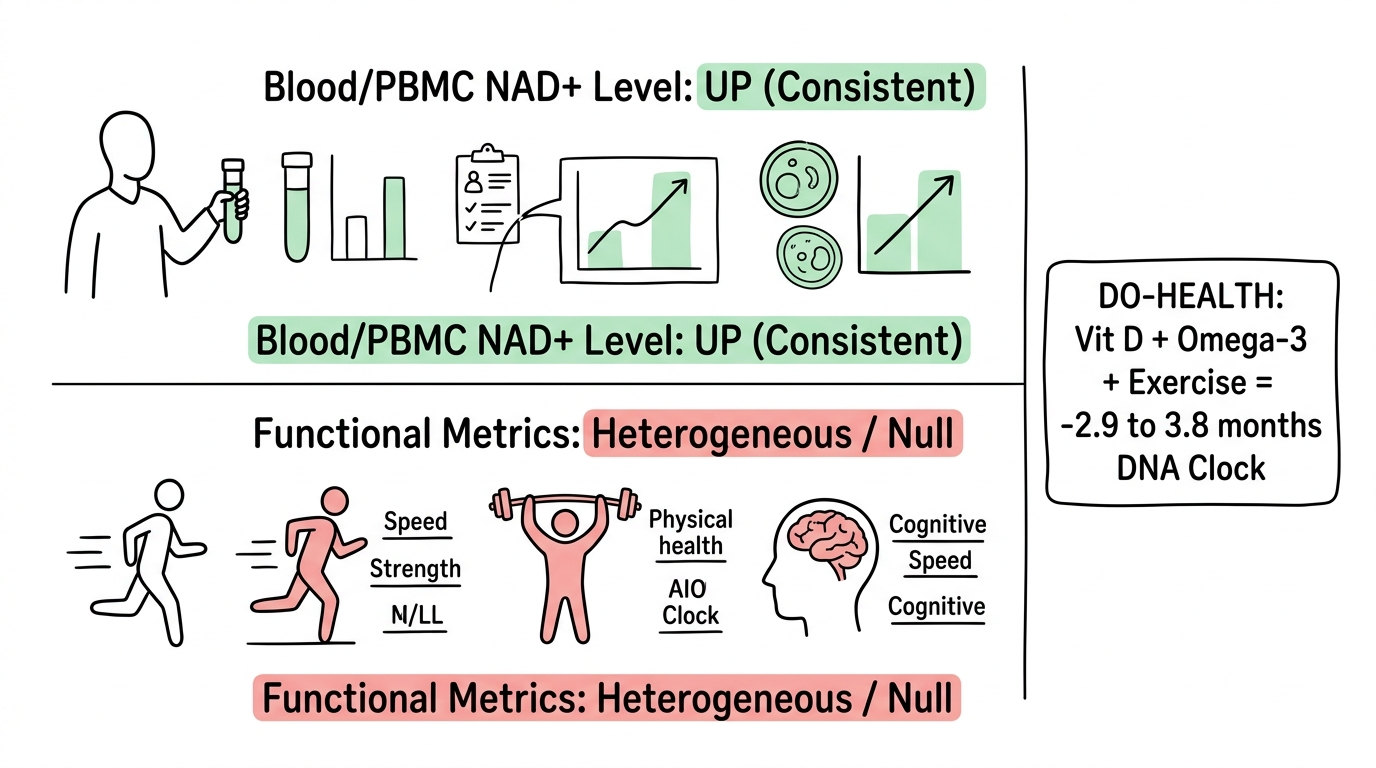 Figure 1: Human studies show NAD+ metabolites rise reliably, but functional benefits remain limited.
So even if the metabolic route takes a detour, does blood NAD+ actually go up?
Yes. That much is well established.
In 2026, Gallagher and Emmanuel published a PRISMA-guided systematic review in Ageing Research Reviews, encompassing 113 studies (33 human intervention trials, 80 animal studies). The conclusion: oral NR and NMN consistently raise NAD+-related metabolites in human blood and PBMCs, with good tolerability.
But here is the critical gap: "higher blood NAD+" and "feeling younger or functioning better" are two different things.
On functional endpoints — metabolism, vascular health, physical performance, cognition — human trial results are heterogeneous, with many yielding null findings or showing effects only on narrow, specific biomarkers. No large, rigorously controlled randomized trial has demonstrated clinically meaningful anti-aging benefits of NMN or NR in healthy older adults.
By contrast, a 2025 Nature Aging study from the DO-HEALTH trial showed that the combination of vitamin D + omega-3 + home exercise slowed DNA methylation clocks by 2.9 to 3.8 months (Bischoff-Ferrari et al., 2025) — a quantifiable "slower aging" benefit whose main ingredients are far cheaper than NMN.
Animal data remains strong: Zhou et al. (2025) in The Journal of Nutrition reported that mice on a high-fat diet showed improved metabolic markers, muscle function, and kidney health after seven months of NMN supplementation. But mice are not humans. That caveat never expires.
Beyond "Does It Work": A Risk You May Not Have Considered
If you think NAD+ supplementation is simply a binary question of effective-or-not, you are oversimplifying.
Pei et al.'s review raises a sobering point: in the context of tumors, NAD+ may actually fuel the problem. Cancer cells also depend on NAD+ for rapid proliferation. In certain tumor microenvironments, elevated NAD+ can sustain the Senescence-Associated Secretory Phenotype (SASP), worsening inflammation.
This is not a reason to panic. It is a reason to remember that "more is better" is almost never true in biology. Individualized, precision-guided NAD+ modulation — not blanket supplementation — is where the science is actually heading.
So What Should You Actually Do?
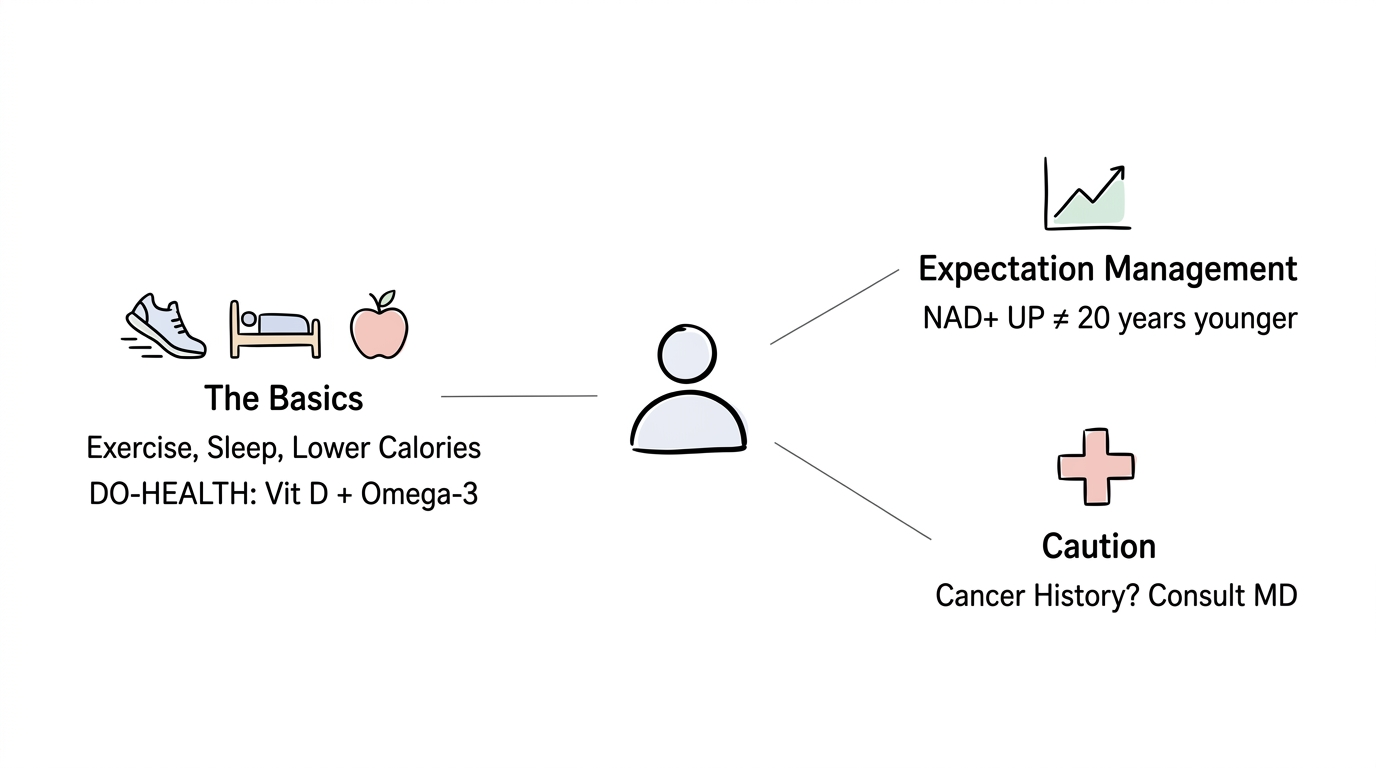 Figure 2: Prioritize proven lifestyle interventions before expecting NMN or NR to work like a shortcut.
If you asked me: "Is it worth buying NMN?" — the honest answer in 2026 is that you probably don't need to yet.
Three evidence-based takeaways from the latest research:
Master the basics first. Exercise, adequate sleep, and moderate caloric restriction are the interventions with the most consistent human evidence for slowing biological aging. The DO-HEALTH combination (vitamin D + omega-3 + exercise) has real DNA clock data behind it.
If you want to try, manage your expectations. Oral NMN/NR will raise blood NAD+. That is real. But do not expect to "feel twenty years younger" — no human data supports that claim.
Consult your physician if you have specific health concerns. Especially if you have a personal or family history of cancer, the dual role of NAD+ in tumor biology deserves careful evaluation.
Science Is Not an Advertisement
The science of NAD+ is real, worth following, and genuinely complex. It is a central node in aging biology. Researchers see genuine light on this path. But "seeing light" and "having arrived" are separated by an honest distance.
Anti-aging research is revealing the truth about aging one paper at a time, and every rigorous study says the same thing: life is not an equation a single capsule can solve.
Keep following this field. But first, go for a run and get a good night's sleep — scientists have already measured that effect for you.
📖 Further reading: Want the full evidence picture behind this discussion? A 2026 PRISMA systematic review pooled 113 studies — I break down, section by section, what it actually proved and what's still missing: Where the 2026 PRISMA Review Leaves the NAD⁺ Evidence.
References
- Yaku K, et al. (2025). Nicotinamide riboside and nicotinamide mononucleotide facilitate NAD+ synthesis via enterohepatic circulation. Science Advances, 11, eadq8380.
- Gallagher JC, Emmanuel N. (2026). NAD+ supplementation for anti-aging and wellness: A PRISMA-guided systematic review. Ageing Research Reviews.
- Pei Z, et al. (2026). NAD+ as a central metabolic hub regulating the hallmarks of aging. Mechanisms of Ageing and Development.
- Zhou Y, et al. (2025). Long-term NMN administration mitigates HFD-induced physiological decline in aging mice. The Journal of Nutrition, 155, 100-112.
- Bischoff-Ferrari HA, et al. (2025). Individual and additive effects of vitamin D, omega-3 and exercise on DNA methylation clocks. Nature Aging, 5, 218-231.