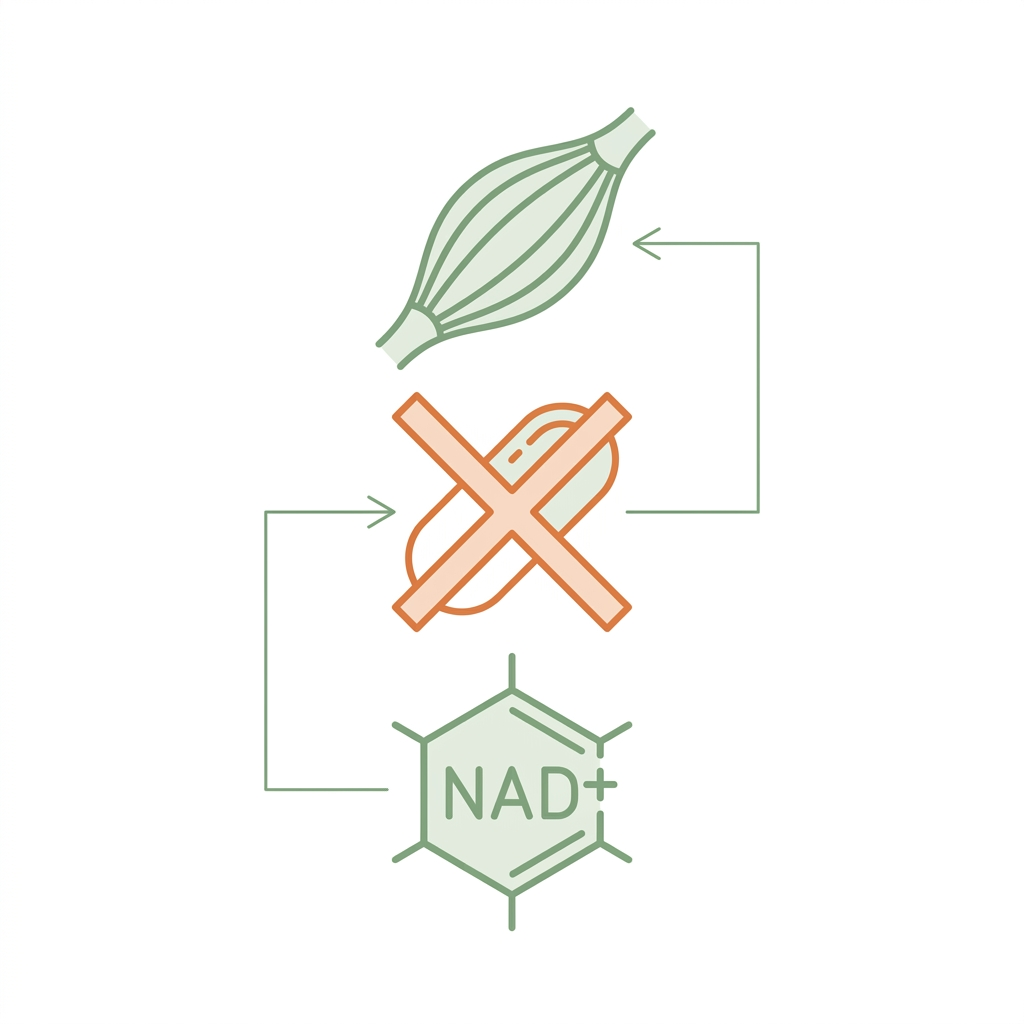
The pitch writes itself: as you age, cellular NAD+ levels decline, mitochondria lose their fuel, and muscles begin to waste away. Take NMN or NR daily, restore NAD+, reverse the clock. The science looked solid. Animal models were promising. A whole industry grew around it.
Then, in 2025, two studies arrived — and the story got complicated.
Lightning Strike One: 85% Depletion, Zero Functional Damage
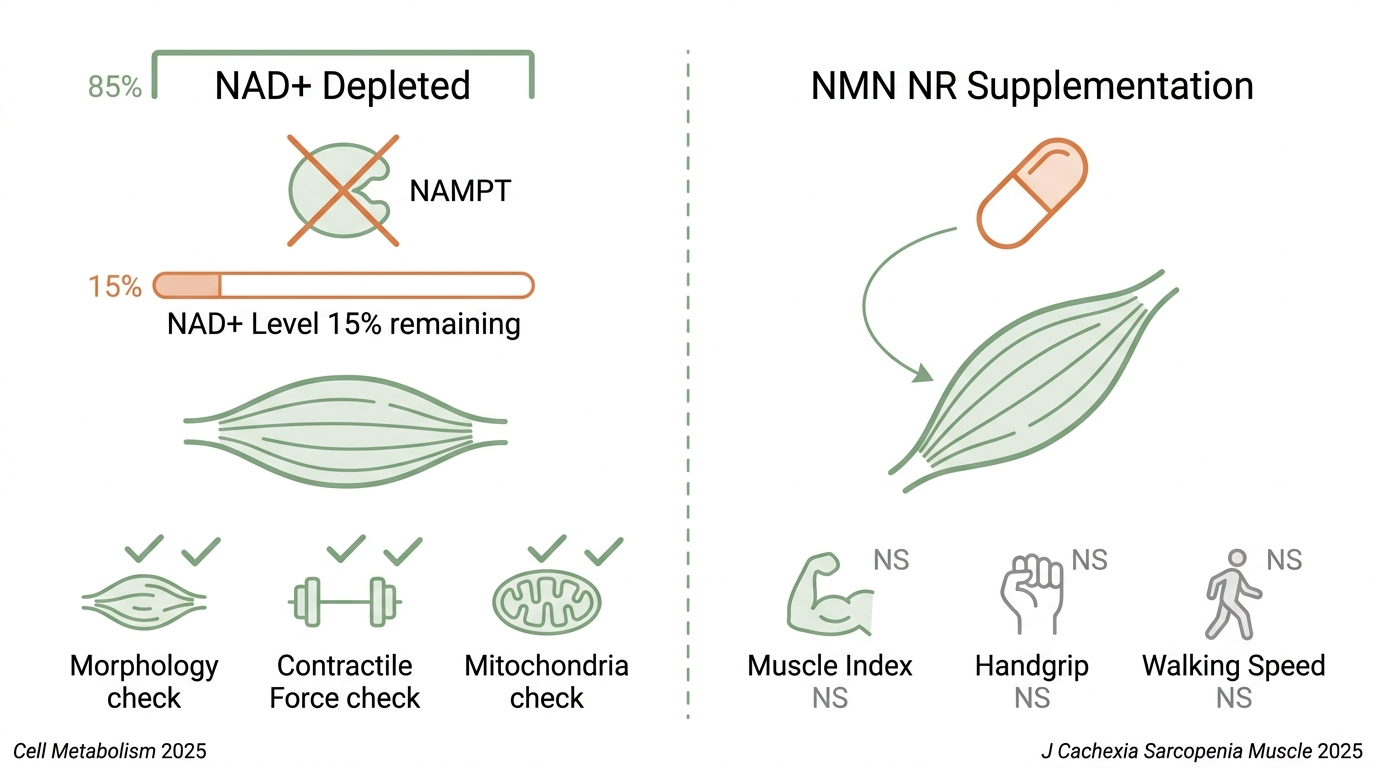
Researchers at the University of Copenhagen engineered adult mice to specifically knock out NAMPT — the enzyme responsible for producing NAD+ in skeletal muscle — causing an 85% collapse in muscle NAD+ levels.
The result was genuinely surprising. Muscle morphology was normal. Contractile force was normal. Exercise tolerance was normal. Mitochondrial respiratory capacity was intact. Transcriptomic and proteomic profiles showed no significant disruption. Even when these mice were maintained in a state of severe NAD+ deficiency for their entire lives, neither their rate of aging nor their systemic metabolism appeared affected.
This study, published in Cell Metabolism, directly challenges the foundational assumption that skeletal muscle NAD+ depletion is a primary driver of aging and muscle loss. If muscle can function normally at 15% of its usual NAD+ level, what exactly is being restored when you take a supplement?
Lightning Strike Two: Clinical Trials Fail to Deliver
Around the same time, a meta-analysis compiled results from 8 randomized controlled trials enrolling 399 participants — predominantly adults over 60, precisely the demographic most targeted by NMN and NR marketing.
The verdict was stark. Neither NMN nor NR supplementation produced statistically significant improvements in skeletal muscle index (SMI), handgrip strength, or walking speed. NMN showed a minor benefit in leg press performance, but — in a result the authors themselves flagged as puzzling — thigh muscle mass actually decreased in the same group.
Earlier human studies followed a similar pattern. A 2019 trial showed that NR supplementation did raise NAD+ metabolite levels in aged skeletal muscle. A 2022 NMN trial showed a slight improvement in walking speed that fell short of significance. The through-line: the supplement gets into the muscle. The muscle, largely, doesn't respond.
So NAD+ Is Useless?
Not quite. The story is about context, not condemnation.
In Duchenne muscular dystrophy (DMD), a condition where NAD+ depletion is genuinely part of the disease mechanism, supplementation makes biological sense. Both rodent and large-animal models show benefits. And there's growing evidence that inhibiting CD38 — the enzyme that degrades NAD+ — may be more effective than flooding the system with NMN or NR. Drugs like isatuximab are already being explored along this pathway.
In disuse atrophy — the kind of muscle loss that follows rotator cuff injuries, prolonged bed rest, or limb immobilization — local injection of recombinant NAMPT protein has shown striking protective effects in animal models, reducing muscle mass loss from 42% to 22% while boosting NAD+ biosynthesis 1.4-fold.
What the evidence does not support is the broader claim: that healthy older adults should take systemic NAD+ precursors to prevent age-related sarcopenia.
Recalibrating Expectations
None of this means NAD+ metabolism is unimportant. The NAMPT–NAD+–SIRT1 axis remains a central regulator of muscle energy metabolism and aging biology. Exercise reliably upregulates NAMPT — that much hasn't changed.
What has changed is how we should think about supplementation strategy.
First, the functional threshold for skeletal muscle NAD+ may be far lower than previously assumed. If 85% depletion causes no detectable dysfunction, the gradual decline of normal aging may never reach a point where supplementation provides meaningful benefit.
Second, NAD+ supplementation likely depends heavily on baseline deficit. Patients with genuine, severe NAD+ insufficiency — DMD, mitochondrial disorders — are the real target population, not healthy older adults seeking general longevity benefits.
Third, future research needs better patient stratification: Who truly has insufficient NAD+? How depleted is too depleted? What functional markers should follow supplementation?
What You Should Do
If you're currently taking NMN or NR, don't panic — and don't immediately throw them out. The safety profile is fine. But recalibrate: these supplements may have positive effects on inflammatory markers or other metabolic pathways not captured in these muscle-focused trials. What they probably won't do is meaningfully protect your aging muscles.
The most evidence-backed muscle protection strategy in 2025 remains unchanged from 1925: resistance training.
References
- Chubanava S et al. NAD depletion in skeletal muscle does not compromise muscle function. Cell Metabolism, 2025. PMID: 40311622
- Fan H et al. The Effect of NMN and NR on Skeletal Muscle Mass and Function: A Systematic Review and Meta-Analysis. J Cachexia Sarcopenia Muscle, 2025. PMID: 40275690
- Ryu D et al. NAD+ repletion improves muscle function in muscular dystrophy and counters global PARylation. Science Translational Medicine, 2016. PMID: 27798264
- Elhassan YS et al. Nicotinamide Riboside Augments the Aged Human Skeletal Muscle NAD+ Metabolome and Induces Transcriptomic and Anti-inflammatory Signatures. Cell Reports, 2019. PMID: 31412242
- Zhang Y et al. NAMPT-elevated NAD+ biosynthesis prevents muscle disuse atrophy. J Cachexia Sarcopenia Muscle, 2023. PMID: 36864250
- de Zélicourt A et al. CD38-NADase is a new major contributor to Duchenne muscular dystrophic phenotype. EMBO Molecular Medicine, 2022. PMID: 35298089