Think about a phone you've had for a few years. You've swapped the screen. You cleared the storage. But the battery? It just doesn't hold a charge anymore. By noon, you're hunting for an outlet.
Your cells have the same problem.
The molecule behind it is called NAD+ — nicotinamide adenine dinucleotide, if you want the full name. It's essentially the fuel your cells run on. Energy metabolism, DNA repair, gene expression — all of it burns through NAD+. And by middle age, you have roughly half the NAD+ you did at twenty.
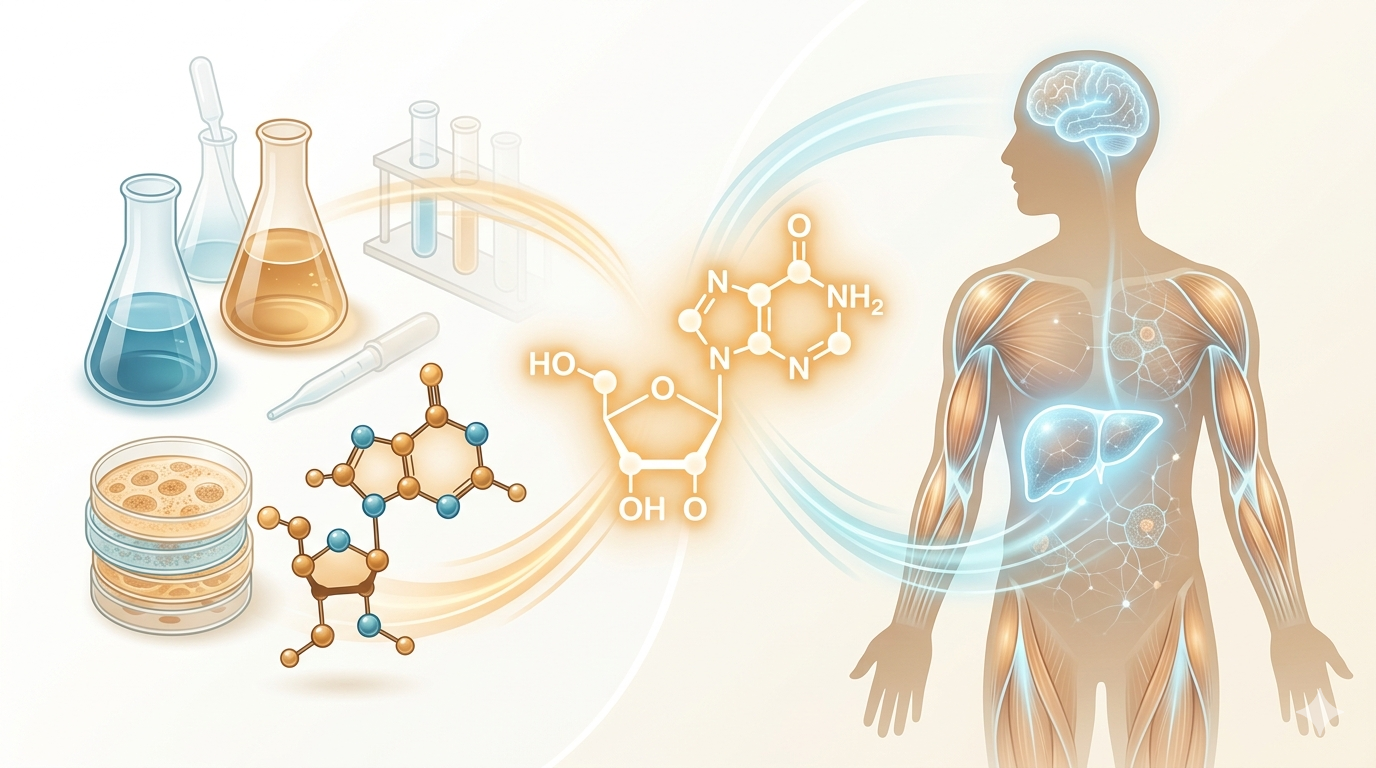
A 2025 review in Nature Aging by Zhang, Wang, and Fang mapped out where the science stands — from laboratory findings to human clinical trials. The picture is complex. But some things are becoming clear.
The Repair Crew That Needs a Paycheck
NAD+ isn't just an energy source. Think of it as a wage that keeps your cellular maintenance workers on the job.
Inside your cells, a family of proteins called Sirtuins — sometimes called longevity proteins — does some of the most important upkeep in your body. They patch damaged DNA. They clear out worn-out mitochondria. They quiet genes that shouldn't be switched on. Sirtuins are good at their job. But they can't work without NAD+.
When NAD+ drops, Sirtuins lose their funding. The repair crew goes home. Mitochondria start leaking reactive oxygen species — tiny chemical sparks that damage proteins and membranes. Immune cells slow their response. Muscles take longer to recover. Your brain struggles to maintain its synaptic connections.
You experience this as fatigue that doesn't shift, a memory that misfiles things, a body that bounces back slower than it used to.
Zhang and colleagues emphasize something worth sitting with: NAD+ decline isn't a localized problem. It's a system-wide signal that drives aging across every major organ simultaneously.
The Supplements Getting Attention
You can't just swallow NAD+ directly — your gut breaks it down before it gets anywhere useful. So researchers have focused on precursors: compounds your body can convert into NAD+.
The two front-runners are NR (nicotinamide riboside) and NMN (nicotinamide mononucleotide).
NR has the longer track record in humans. Multiple randomized controlled trials using 250 to 1,000 mg per day show it reliably raises NAD+ levels in blood. Short-term safety looks solid. Some trials found improvements in liver enzyme markers and lower inflammatory signals. Results on cognitive function and muscle performance? Inconsistent across studies.
NMN's human data is catching up. An eight-week Japanese trial with healthy middle-aged men found that daily NMN supplementation increased NAD+ metabolites in the blood. Walking speed and grip strength showed positive trends. The sample size was small — not enough to draw firm conclusions — but the direction was encouraging.
Here's the honest answer to which one you should take: nobody knows yet. The two compounds travel slightly different metabolic routes, and different tissues seem to prefer different entry points. A one-size-fits-all recommendation doesn't exist at this stage.
Not All Organs Play by the Same Rules
This is where the Zhang et al. review gets genuinely interesting. Your brain, muscles, and liver each have a different relationship with NAD+.
Your brain is the biggest NAD+ spender in your body. Neurons are metabolically intense, and they have almost no tolerance for supply disruptions. But your brain sits behind the blood-brain barrier — a selective filter that makes it hard for orally consumed molecules to reach neural tissue. Patients with Alzheimer's disease and Parkinson's disease show significantly lower NAD+ levels in brain regions. The link is real. But no clinical trial has yet shown that taking NR or NMN actually slows neurodegeneration in humans. That question is still open.
Muscle is the more optimistic story. Animal studies consistently show that NAD+ supplementation improves muscle function and exercise endurance. Early human signals lean positive. For sarcopenia — the age-related muscle loss that quietly steals your independence — this is a direction worth watching.
Liver is NAD+'s main production site and also ground zero for metabolic disease. Fatty liver and insulin resistance are both linked to NAD+ shortfalls. Some NR trials have seen liver function markers improve. Long-term effects remain to be confirmed.
The Dosing Problem No One Has Solved
The current clinical trials use doses ranging from 250 to 2,000 mg per day. That's a wide gap. Absorption varies by person. Your liver's conversion efficiency differs from your neighbor's. Tissue distribution is uneven.
The next phase of this research is about precision — using biomarkers to track your actual NAD+ levels the way you'd monitor blood glucose, then adjusting supplementation based on what your body actually needs rather than a generic dose on a label.
That's the future. What about right now?
Five Things You Can Do Today
Exercise — and make it a mix. Aerobic and resistance training together is the most reliable way to push your body into producing more NAD+ on its own. About 150 minutes of moderate activity per week. That's the number that shows up across the literature.
Keep your sleep schedule consistent. Deep sleep is when your cells run their repair programs — DNA patching, mitochondrial recycling. Irregular sleep compresses that window. You can't fully compensate with supplements.
Eat foods that carry vitamin B3. Chicken breast, tuna, peanuts, mushrooms, avocado. B3 (niacin) is a direct NAD+ building block. Getting it from food is the safest starting point.
Cut back on alcohol if you drink heavily. Metabolizing alcohol burns through NAD+. Before you think about adding more, it makes sense to stop the drain first.
Lower the sources of chronic inflammation in your life. Processed food, refined sugar, sustained stress — all of them activate immune pathways that consume NAD+. Reducing these inputs is essentially the same as giving your battery a longer runtime between charges.
NAD+ research is moving from the bench toward the clinic. Trials are underway. Better biomarkers are being developed. Precision protocols are coming.
But your cells don't wait for the peer review process. They need this molecule now. And the good news is that the most evidence-backed ways to support NAD+ don't require a prescription or a supplement stack. They require consistency.
Steady supply. Less unnecessary drain. That's the protocol.
Based on Zhang, Wang & Fang (2025). Nature Aging. DOI: 10.1038/s43587-025-00947-6