You've been collecting articles for three years. A thousand notes in Notion. But when you actually need something, you open a new Google tab.
The problem isn't that you're lazy. The problem is that there's a fundamental gap between storing knowledge and being able to use it — and most "second brain" systems do nothing to close that gap.
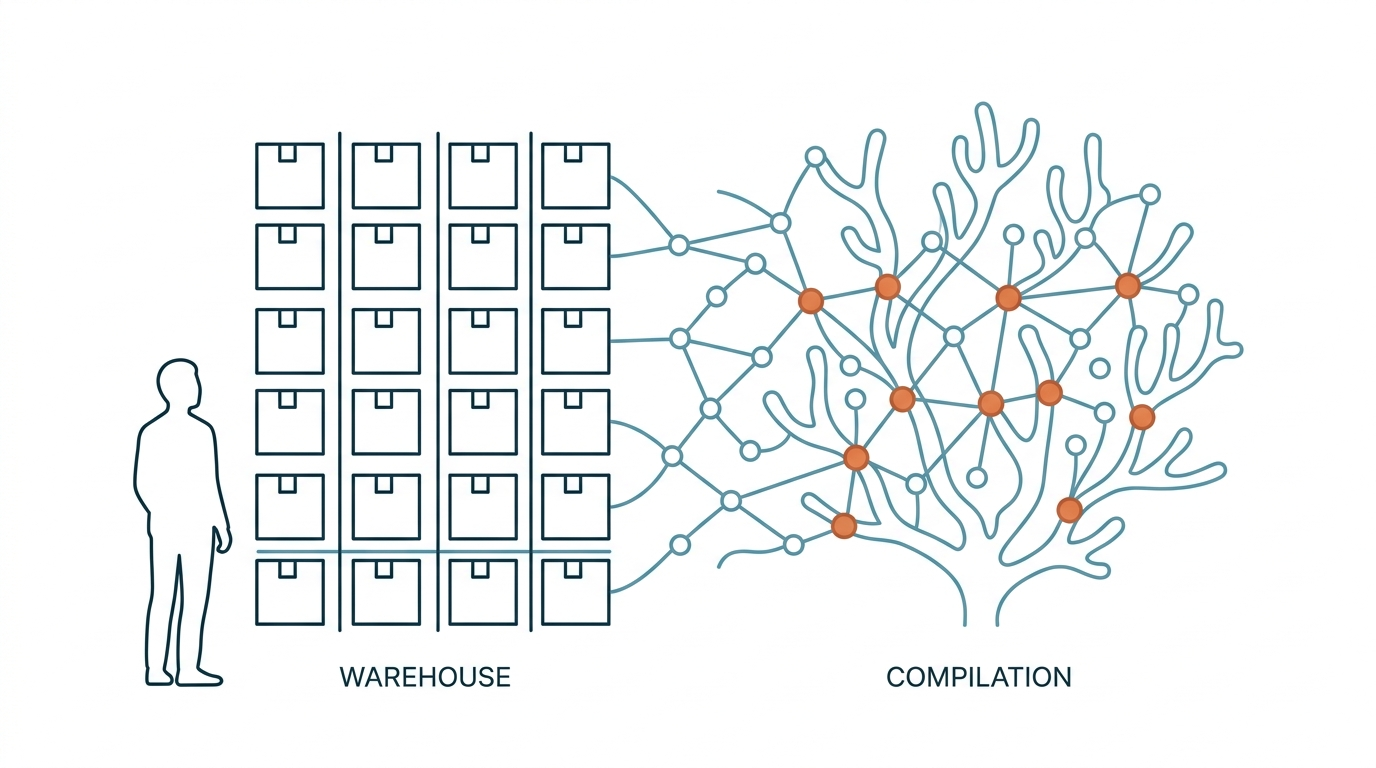
Your Knowledge Base Is a Warehouse
The typical knowledge management workflow looks like this: you see a good article, you save it. You hear an interesting idea, you note it. You read a paper, you bookmark it. Three years later, you have thousands of items that share exactly one relationship: they all live in the same app.
This is the core confusion: collecting is not learning. Collecting moves things into storage. Learning encodes things into a network of connections. Your Notion database has a thousand articles with no links between them. It's not a second brain — it's a very organized warehouse.
Traditional RAG (Retrieval Augmented Generation) repeats this mistake in AI form. You ask a question, the system pulls relevant chunks from the warehouse, the AI assembles an answer, and you close the session. Every query is one-shot. The system learns nothing. The warehouse stays a warehouse.
Karpathy's Three-Layer Architecture
Andrej Karpathy's proposal changes the fundamental job description of an AI knowledge system. Rather than just answering questions, the AI maintains your knowledge in a living, structured form.
The architecture has three layers. At the bottom: raw sources — anything you throw in. Articles, notes, papers, conversation transcripts, voice memos. At the top: a schema — rules defining how the AI should maintain the middle layer. In the middle, where everything interesting happens: a wiki — AI-maintained structured knowledge pages, written in Markdown inside Obsidian.
Here's what makes the middle layer different. When you drop in a new article about Agent memory management, the AI doesn't just file it. It reads it, identifies which existing topic pages it affects, and updates them. A single article might simultaneously touch "Agent Architecture," "Context Engineering," and "Prompt Design" — each page incrementally revised, new information woven into the existing network.
Even more powerful: every query strengthens the system. When you ask a cross-domain question, the AI connects previously unrelated pages to answer you, and those new connections persist as synthesized entries. The more you ask, the smarter the system gets.
The Second Brain Part 2 framework extends this with domain specialization: instead of one universal knowledge base, build separate vaults per domain. One for competitive intelligence. One for personal health. One for client knowledge. Each vault develops its own concept graph and entity network. You wouldn't store recipes and tax records in the same drawer — the same principle applies to knowledge.
The Shift That Matters
The change here isn't technical. It's a shift in what we expect knowledge management to do.
Old expectation: convenient storage. Put it in, get it out. Retrieval on demand.
New expectation: continuous appreciation. Every input and every query makes the system more valuable. Knowledge compounds rather than accumulates.
For researchers, this transforms literature review from a one-time slog into a continuously running compilation process. Every paper you've read over the past three years gets encoded into an increasingly detailed knowledge map. When a new paper arrives, the system automatically identifies which older papers it relates to, what gaps it fills, and what new questions it opens.
For organizations, this means institutional knowledge stops walking out the door when people leave. Every team member's contributions get compiled into the organizational knowledge network. What walks out with a departing employee is their personal experience. The structured knowledge stays.
A Note on Getting Started
You don't need to build Karpathy's full system on day one. The mindset shift is the starting point: when you next encounter something worth saving, ask not "where should I store this?" but "which parts of what I already know does this connect to?" Start with two or three topic pages and let the AI help you maintain them. The architecture scales from there.
Your second brain shouldn't be a warehouse. It should be a coral reef — every new grain of sand gets built into the structure, making the whole thing more solid.
References
- Karpathy, A. (2026). AI-native knowledge compilation architecture. Personal blog / X thread.
- Two ways to build a second brain with LLMs. (2026).
- Part 2: Your Second Brain System (Done For You). (2026).
- I Gave Claude Code 300 Huberman Episodes. It Replaced My Coach. (2026).