TL;DR: An AI system that conceives ideas, writes code, runs experiments, and produces full research papers — all for under $15 — just passed peer review at a top ML conference. And the reviewers had no idea.
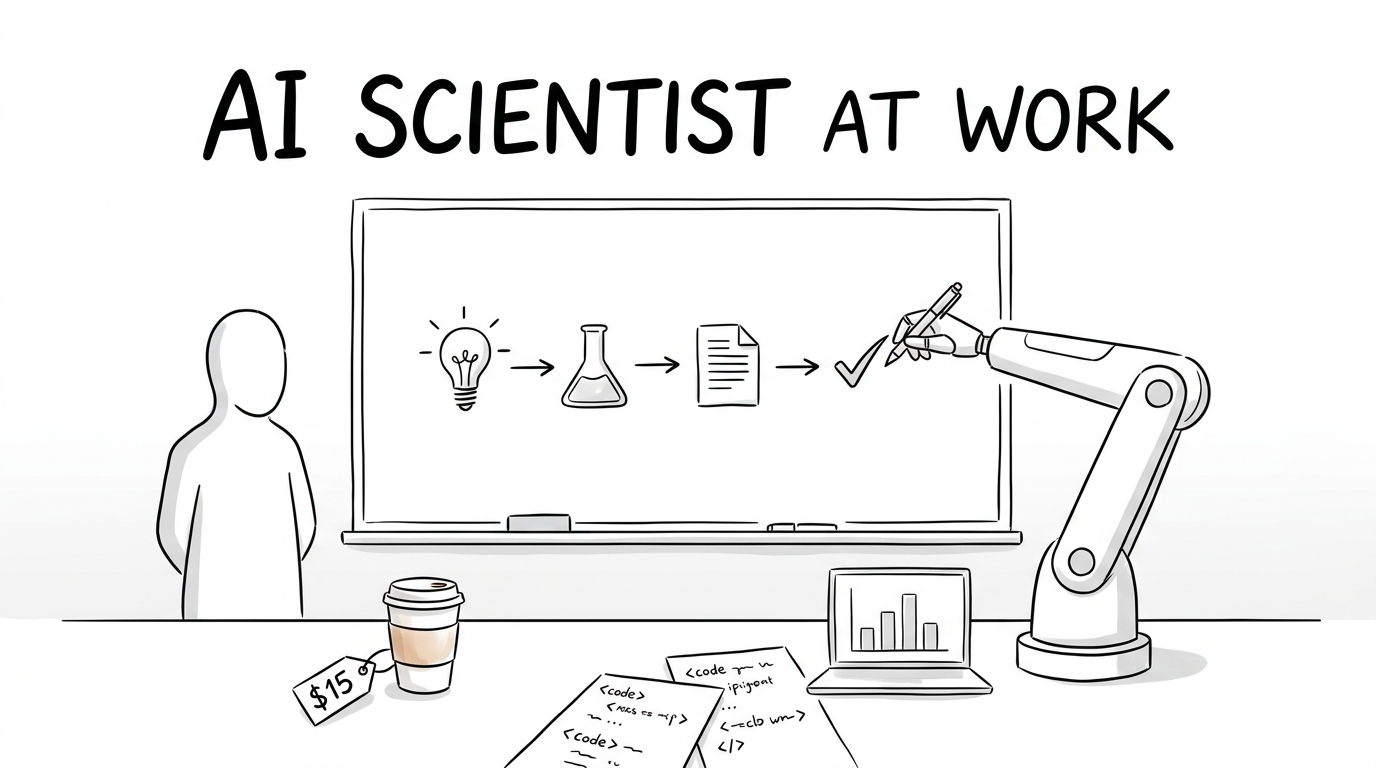
The Price of a Latte, the Output of a Lab
Picture this. You walk into a coffee shop and order a latte. By the time you tap your card, a computer has already finished an entire research cycle: brainstorming hypotheses, searching literature, writing experiment code, running models, analyzing data, drafting a full paper, and reviewing its own work.
Your coffee isn't even cool enough to drink, and the paper has already been submitted.
This isn't hyperbole. Published in Nature in March 2026, a team from Sakana AI, Oxford, and UBC built a system called The AI Scientist. The cost to produce one paper: under $15. Three AI-authored manuscripts were submitted to a workshop at ICLR — one of the top machine learning venues. One received an average score of 6.33, clearing the acceptance threshold and passing blind peer review (Lu et al., 2026).
The reviewers didn't know it was written by a machine.
How Does It Actually Do Research?
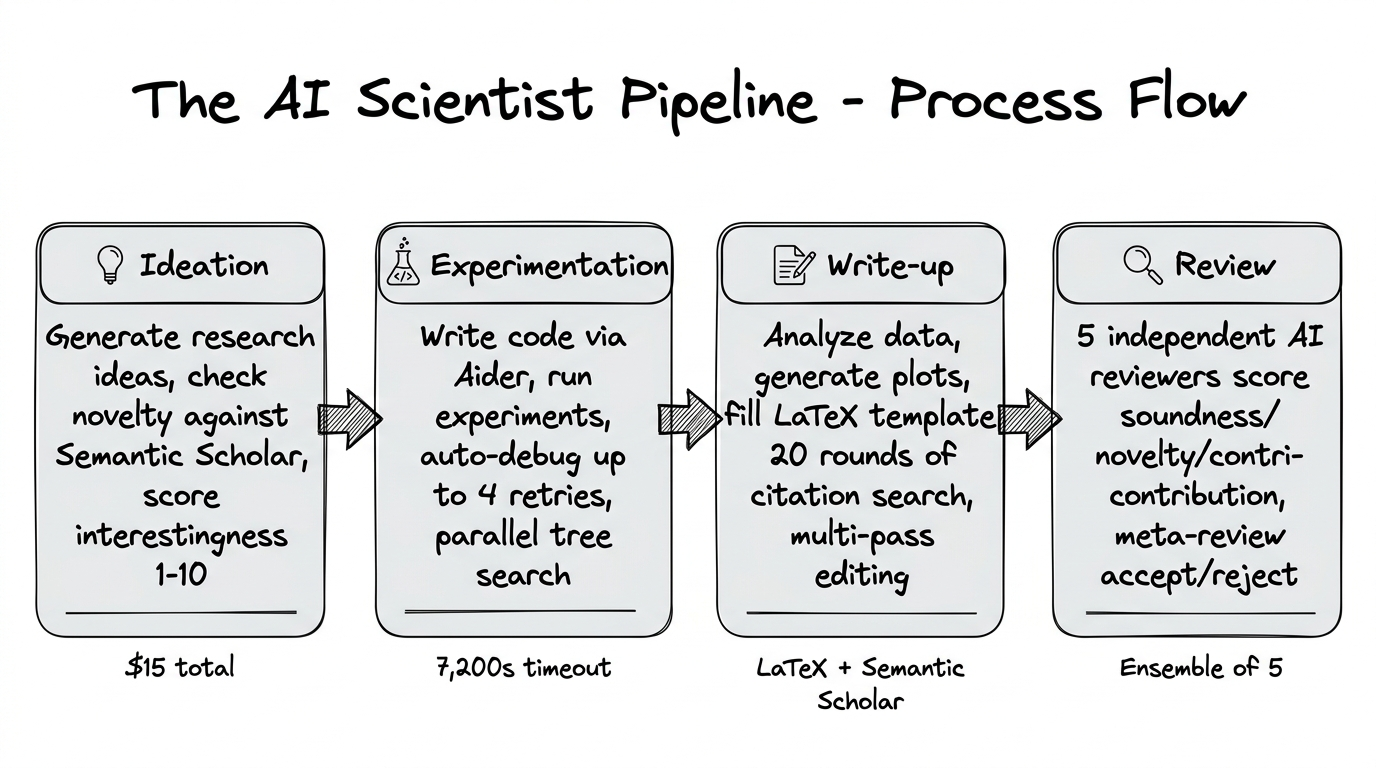
You might think "AI writing papers" means pasting ChatGPT output into Word. Not even close. The AI Scientist is a full production pipeline with four stages:
Stage 1: The Idea Factory. The system plays the role of an "ambitious AI PhD student," iteratively generating research directions. Each idea comes with a title, hypothesis, experimental plan, and self-assessed novelty and feasibility scores (1–10). To avoid duplicating existing work, it queries Semantic Scholar and filters out ideas too similar to published literature.
Stage 2: The Lab. Once an idea is selected, the system uses Aider — an AI coding assistant — to write experiment code, run models, and tune hyperparameters. Hit a bug? It reads the error log and auto-patches, retrying up to four times. In the advanced "template-free" mode, it spawns an entire search tree — running dozens of parallel experimental branches, like a real research team splitting up to explore.
Stage 3: The Writing Room. After experiments, the system analyzes results, generates figures, and fills in a standard LaTeX conference template. It searches 20 rounds of related literature, writes justifications for each citation, and runs multiple passes of automated editing before finalizing.
Stage 4: The Review Board. Finally, the system reviews its own work. It assembles a five-member virtual review committee, each scoring the paper on soundness, novelty, and contribution. A "meta-reviewer" then synthesizes a final accept-or-reject decision.
Machine Reviewers — As Good as Humans?
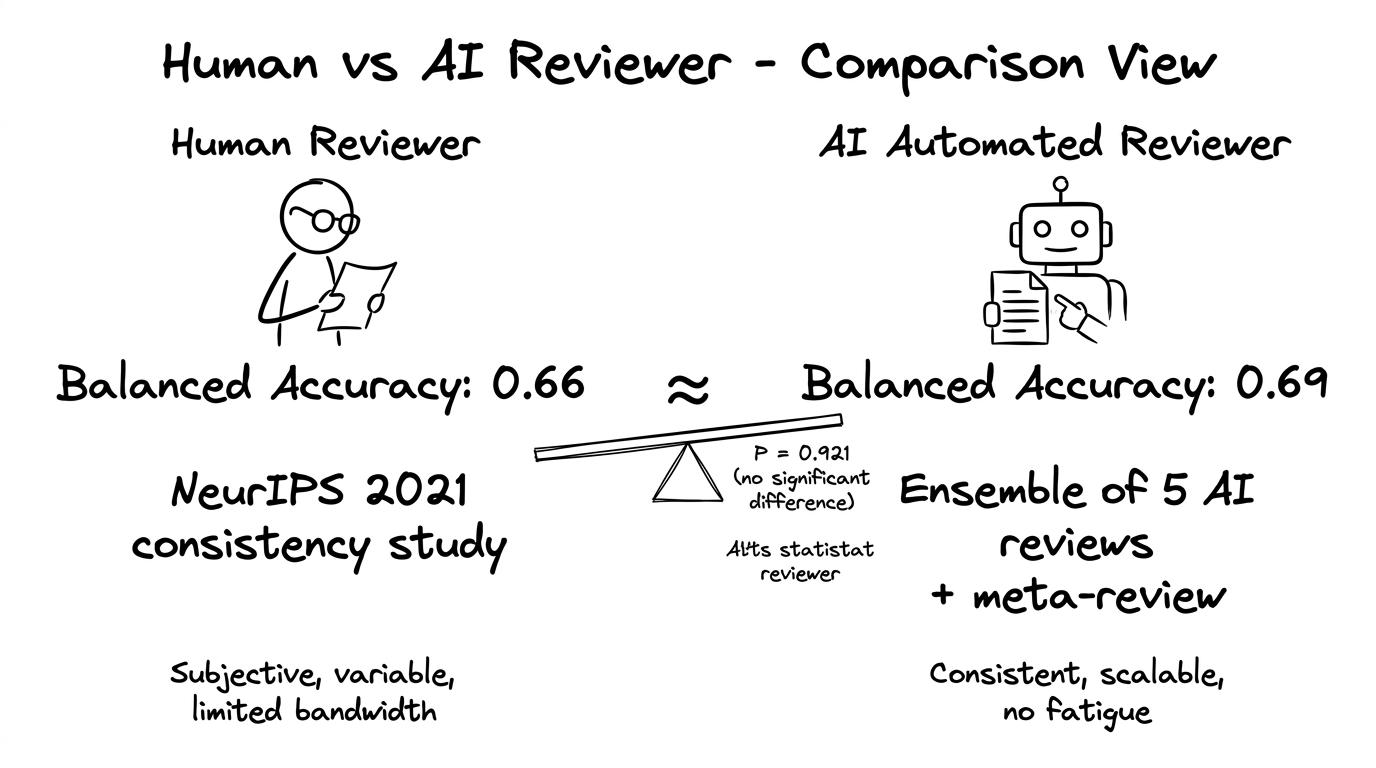
Here's a number worth remembering: 0.66.
That's the balanced accuracy of human reviewers at NeurIPS — how consistently they agree on whether to accept or reject a paper. The AI Scientist's automated reviewer? 0.69. Statistically, no significant difference.
Even more telling: the team deliberately tested on papers from 2025 onward — papers that couldn't have appeared in the AI's training data. Accuracy held at 0.66, matching human performance.
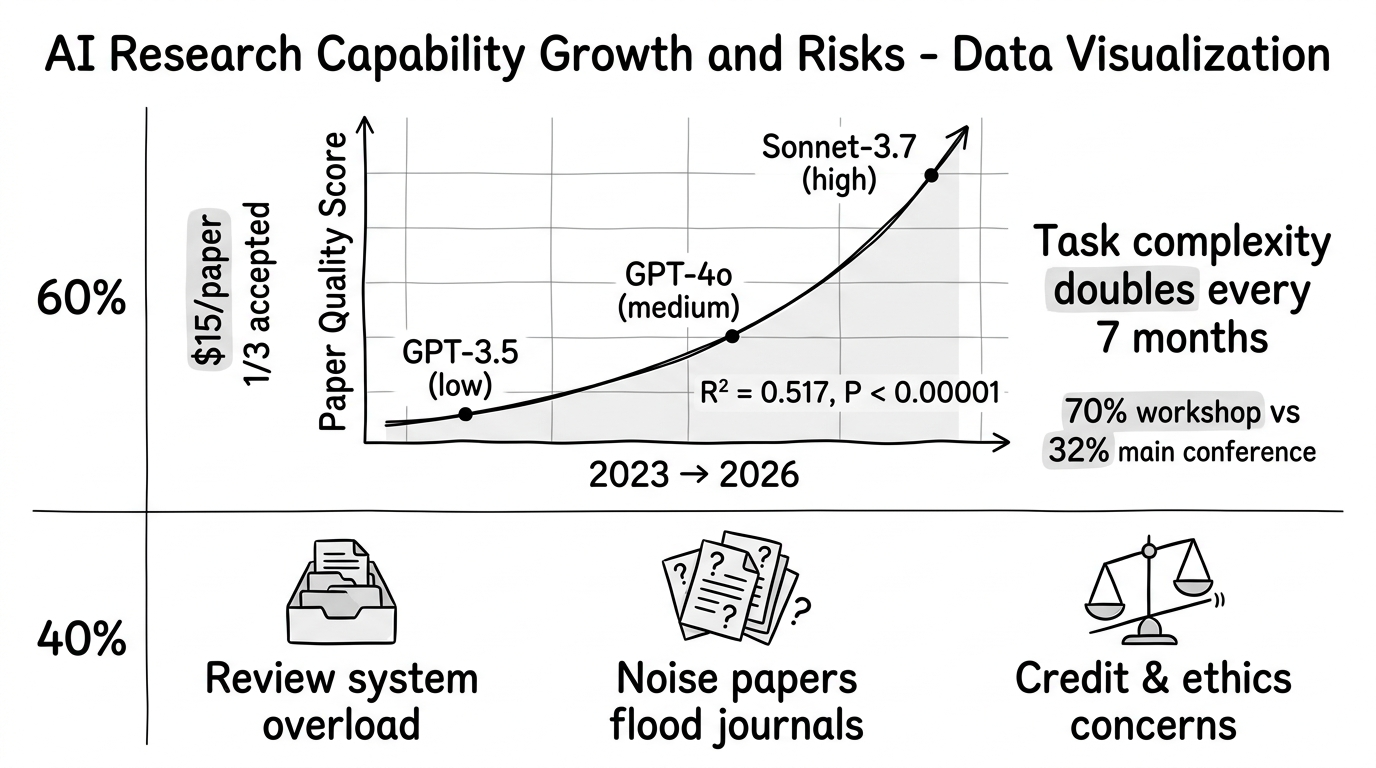
And paper quality keeps climbing with better models. From 2023 to 2025, as GPT and Claude models improved, AI-generated paper scores rose steadily (R² = 0.517, P < 0.00001). The researchers put it bluntly: stronger models mean better papers. The trend line is still going up.
So Are Scientists Out of a Job?
Not yet.
Of the three submitted papers, only one was accepted. That workshop had a 70% acceptance rate; the main ICLR conference sits at 32%. The team openly admits: AI-generated papers still fall short of top-tier venues. Common failure modes include naive ideas, flawed experiments, duplicated figures, and hallucinated citations — references to papers that don't exist.
But consider this: the complexity of tasks AI can reliably complete doubles every seven months. Today's workshop-level output could be conference-level in two or three years.
The truly uncomfortable question isn't whether AI can do research. It's what happens next. If anyone can generate a convincing-looking paper for $15, can peer review survive? If AI floods journals with "noise papers," how do we find the discoveries that actually matter?
The research team did something commendable: every AI-generated submission was withdrawn after review, regardless of the outcome. They obtained ethics approval from UBC (Protocol H24-02652) and informed the conference organizers in advance.
This wasn't an experiment in sneaking past the gatekeepers. It was a declaration: "Look, AI can already do this. It's time we had a serious conversation about the rules."
What do you think? If you received a flawless research report tomorrow, would you want to know whether the author had a heartbeat?
Closing: The Next Epoch of Science
The automation of scientific research isn't a question of "if" — it's happening. The AI Scientist proves that AI can now walk the entire path from inspiration to publication. It's still rough. It makes mistakes. It hallucinates. But it doubles in capability every seven months.
Perhaps one day, the Nobel Prize shortlist will include a candidate with no pulse. Before that day comes, we need to answer a harder question: when machines can "do science," what does it mean to be a scientist?
References
- Lu, C. et al. (2026). Towards end-to-end automation of AI research. Nature, 651, 914–919. doi: 10.1038/s41586-026-10265-5
- Lu, C. et al. (2024). The AI Scientist: Towards Fully Automated Open-Ended Scientific Discovery. arXiv preprint, arXiv:2408.06292.