You might think that making AI faster means giving it more memory. More storage, bigger chips, problem solved. But that intuition is wrong — and the real answer is both more nuanced and more interesting.
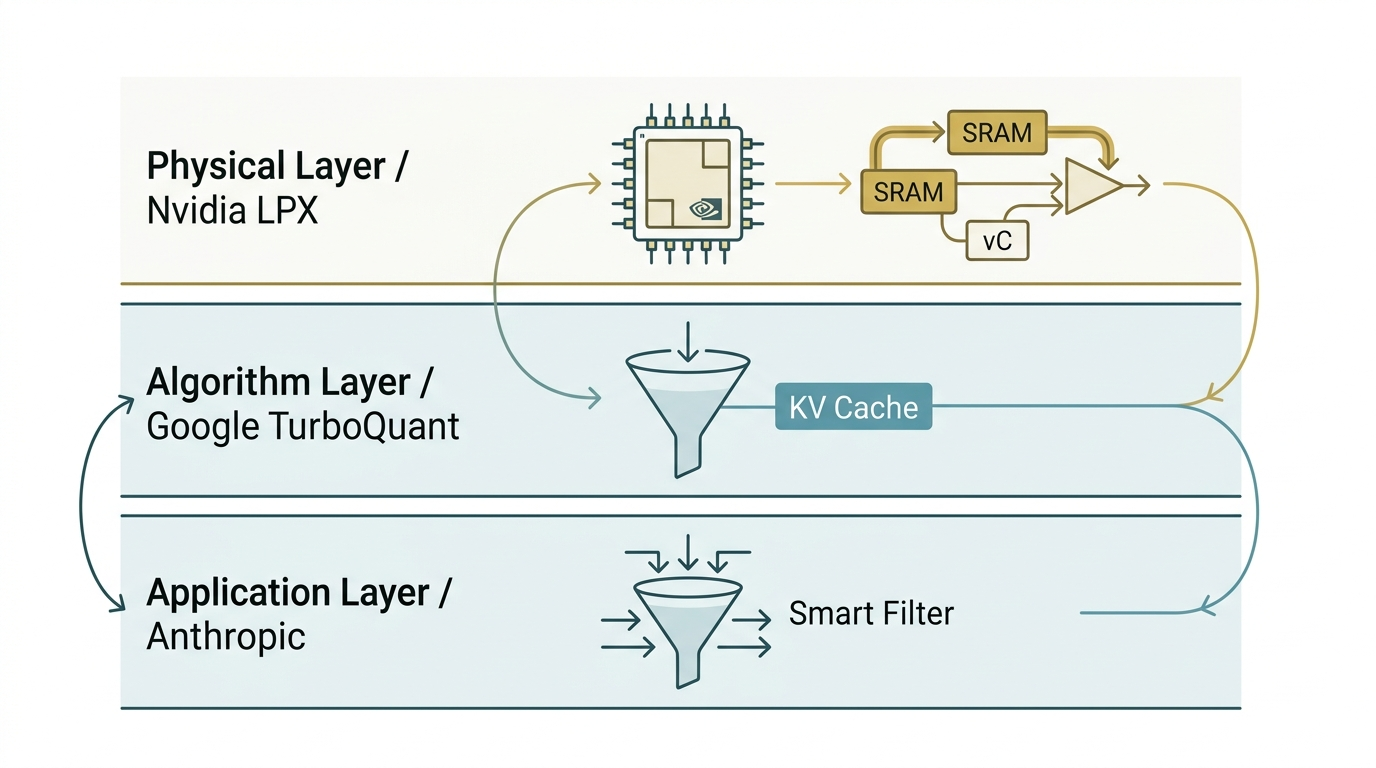
Three major tech companies are quietly solving three distinct versions of the same problem. Their solutions don't compete with each other. They stack.
The Core Problem: Bandwidth, Not Capacity
Picture a library where the librarian can only carry one book at a time. It doesn't matter how many bookshelves you add — the librarian is always the bottleneck.
That's AI inference today. When a large language model generates its next word, it doesn't struggle with computation. Modern GPUs are wildly overpowered for the actual math involved. The real constraint is memory bandwidth — how fast data can flow between the model's parameters and the processor doing the work.
Every time a model generates a token, it must read enormous amounts of state information from memory. If that read process is slow, everything waits. Adding more compute — a bigger GPU, more VRAM — doesn't fix a traffic jam. You need to widen the road, optimize the signals, and reduce the number of unnecessary trips. All three, simultaneously.
Layer 1: The Physical Layer — Nvidia LPX
Nvidia's approach starts at the hardware itself. Their LPX architecture adds a dedicated high-speed SRAM layer inside the GPU, specifically designed to cache intermediate results from the feed-forward network (FFN) layers.
Why does this matter? Standard GPU memory (HBM — High Bandwidth Memory) is capacious but relatively slow to access. SRAM is much faster, though smaller. By routing certain computations through SRAM instead of HBM, LPX reduces the round-trip time for the most frequently accessed data.
The practical result: token generation speeds become more consistent. The variance that previously caused unpredictable latency spikes gets absorbed by faster local access.
Think of it as building a dedicated fast lane on a congested highway — certain high-priority traffic bypasses the main bottleneck entirely.
Layer 2: The Algorithmic Layer — Google TurboQuant
If Nvidia widens the road, Google optimizes traffic signals. Their TurboQuant technology targets the single largest memory consumer in generative AI inference: the KV Cache (Key-Value Cache).
Every token a model generates requires storing its key and value vectors for use in subsequent attention calculations. In a conversation spanning 10,000 tokens, the KV Cache balloons into something nearly unmanageable. The longer the conversation, the slower and more expensive each new response becomes.
TurboQuant's innovation is performing dynamic KV Cache compression during inference, without calibration data. Previous compression approaches required preparing special training datasets to tune the compression parameters. TurboQuant eliminates that requirement — it compresses on the fly.
The result: significant memory footprint reduction, improved throughput, and lower cost per token — without requiring any changes to model training or deployment infrastructure.
Layer 3: The Application Layer — Anthropic
While Nvidia and Google work on the supply side (making memory faster and smaller), Anthropic attacks demand. Their strategy: don't let everything into the context in the first place.
Anthropic has developed intelligent context management systems that:
- Select — determine which past conversation elements are genuinely relevant to the current query
- Compress — apply lossless or lossy compression to necessary information
- Distill — extract key summaries from lengthy conversation histories
The goal is enabling long-running AI agents to maintain coherent understanding of information from hours or days ago, without paying the full memory cost of storing every detail.
The analogy: a skilled executive assistant doesn't dump the complete archive of meeting notes on their boss's desk. They prepare a precisely curated briefing — the critical facts, decisions, and context, organized for immediate use.
Why These Three Layers Are Complementary, Not Competing
When people first encounter these three approaches, the natural question is: which one is the "real" solution?
The answer: none of them alone is sufficient.
Consider urban traffic congestion:
- Widen roads without optimizing signal timing, and you just delay the traffic jam
- Optimize signals without adding road capacity, and you hit a hard ceiling
- Reduce car trips through demand management alone, and urban growth overwhelms the savings
Urban mobility requires all three simultaneously. So does AI memory.
Hardware improvements (Layer 1) deliver roughly 20-30% gains. Algorithmic compression (Layer 2) adds another 20-30%. Application-layer selection (Layer 3) determines whether long-horizon agent tasks are feasible at all — not just slightly faster, but possible versus impossible.
Combined, these three layers can deliver 2-3x or greater improvements. That's the difference between an AI agent that degrades after a 30-minute conversation and one that maintains coherence across a multi-hour work session.
What This Enables
The combined effect of these three layers makes something previously impossible into something practical: AI that genuinely remembers.
Until recently, long conversations meant dramatically slower responses and exponentially higher costs. The economics forced users to constantly start fresh — losing context, repeating context, losing efficiency.
When all three layers operate together, AI systems can:
- Handle substantially longer context windows
- Maintain consistent output speed as conversations grow
- Scale cost more linearly (rather than quadratically) with conversation length
- Support genuinely long-running autonomous agent tasks
Imagine a customer service AI that can reference a month of interaction history while still responding in under two seconds. That capability requires hardware efficiency, algorithmic compression, and intelligent context selection working in concert.
The Bigger Picture
AI's memory problem looks like a hardware challenge. But solving it requires systems engineering wisdom — improvements at the physical layer, the algorithmic layer, and the application layer, applied simultaneously.
This isn't something any single company solves alone. It's the product of an entire industry converging on the same set of constraints, approaching them from different angles.
The next time someone tells you AI's memory limitations will be solved by just "making bigger chips," you now know the real answer: three separate problems, three separate solutions, none of them optional.
References
- Nvidia. (2025). LPX Architecture: Memory Bandwidth Optimization for Inference Workloads. Nvidia Developer Blog.
- Google. (2025). TurboQuant: Dynamic KV Cache Compression Without Calibration Data. Google Research.
- Anthropic. (2025). Memory Management in Long-Horizon Agents: Intelligent Context Selection and Compression. Anthropic Research.
- Various industry analyses. (2024–2026). Memory bandwidth bottleneck in LLM inference.
- Transformer inference research papers. (2024–2026). Token generation and KV cache dynamics.