That impressive AI agent demo you saw on Twitter? It probably falls apart in three minutes of real-world use. Not because the model is weak — because nobody built the guardrails.
The Gap Between Demo and Production
There's a pattern that repeats itself constantly in the AI world: a developer builds something that looks stunning in a controlled five-minute demo, posts it online, and it goes viral. Three months later, the project is quietly abandoned. The model was capable enough. The infrastructure around it wasn't.
Think of it this way: hiring a brilliant but inexperienced new employee. They can learn anything. But you wouldn't hand them unsupervised access to customer complaints, production systems, or financial accounts on day one. The problem isn't their intelligence. The problem is they need a framework — a set of rules, escalation paths, and checkpoints — that lets their intelligence operate within safe boundaries.
That framework, for AI Agents, is called a Harness.
Four Categories, Twelve Patterns
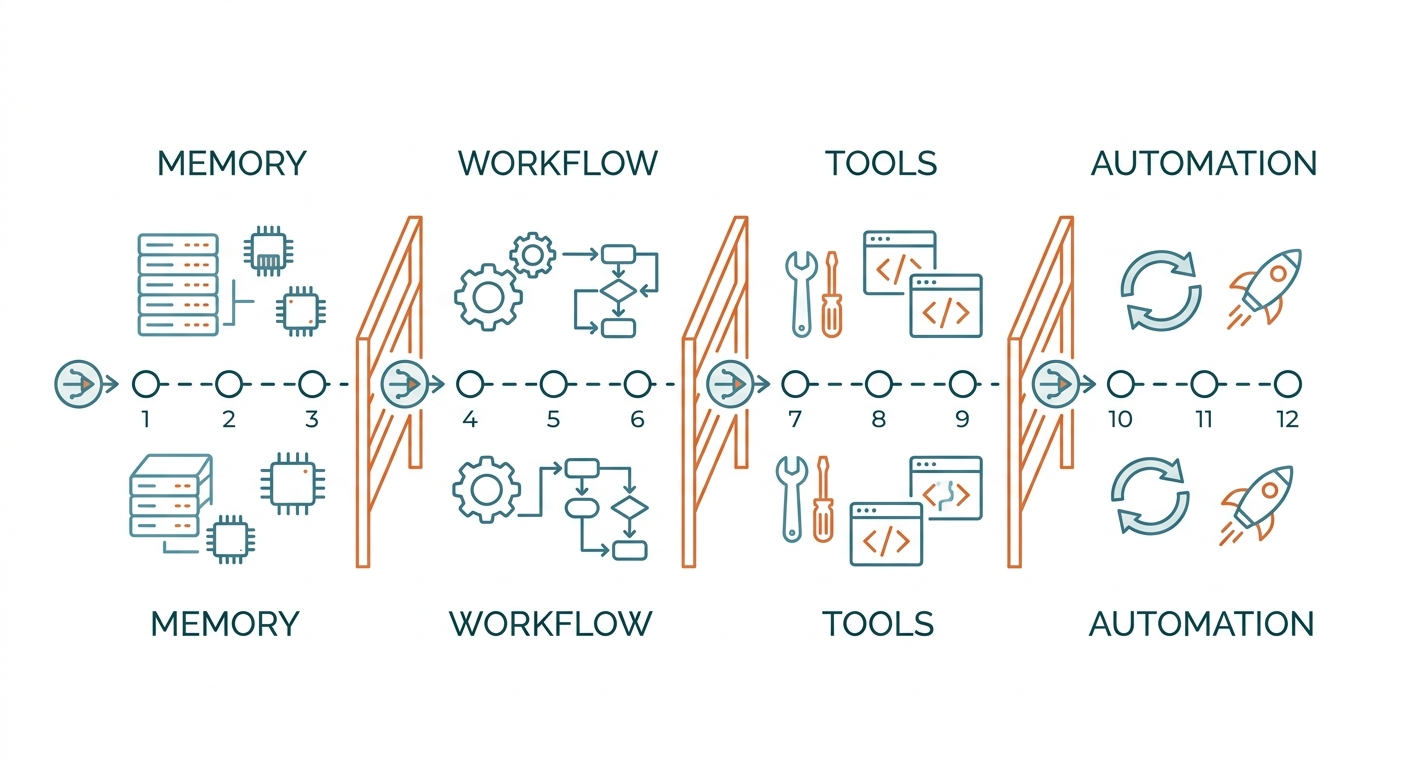
Anthropic's engineering team distilled Claude Code's development experience into twelve reusable design patterns across four categories.
Category 1: Memory and Context
The most dangerous thing an Agent can do is forget. Three patterns address this. Persistent instruction files ensure the Agent reads the same rulebook every time it starts — like an employee handbook that gets loaded before every shift. Layered memory separates short-term working memory from long-term knowledge storage, compressing the former and persisting the latter. Progressive compression handles the trickiest scenario: extremely long sessions where the Agent might forget step 3 by step 100, automatically preserving recent details while summarizing earlier context.
Category 2: Workflow and Orchestration
Explore-Plan-Execute loops force the Agent to understand the full problem before touching anything — rather than jumping in and editing whatever it sees first. Isolated sub-agents break large tasks into specialized smaller Agents, each with its own context bubble, preventing contamination between workstreams. Fork-Join parallelization lets multiple subtasks run simultaneously and merge results, dramatically compressing complex task timelines.
Category 3: Tools and Permissions
Command risk tiering classifies every operation: low risk (reading files), medium risk (modifying files), high risk (deletion, publication). High-risk operations require human confirmation. Single-purpose tools enforce a one-job-per-tool rule, reducing the chance of unexpected side effects — the same discipline used in surgical instrument design.
Category 4: Automation
Deterministic lifecycle hooks are the most critical guardrail of all. Certain operations are not left to the AI's judgment about whether to execute them — they're hardcoded into the pipeline as mandatory steps. Format-checking before every code commit. Security scanning before every package install. These don't rely on the AI deciding to be careful. They make carefulness structurally inevitable.
The Real Question Has Changed
These twelve patterns collectively shift how we should evaluate AI tools — and it's a significant shift.
The old question was: "Is this AI smart enough?" The new question is: "Are this AI's guardrails mature enough?"
Consider a car analogy: engine horsepower matters, but what makes you willing to drive on a highway is the braking system, the airbags, and the lane departure warning. You want the engine. You need the safety systems.
For teams adopting AI tools, this translates into a concrete evaluation criterion: don't just benchmark the model. Assess the entire harness. A mid-tier model running three solid guardrail patterns will consistently outperform a top-tier model running none.
The model is the engine. The Harness is the chassis. How fast you go depends on the engine. Whether you arrive safely depends on the chassis.
References
- Anthropic. (2026). 12 Agentic Harness Patterns from Claude Code. Anthropic Engineering Blog.
- Raschka, S. (2026). Components of A Coding Agent.
- Meta-Harness: Automated search over harness code designs. Top AI Papers of the Week, 2026.