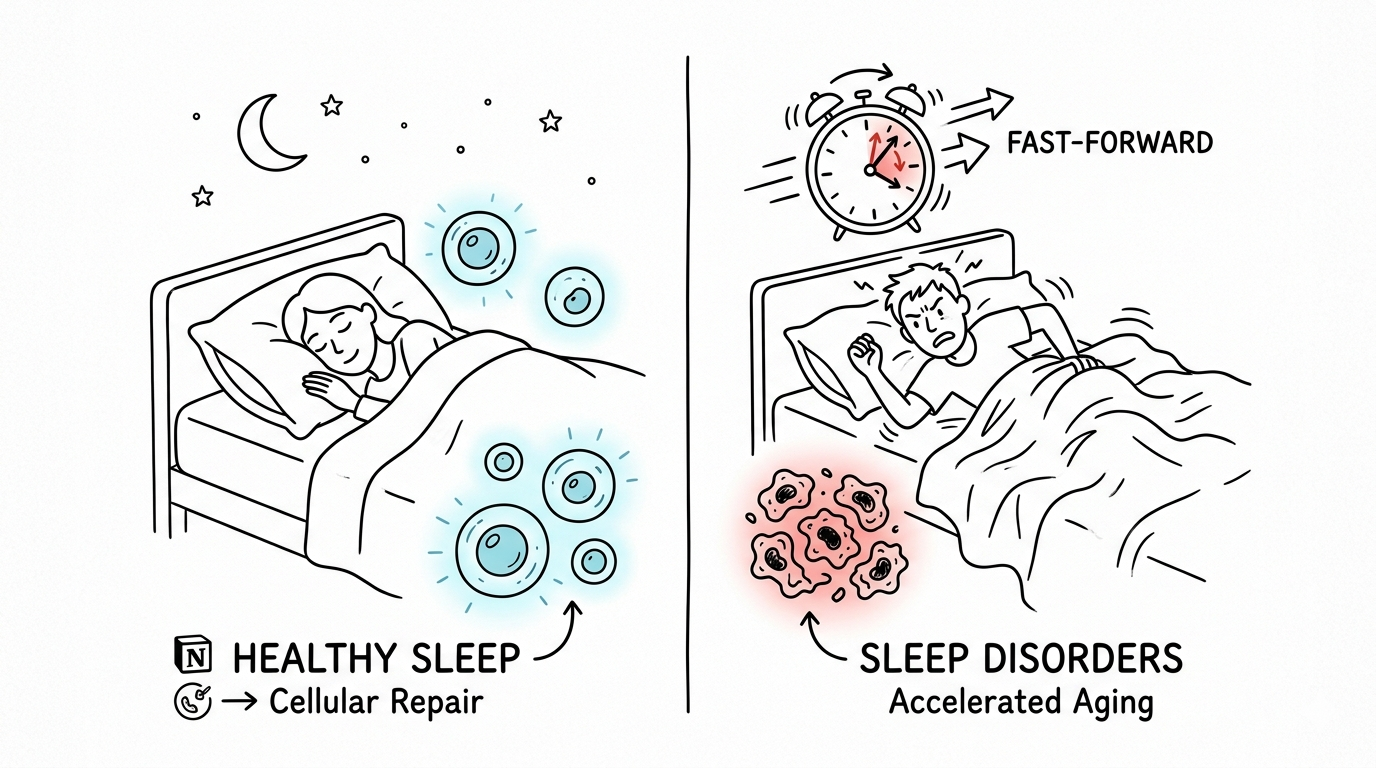
2 AM, Phone in Hand. Your Cells Are Already Aging.
Three hours of tossing. You finally fall asleep, then your own snoring wakes you. Morning arrives and you feel worse than before bed.
You think it's bad luck. It's not.
Your DNA is being reprogrammed.
A 2025 study in the Journal of Affective Disorders used Mendelian randomization — the gold standard for causal inference — to slice open the relationship between sleep disorders and aging. The conclusion is blunt: insomnia doesn't just make you tired. It directly accelerates your epigenetic age.
Not correlation. Causation.
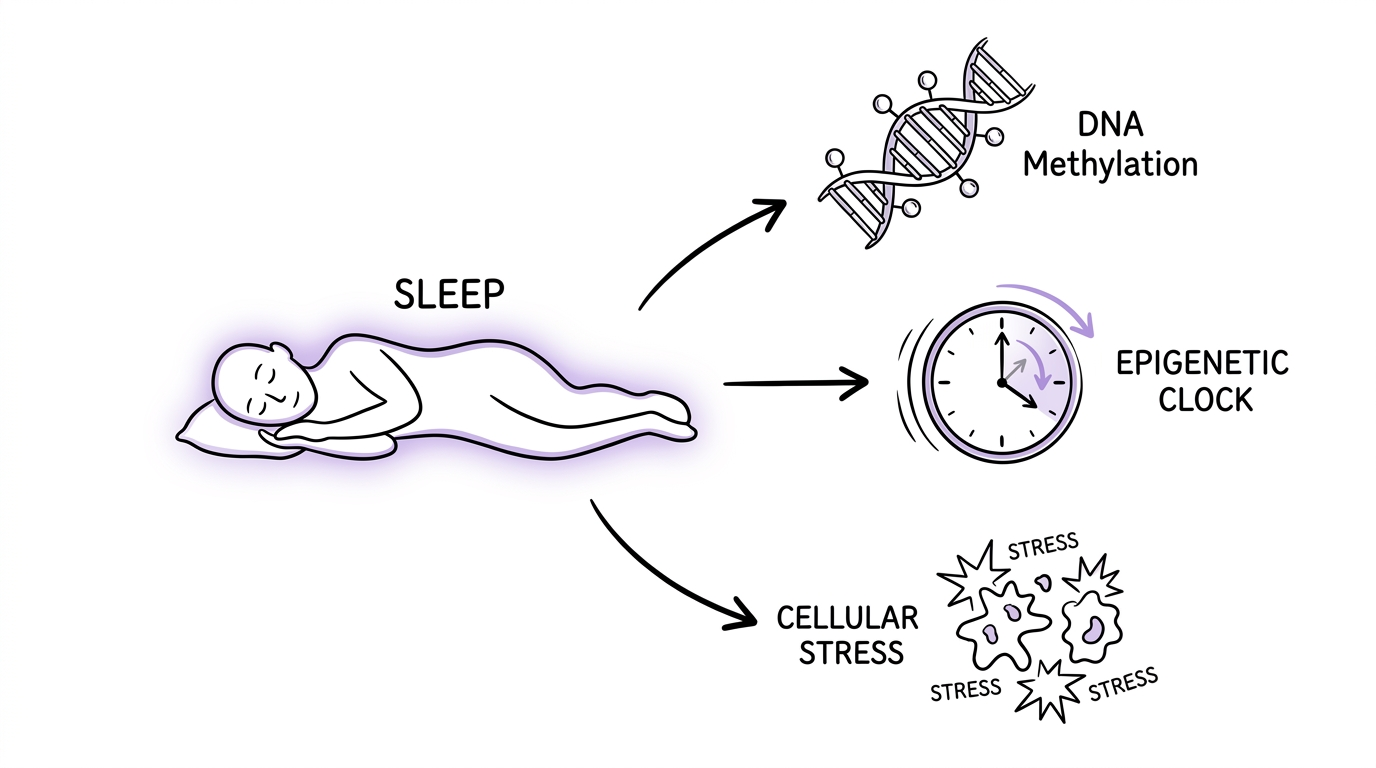
Your Body Needs Downtime for Maintenance
Sleep is your body's shutdown maintenance window. During sleep, cells repair DNA damage, flush metabolic waste, recalibrate the immune system. Chronic poor sleep means the machine never stops for servicing. Parts wear out early — literally.
The study examined three sleep problems:
- Insomnia: Can't fall asleep, or wake at 3 AM and never get back
- Daytime sleepiness: Slept enough hours but still drowsy all day — like a phone battery that only lasts two hours
- Sleep apnea (OSA): Breathing repeatedly stops during sleep — engine stalling and restarting all night
Mendelian randomization uses your genes as nature's randomization tool. Born into the "prone to insomnia" group or the "sleep easily" group, researchers compare aging markers decades later — bypassing lifestyle confounders to nail causation.
The Numbers Hit Hard
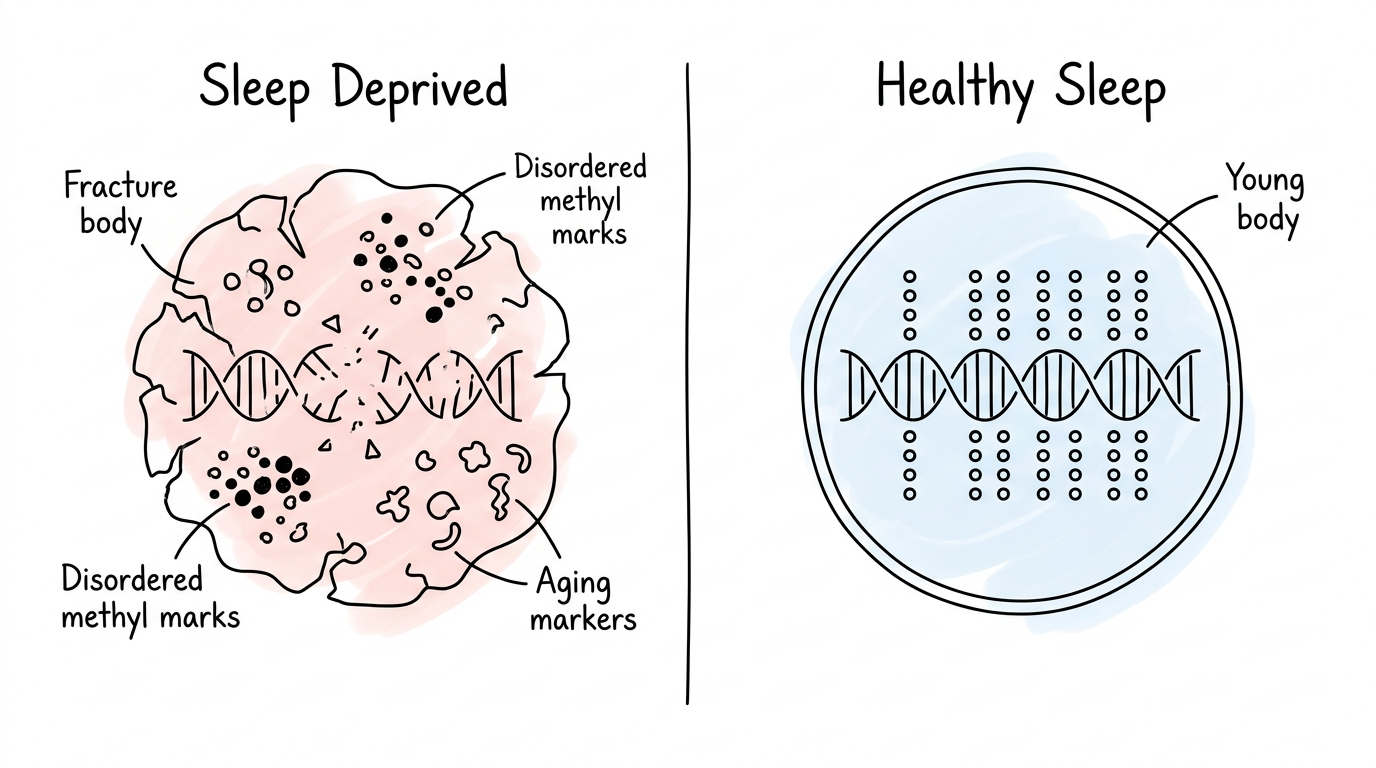
Insomniacs show a biological age 1.57 years older than their actual age by DNA methylation (IEAA, 95% CI: 0.40–2.73, P_FDR = 0.035).
Translation: your phone is two years old, but the system reads "3.5 years of use" because you've been running it nonstop.
Insomnia also significantly increased the frailty index (β = 0.42, P_FDR < 0.001). Frailty isn't "feeling tired" — it's systemic physiological decline: slower walking, weaker grip, higher fall risk.
Sleep apnea goes further: it accelerates facial aging (β = 0.03, P_FDR = 0.016). Repeated oxygen deprivation degrades collagen and skin elasticity — like a rubber band stretched until it stops snapping back.
Daytime sleepiness isn't just drowsiness. It correlates significantly with frailty (β = 0.33) — possibly your cells broadcasting an energy crisis.
What Can You Do?
Right now: CBT-I (cognitive behavioral therapy for insomnia) — the drug-free gold standard. If your partner reports snoring with breathing pauses, get a sleep study (PSG). CPAP for OSA may simultaneously slow aging. Sleeping 7-8 hours but still exhausted? Check thyroid function and vitamin D.
Coming soon: Genotype-based personalized sleep interventions. Anti-aging drug targets blocking the "sleep disorder → epigenetic acceleration" pathway. Wearables detecting real-time "epigenetic age" shifts.
Would you trade better sleep habits for 1.5 years of younger biological age?
Tonight's Choice Shapes You a Decade From Now
Sleep isn't optional wellness advice. It's your cells' only nightly repair window.
Next time you're scrolling at 2 AM, remember: you're not sacrificing tomorrow's energy. You're borrowing against your biological age for the next ten years.
The good news: start changing — regular schedule, address the snoring, seek treatment — and your cells can still bounce back. The biological clock accelerates, but it can also decelerate.
Sleep well. Not just for tomorrow. For the you that exists ten years from now.
References
- Zhang, Z. et al. (2025). Journal of Affective Disorders, 391, 119989. DOI: 10.1016/j.jad.2025.119989
- Horvath, S. (2013). Genome Biology, 14, R115.
- Cappuccio, F.P. et al. (2010). Sleep, 33, 585–592.