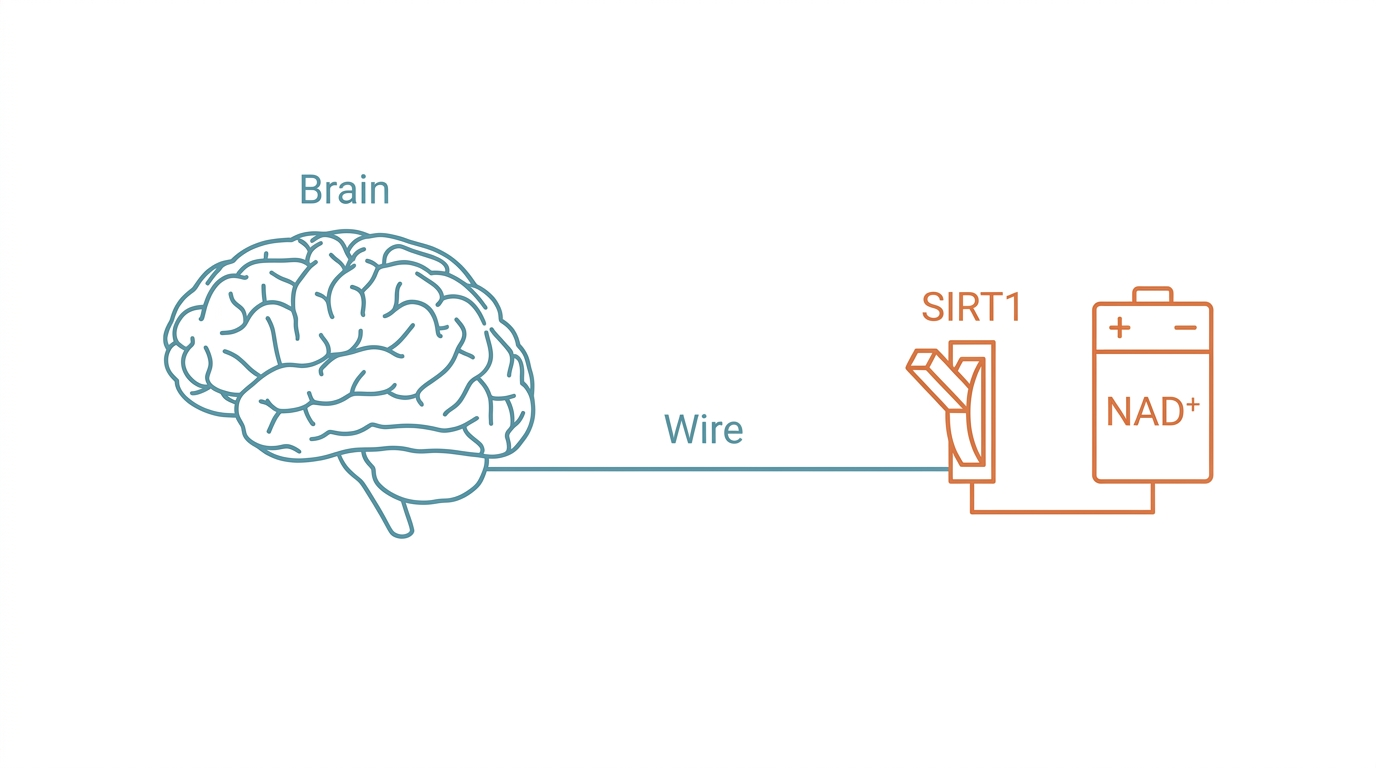
The brain slows down and dulls with age, and memory isn't what it was. We almost take that for granted. But have you ever wondered: if aging had a molecular master switch, could a drug flip it back on and bring an aging brain back to life? A 2026 review places its bet on one name, SIRT1.
Who Is SIRT1? The Enzyme That Quits When the Power's Out
SIRT1 is an NAD⁺-dependent enzyme; without enough NAD⁺, it goes on strike. If you've read the story of NAD⁺ collapsing with age, this old friend will look familiar. SIRT1 needs that NAD⁺ "battery" to run, issuing orders to genes, maintaining mitochondria, and steadying the cell's stress resilience. As we age and NAD⁺ falls, SIRT1 weakens too. In the brain, that failure is especially costly: it's linked to synaptic decline, memory loss, and even Alzheimer's and Parkinson's risk.
In the Brain, It's a Caretaker Wearing Many Hats
This review lays out at least 6 physiological roles for SIRT1, like an all-purpose building manager inside the cell. It preserves genomic stability, dampens the NF-κB inflammation line, boosts mitochondria by activating PGC-1α, and raises antioxidant defenses. More intriguing is its geography: SIRT1 carries extra weight in 2 brain regions, the hippocampus and the hypothalamus, the first governing memory, the second energy balance and stress resilience. Like the key facilities manager of a building, once it dozes off, everything from power to fire safety starts to fail.
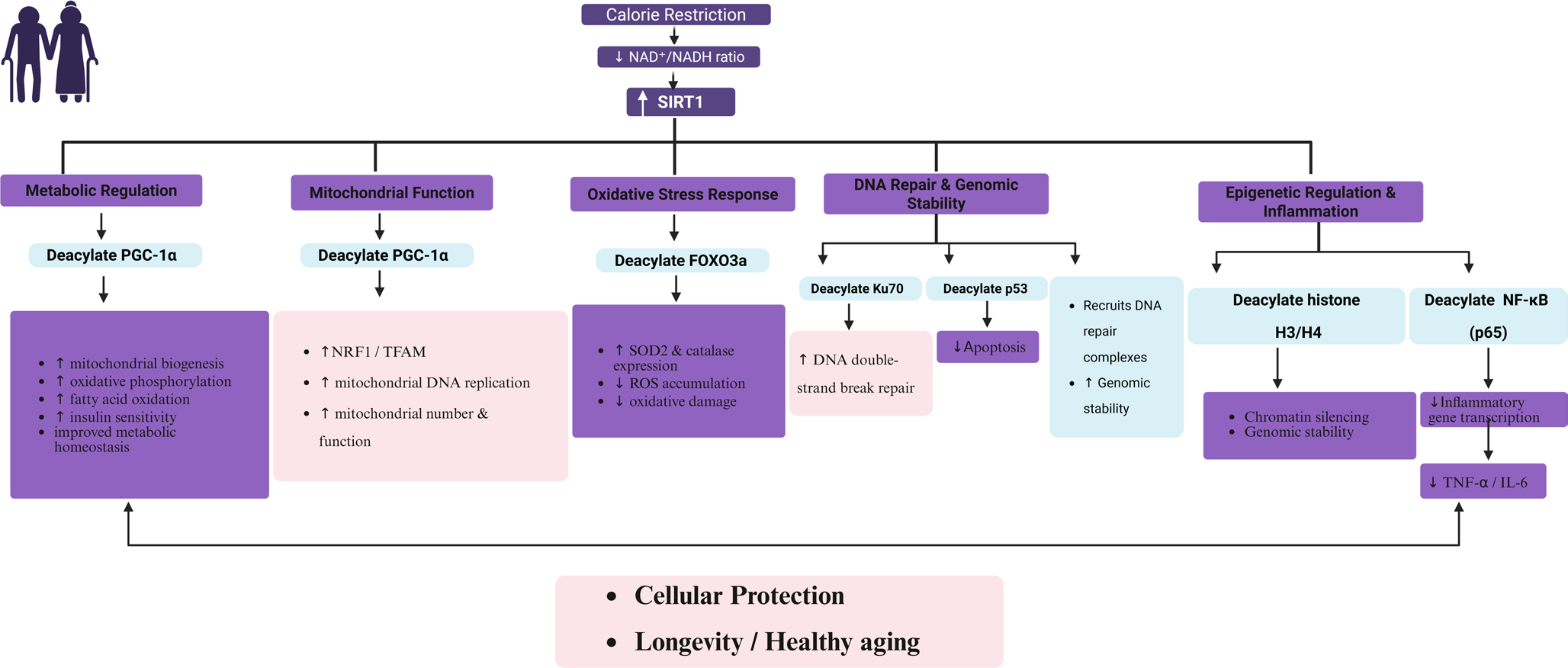 Figure 1. SIRT1 regulates six cellular protection pathways through deacetylation. Adapted from Alameen et al. (2026), NeuroMolecular Medicine.
The Drug's Two Hands: Soothe, and Clear
What makes SIRT1 activators appealing is a two-handed strategy against "senescent cells." Aging tissue accumulates cells that refuse to leave and keep spewing inflammatory signals, like staff who won't quit yet won't stop complaining. The review notes that SIRT1 activators may act with both hands at once: one "soothes," making those cells behave (senomorphic); the other "clears," showing them the door (senolytic). Paired with boosted autophagy, the cell's self-repair routine, this could in theory take pressure off an aging brain.
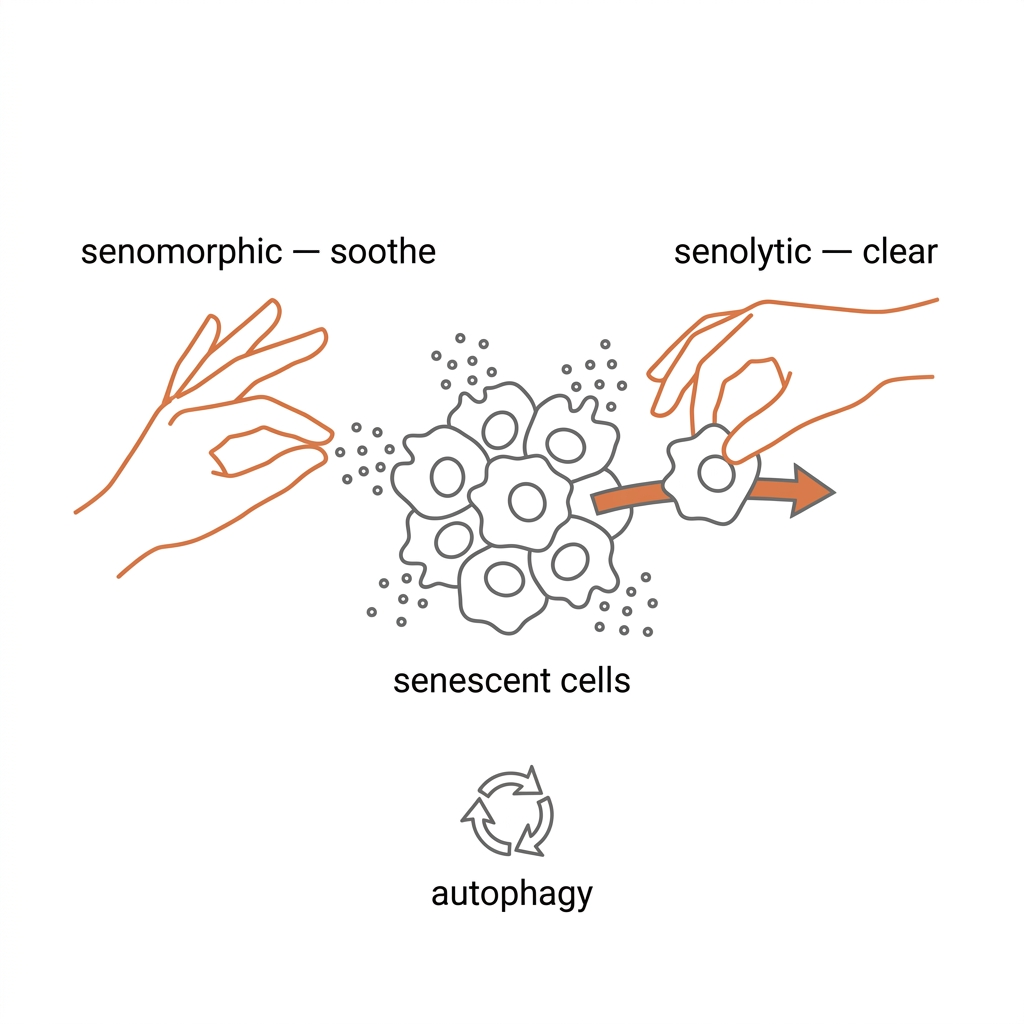 Figure 2. Senomorphic and senolytic dual action of SIRT1 activators on senescent cells.
Don't Mistake a Review for a Prescription
Hit the brakes hard, because this is a review, and its evidence comes only from animal and early clinical work, its biggest limitation, not a ready-made fix. A piece of history matters here: SIRT1 "direct activators" don't have a clean reputation. Early activation data for compounds like resveratrol and SRT1720 turned out to possibly be artifacts of the fluorescent tags in the assay design. In other words, "activating SIRT1" is easier said than done. Whether we can safely and precisely tune it in humans has no large-trial answer yet. Over-the-counter resveratrol supplements should certainly not be equated with these research-stage drugs.
So What's This Review Worth?
Its value is gathering scattered clues into one clear research direction: the NAD⁺–SIRT1 axis deserves serious pursuit in brain pharmacology. Seen another way, it echoes a humbler conclusion. Since SIRT1 needs NAD⁺ to have any strength, the habits repeatedly shown to prop up NAD⁺, exercise, sleep, and calorie control, are already maintaining that switch for your brain. Until a real drug matures, that remains the surest move.
References
- Alameen, A. A. M., et al. (2026). SIRT1 Activators as Geroprotective Agents in Brain Aging: Mechanisms and Therapeutic Potential. NeuroMolecular Medicine, 28, 20. doi: 10.1007/s12017-026-08923-y