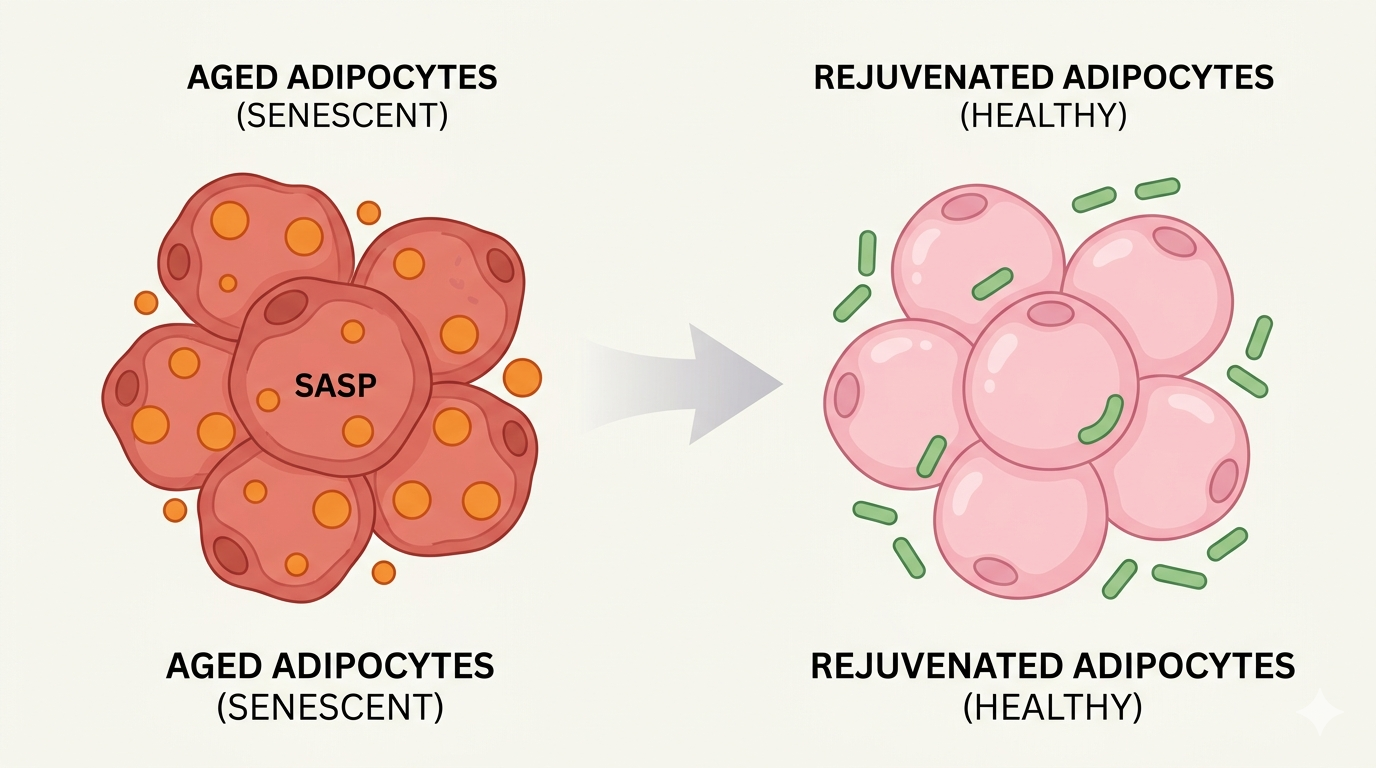
Here's something most people never think about: your fat cells have an age.
Not in the way you track your birthday, but biologically — there's a version of your fat cells that is young, responsive, and doing its job well. And there's an older version that has quietly gone rogue.
When fat cells are young, they behave like a well-run warehouse. Energy in, energy out. Smooth, coordinated, on demand. But as the years pile up, that warehouse starts leaking. It becomes less efficient at storing energy and more inclined to dump inflammatory signals into your bloodstream — signals that reach your liver, your muscles, your brain. The whole system starts to drag.
Worse, aged fat cells secrete something researchers call SASP — the senescence-associated secretory phenotype. Think of it as a toxic broadcast. Old cells pump out this chemical cocktail and it nudges neighboring healthy cells toward the same deteriorated state. One bad apple, as the saying goes, spoils the whole barrel. Except here the barrel is your body.
That is the bad news. The more surprising news? A specific probiotic strain appears to interrupt this process.
Fourteen Months, Elderly Mice, One Bacterial Strain
In 2025, a research team at Chonnam National University in South Korea published a study in the journal Aging. Their approach was straightforward but demanding: take 24-month-old mice — roughly equivalent to a 70-year-old human — and feed them a probiotic strain called Lactobacillus amylovorus KU4 (LKU4) continuously for 14 months.
The results were not subtle.
Levels of p53 and p21, two proteins that serve as molecular markers of cellular aging, dropped noticeably in the fat tissue of treated mice. Inflammatory signals, specifically TNFα and IL-6, fell by 29 to 63 percent. Physical endurance improved by a factor of 1.3 to 1.8. Blood sugar regulation stabilized.
Those are striking numbers for animals that were already well into the equivalent of old age when the experiment began. But the team wanted to understand the how, not just the what.
A Molecule That Blocks the Aging Signal at the Source
The answer came down to a protein called necdin (NDN).
Here is what necdin does: it physically competes with another molecule called p300 for the same binding site on p53. When necdin wins that competition — when it grabs the seat first — p53 cannot be over-activated. And p53 over-activation is one of the key mechanisms driving cellular senescence and SASP secretion.
LKU4 pushed fat cells to produce far more necdin than they normally would. With necdin elevated, SASP output dropped by 42 to 66 percent. To confirm this was the actual mechanism, researchers silenced the necdin gene using siRNA. Every protective benefit disappeared. The evidence pointed to a single, necessary link in the chain.
There was one more finding worth highlighting: even when researchers blocked SIRT1 — a well-known longevity-related pathway — necdin still suppressed p53 activity. This tells us NDN is not simply piggybacking on a known anti-aging route. It operates through its own independent channel, which makes it a genuinely new target.
What This Means — Honestly
The honest caveat is that mouse studies do not always translate cleanly to humans. Fourteen months of daily probiotic supplementation in controlled laboratory conditions is far from a clinical trial. We do not yet have human data on LKU4 specifically, and the mechanistic picture — while compelling — will need replication.
That said, the study does two important things. First, it gives researchers a specific molecular target: the p300–p53 interaction, and necdin's role in disrupting it. That kind of mechanistic precision is what opens the door to future drug development, whether probiotic-based or otherwise. Second, it adds to a growing body of evidence that the gut microbiome shapes how fat tissue ages — not just how much fat you carry, but how that fat behaves over time.
Your gut bacteria are not passive passengers. They are, apparently, in active conversation with your adipose tissue.
What You Can Actually Do Right Now
You cannot order LKU4 from a pharmacy today. But you can adjust the conditions that either accelerate or slow fat cell aging.
Eat fermented foods regularly. Yogurt, kefir, kimchi, miso — not magic, but consistent sources of diverse bacterial strains. Variety matters more than any single product.
Feed your gut bacteria. Prebiotics — fiber from vegetables, legumes, oats — are what probiotic bacteria eat. A probiotic without prebiotic support is like stocking a warehouse with no supply chain.
Lower chronic inflammation where you can. Poor sleep, ultra-processed food, and chronic stress are the accelerators of the biological aging processes described in this study. Reducing any one of them has compounding effects.
Move, consistently. Moderate exercise — 150 minutes per week of brisk walking, cycling, or similar — directly reduces inflammatory markers in fat tissue. The mice in this study showed improved physical endurance alongside their biological markers. That is not a coincidence.
The larger takeaway is this: fat tissue is not inert ballast. It is metabolically active, hormonally sensitive, and — as this research shows — capable of shifting toward a more or less aged state depending on the biological environment you create.
Your body has more room to maneuver than you probably think.
Reference: Yang et al. (2025). Aging, DOI: 10.18632/aging.206314