Your Cells Are Going Bankrupt
Fifty years old. Half the NAD+ you had at twenty — gone.
NAD+ is the energy currency every cell needs to function. Without it, DNA goes unrepaired, inflammation runs unchecked, and senescent cells pile up. Think of a city in fiscal collapse: streetlights flickering, garbage mounting, pipes bursting.
Why does NAD+ decline? Can we stop it?
In January 2025, Professor Shin-ichiro Imai at Washington University published "NAD World 3.0" in npj Aging. His argument: your body contains a sophisticated NAD+ supply chain, and two molecular players — the NMN transporter and eNAMPT — hold the keys to longevity.

Gasoline, Fuel Tanks, and Mobile Tankers
Think of NAD+ as gasoline. Your cells are engines. No fuel, no ignition.
"So just pour NAD+ in?" You can't. The molecule is too large to cross cell membranes — like trying to dump a 50-gallon drum directly into a car's fuel port.
The workaround: NMN (nicotinamide mononucleotide). It's a compact fuel packet that slips into cells and rapidly converts to NAD+. In 2019, Grozio et al. (Nature Metabolism) discovered that cell membranes carry a dedicated NMN transporter (Slc12a8) — a VIP lane that lets NMN enter without being broken down first.
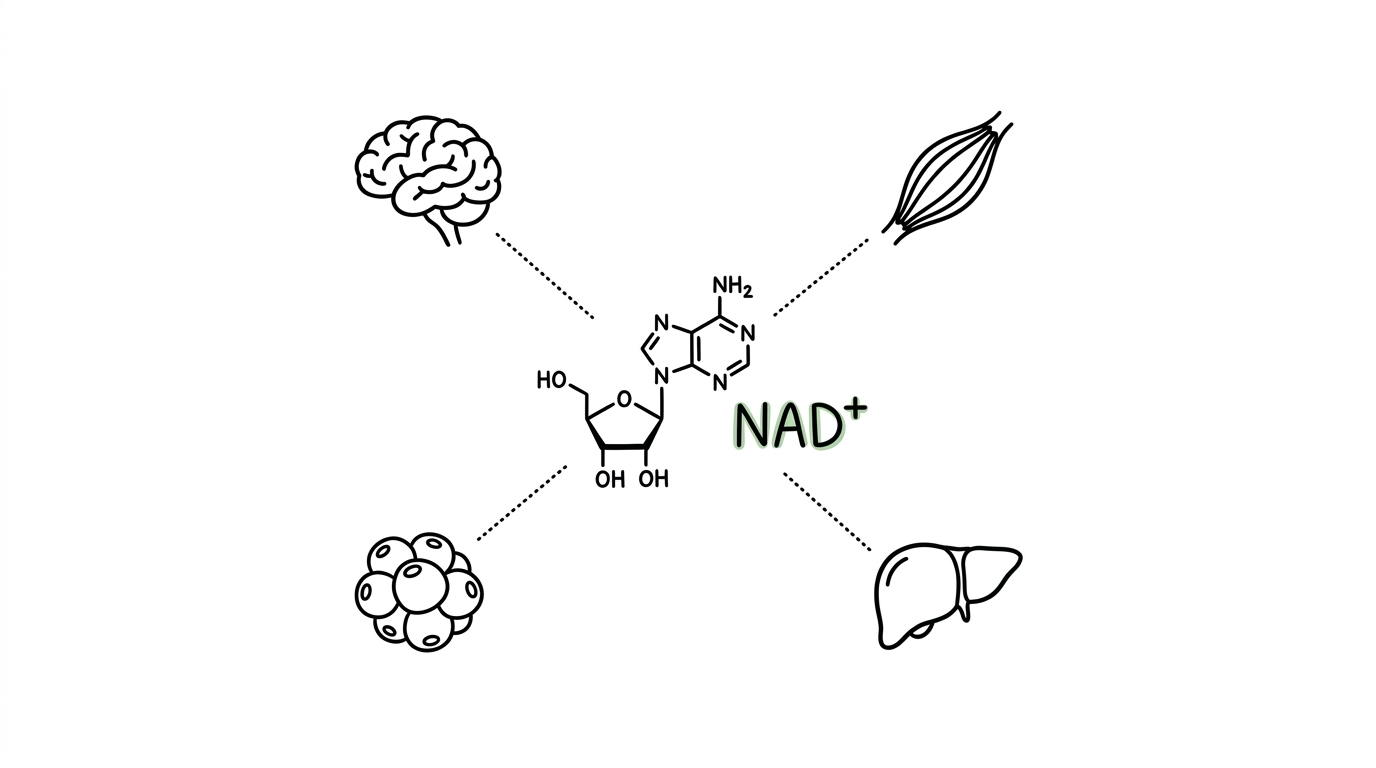
Then there's eNAMPT: your body's mobile refueling truck. Dispatched by the hypothalamus — the brain's central command — it circulates through the bloodstream, delivering NMN to adipose tissue, skeletal muscle, and liver. Yoon et al. (2015, Cell Metabolism) showed that eNAMPT acts as both an enzyme and a hormone, regulating inflammation and metabolism on the go.
Your brain is orchestrating NAD+ distribution across your entire body. Every single day.
From 1.0 to 3.0: A Conceptual Revolution

NAD World 1.0 (2009, Cell Metabolism): Focus on intracellular NAD+ synthesis via NAMPT. Simple and intuitive.
NAD World 2.0 (2016, Science, with Guarente): Expanded to whole-body communication. The hypothalamus regulates peripheral NAD+ metabolism through neural signals.
NAD World 3.0 (2025, npj Aging): The spotlight shifts to multi-layered feedback loops built from NMN transporters and eNAMPT. When a tissue runs low on NAD+, it sends distress signals back to the hypothalamus, which dispatches more eNAMPT. Inventory low → trigger resupply → restore balance. A dynamic supply chain management system.
The numbers are stark:
- Adipose NAD+ at 60 vs. 20: down ~50% (Yoshino et al., 2011)
- Skeletal muscle NAD+ in aged mice: only 30% of young levels (Gomes et al., 2013)
- NMN supplementation for 12 months in aged mice: lifespan extended ~10-15% (Mills et al., 2016)
Human Trials Are Running — But Keep Your Wallet Closed
NMN isn't science fiction. Japanese researchers (Irie et al., 2020) gave healthy men 100-500 mg NMN daily for 10 weeks — blood NAD+ rose significantly, no side effects. A US study (Yoshino et al., 2021, Science) found that NMN improved insulin sensitivity in postmenopausal women.
But sample sizes are small, follow-up periods short. Long-term safety data is still accumulating.
Don't want to wait? Caloric restriction of 20-30% activates NAD+ synthesis pathways. High-intensity interval training fires up NAMPT. Avocados, mushrooms, and leafy greens supply vitamin B3, a NAD+ precursor.
Would you pop a capsule, or bet on your fork and running shoes to keep your cells alive?
The Gears Won't Stop, But You Can Change the Speed
NAD World 3.0 delivers a profound message: aging isn't a one-way collapse. It's a complex system falling out of balance. From intracellular energy production to cross-tissue resupply coordination to central brain command — the machinery is as precise as a Swiss watch.
The good news? Watches have many gears, and every gear is a point of intervention. How fast your cells count down may not be written entirely in your DNA.
It's written in your daily choices.
References
- Imai, S. (2025). npj Aging, 11, 6.
- Grozio, A. et al. (2019). Nature Metabolism, 1, 47–57.
- Yoon, M.J. et al. (2015). Cell Metabolism, 21, 471–483.
- Mills, K.F. et al. (2016). Cell Metabolism, 24, 795–806.
- Irie, J. et al. (2020). Endocrine Journal, 67, 153–160.
- Yoshino, M. et al. (2021). Science, 372, 1224–1229.