Seven Longevity Genes. Zero Fuel.
Sirtuins — a family of seven proteins conserved across a billion years of evolution, from yeast to humans. Scientists call them "longevity genes" because boosting their activity extends lifespan in virtually every organism tested.
Impressive résumé. One problem: Sirtuins don't run on enthusiasm.
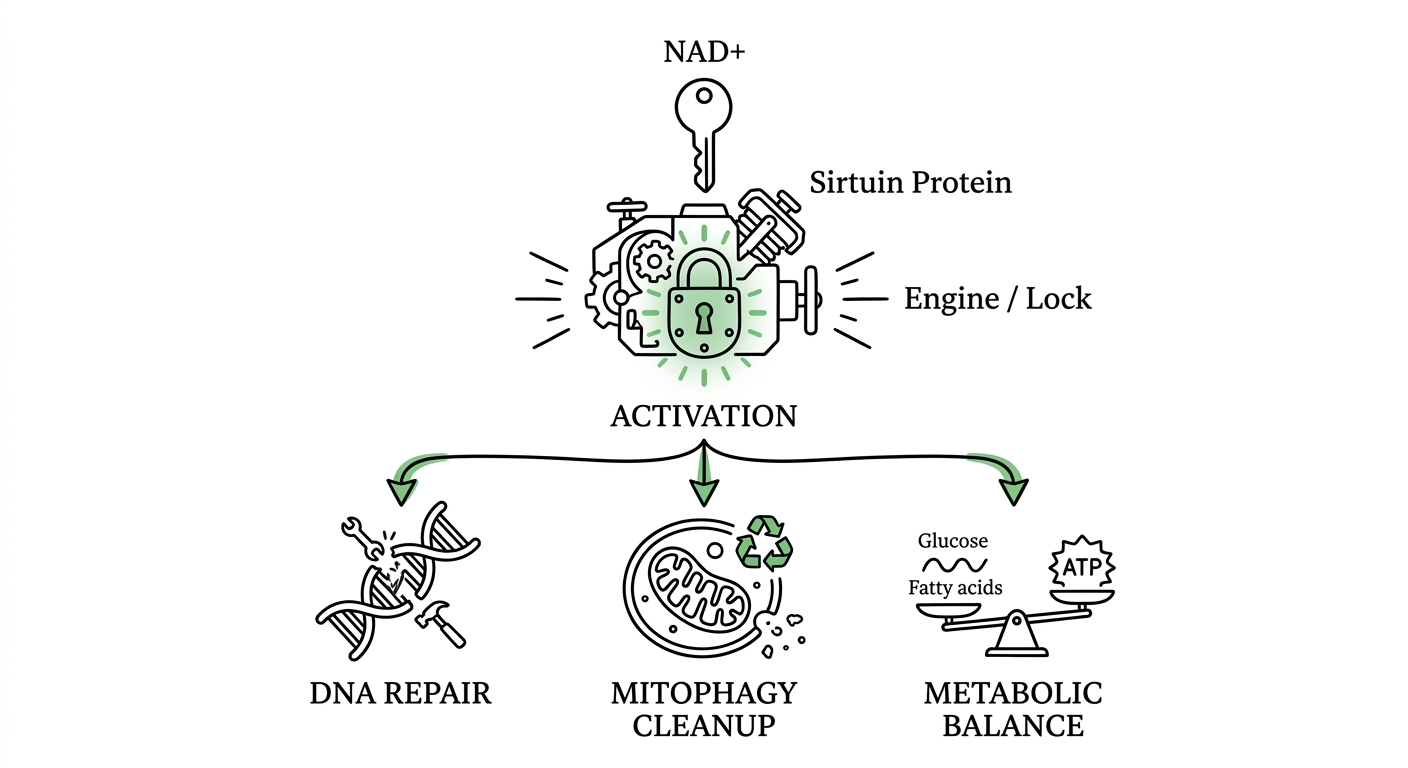
They need NAD+. Without it, Sirtuins are an unplugged refrigerator — structurally intact, functionally useless. In 2016, Imai and Guarente published a landmark review in npj Aging and Mechanisms of Disease mapping how this partnership works: NAD+ is the fuel, Sirtuins are the engine, and neither means anything alone.
A Secret Communication Network Across Your Organs
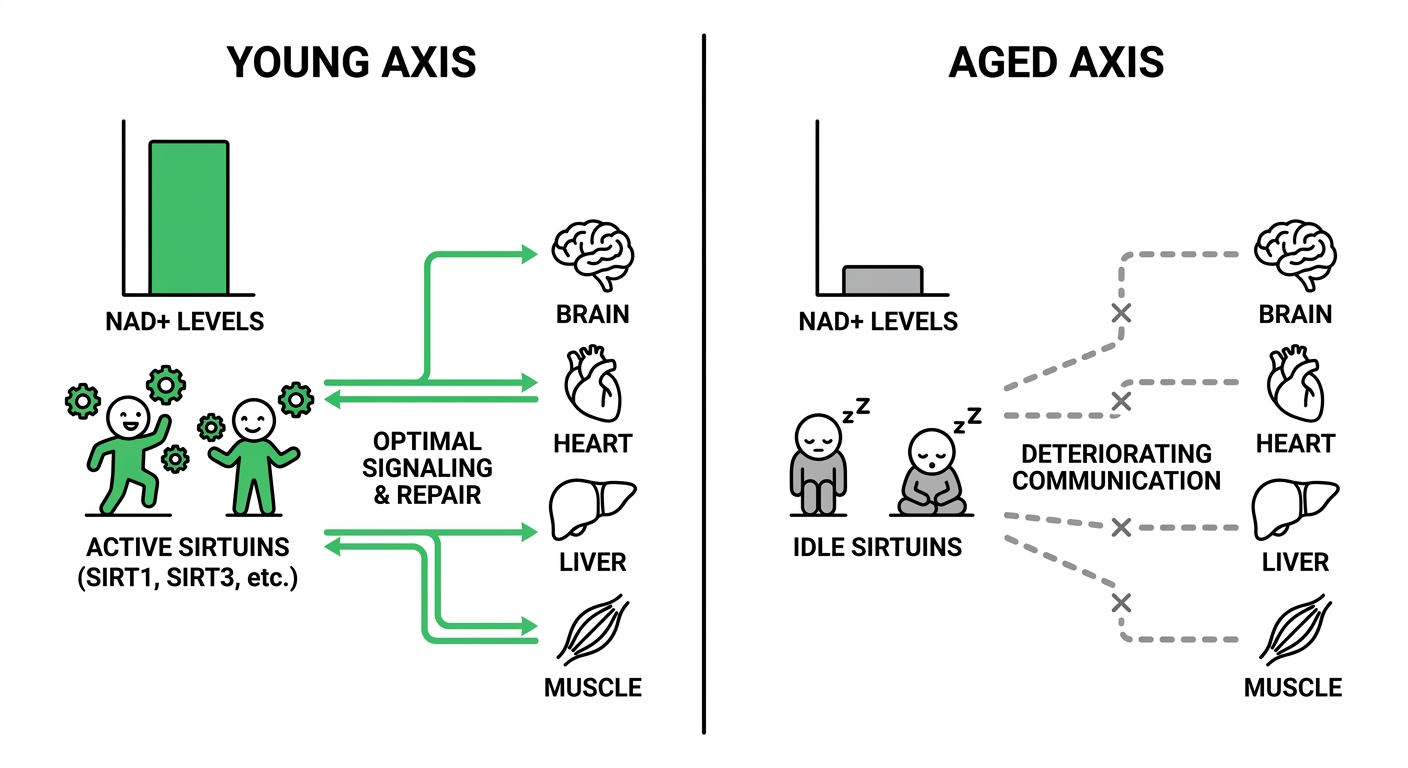
The NAD+/Sirtuin story isn't confined to individual cells. It's a body-wide broadcast system.
Your hypothalamus — a peanut-sized structure deep in the brain — functions as the body's "aging command center." When SIRT1 activity runs high there, it sends "age slowly" signals throughout the body. When activity drops, the signal dies. Every organ starts aging on its own schedule.
Then there's fat tissue. Your adipocytes secrete an enzyme called eNAMPT into the bloodstream, helping distant organs synthesize NAD+. Fat isn't just energy storage — it's a mobile NAD+ charging station.
Young: supply lines open. Old: eNAMPT secretion drops, the NAD+ supply chain fractures, Sirtuins go dark across every organ.
The Numbers
- Human blood NAD+ drops roughly 50% between ages 20 and 60
- Mice overexpressing SIRT1 specifically in the hypothalamus lived 16% longer (Satoh et al., 2013, Cell Metabolism)
- NMN supplementation restored eNAMPT levels in aged mice, reversing multiple aging markers
- SIRT3 deletion reduces mitochondrial electron transport efficiency by 40%, spiking reactive oxygen species
Imai's "NAD World 2.0" model frames this as systemic collapse. Hypothalamus, fat, muscle, liver — all organs linked through the NAD+/Sirtuin axis. One break cascades everywhere.
What Can You Do?
Right now: Endurance exercise directly boosts NAMPT activity and muscle NAD+ synthesis. Caloric restriction remains the oldest known Sirtuin activator — 16:8 intermittent fasting has human data. Limit alcohol: ethanol metabolism burns through NAD+ reserves.
Under investigation: Oral NMN/NR supplements (multiple clinical trials show increased blood NAD+). eNAMPT exosome delivery. Small-molecule SIRT1 activators (SRT1720) that bypass NAD+ entirely.
Are your Sirtuins running at full speed, or parked in the garage waiting for fuel?
The Music Stopped — Will You Restart It?
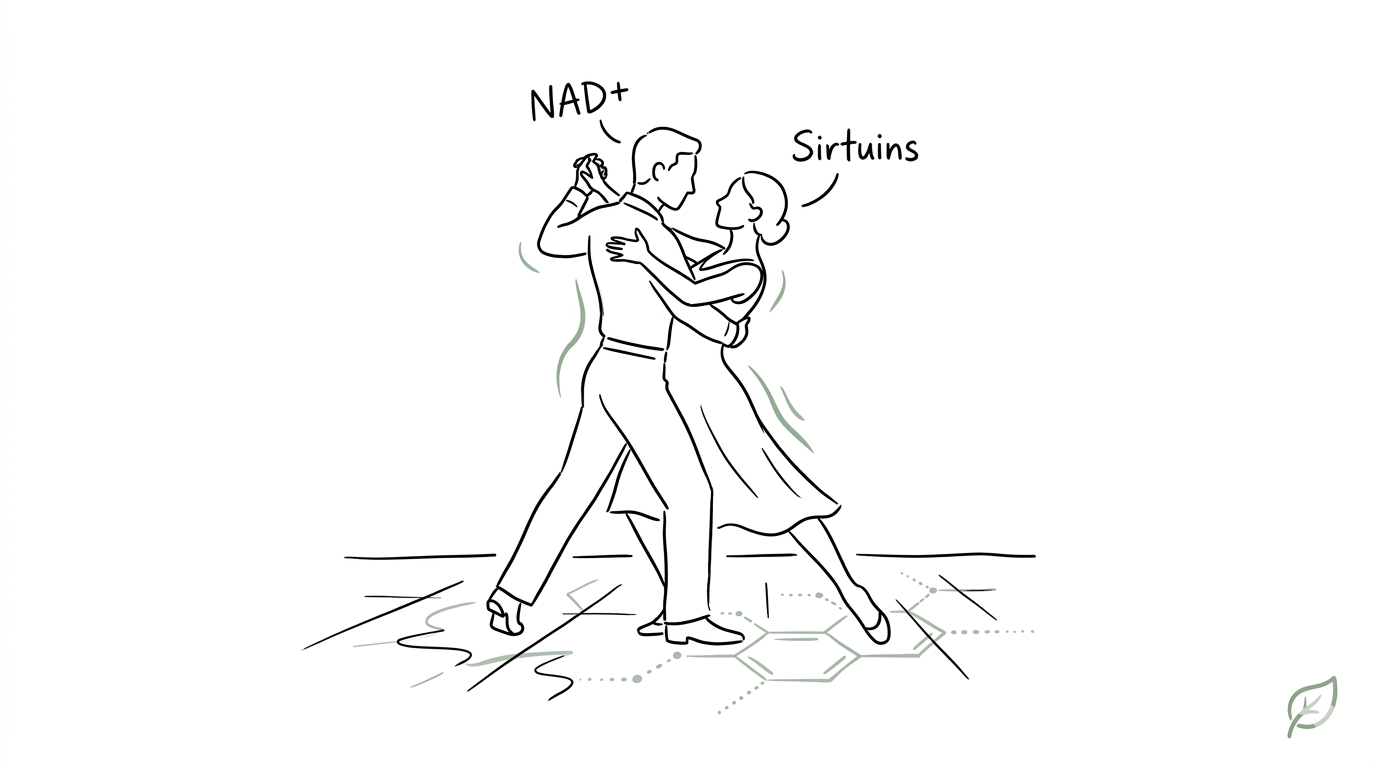
NAD+ and Sirtuins dance a molecular tango. When the music (NAD+) stops, even the best dancer (Sirtuins) stands still.
The good news: you can press play again. Exercise, diet, future precision supplementation — each one restarts the music.
The question is whether you'll stand up and dance.
References
- Imai, S. & Guarente, L. (2016). npj Aging and Mechanisms of Disease, 2, 16017. DOI: 10.1038/npjamd.2016.17
- Satoh, A. et al. (2013). Cell Metabolism, 18, 416–430.
- Yoshino, J. et al. (2018). Cell Metabolism, 27, 513–528.