Picture a city. Every building needs electricity. When the power grid starts failing, you don't just lose the lights — hospitals shut down, water treatment stops, traffic systems go dark. The whole city starts unraveling, one neighborhood at a time.
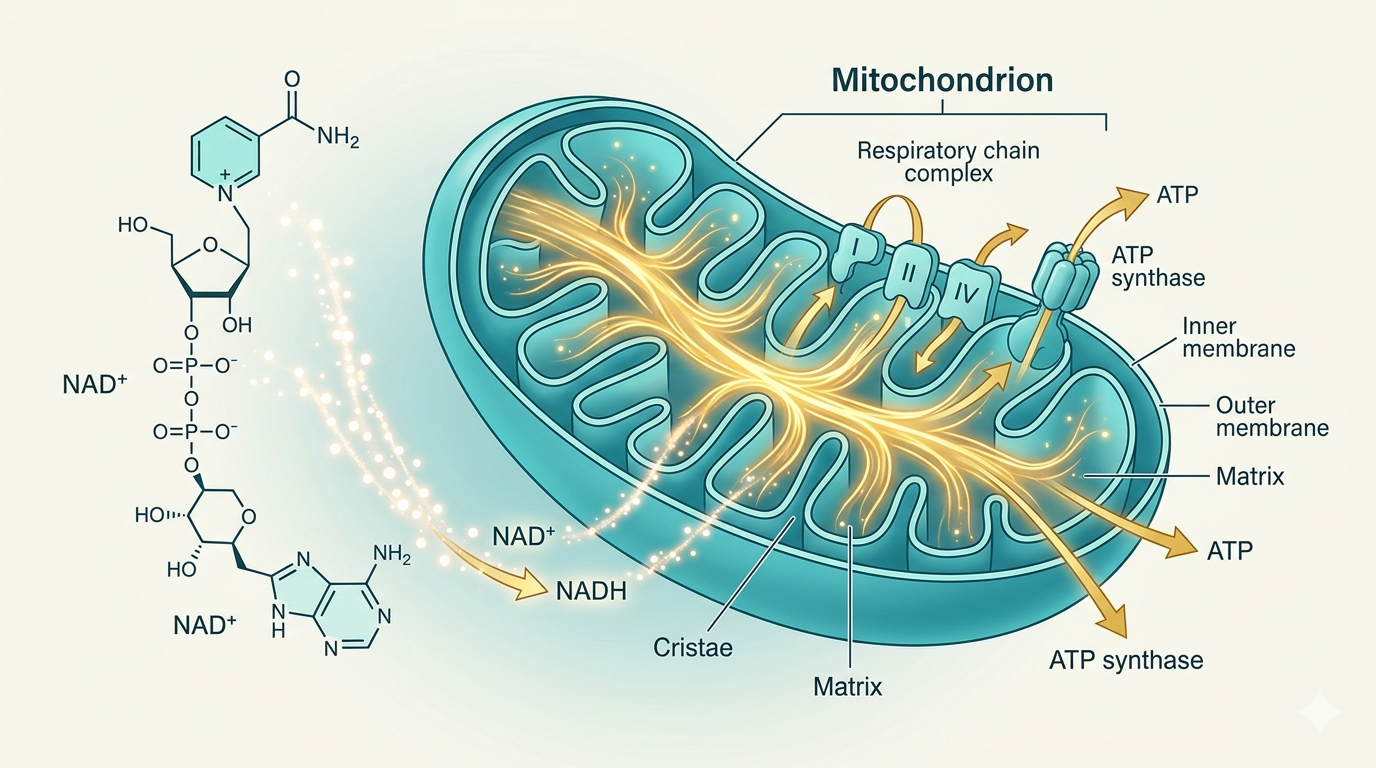
Your body runs a version of this scenario, and the molecule at the center of it is NAD+.
What NAD+ Actually Does
NAD+ (nicotinamide adenine dinucleotide) isn't glamorous. It won't appear on a wellness influencer's "morning stack" with a compelling origin story. But without it, your cells cannot convert food into usable energy. Full stop.
Think of NAD+ as the spark plugs inside your mitochondria — those bean-shaped structures that scientists call the "powerhouses of the cell." Mitochondria don't just generate energy. They're constantly patrolling for damage, recycling worn-out components, and keeping oxidative stress from spiraling out of control. All three of those maintenance jobs depend on NAD+.
Here's the catch: by the time you reach middle age, your NAD+ levels have dropped to roughly half of what they were in your twenties. That decline isn't dramatic on any given Tuesday. But over years, it quietly erodes your cells' ability to repair themselves.
Three Ways Your Mitochondria Keep Themselves Alive
Your mitochondria run three overlapping repair systems. Each one depends on NAD+ to function. When NAD+ drops, all three start to struggle simultaneously — and that's where the trouble starts.
Mitophagy is the recycling program. When a mitochondrion gets too damaged to function well, the cell is supposed to flag it, break it down, and recover the usable parts. Think of it like waste disposal: if the trucks stop running, garbage piles up. Dysfunctional mitochondria accumulate, leak reactive oxygen species, and drive inflammation. NAD+ powers the proteins — including SIRT1 and SIRT3 — that run this entire cleanup operation.
UPRmt (the mitochondrial unfolded protein response) is the repair crew. Proteins inside mitochondria sometimes misfold under stress. UPRmt is the quality-control system that detects those errors and attempts to fix them. Without adequate NAD+, the signal never reaches the repair crew, and misfolded proteins pile up inside the organelle.
Antioxidant defense is the fire suppression system. Mitochondria generate free radicals as a natural byproduct of energy production. Under normal conditions, antioxidant enzymes neutralize them fast enough to prevent damage. NAD+ feeds this entire process. When NAD+ is depleted, antioxidant capacity falls and oxidative stress accumulates — a slow-burning fire in every cell.
Not All Tissues Age the Same Way
Here's something researchers are still working out: your brain, your muscles, and your liver don't all experience NAD+ decline in the same way or at the same pace.
Brain cells — neurons — are especially sensitive. They fire constantly, have enormous energy demands, and have very limited ability to regenerate. A brain running on depleted NAD+ is a brain more vulnerable to the kind of mitochondrial dysfunction that precedes neurodegenerative disease.
Skeletal muscle tells a different story. Muscles have a remarkable capacity to upregulate NAD+ production in response to exercise. This is one reason physical activity has such outsized effects on metabolic health — it's not just burning calories. It's actively restoring the cellular machinery.
The liver, meanwhile, sits at the metabolic crossroads of the body. It processes alcohol, manages fat storage, and synthesizes NAD+ from dietary precursors. Chronic alcohol consumption is particularly destructive here: alcohol metabolism actively consumes NAD+, depleting the reservoir that liver cells need to maintain their own mitochondria.
Can You Actually Raise NAD+ Levels?
Short answer: yes, though the research is still maturing.
NMN (nicotinamide mononucleotide) and NR (nicotinamide riboside) are precursor molecules — raw ingredients your body can use to synthesize NAD+. Several clinical trials have now demonstrated that oral supplementation with either compound can measurably increase NAD+ levels in human blood and tissue.
What those elevated levels translate to in terms of long-term health outcomes is still being studied. The mechanistic logic is sound. The human trial data on disease prevention and longevity are not yet conclusive. That's not a reason to dismiss the research — it's a reason to stay curious and follow it.
What You Can Do Right Now
You don't need a supplement subscription to protect your NAD+ levels. The most effective interventions are the least exciting ones.
Move for 150 minutes a week. This is not a soft suggestion. Exercise — particularly endurance and resistance training — is the most reliably documented method for stimulating NAD+ biosynthesis in skeletal muscle. Brisk walks count. So does cycling, swimming, and lifting.
Protect your sleep. Seven to nine hours isn't a luxury. Mitochondrial repair runs on a circadian schedule, and NAD+ metabolism is tightly coupled to that clock. Chronic sleep deprivation disrupts both.
Eat foods rich in vitamin B3. Niacin is the dietary precursor to NAD+. Chicken breast, tuna, salmon, peanuts, and mushrooms are all solid sources. You don't need to overhaul your diet — just make sure these foods appear regularly.
Consider time-restricted eating. Intermittent fasting, even a modest 16:8 approach, activates the same SIRT1 pathways that NAD+ supports. The combination appears to be synergistic.
Reduce alcohol. This one is blunt: alcohol consumption degrades NAD+ directly. Occasional drinks are a lifestyle choice, not a medical crisis. But if you're drinking daily, your liver's NAD+ reservoir is paying for it.
The science of NAD+ and mitochondrial health is moving fast. A 2025 review in npj Metabolic Health and Disease (DOI: 10.1038/s44324-025-00067-0) synthesized the current state of the field — and the picture that emerges is one where the foundational interventions are remarkably accessible. The supplements may help. The fundamentals definitely do.
Start with the fundamentals.