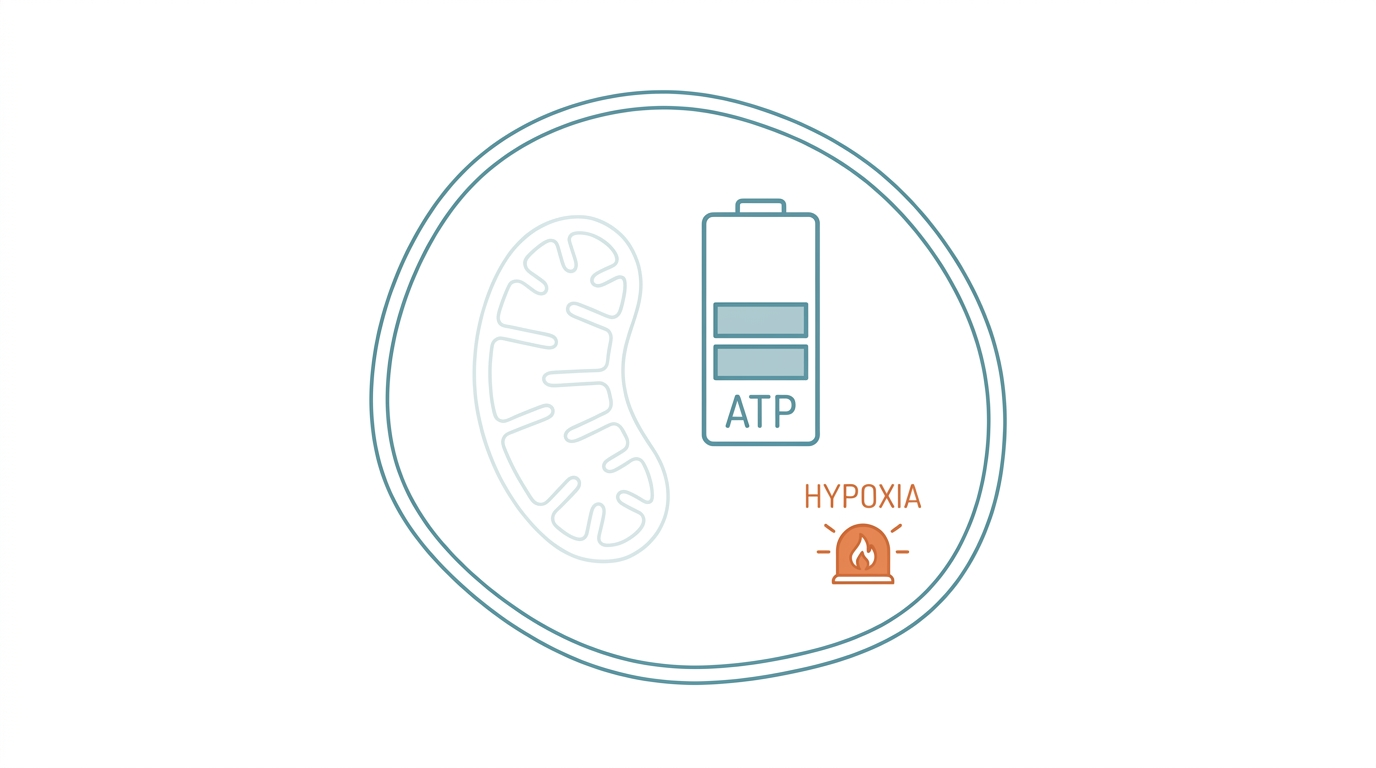
You bought NMN, took it for three months, and the face in the mirror hasn't budged. So where's the catch? It hides inside a paradox: your cells have plenty of oxygen, yet they keep acting as if they're starved of it. That illusion is one of aging's quietest switches.
NAD⁺ Is the Cell's Battery, and It's Running Flat
NAD⁺ is the molecule every cell uses to shuttle energy around, like a battery shared across the whole body. Young, it's fully charged and the mitochondrial power plant hums. Older, the charge keeps draining. How steep is the drop? In mouse skeletal muscle, NAD⁺ falls from around 230 units at 6 months to about 75 units at 22 months, nearly a 70% loss. Once the battery bottoms out, trouble starts.
Truth One: Cells Fake Hypoxia in Plain Air
A 2013 Cell study found that when NAD⁺ drops, the whole signaling line misfires and the cell misreads itself as oxygen-starved. With too little NAD⁺, the enzyme SIRT1 that depends on it stalls. Once SIRT1 lets go, HIF-1α, the hypoxia signal that should be cleared away, piles up even when oxygen is abundant. The cell is fooled. Believing it's hypoxic, it dials down a switch called TFAM, hitting the mitochondrion's own gene set while sparing the nuclear genes. Half the plant's parts break, so it can't turn. The prettiest result came last: a single week of the NAD⁺ precursor NMN in 22-month-old mice pushed those broken markers back to youthful levels, and only when SIRT1 was intact. The collapse, it turns out, is reversible.
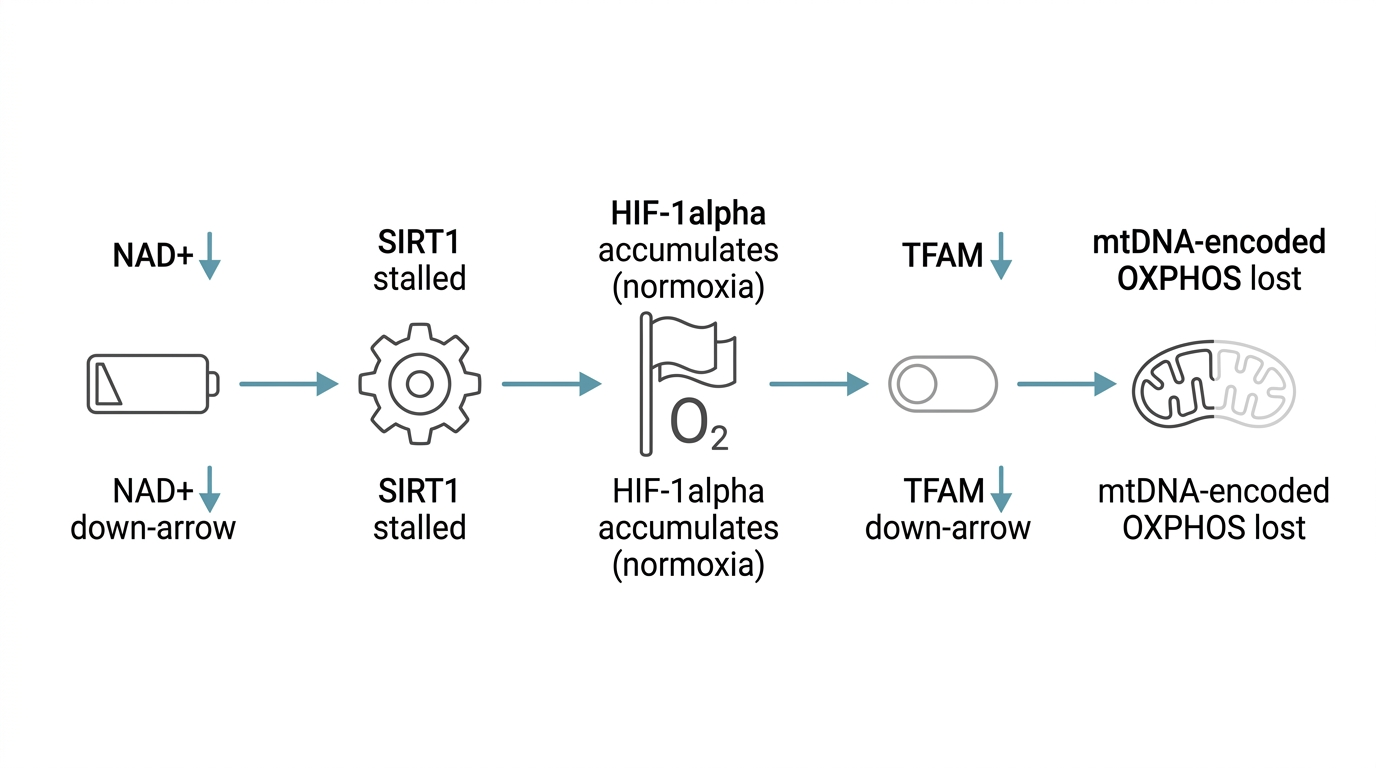 Figure 1: How declining NAD⁺ tricks cells into "faking hypoxia" and severs nuclear-mitochondrial communication. NAD⁺ ↓ → SIRT1 stalled → HIF-1α accumulates under normoxia → TFAM ↓ → mtDNA-encoded OXPHOS subunits lost.
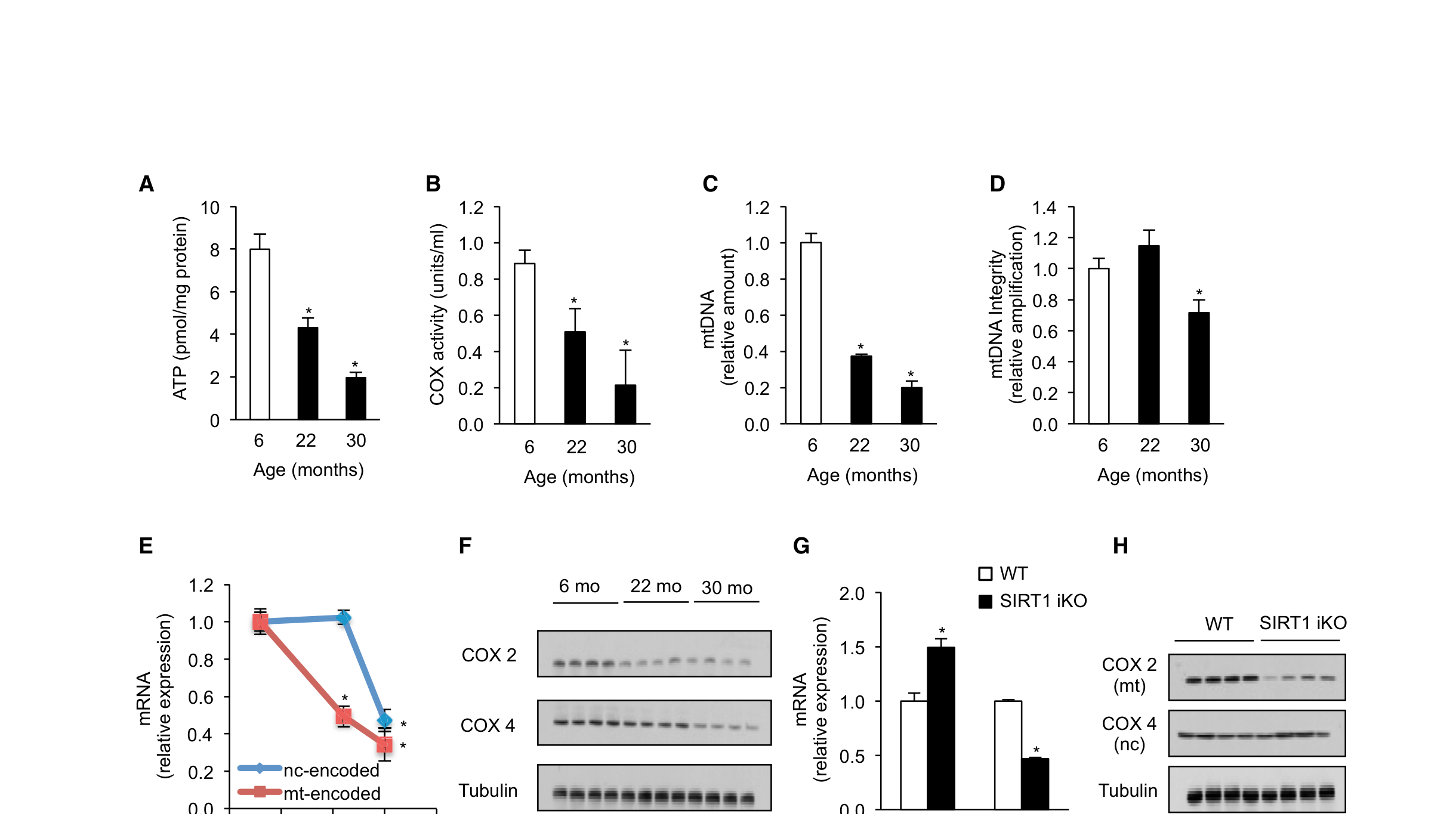 Figure 2: Aging systematically dismantles mitochondria. (A-D) ATP, COX activity, mtDNA content, and mtDNA integrity all decline from 6→22→30 months; (E) mitochondrial-encoded genes (red) selectively collapse while nuclear-encoded genes (blue) hold steady; (G-H) SIRT1 knockout recapitulates the same phenotype. Adapted from Gomes et al. (2013), Cell, Figure 1.
Truth Two: The Culprit Is a Pair of Scissors That Keeps Growing
So why does NAD⁺ fall? A 2016 Cell Metabolism paper named the culprit: an enzyme called CD38. CD38 breaks NAD⁺ down, snipping it apart like scissors, and it accumulates across tissues with age. Knock out CD38 in mice and they keep robust NAD⁺ and healthy mitochondria into old age, with less obesity and metabolic syndrome. Here's the detail that embarrasses the supplement industry: CD38 is also the main mouth that eats NMN inside the body. Much of the raw material you swallow gets snipped before it ever becomes NAD⁺.
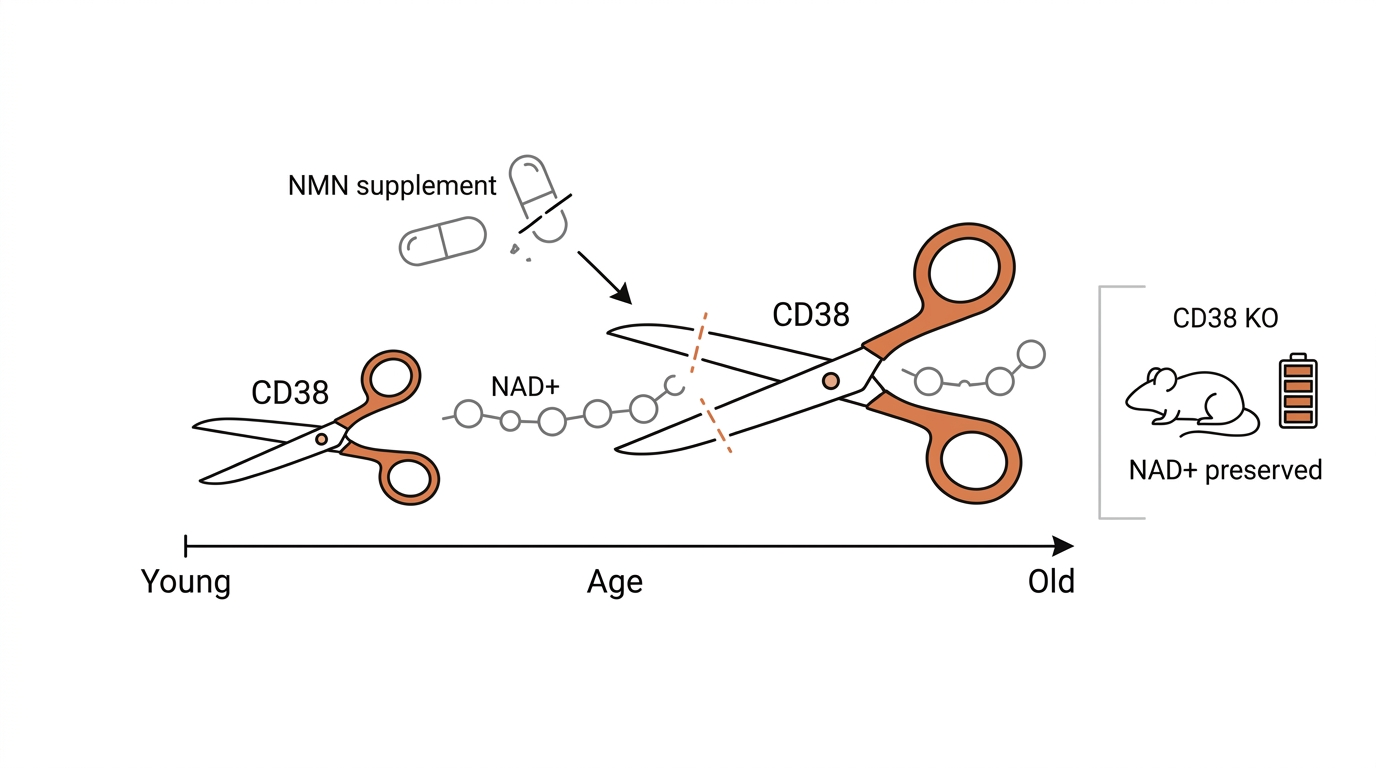 Figure 3: NADase CD38 grows with age like an ever-larger pair of scissors, degrading NAD⁺ and consuming supplemented NMN. CD38-knockout mice retain robust NAD⁺ into old age.
Truth Three: Top NAD⁺ Back Up and Old Cells Really Rejuvenate
A 2016 Science study pushed the story to its most hopeful edge: replenishing NAD⁺ can wake sleeping stem cells. Feeding aged mice another precursor, NR, reignited their muscle stem cells. Regeneration, grip strength, and running ability improved; neural and melanocyte stem-cell aging was delayed; and lifespan stretched longer. The key was that NR switched on the mitochondria's "quality control" response, calling in a repair crew to clear out the junk proteins.
Don't Hit Buy Yet: Better Biochemistry Isn't a Younger You
Pump the brakes, because these three landmark results came almost entirely from mice and cells, the single biggest limitation. That same 2013 study said it plainly: after a week, the biochemistry was fixed, but grip strength hadn't improved at all. Prettier markers don't equal a stronger body. Mice aren't people, either. Reading "extends mouse lifespan" as "proven to extend human lifespan" is the field's most common myth. A 2026 human systematic review put it bluntly: supplements often lift NAD⁺-related biochemical markers, yet the clinical outcomes we actually care about, like stamina and metabolism, still show no consistent answer.
So What Should We Do?
Stack the three pieces together and the direction is clear: feeding raw material isn't enough; you also have to rein in those scissors. That's why the next generation of anti-aging strategy is pairing NAD⁺ precursors with CD38 inhibitors, adding water while plugging the leak. But until those combinations clear human trials, the steadiest moves stay humble: regular exercise and modest calorie control, both shown by the same body of research to prop up NAD⁺ at the source. Are your cells still faking hypoxia? Maybe what really needs topping up isn't a capsule.
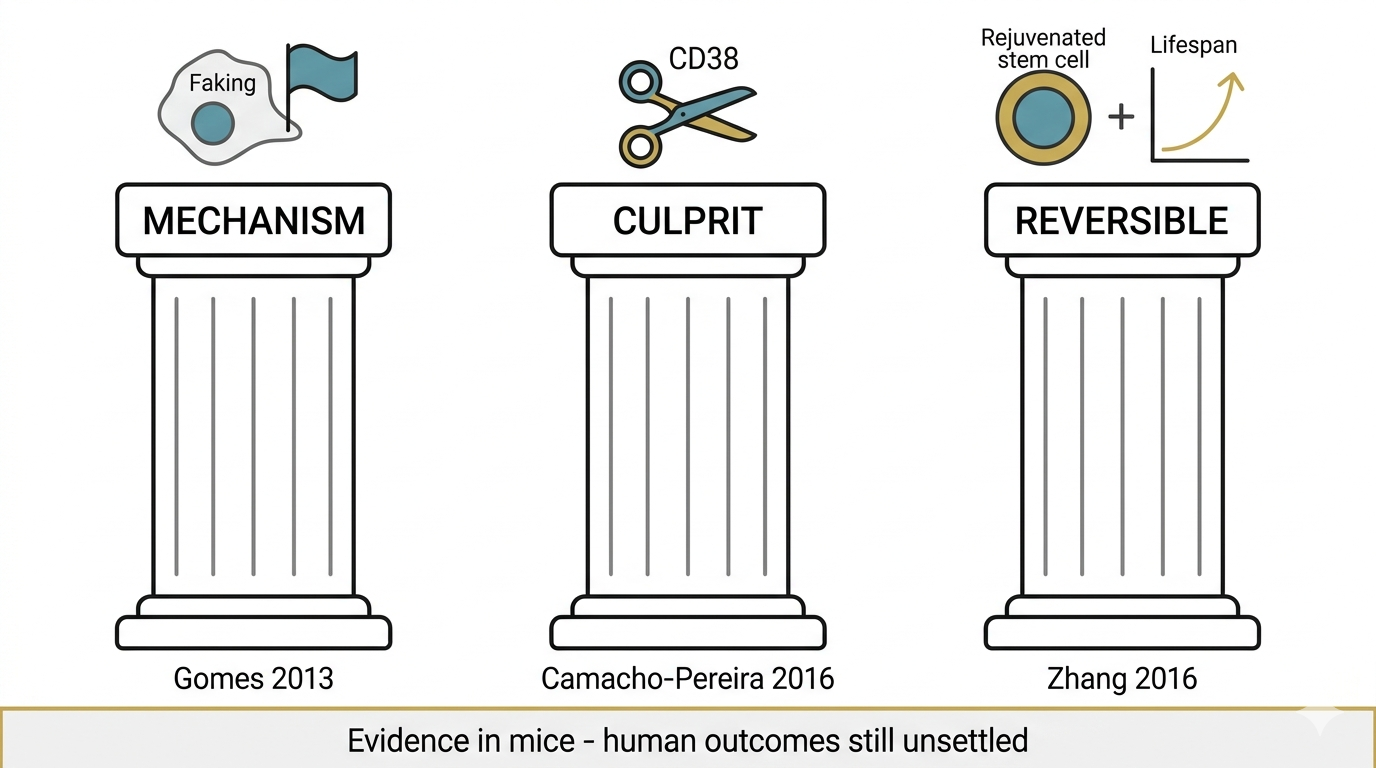 Figure 4: The three pillars of NAD⁺ collapse — mechanism (Gomes 2013), culprit (Camacho-Pereira 2016), and reversibility (Zhang 2016). Bottom line: evidence is in mice; human clinical outcomes remain unsettled.
References
- Gomes, A. P., et al. (2013). Declining NAD⁺ Induces a Pseudohypoxic State Disrupting Nuclear-Mitochondrial Communication during Aging. Cell, 155(7), 1624-1638. doi: 10.1016/j.cell.2013.11.037
- Camacho-Pereira, J., et al. (2016). CD38 Dictates Age-Related NAD Decline and Mitochondrial Dysfunction through an SIRT3-Dependent Mechanism. Cell Metabolism, 23(6), 1127-1139. doi: 10.1016/j.cmet.2016.05.006
- Zhang, H., et al. (2016). NAD⁺ repletion improves mitochondrial and stem cell function and enhances life span in mice. Science, 352(6292), 1436-1443. doi: 10.1126/science.aaf2693