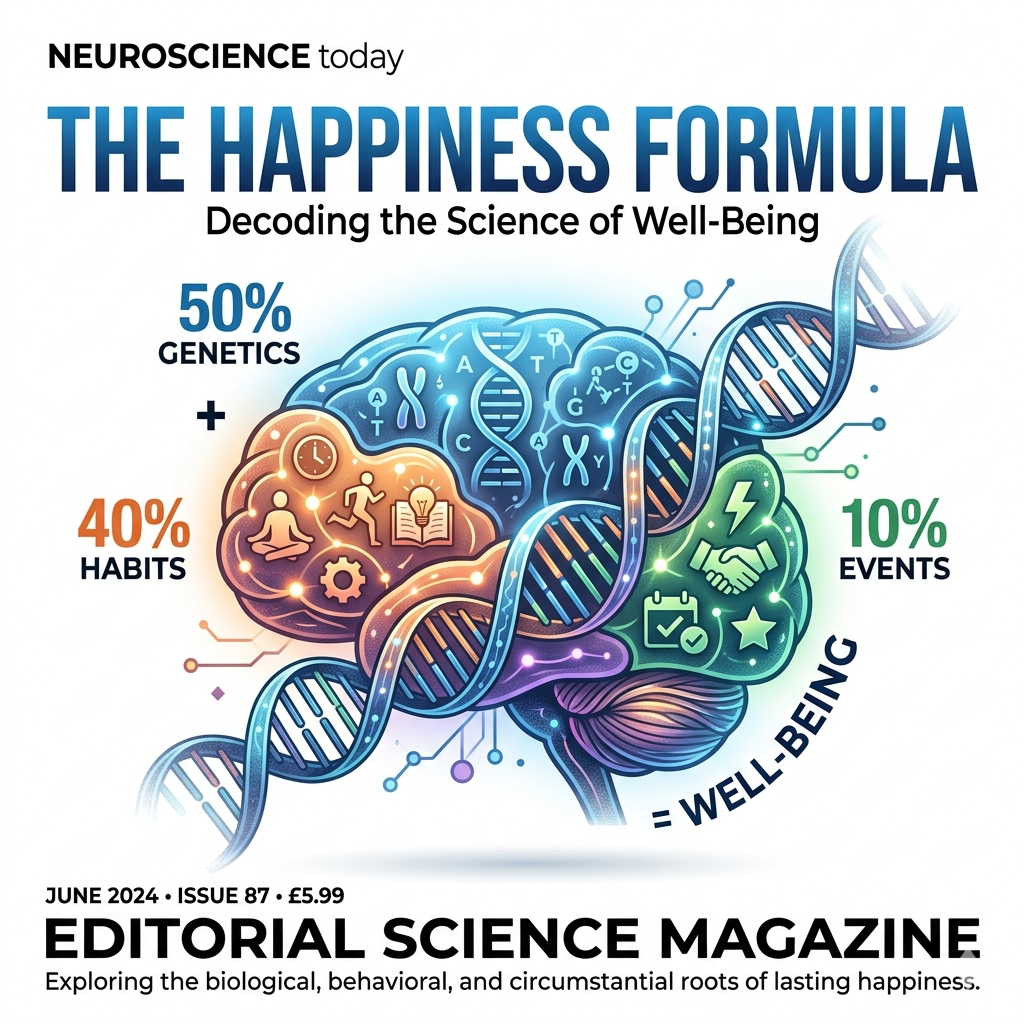
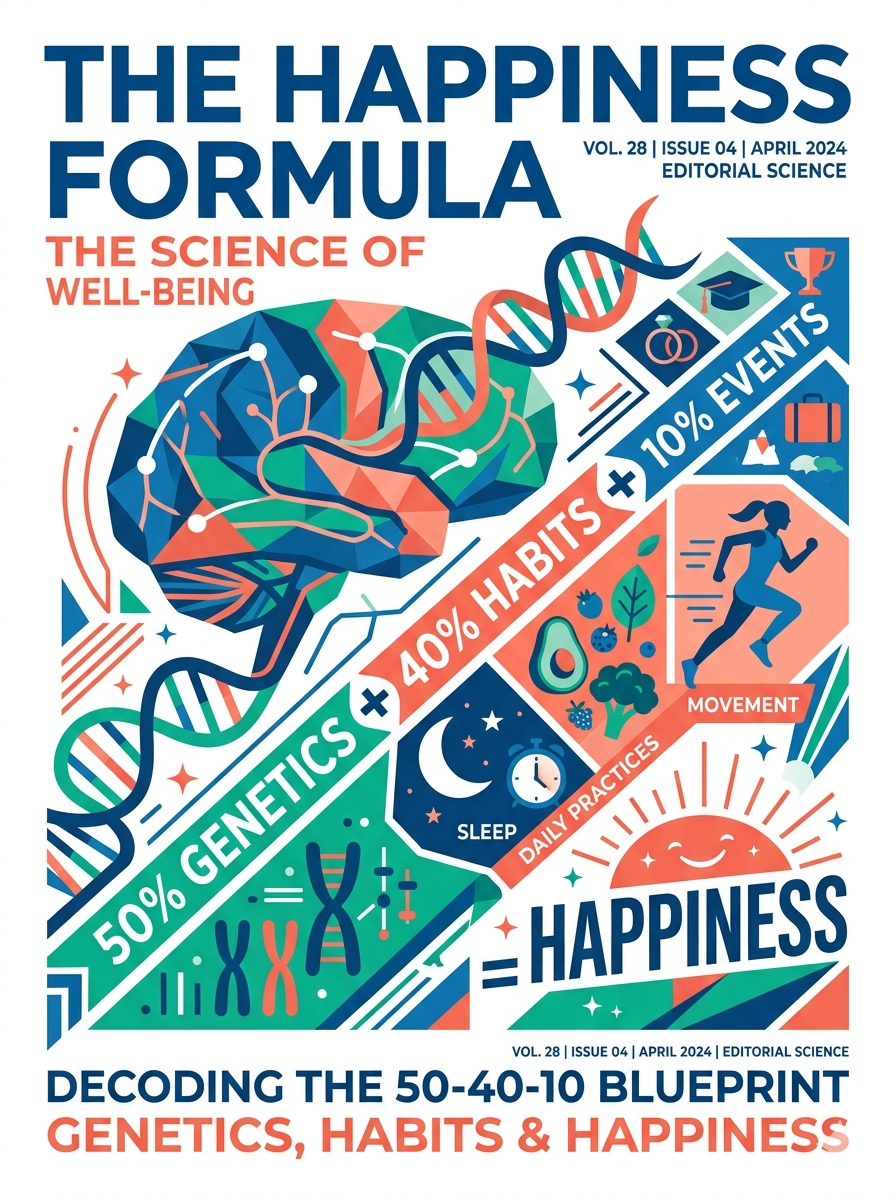
Can Happiness Be Engineered? The 50-40-10 Rule, Epigenetics, and the Body-Mind Map You Can Still Influence
If you won the lottery, would you stay happy for life? Most people instinctively say yes. The colder answer from psychology is: probably not. Good news can flare like fireworks. What keeps a person steady over time often looks less like luck and more like sleep, food, movement, relationships, stress load, and the way the brain learns to relate to itself.
Lead: The 50-40-10 rule separates happiness into baseline, habits, and events. Epigenetics and nutritional psychiatry add a harder truth: genes are not a verdict, and the body is not just a background stage for emotion.
The 50-40-10 rule is closer to a division of labor than a final sentence
Long-term well-being behaves more like baseline plus habits than like one lucky event stretched forever.
Lyubomirsky and colleagues helped popularize a memorable frame: around 50% of happiness tracks with baseline tendencies, around 40% with intentional daily activity, and only about 10% with external events. The point is not to worship the numbers as if they were exact engineering constants. The point is to regain proportion. Good things matter. Bad things matter too. But the mind often drifts back toward its earlier set point.
So happiness may be less like winning and more like maintenance. Promotion, romance, a bonus, or a perfect weekend can lift you. Loss, conflict, illness, or humiliation can push you down. Still, the levers people touch most often are sleep, movement, social rhythm, food quality, and the way stress is metabolized.
Epigenetics behaves more like a dimmer switch than a steel gate
Genes provide the buttons, while daily life helps decide which buttons are pressed.
Epigenetics does not rewrite the DNA sequence itself. It changes the likelihood that certain genes will be read. A useful metaphor is a mixing board: the keys stay the same, but volume, noise suppression, and timing can shift. Food, exercise, sleep, toxic stress, and social support may all influence which biological pathways are amplified and which are quieted.
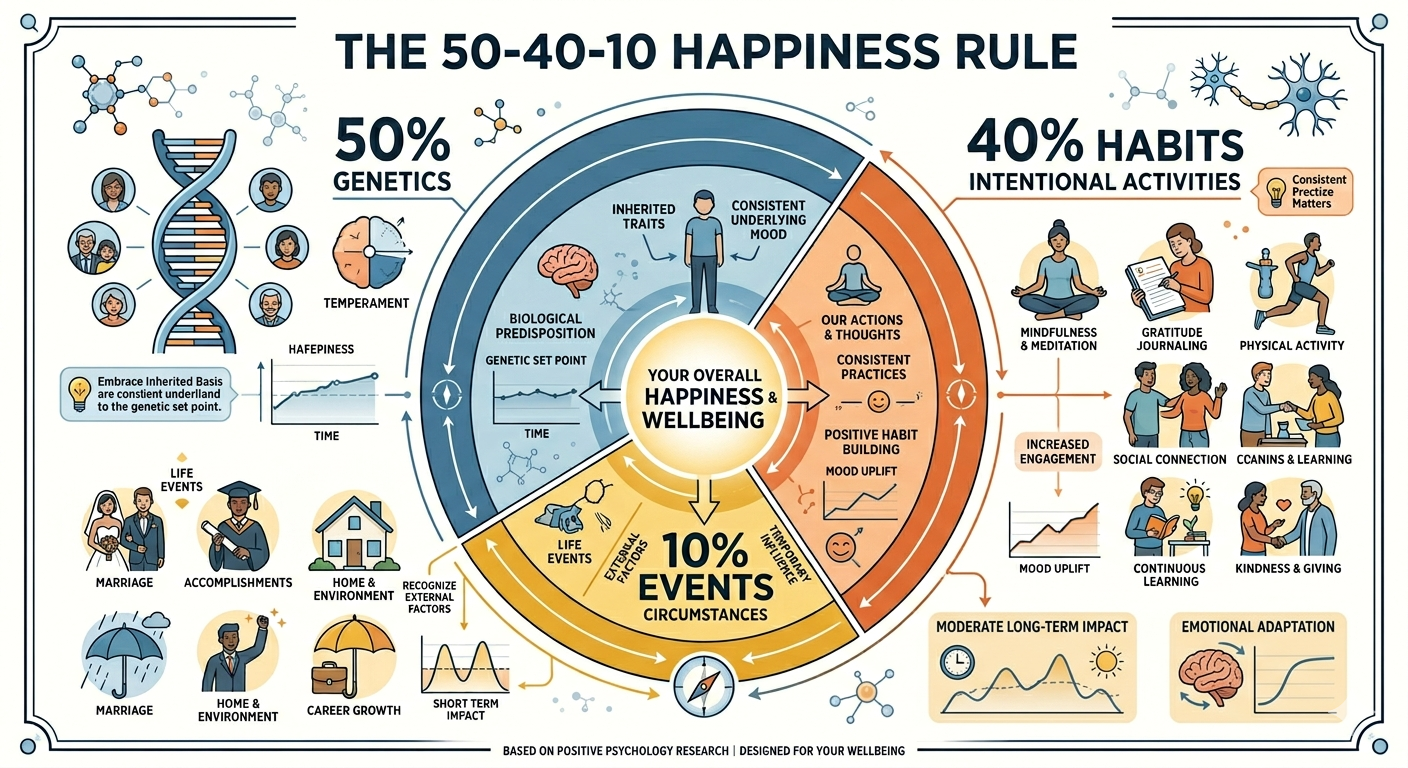
Figure 1: The 50-40-10 architecture of happiness
That is why the practical focus returns to lifestyle. Not because genes do not matter, but because the most reachable levers often live inside ordinary days. Meals act like repeated votes. Sleep is a repair window for the nervous system. Movement can work like a small electrical reset for a stalled mind. One good decision will not flip your life overnight, yet repeated decisions can push the switches in a different direction.
Still, this is not permission to treat every emotional struggle as a supplement problem. Much of the epigenetic literature comes from animal models, cellular work, or broad association studies. At the level of an individual human being, outcomes still depend on illness course, trauma history, sleep, medication, and living conditions. This is closer to tuning than to miracle reversal.
Emotional patterns often begin with the body speaking first
What feels like “bad mood” may already be the body pulling hard on the alarm line.
One of the most useful ideas in nutritional psychiatry is that emotion does not live in the brain alone. Inflammation can act like constant background noise. Mitochondria can behave like a drained battery. Oxidative stress can feel like sparks falling inside a storage room. The gut-brain axis works like a two-way hotline, sending signals back to the nervous system all day. When several of these systems lose balance together, the result may not just be fatigue, but irritability, low mood, brain fog, or attention that refuses to engage.
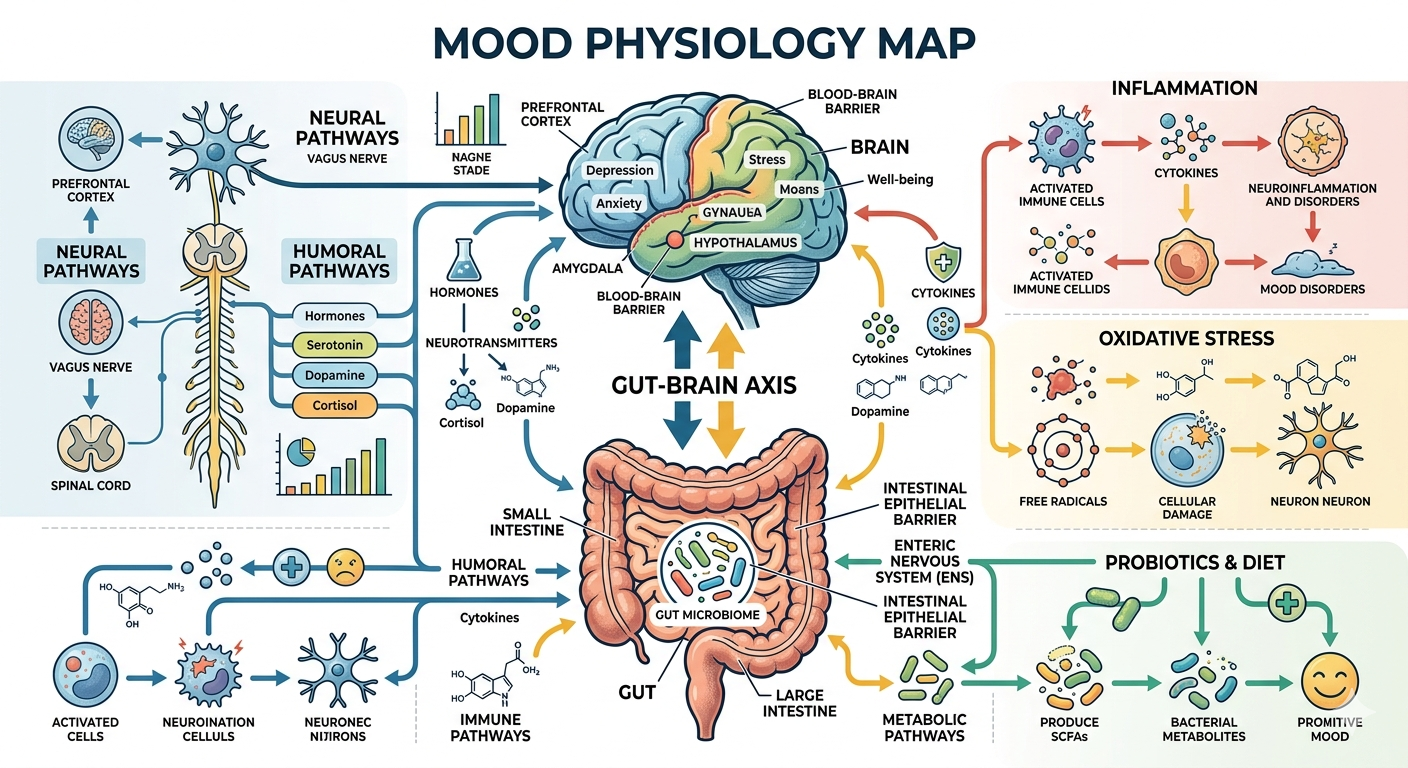
Figure 2: Inflammation, oxidative stress, and the gut-brain emotion map
That is why body-based framing can feel so clarifying. It translates “I feel terrible” into more workable questions: Is sleep collapsing? Is blood sugar swinging? Has activity dropped? Is digestion constantly off? Is stress exposure simply too high? Once the map becomes clearer, intervention becomes less mystical and more practical.
It is also important to slow down around labels such as “pyrrole type.” Some clinicians in functional or nutritional medicine use it as a clue about stress sensitivity and nutrient demands. It is not a universal psychiatric category. As a prompt for further assessment, it may be useful. As a one-size-fits-all diagnosis, it moves too fast.
Metacognition means sitting back on the bench and reclaiming the leash
When emotion surges, you may not stop it instantly, but you can learn not to run behind it.
Dr. Ma uses a vivid metaphor: the mind can feel like an overexcited dog. Anxiety, sadness, or panic yanks the leash and drags the whole person forward. Metacognition does not magically turn the dog calm. It helps you sit back on the bench and notice, “Anxiety is happening,” instead of “I am anxiety.”
That distance matters. It does not erase pain. It gives you a little room inside the pain. Even 5 minutes of breathing, journaling, or simple observation practiced daily can help more than remembering self-regulation only at the edge of collapse.
The “energy ball” is less mysticism than a rough meter of environmental load
Some environments tire you while still stretching you. Others drain you and make you smaller.
What Dr. Ma calls the “energy ball” can be read as a simple environment check. If a setting leaves you tired but still learning, growing, or feeling respected, the system may be stretching. If every return makes you smaller, more ashamed, and more defensive, something in that environment is likely grinding the nervous system down.
The value of this metaphor is not magic. It is contrast. It helps a person separate “I am tired” from “I am being chronically worn thin.” Workplaces, families, intimate relationships, and online spaces can all become either expansion zones or shrink zones.
Leaving is not always the first or only move. Sometimes boundaries, reduced exposure, better sleep, more predictable meals, and stronger support are already forms of rescue. When departure is needed, it usually takes planning, not just one burst of courage.
The goal is not to force happiness to 100
Pulling the system back into something adjustable is often more realistic than demanding instant joy.
If you keep asking whether you are weak or simply overloaded, start with order rather than blame. Check sleep, blood sugar swings, movement, and stress exposure first. Then ask whether certain settings reliably worsen mood or attention. Only after that should you decide whether a fuller psychiatric or psychological assessment is needed. Many people are not broken. Their systems have just run out of slack.
Happiness is not a winning ticket. It is the slow work of tuning a complicated console back into range. The 50-40-10 rule gives proportion. Epigenetics gives flexibility. Nutritional psychiatry reminds us that emotion lives in the body. Metacognition helps us take back the leash. You do not need to become happy overnight. Start by making the system a little steadier.
References
- Interview with Dr. Ma Ta-Yuan and Dr. Sung Yen-Jen (2026). Episode summary on happiness, emotional constitutions, and mental health. Original link pending.
- Lyubomirsky S, Sheldon KM, Schkade D. (2005). Pursuing happiness: the architecture of sustainable change. Review of General Psychology. doi: 10.1037/1089-2680.9.2.111
- Feinberg AP. (2018). The Key Role of Epigenetics in Human Disease Prevention and Mitigation. New England Journal of Medicine. doi: 10.1056/NEJMra1402513
- McGrath JJ, et al. (2008). The association between pyrrole disorder and schizophrenia. Medical Hypotheses. doi: 10.1016/j.mehy.2007.06.032
- Cryan JF, Dinan TG. (2012). Mind-altering microorganisms: the impact of the gut microbiota on brain and behaviour. Nature Reviews Neuroscience. doi: 10.1038/nrn3346