80% of People Will Experience Back Pain in Their Lifetime
Over 540 million people worldwide are suffering from lower back pain right now. A major culprit: intervertebral disc degeneration. Think of discs as shock absorbers between your vertebrae — water-rich cushions that let you bend, twist, and jump without bone grinding on bone.
The problem? These shock absorbers age.
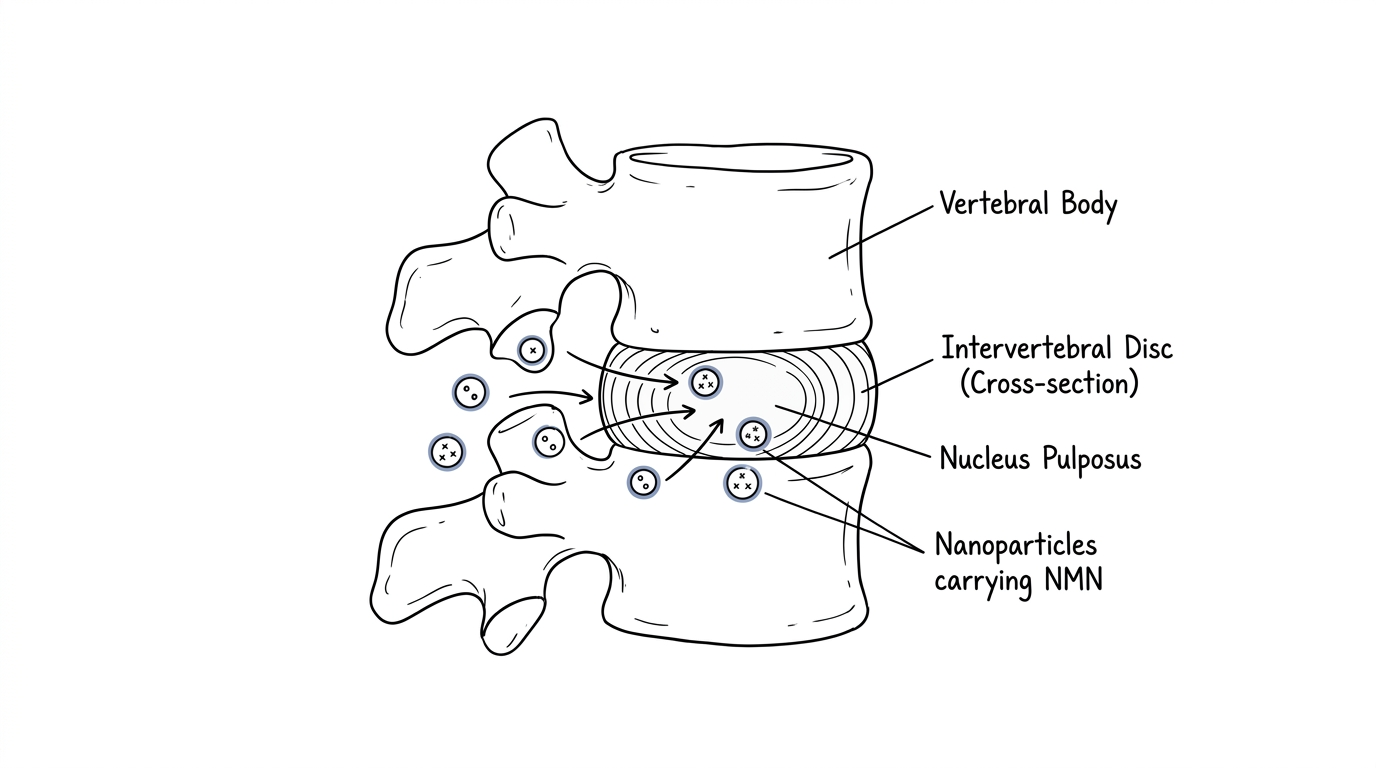
Discs are among the most avascular structures in the human body. Nutrients reach them through slow diffusion. Once the cells inside — nucleus pulposus cells (NPCs) — start aging and NAD+ runs dry, the whole structure shrinks like a dehydrated sponge: cracking, stiffening, losing elasticity.
Painkillers mask the pain. Surgery removes herniated tissue. Neither restores young cells. Is there a way to deliver a "youth formula" directly inside?
A 2025 study in Stem Cell Research & Therapy offers a surprising answer.

Exosomes: Nature's Delivery Parcels
Your body runs a natural logistics network. Cells release exosomes — nano-scale vesicles roughly 30-150 nm in diameter, a hundred times smaller than a red blood cell. These tiny packages carry proteins, RNA, and lipids between cells.
The research team did something clever: they extracted exosomes from mesenchymal stem cells (MSCs) and loaded them with NMN.
Why exosomes as carriers? Three reasons:
- Superior penetration: They cross the dense extracellular matrix that blocks most molecules
- Immune stealth: As biological "insiders," they don't trigger rejection like synthetic nanoparticles
- Precision targeting: Surface receptors recognize and fuse with target cells
Oral NMN must survive digestion and liver metabolism — very little reaches the disc. Exosome-loaded NMN gets a direct express lane.
Results: Senescent Cells Woke Up

The team induced NPC senescence with oxidative stress (mimicking real disc degeneration), then tested three groups:
- Control: Nothing added. Cells kept aging.
- NMN alone: Some improvement, limited effect.
- Exosome-NMN: Results were dramatic.
Exosome-NMN group outcomes:
- NAD+ levels restored to >85% of young cells
- Senescence markers (p16, p21, SA-β-gal) dropped significantly
- Extracellular matrix synthesis (collagen II, proteoglycans) normalized
- Inflammatory cytokines (IL-6, TNF-α) plummeted
In animal models, injecting exosome-NMN into degenerating discs produced visible recovery in disc height and hydration on MRI. Not pain relief — structural repair.
How Far from the Clinic? What Can You Do Now?
Honestly, there's still a road ahead. Mass production, quality control, optimal dosing, injection frequency — all need more clinical trial data. But the direction is clear: right molecule, right carrier, right destination.
Until then: core muscle training, avoid prolonged sitting (seated spinal pressure is 1.4x standing), maintain healthy weight.
How much time will you invest in your "spinal shock absorbers" — before they fail?
The Delivery Truck Has Departed
The real breakthrough isn't NMN itself — its anti-aging effects are well-documented. The innovation is the delivery method. Exosomes show us a future where precision anti-aging isn't about swallowing a universal pill, but engineering biological vehicles to deliver repair factors exactly where they're needed.
The spine today. The brain, joints, heart — perhaps tomorrow.
The nano delivery truck has already left the depot.
References
- Stem Cell Research & Therapy (2025). DOI: 10.1186/s13287-025-04460-w
- Yoshino, J. et al. (2011). Cell Metabolism, 27, 513–528.
- Mills, K.F. et al. (2016). Cell Metabolism, 24, 795–806.