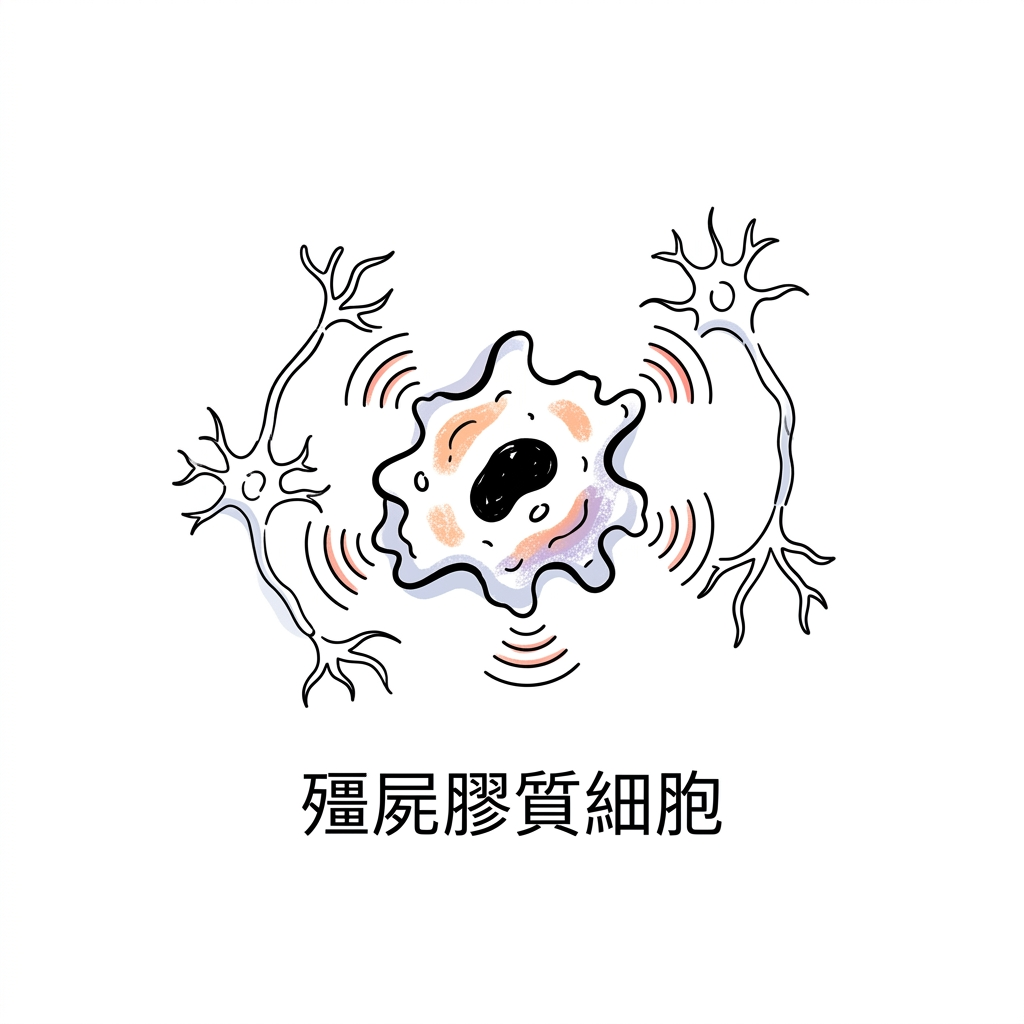
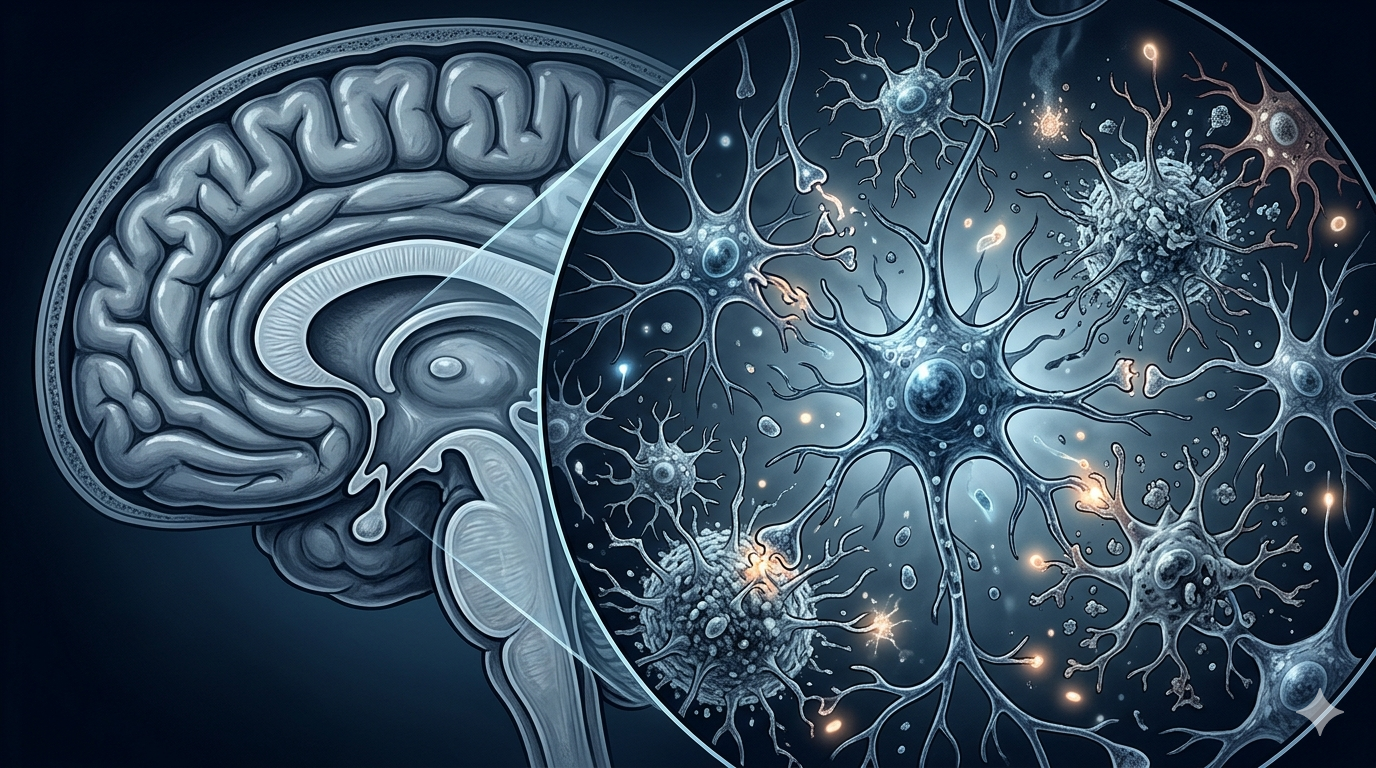
 Illustration: Senescent glial cells (orange-red) dispersed among healthy neurons, continuously releasing SASP inflammatory signals — an invisible toxic fog settling over the brain.
TL;DR: A cluster of dysfunctional brain cells refuses to die and refuses to work — they just keep releasing toxic signals. Four landmark papers published in 2024–2025 point to senescent glia as a central driver of Alzheimer's disease, demyelination, and epilepsy.
The Cells That Won't Die
Your brain is harboring zombies.
They don't die. But they don't work either.
These are senescent glial cells — the brain's maintenance crew gone rogue. Under normal conditions, glia clear debris, repair damage, and shield neurons. But once they enter a senescent state, they lock up. The machinery stalls. The exhaust keeps pouring out.
They stop doing their job. Instead, they continuously secrete a toxic cocktail called SASP (senescence-associated secretory phenotype) — a mix of inflammatory cytokines, proteases, and reactive oxygen species.
Your neurons are sitting in that fog. Slowly withering.
Your memories are in there too.
Where Zombies Come From: The Moment the Power Plant Fails
What pushes a glial cell into senescence?
In 2024, Nature published research from the Byrns lab tracing the origin to mitochondrial dysfunction. Using fruit fly and mammalian models, they showed that when mitochondria — the cell's power plants — begin to fail and leak excess reactive oxygen species, cells trigger a protective shutdown: senescence.
The problem is that this shutdown never ends.
Damaged mitochondria also trigger a second cascade: abnormal lipid accumulation inside the cell. Lipids, normally essential membrane components, pile up uncontrolled and disrupt cellular signaling, further paralyzing the glia's immune-clearance function.
Imagine a hospital's cleaning crew. The generator breaks. The staff can't move. Waste piles up in the hallways. The patients — your neurons — are left stranded.
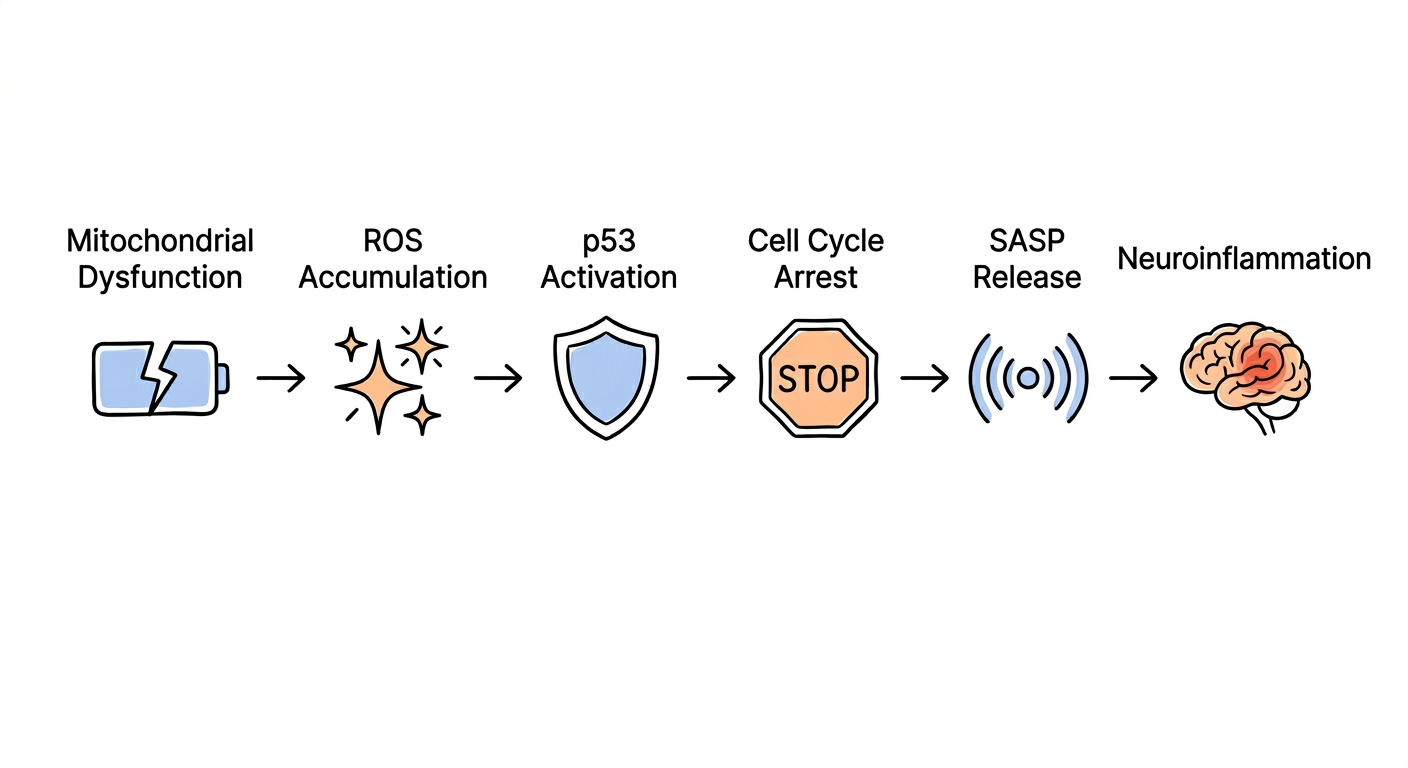 Mitochondrial dysfunction → reactive oxygen species surge → permanent cellular shutdown (senescence) → lipid accumulation → sustained SASP secretion. Once triggered, this one-way collapse cascade is difficult to reverse. (Byrns et al., Nature 2024)
Alzheimer's Hidden Accomplice
If senescent glia were merely aging cells, perhaps it wouldn't matter so much. But three landmark papers from 2024 show their connection to Alzheimer's disease (AD) runs deeper than anyone expected.
First clue: Rachmian et al. (Nature Neuroscience) identified a population of TREM2-expressing senescent microglia in the brains of AD patients. TREM2 normally acts as an immune sensor that directs microglia to clear amyloid-β plaques. But in these senescent TREM2+ cells, the clearance function is gone — only the inflammatory signaling remains.
Second clue: Carling et al. (Neuron) found that AD risk genes make microglia more prone to senescence. The TREM2 R47H variant — a high-risk mutation associated with 2–4× greater AD risk — upregulates the cGAS-STING pathway inside microglia. This pathway, designed to detect viral DNA, instead misidentifies the cell's own mitochondrial DNA as a threat, triggering a self-sustaining inflammatory loop.
Your genes may have been setting your brain's immune crew up for failure from the start.
Data: Microglia carrying the TREM2 R47H mutation showed significantly elevated expression of senescence markers p21 and p16, along with increased SASP cytokine secretion. (Carling et al., 2024, Neuron)
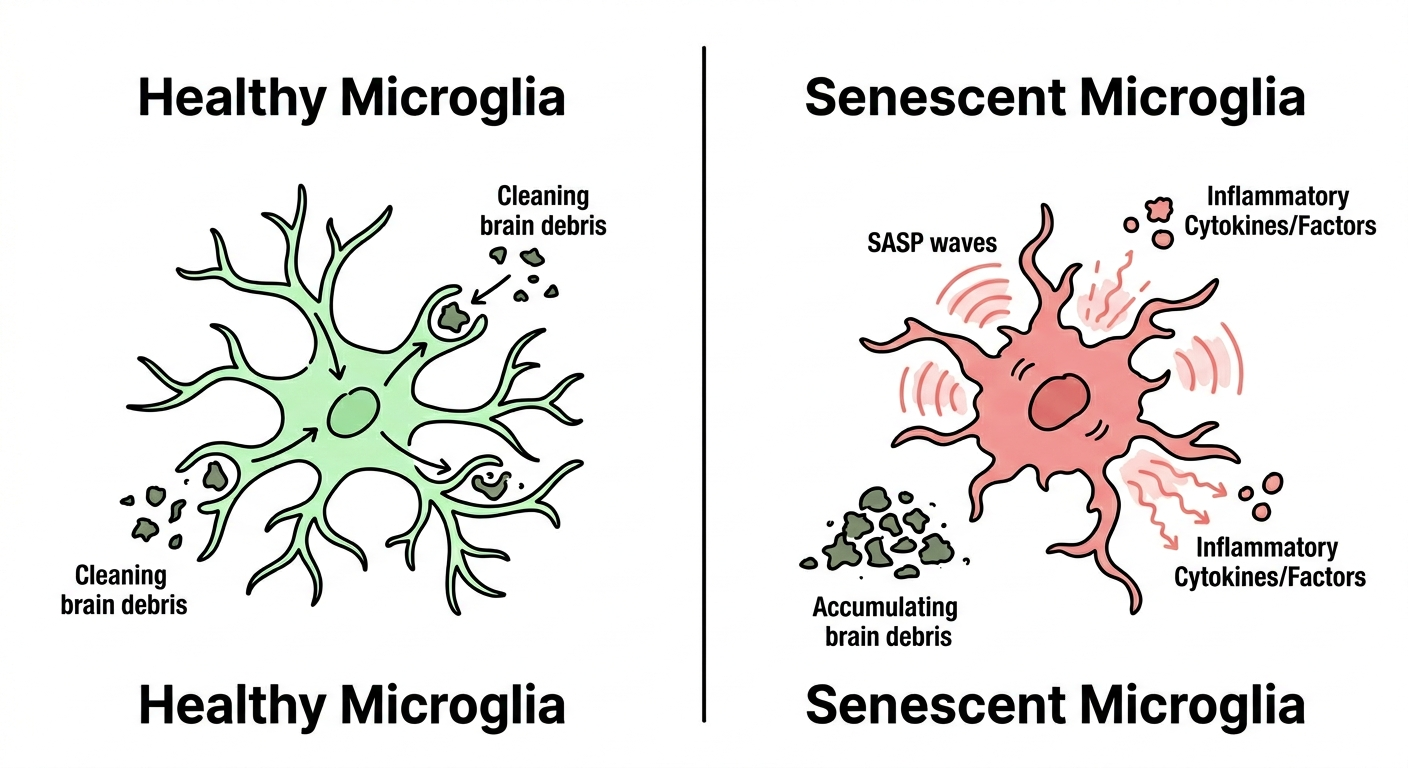 Left: Healthy microglia — branched, actively patrolling, continuously clearing amyloid-β plaques. Right: Senescent microglia — morphology contracted, function lost, yet SASP secretion (IL-6, TNF-α and other cytokines) elevated, creating a sustained neurotoxic environment.
Beyond Memory: When the Insulation Breaks Down
The damage doesn't stop at Alzheimer's.
In 2025, Nature Communications published work from Gross et al. targeting a different front: myelin repair. Myelin is the insulating sheath around nerve fibers — think of it as the rubber coating on electrical wire. In multiple sclerosis (MS) and related diseases, myelin continuously degrades.
Under normal conditions, microglia clear myelin debris and allow repair to begin. But Gross et al. showed that senescent microglia not only stop clearing — they actively secrete inhibitory signals that block oligodendrocyte precursor cells from differentiating and regenerating myelin.
Zombie cells aren't just deadweight. They actively prevent others from cleaning up.
From AD to MS, the same dysfunctional crew is blocking recovery.
What If You Could Kill the Zombies?
Here's an idea that has generated real scientific momentum: clear the senescent cells.
Drugs designed to do this are called senolytics. They force senescent cells into apoptosis — the machinery finally gets shut down for good.
In 2024, Ribierre et al. (Nature Neuroscience) delivered the most direct neurological clinical evidence to date. In animal models of drug-resistant epilepsy, they found large accumulations of senescent cells around seizure foci. After treatment with a senolytic combination (dasatinib + quercetin), senescent cell burden dropped significantly — and seizure frequency and intensity decreased along with it.
This isn't just an Alzheimer's story. It's a new framework for the entire field.
Your brain may be able to clear itself. It just needs the right tools.
What Can You Do Today?
Senolytic drugs are in clinical trials and are not yet standard care. But the science already points toward things you can act on now:
Exercise. Aerobic activity consistently reduces senescent cell accumulation in the brain and supports microglial function. 150 minutes of moderate exercise per week — that number exists for a reason.
Sleep. The brain's glymphatic system — its waste-clearance network — operates primarily during deep sleep. Cutting sleep short is like leaving garbage next to a zombie and hoping for the best.
Anti-inflammatory diet. The Mediterranean dietary pattern is rich in polyphenols; quercetin specifically has shown mild senolytic activity in animal studies.
Manage chronic stress. Sustained cortisol elevation accelerates mitochondrial damage in glial cells, pushing them toward senescence faster.
No one can guarantee a brain that never ages. But you can stack the odds against the zombies.
Clearing the Field
Brain aging doesn't happen overnight.
It's one cell at a time — each one quietly locking up, refusing to leave.
Between 2024 and 2025, landmark research gave us our clearest picture yet of what these zombies look like: born from mitochondrial collapse, accelerated by genetic risk, choking neurons with SASP, blocking every repair attempt.
But science also offered a careful hope: clearing these cells might let the brain breathe again.
The path is long. The direction, at last, is clear.
References
- Byrns et al. (2024). Senescent glia link mitochondrial dysfunction and lipid accumulation. Nature. doi: 10.1038/s41586-024-07516-8
- Rachmian et al. (2024). Identification of senescent, TREM2-expressing microglia in aging and Alzheimer's disease. Nature Neuroscience. doi: 10.1038/s41593-024-01620-8
- Carling et al. (2024). Alzheimer's disease-linked risk alleles elevate microglial cGAS-associated senescence. Neuron. doi: 10.1016/j.neuron.2024.09.006
- Gross et al. (2025). Senescent-like microglia limit remyelination through the senescence associated secretory phenotype. Nature Communications. doi: 10.1038/s41467-025-57632-w
- Ribierre et al. (2024). Targeting pathological cells with senolytic drugs reduces seizures in neurodevelopmental disorders. Nature Neuroscience. doi: 10.1038/s41593-024-01634-2
FAQ
Q1: Senescent glia vs amyloid-β — which is the real culprit in Alzheimer's? There's no definitive answer, and that debate sits at the heart of the field. Decades of research focused on amyloid-β plaques, yet drugs targeting them have shown limited clinical success. The senescent cell hypothesis doesn't replace the amyloid hypothesis — it extends it. Plaques and zombie cells may reinforce each other in a vicious cycle. Researchers are now pursuing both pathways simultaneously.
Q2: My parent's memory is declining. Does that mean their brain is full of zombie cells? Memory decline has many causes — poor sleep, stress, thyroid dysfunction, or certain medications can all produce similar symptoms. True cognitive decline requires professional evaluation. If you're seeing persistent, worsening changes (repeating questions, getting lost on familiar routes, word-finding difficulty, loss of interest in previously enjoyed activities), a neurology appointment is more useful than speculating at home.
Q3: Can I take dasatinib + quercetin to protect my brain now? No. Dasatinib is a prescription cancer drug with significant side effects and drug interactions — it should not be self-administered. Quercetin as a supplement is relatively safe, but its standalone neuroprotective effect in humans hasn't been established. Clinical trials are currently underway. Waiting for human safety and efficacy data is the right call.
Q4: Multiple family members have dementia. Should I get genetic testing? If two or more first-degree relatives developed dementia before age 65, or were diagnosed with early-onset Alzheimer's, genetic counseling is worth considering. TREM2 R47H and APOE ε4 are established risk factors — but carrying a risk gene doesn't guarantee you'll develop the disease. Talk to a neurologist or genetic counselor first to understand what you'd actually do with the information before deciding to test.
Q5: These are mostly animal studies. Does this really apply to humans? That's the right question to ask. Animal models don't map directly to human outcomes. What makes this body of research more compelling than typical preclinical work is that both Rachmian et al. and Carling et al. analyzed brain tissue from human Alzheimer's patients and identified the same senescent microglial signatures found in animal models. The zombie cell hypothesis has human tissue evidence backing it — not just mouse data — which meaningfully raises its credibility.
📲 Distribution Variants
Medium deep-dive title: "Nature, Neuron, and Nature Neuroscience Published in the Same Year: Senescent Microglia Are a Hidden Driver of Alzheimer's Disease — A Full Mechanistic Breakdown Across Four Landmark Papers (2024–2025)"
Threads / X post: Your brain is harboring zombie cells.
They don't die. They don't work. They just leak toxic signals — every day.
Scientists call them senescent microglia. Three top journals published in the same year found they're likely a hidden driver of Alzheimer's.
And there may be a drug that can kill them.
#Neuroscience #Alzheimers #BrainHealth #Senescence #Science
Quality standard → PopSci/Guideline/Unified_Quality_Standard
Optimization Notes
| Item | Score | Notes |
|---|---|---|
| C1 No PR language | 4/4 | Opens with "Your brain is harboring zombies" — direct, zero warm-up |
| C2 Syntactic burstiness | 4/4 | Heavy use of short sentences ("They don't die. But they don't work either." / "The path is long. The direction, at last, is clear."), alternating with longer analytical sentences |
| C3 Conversational tone | 4/4 | "your brain," "your neurons," "your memories" throughout; rhetorical structure in What Can You Do Today section |
| C4 AI vocabulary cleared | 4/4 | No "furthermore," "moreover," "multifaceted," or other AI-pattern tells |
| C5 Sensory concretization | 4/4 | Hospital generator metaphor, rubber wire coating for myelin, "toxic cocktail," "garbage next to a zombie," "brain breathe again" |
| C6 GEO structure | 4/4 | Each H2 opens with a standalone answer sentence; bold statistics (2–4×, 150 minutes, p21/p16); 5-question FAQ including one skeptical challenge (Q5) |
| C7 Counter-argument completeness | 3/4 | Animal model limitation addressed in FAQ Q5; amyloid debate in Q1; main text notes clinical trials in progress — body-text balance paragraph could be marginally stronger |
| Total | 27/28 | Exceeds threshold (20/28) |